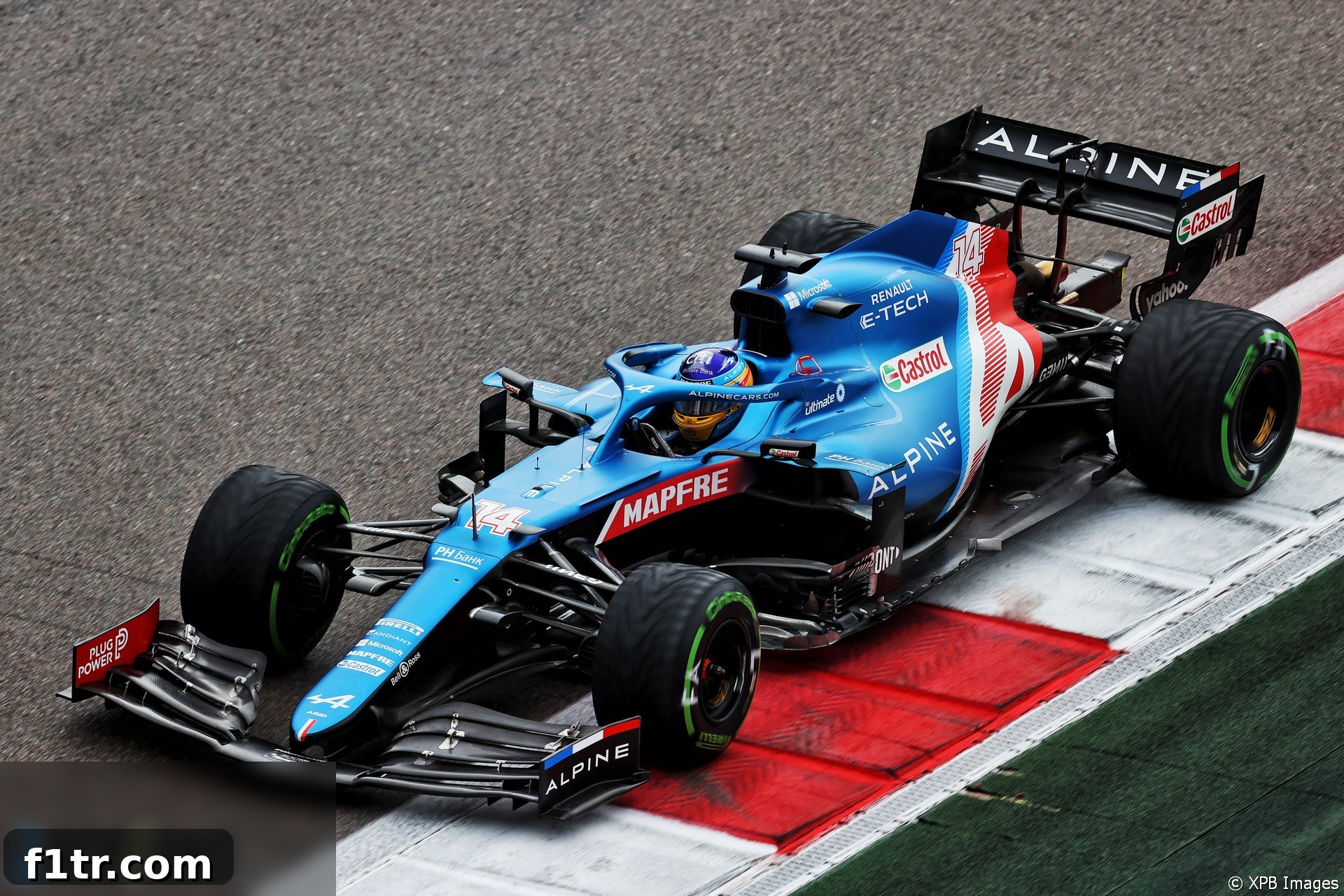
Fernando Alonso, the highly experienced two-time Formula 1 world champion, has offered a measured and realistic assessment of his prospects for the Russian Grand Prix. Despite securing an impressive sixth position on the grid for his Alpine, Alonso harbors reservations about his ability to maintain such a high finishing spot during the race. His caution stems from a keen understanding of the competitive landscape, acknowledging that several potentially faster cars and top-tier drivers will be lining up behind him, all eager to make their way through the field at the Sochi Autodrom.
Alonso’s Pre-Race Concerns: The Onslaught from Behind
Advert | Become a Supporter & go ad-free
Alonso’s analysis is rooted in the harsh realities of Formula 1, where raw pace and strategic execution often determine race day outcomes, regardless of qualifying heroics. He specifically highlighted a trio of drivers whose presence behind him on the grid presented an immediate and significant threat to Alpine’s points-scoring ambitions. These drivers, representing constructors with inherently quicker machinery, are expected to advance swiftly, making the defense of P6 an arduous task.
Valtteri Bottas and Sergio Perez: Direct and Formidable Opponents
The first name on Alonso’s list of formidable challengers was Valtteri Bottas. Starting directly behind Alonso in seventh place, Bottas, driving for Mercedes, commands a car that consistently contends for pole positions and race victories. “Bottas is starting behind – that will be very difficult to keep behind,” Alonso openly admitted. The Mercedes W12, with its superior performance envelope, is widely anticipated to have a notable pace advantage over the Alpine A521 over a full race distance. Bottas’s experience and the competitive edge of his machinery make him an almost certain challenger for higher positions from the very outset of the Grand Prix.
Further back, in ninth position, was Sergio Perez of Red Bull Racing. The Red Bull RB16B has proven to be a championship-contending car throughout the 2021 season, consistently challenging Mercedes at the front. Even from ninth, Perez represents a clear and present danger to Alonso’s position. “Checo is P9 as well. So we know that we are P6, but rapidly this can be P9 or P8,” Alonso remarked, underscoring the precariousness of his starting position when faced with such potent opposition. Both Bottas and Perez possess the machinery and the race craft to quickly dispatch midfield cars and ascend the order, making Alonso’s defensive task incredibly challenging.
Max Verstappen: The Inevitable Charge from the Back
However, arguably the most significant threat to Alonso and indeed to the entire grid was Max Verstappen. The Red Bull championship leader was set to start from the very back of the grid due to a power unit penalty. Despite this considerable disadvantage, Alonso held no illusions about Verstappen’s capability to carve through the field. “Verstappen will come to us in the race as we saw in Monza Bottas started last and finished on the podium. So I think Verstappen will do the same type of things,” Alonso predicted. This reference to Valtteri Bottas’s remarkable drive from the back to a podium finish at the Italian Grand Prix just weeks prior served as a stark reminder of what a front-running car and driver can achieve, even with a grid penalty. Verstappen, known for his relentless attacking style and the Red Bull’s formidable race pace, was widely expected to be a major factor in the latter stages of the Russian Grand Prix. His progression through the midfield is typically swift and decisive, applying immense pressure on every car in his path, including Fernando Alonso’s Alpine.
The “Natural Position” and the Realities of Race Pace
Alonso’s pragmatic approach extended beyond just the drivers behind him, encompassing those who outqualified him. McLaren’s Lando Norris, who secured a phenomenal pole position, Ferrari’s Carlos Sainz Jnr, starting second, and Williams’ George Russell, who stunned many with third place, were also expected to face similar intense pressure from the established front-runners. Alonso articulated this with a seasoned perspective, stating, “That’s the same comment, I guess, for the guys in front. We know that before [long] in the race you finish in your natural position. So we are aware of that.”
The concept of a “natural position” in Formula 1 is a cornerstone of race strategy. It refers to the ultimate performance ranking a car and driver pairing is expected to achieve over a full Grand Prix distance, largely dictated by the car’s inherent speed, tire management capabilities, and power unit performance. While qualifying can occasionally produce unexpected results due to a driver’s exceptional lap, strategic slipstreams, or unique track conditions, race day often sees the established hierarchy of car performance reassert itself. Top teams like Mercedes and Red Bull, with their vast resources and superior car development, typically possess the raw pace and strategic flexibility to overcome initial grid disadvantages and claim their rightful positions at the front of the pack.
For Norris, Sainz, and Russell, despite their commendable qualifying performances, holding off the full might of a Mercedes or a Red Bull over 53 laps at Sochi presents an monumental challenge. The Russian Grand Prix circuit, with its unique layout featuring an exceptionally long main straight, followed by a sweeping run into Turn 2, and subsequent medium-speed corners, provides multiple opportunities for cars with superior straight-line speed, stronger tire degradation characteristics, and better overall race pace to execute overtakes. The blend of high-speed sections and technical turns tends to amplify the fundamental performance differences between the top-tier teams and the rest of the midfield. Therefore, Alonso’s realistic outlook is not an admission of defeat but a profound acknowledgment of the sport’s inherent performance hierarchy and the relentless competitiveness of the leading contenders.
Alpine’s Strategic Imperative: The Constructors’ Championship Battle
Despite the formidable challenges from faster cars, Fernando Alonso made it clear that Alpine’s primary objective for the Russian Grand Prix remained unwavering: to secure vital points in the fiercely contested Constructors’ Championship. The team’s immediate focus wasn’t necessarily on battling the Mercedes and Red Bulls for podiums, but rather on outperforming their direct midfield rivals. “We are ready to fight and try to score points,” Alonso affirmed. “Our main targets are Aston Martin and AlphaTauri for the remaining of the year for the constructors’.”
This strategic approach underscores Alpine’s broader goals for the 2021 Formula 1 season. The Constructors’ Championship carries immense financial rewards and significant prestige for every team. Even marginal improvements in championship standings can translate into millions of dollars in prize money, which is critical for ongoing car development, attracting talent, and ensuring the team’s long-term sustainability. By specifically targeting Aston Martin and AlphaTauri, Alpine aimed to solidify its position as a leading force in the highly competitive midfield, a crucial step toward its ambitious long-term objective of returning to the sport’s elite echelons. At the time of the Russian Grand Prix, the midfield battle was incredibly close, with these three teams often engaging in intense battles for every available championship point. Alonso’s P6 start provided a significant advantage in this specific context, placing him ahead of his key championship rivals. “We start in front of them and we want to finish in front of them,” he declared, emphasizing the team’s unwavering commitment to maximizing their points haul against their direct competitors. He also judiciously noted that “there are other competitors that maybe are not in our race,” subtly acknowledging that the battle at the very front often operates on a different plane than the fierce competition raging in the midfield.
Advert | Become a RaceFans supporter andgo ad-free
The Sochi Autodrom: A Circuit Demanding Strategy and Pace
The Sochi Autodrom, nestled within the expansive Olympic Park, is renowned for its remarkably smooth asphalt and a distinctive layout that merges long, high-speed straights with a challenging series of 90-degree corners, notably featuring the iconic and elongated Turn 3. These unique characteristics often culminate in races where strategic tire management, efficient power unit deployment, and effective utilization of DRS zones are paramount. The lengthy run from the starting grid down to the first substantial braking zone at Turn 2, which itself is a sweeping left-hander, frequently creates a dynamic and sometimes chaotic start, presenting prime overtaking opportunities right from the outset. For drivers like Max Verstappen, starting from the back of the grid, these characteristics are often seen as an advantage, offering clear lanes and high-speed sections that facilitate rapid progression through the field. Conversely, for drivers like Fernando Alonso, whose objective is to defend a hard-earned position, it necessitates an acute awareness of the slipstream effect and the inherent pace differential of the cars behind. The circuit’s relatively low tire degradation rates can also lead to longer stints and fewer pit stops, placing a greater emphasis on raw race pace and driver skill over intricate multi-stop tire strategies, thereby further supporting Alonso’s “natural position” theory. Moreover, the weather in Sochi can be notoriously unpredictable, with rain frequently influencing previous editions of the Grand Prix, introducing an additional layer of complexity to race strategy and potentially leveling the playing field for different car performances, which could benefit a skilled driver like Alonso.
Alonso’s Enduring Legacy and Alpine’s 2021 Aspirations
Fernando Alonso’s highly anticipated return to Formula 1 in 2021 with Alpine was a landmark event for the sport. His unparalleled experience, tactical astuteness, and relentless competitive drive proved invaluable assets for the French team throughout the season. While his P6 qualifying performance in Russia was a clear testament to his enduring talent and ability to extract maximum performance, his subsequent cautious assessment reflected a profound and realistic understanding of the sport’s intricate dynamics and the intensely competitive landscape of the 2021 season. Alpine, as a team, aimed to establish itself as a consistent points-scorer and a formidable midfield presence. The Russian Grand Prix represented another critical opportunity to solidify this standing and incrementally gain ground on their rivals in the Constructors’ Championship. Alonso’s impressive ability to wring every ounce of performance from his car during qualifying, coupled with his pragmatic and realistic race day expectations, vividly showcased the mature and strategically astute approach that defined his second career stint in Formula 1. The battle for midfield supremacy was often as fiercely contested as the fight for the lead, and every single point secured at Sochi would contribute significantly to Alpine’s overarching seasonal objectives and future ambitions.
2021 Russian Grand Prix Further Reading
- Norris says he missed few chances to win in 110-race wait for first F1 victory
- Sochi disappointment will make Norris and McLaren stronger, says Seidl
- F1 race start times could be brought forward to avoid Spa-style wash-outs
- New technology in Ferrari’s power unit update vital for 2022 – Binotto
- Mercedes have left too many points on the table, admits Wolff
Browse all 2021 Russian Grand Prix articles