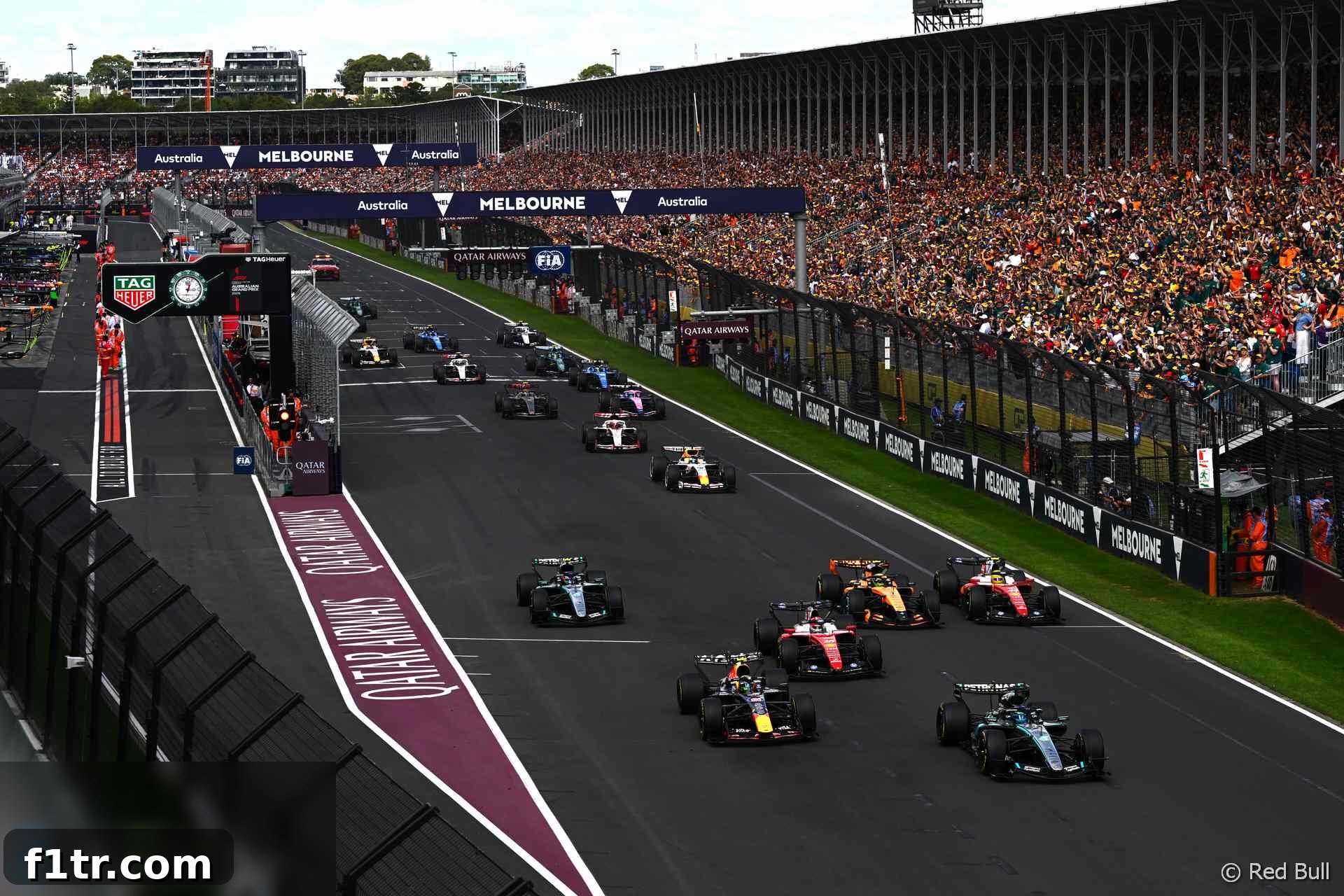
Formula 1 standing starts have been more dramatic than usual this season because the new power units have introduced greater variability off the line.
Advert | Become a Supporter & go ad-free
Some cars consistently launch better than others, while a few drivers have produced notably poor starts on occasion. Those slow departures have become a safety concern: several near-misses occurred when drivers almost collided with slower cars ahead. Only Franco Colapinto’s quick reactions prevented a major incident when Liam Lawson’s Racing Bulls car hesitated off the line in Melbourne.
This week the FIA announced measures aimed at reducing the risk from very slow starts. The governing body has developed a “low power start detection” system that can identify cars with abnormally low acceleration shortly after clutch release. In those cases, an automatic MGU-K deployment will be triggered to ensure a minimum level of acceleration and reduce start-related hazards without conferring what the FIA describes as a sporting advantage.
Whether that intervention is truly neutral from a sporting perspective depends on circumstances. If every car is equally likely to need the fallback power delivery, the effect is consistent across the field. But if certain designs or cars are more prone to suffering very poor starts, the system will disproportionately help those teams and drivers.
Looking at the evidence so far, some drivers have repeatedly made stronger starts than others. Drivers who qualify toward the back of the grid naturally have more opportunities to gain places at the first corner than those starting at the front. Mercedes’ drivers, for example, have often lost places at the start but they have still locked out the front row across all four races so far, including both parts of the sprint weekend in Shanghai.
Best and worst starts
| Rank | Gain | Driver | Round | Event |
|---|---|---|---|---|
| 1 | 8 | Fernando Alonso | China | Sprint race |
| =2 | 7 | Carlos Sainz Jnr | Australia | Grand prix |
| =2 | 7 | Arvid Lindblad | China | Grand prix |
| =2 | 7 | Liam Lawson | China | Grand prix |
| =2 | 7 | Fernando Alonso | Australia | Grand prix |
| Rank | Loss | Driver | Round | Event |
|---|---|---|---|---|
| 1 | 10 | Liam Lawson | Australia | Grand prix |
| 2 | 9 | Isack Hadjar | China | Grand prix |
| 2 | 9 | Nico Hulkenberg | China | Sprint race |
| 7 | 7 | Andrea Kimi Antonelli | China | Sprint race |
| 7 | 7 | Max Verstappen | China | Sprint race |
On average, three teams have struggled significantly more than their rivals at the start this season. One of them is Mercedes, but Audi’s drivers have experienced the greatest difficulty in getting away cleanly so far.
Advert | Become a Supporter & go ad-free
It should be noted the new rule targets only extreme cases of poor starts, like Lawson’s in Australia, so its impact may be limited to relatively rare incidents.
The change is not expected to blunt the advantage of teams that regularly execute strong standing starts. Ferrari, for example, averages nearly two places gained per car per race, which is impressive given how high their cars typically qualify.
Ultimately, as teams adapt to the revised power unit regulations and the FIA’s planned electronic safeguards, the variability in standing starts is likely to reduce. The FIA will trial the low power start detection system during the Miami Grand Prix weekend before finalising its implementation, so further refinements could still follow.
Miss nothing from RaceFans
Get a daily email with all our latest stories – and nothing else. No marketing, no ads. Sign up here:
Formula 1
- Poll: Has the time finally come for Hamilton to hang up his helmet?
- Grosjean felt Renault ‘told everyone I wasn’t good enough for F1’ before return
- There’s one 2026 change Verstappen will approve of: Zero penalty points
- Which F1 drivers have made the strongest start to 2026 against their team mates?
- “Not correct” to say Ferrari should have discovered Antonelli instead of Mercedes
Browse all Formula 1 articles