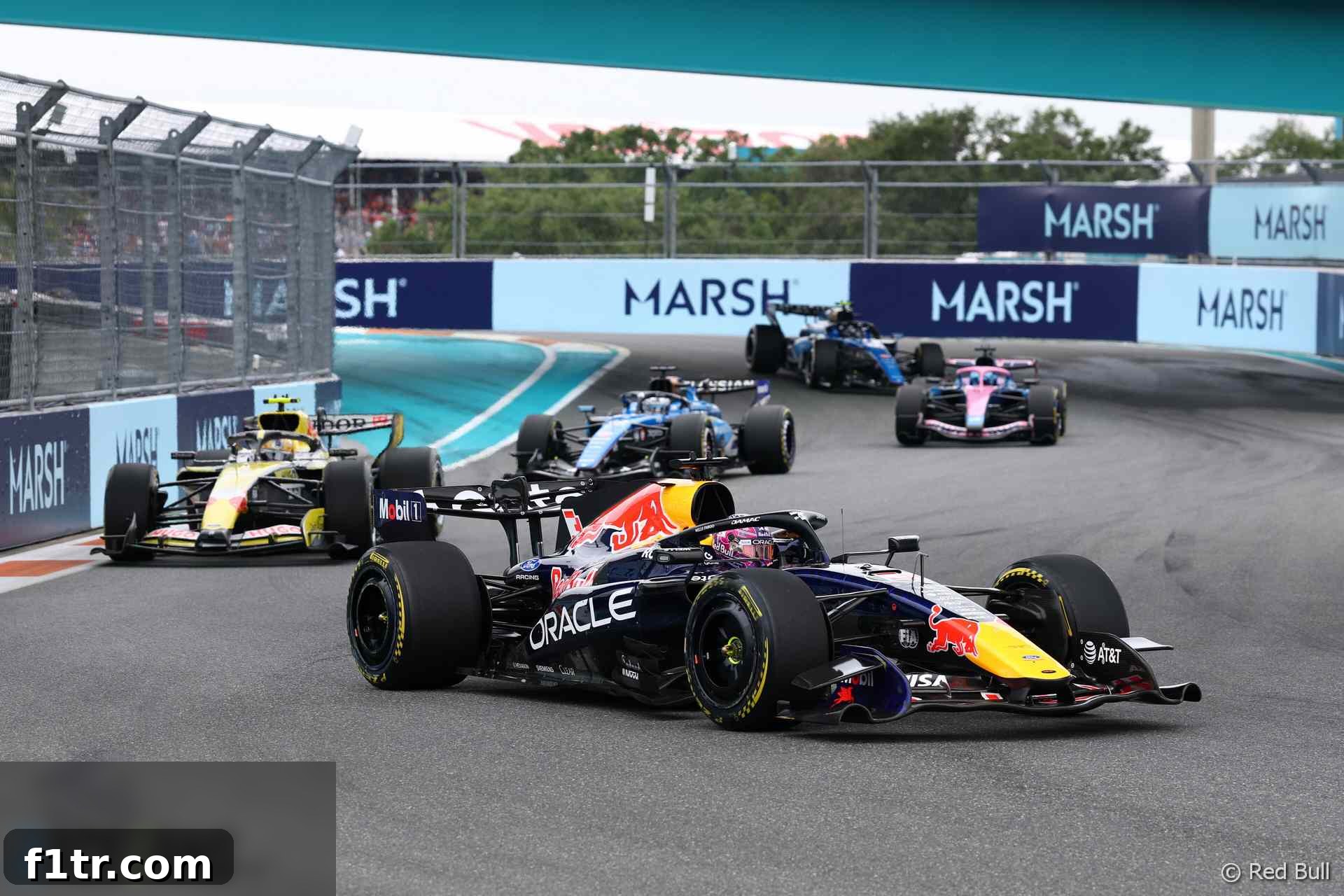
Liam Lawson clearly disagreed with his team’s instruction to let Max Verstappen pass him on the second lap of the Miami Grand Prix, yet he complied immediately when ordered to yield to his former team-mate at Racing Bulls’ sister team.
The incident began after Verstappen spun on the first lap and fell behind Lawson. Although Verstappen closed in on the Racing Bulls car, he remained behind as the pair braked for turn 11.
Verstappen dived up the inside but never managed to get fully alongside Lawson. The move forced Lawson wide and both cars went off the track on the outside of the corner.
Lawson rejoined ahead of Verstappen. The four-time champion, clearly irritated, called Lawson an “idiot” over the radio.
“I don’t know what Max was doing there,” Lawson said as he began the second lap. His race engineer, Alexandre Iliopoulos, made no immediate reference to the incident until Lawson accelerated out of turn eight later that lap.
“Liam, we need to give the position back to Max,” Iliopoulos said. “We need to give the position to Max. 1.3 behind. Behind him, 1.3 Albon. Do it as soon as possible.”
Despite protesting, Lawson followed the instruction. “He drove into the side of me,” Lawson said as he backed off significantly at the next braking zone. “I don’t understand.”
On the face of it, Lawson’s protest had merit. F1’s driving standards state a driver attempting an inside overtake must “have its front axle at least alongside the mirror [of] the other car prior to and at the apex” and must be “driven in a fully controlled manner particularly from entry to apex and not have ‘dived in’.”
Verstappen’s onboard footage showed he did not meet those criteria. A quick glance at the positions suggested Lawson had defended his place legitimately.
Teams decide whether a driver should surrender a position, so it is notable that Racing Bulls reached the conclusion that Lawson should yield and insisted he do so without delay.
The call stands in contrast to Verstappen’s similar maneuver on Lewis Hamilton in the sprint race the previous day. In that incident Verstappen also dived inside at the same corner and both cars left the track, but Verstappen emerged ahead.
In that case Verstappen’s race engineer, Gianpiero Lambiase, warned his driver that the pass should not stand, advising, “I think it’s best you give the position back to Hamilton,” rather than issuing a blunt team order like the one Lawson received.
So did Racing Bulls unnecessarily instruct Lawson to give up the position? The available evidence suggests they did.
Was the decision the result of a mistaken interpretation of the rules, similar to the time Red Bull incorrectly told Verstappen to let George Russell past in Spain? That is possible, though this incident appears clearer than that earlier case.
The circumstances also raise another possibility: that, as on other occasions, Red Bull’s second team acted in ways that benefited the senior team. Whatever the motive, the episode highlights how team radio decisions and split-second judgments can determine track position, even when the on-track evidence points in a different direction.
Advert | Become a RaceFans supporter andgo ad-free
Miss nothing from RaceFans
Get a daily email with our latest stories. No marketing, no ads. Sign up here:
Comment
- Lawson was right: Racing Bulls should not have ordered him to let Verstappen past
- The shadow of motorsport’s worst tragedy hangs over F1’s latest safety debate
- F1 got lucky three ways. But now it has a difficult and urgent problem to solve
- Verstappen’s overreaction shows he knows he cost himself the 2025 title
- F1’s sticking-plaster fix for Qatar tyre failures is an embarrassment
Browse all comment articles