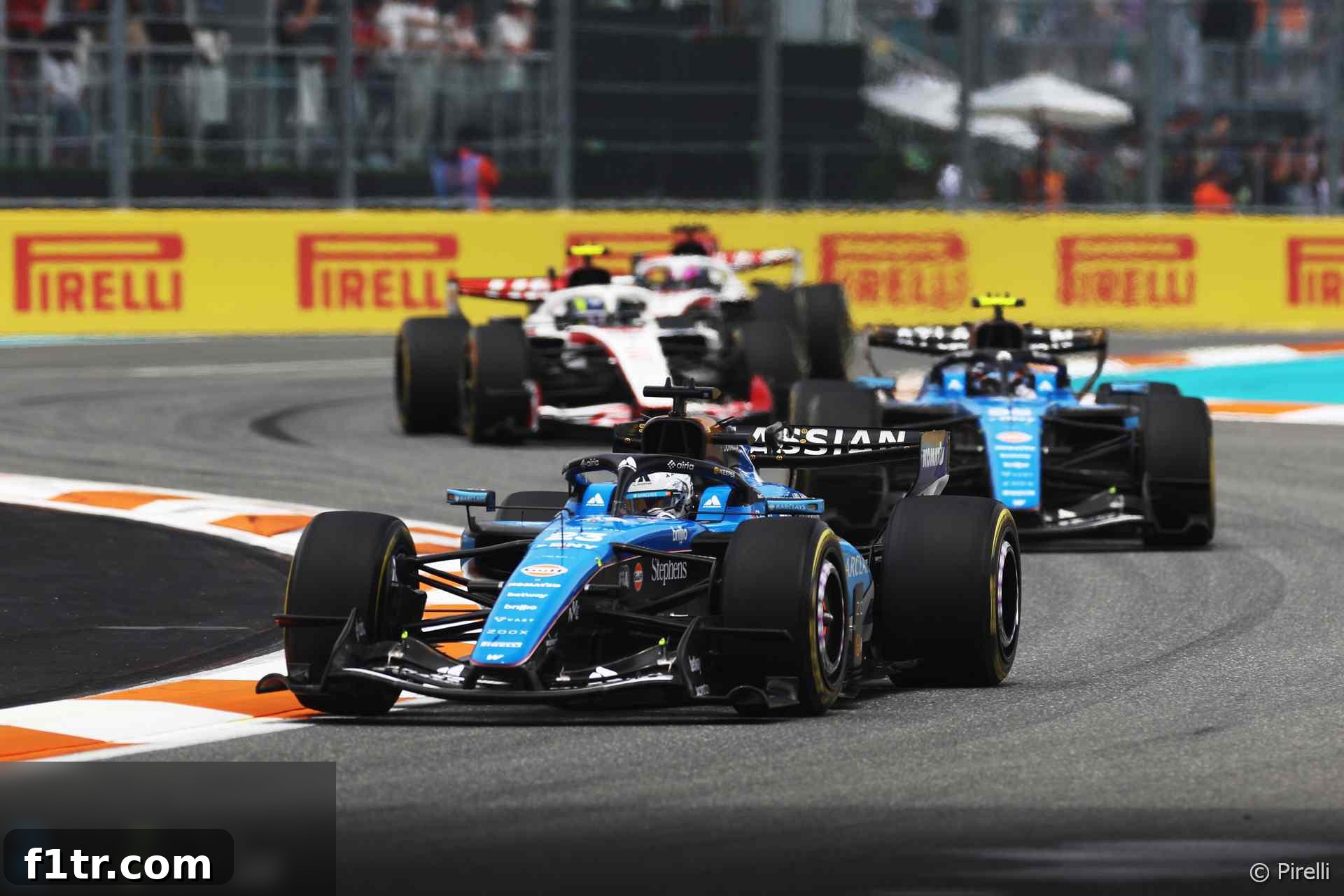
Williams arrived last year with renewed momentum under James Vowles, who in his third season as team principal steered the team to its best championship finish since 2017.
Advert | Become a Supporter & go ad-free
Vowles, however, stressed that finishing fifth in the standings had not distracted Williams from the longer-term goal of maximising the opportunity presented by the 2026 regulation changes.
“We wanted to make a step forward from where we were,” he said at the end of last year. “We wanted to make sure that we demonstrated to the world we’re a different team to where we have been and that we’ll make strides forward, but never losing focus on our future, i.e. 2026 and beyond.”
The organisational changes Vowles made at Grove were also a key selling point when convincing Carlos Sainz Jnr to join the team. By the end of the season Sainz had delivered two grand prix podiums and helped Williams secure that fifth place, a result that vindicated his decision to turn down other offers.
Four rounds into the 2026 campaign—the year Williams had been planning for—the picture is very different. Alpine have been consistent, scoring in every race and sitting fifth in the championship, while Williams have managed just five points.
Williams’ slow start was not a surprise. They were the only team unable to get their car ready in time to attend the first pre-season test at the Circuit de Catalunya in January.
Vowles described a difficult winter. The unexpected gap created by the cancellation of two Middle East races offered a welcome chance to regroup at Grove.
Advert | Become a RaceFans supporter andgo ad-free
“The break gave us an opportunity to reset, take a breath, catch up, and form a plan,” he said. “Not just for Miami, of which we brought upgrades here, but really what we’re doing now across everywhere up until the end of the season to put ourselves back into a sensible position, fundamentally.”
When Vowles arrived from Mercedes in 2023 he found internal processes that lagged behind the front-runners. Modernising those systems has been necessary but also introduced complications during this off-season.
“We made a lot of changes a few years ago, putting in ERP (enterprise resource planning), PLM (product lifecycle management) systems, different ways of doing planning, different ways of structuring, different ways of working,” Vowles explained. “This was the first proper car build where all of those [systems] were brought into account.
“I think we have made some mistakes on some of that software that we’ve been using. It was our first proper go at planning a completely new regulation car from start to finish.
“When we effectively went through a global review of all of that, it’s tiny, small details but hundreds of them starting to add up. So, there were just inefficiencies across the board that weren’t taken into account and only came to light once you started stressing the system.”
As research revealed further development options for the FW48, the design’s complexity became a serious burden.
Advert | Become a RaceFans supporter andgo ad-free
“We started early in the wind tunnel, no doubt about that, [but] we did not start the build of the car early,” Vowles said. “What you want to do is keep all of that goodness in the wind tunnel as long as possible. We wanted to stress ourselves to the point of – not quite a championship team – but more aggressive than we had done before.
“The car we produced is the most complex. It doesn’t matter if I use the number of parts – it’s about two times the number of parts – or the time it took, all of it was about one-and-a-half to two times more complex and it didn’t go smoothly through much of that process.”
Problems compounded from there. Once the build program slips, finding external suppliers is difficult because capacity is limited. “So, once you start falling behind, you’re in trouble,” Vowles said.
Some components required redesigns to pass crash tests. “There was a number of crash tests: some were passed incredibly well, some were difficult, frankly, and that put load back into a system at a very difficult point as well.”
Faced with time pressure, the team accepted a compromise: they produced a car that was overweight, planning to trim weight later through upgrades. “Once you start running out of time, weight is quite an easy addition to effectively get a part through to make sure that you are in a sensible place,” he said. “It becomes, basically, a heavy car very quickly as a result.”
Vowles says future upgrades will be delivered in the most efficient sequence the budget cap allows.
Advert | Become a RaceFans supporter andgo ad-free
“The engineering work is done, so the designers aren’t designing, fundamentally. But you have to make sure you’re printing the components in a way that makes sense. So, in other words, we could take out, and we have [in Miami], several kilos out of the floor because we’ve done a new floor.
“I don’t want to just make exactly the same front wing being several kilos lighter. That doesn’t make any sense to anyone. So, you’ve got to body that into an aerodynamic update at the same time. And so that’s the efficient way in cost cap of doing it.
“We could right now take out [weight], if there was no cost cap, print the other bits in the car. We have capacity, we’d take out pretty much all the weight. But there’s some mechanisms that we have to do along that journey. It’s painful but it’s balancing adding aerodynamic performance as well as weight reduction.”
In Miami Williams showed signs of progress: Sainz and Alexander Albon both finished in the top 10 for the first time this season, helped by the retirement of Pierre Gasly’s Alpine after a crash.
Vowles set out a clear short-term target before the team switches focus to the 2027 car. “For me, it’s as we get to where we finish developing the car, which will be after the August break, that the car is sensibly back to being the top of the midfield, with everything in a sensible position, building on next year’s car.
“The engineering that’s been done over the last five weeks is all the weight is removed from the car – it’s not delivered yet, but the engineering work is complete – plus another 10 kilos on top of that. That’s a sensible step.”
Advert | Become a RaceFans supporter andgo ad-free
“Pit stops are back to being in the top three, top four. There’s 150 pit stops completed. That we bring aerodynamic performance that translates on track. Here [in Miami] we’ve had an aero update and exhaust.” He added that another “40, 50 performance projects” are in the pipeline.
Williams have recovered from worse starts in recent years, but how well they rebound this season and whether the 2027 development runs more smoothly will be a key test of whether Vowles’ reforms have achieved their aim.
Formula 1
- Poll: Has the time finally come for Hamilton to hang up his helmet?
- Grosjean felt Renault ‘told everyone I wasn’t good enough for F1’ before return
- There’s one 2026 change Verstappen will approve of: Zero penalty points
- Which F1 drivers have made the strongest start to 2026 against their team mates?
- “Not correct” to say Ferrari should have discovered Antonelli instead of Mercedes
Browse all Formula 1 articles