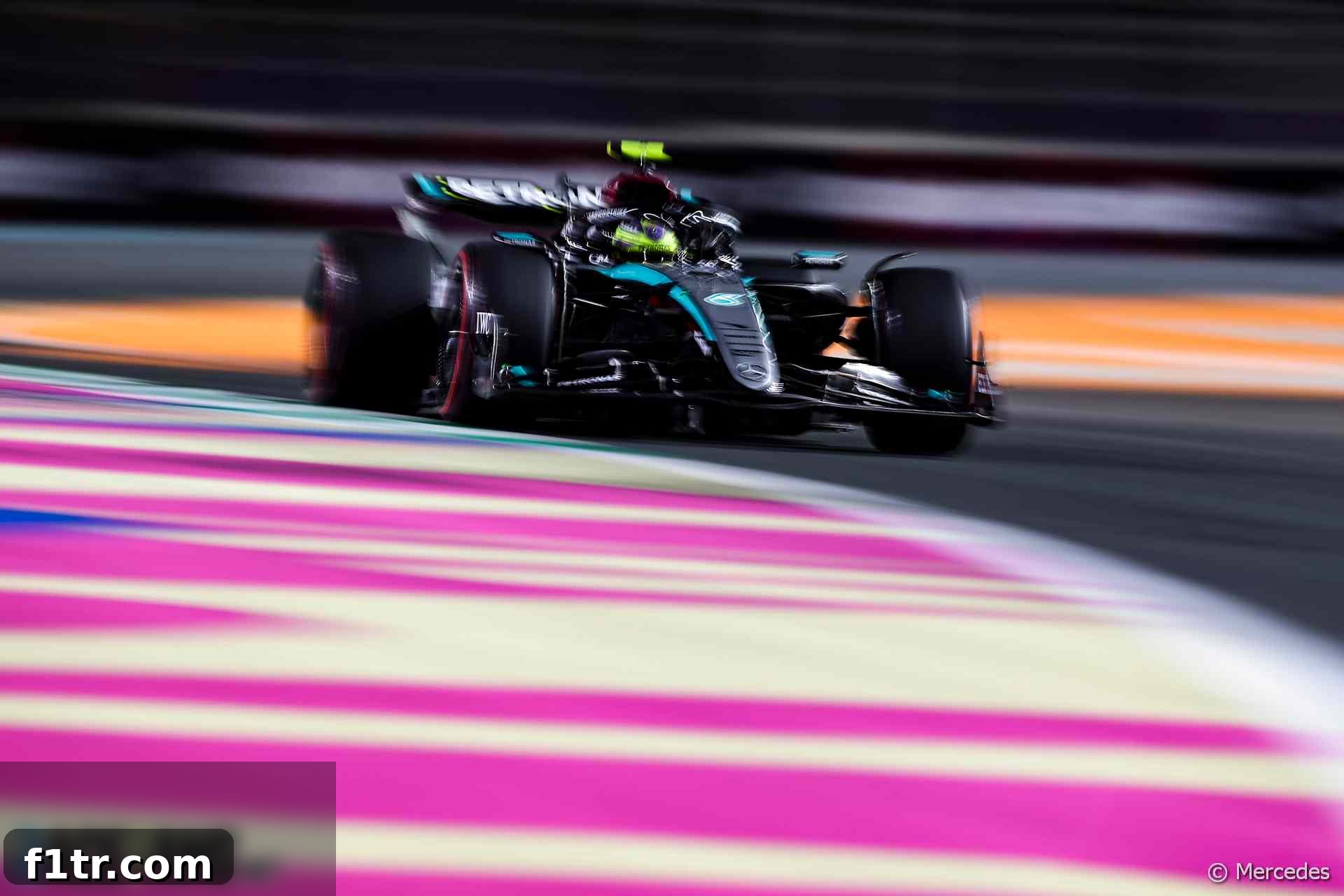
Mercedes believe the reason their car struggled in high-speed corners is down to a fundamental design characteristic.
Advert | Become a Supporter & go ad-free
The team’s drivers found it hard to stay close to rivals through the fastest corners at the Jeddah Corniche Circuit last weekend.
“Fundamentally the limitations that we had in qualifying and the race were broadly the same for both,” said Mercedes’ trackside engineering director Andrew Shovlin in a video published by the team. “So it’s telling you it’s not a small difference, it’s not a tiny bit of camber or a spring or bar here and there, it’s something more fundamental that we need to dig into and understand.”
The team has identified three main reasons why their car fell behind in the quickest corners.
“One issue was balance,” Shovlin explained. “At those very fast corners where the walls are close, drivers need confidence and we were often snapping to oversteer when they really leaned on the tyres. That kind of instability is unsettling and affected both qualifying and the race.”
“In qualifying we also suffered from some bouncing. That proved less of a problem in the race: with more fuel on board and slightly lower speeds it calmed down and wasn’t as significant.
“The biggest problem, though, was a lack of grip there. That’s a key focus for us this week because Melbourne has a similar mix of corners. We’re working hard to understand why we didn’t seem to have the same level of grip as some of our close competitors.”
Advert | Become a RaceFans supporter andgo ad-free
Shovlin estimated Lewis Hamilton and George Russell were losing “around three or four tenths” per lap in the fastest corners. Still, Mercedes are wary of undermining the car’s strengths when addressing that weakness.
“We were actually one of the fastest cars, if not the fastest, in a straight line,” he said. “That means we run a fairly low wing level. We could choose to add downforce and try to claw back time in sectors two and three, but that would cost us on the straights in sector one.
“Ideally we want to keep our straight-line speed and find other ways to improve the fast-corner performance rather than simply bolting on more downforce and paying for it where we’re currently strong.”
Mercedes will use the two-week break between rounds to determine the best approach for the Australian Grand Prix.
“There’s definitely data we’re combing through from Jeddah,” Shovlin said. “We’re also examining data from Bahrain, both the race and the test, and we’ll form a plan for how to approach practice in Melbourne.
“It’s not just about Jeddah. There is substantial work happening in aerodynamics and vehicle dynamics. We’re designing experiments aimed at giving us a clear direction that will deliver performance.”
Advert | Become a RaceFans supporter andgo ad-free
2024 Saudi Arabian Grand Prix
- Bearman’s 2024 Jeddah debut performance makes him ‘feel like an absolute idiot’
- Vowles being patient with Sargeant but expects to see “progress”
- “So I’ve got nothing to worry about?” – The best unheard team radio from Jeddah
- “Shock” of poor start to season showed need for change at Alpine – Famin
- “My tyres are dying”: Stroll’s short-lived struggle until he hit the wall
Browse all 2024 Saudi Arabian Grand Prix articles