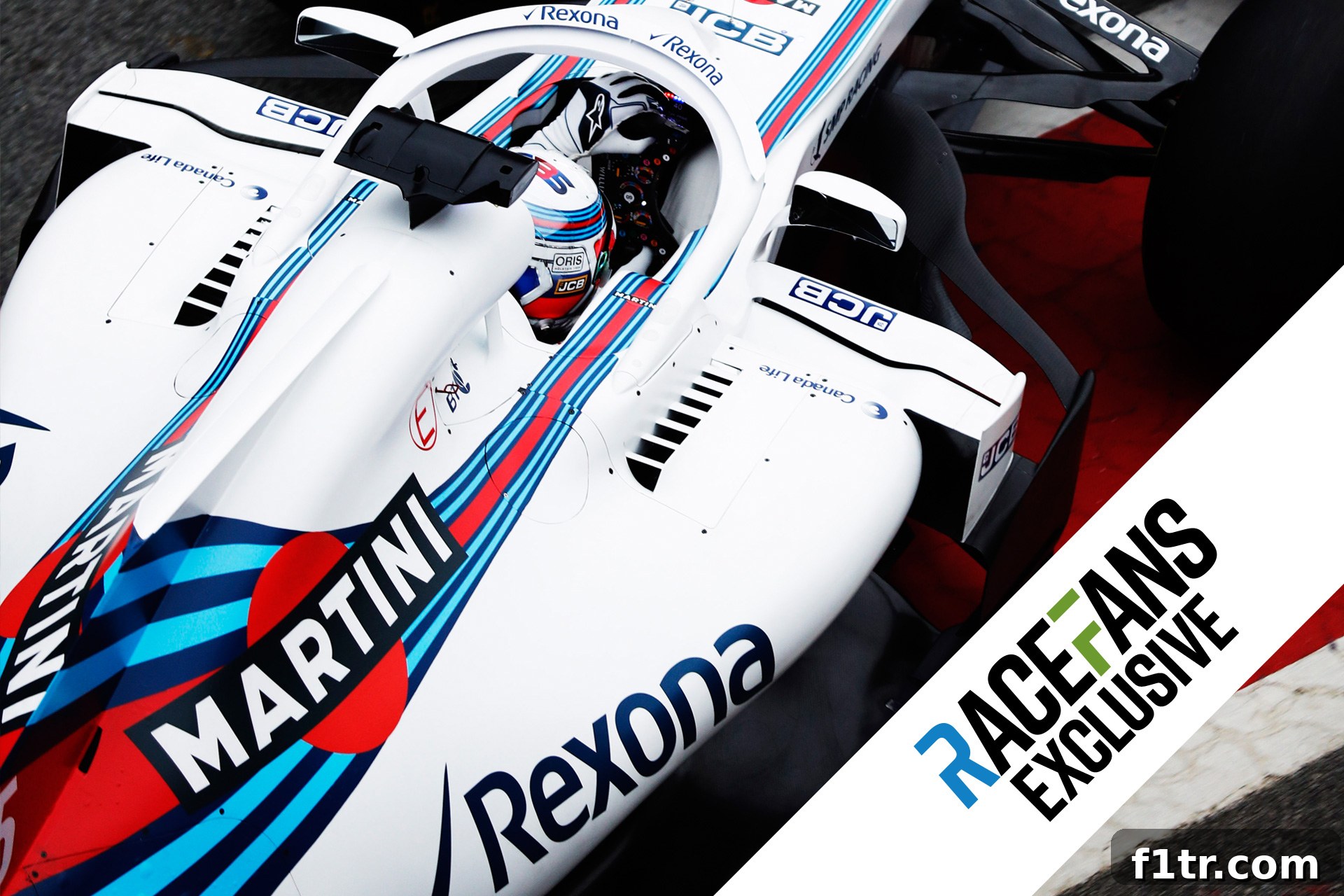
Williams started the V6 hybrid turbo era strongly. A timely partnership with Mercedes helped them finish 2014 as the third-best team in Formula 1 — their best result against Ferrari in two decades.
Since then they have been overtaken as Mercedes’ leading customer team by Force India, which finished ahead of Williams in the standings for the past two seasons. In 2017 Williams collected fewer than half the points of their less well-funded rivals.
For 2018 the midfield looks even more competitive: Renault is investing heavily in its F1 programme, McLaren is powered by Renault engines, Haas showed encouraging pace in pre-season testing and Sauber runs current-specification Ferrari hardware.
Given that landscape, Williams undertook a thorough reassessment of its operation. One notable move was persuading Paddy Lowe to return from Mercedes. Lowe, who began his career at Williams in 1987, played a key role in developing the active suspension systems that gave the team such a dominant advantage in the early 1990s.
Now Lowe’s aim is to lift Williams back towards the front of an especially crowded midfield. Although the team finished sixth in the standings last year, in terms of pace they were often close to Renault and Toro Rosso. With Ferrari customer teams improving and McLaren running Renault power, Williams cannot afford to continue their decline since 2014.
Questions have been raised about Williams’ 2018 driver pairing of Lance Stroll and Sergey Sirotkin. The line-up drew criticism and was rated by some readers as one of the least competitive on the grid. Lowe, who advocated strongly for selecting rookie Sirotkin alongside Stroll, defends the decision.
“I can say with complete confidence we picked the very best drivers to drive our cars that were available,” he tells RaceFans in an exclusive interview. “We weren’t in a position to play fantasy Formula One and pick from anywhere. We selected the best available drivers to us from a fairly wide pool because we were filling the last seat and not directly competing for drivers with other teams.”
“I noticed many articles criticising our choice didn’t actually suggest who they would have preferred, which I found interesting,” he adds.
Lowe says the selection process for Sirotkin was exhaustive and evidence-based rather than purely commercial. “I’ve worked in teams where drivers were chosen on a whim by a team principal — subjectively — and that often led to disappointing results,” he explains.
Sirotkin becomes the first driver backed by SMP Racing to reach Formula 1, a milestone Lowe describes as “a tremendous story.” He also points out that the additional financial support accompanying Sirotkin’s arrival helps the team produce a quicker car in a commercial environment that is particularly challenging for independent teams.
The role of driver funding in modern F1 remains controversial. Lowe acknowledges the reality and is frank about its implications. “Almost all drivers now have the potential to bring some financial contribution,” he says. “That’s the nature of the market, and perhaps even worrying. The way the sport has evolved makes it almost necessary for drivers to bring money, and that’s something the sport should examine.”
Attention around Sirotkin’s promotion was intensified by the fact it came instead of a return for Robert Kubica. Kubica twice appeared close to a comeback following the rally accident that curtailed his original F1 career, but openings at Renault and then Williams did not materialise. Nevertheless, Williams retained Kubica in a development role to assist with a new, substantially revised car.
Lowe made clear Williams needed a more radical approach for their 2018 car rather than an evolution of the 2017 design. “I think we’ve started a journey that is still at its beginning and there is a lot further to go,” he says. “It will be a very exciting process and I feel that excitement throughout the team.”
He is quick to stress the FW41 is a collective achievement rather than a personal project. “It is absolutely not ‘my’ car — it’s the result of an incredible collaboration within the engineering team,” he says. “We must harness the ability, experience and innovation of every individual so they work together to produce the best possible car. That culture has to be created, reinforced and developed over time.”
Williams historically has had extremely talented engineers across the organisation, but Lowe believes the biggest shortcoming was how those individuals collaborated to achieve the best overall result.
If Williams does not maintain progress, they risk returning to the struggles of 2011 and 2013. Their recent decisions have prompted criticism, but the team are clearly not complacent and are taking active steps to reverse their decline.
2018 F1 season preview
- The 2018 F1 season in 20 questions
- Haas exclusive: No more ‘nasty surprises’ as Ferrari relationship matures
- Which F1 drivers will beat their team mates in 2018?
- Williams exclusive: “We’re not in a position to play fantasy F1 driver”
- Toro Rosso exclusive: “I was convinced Honda are in a better position”
Browse all 2018 F1 season preview articles