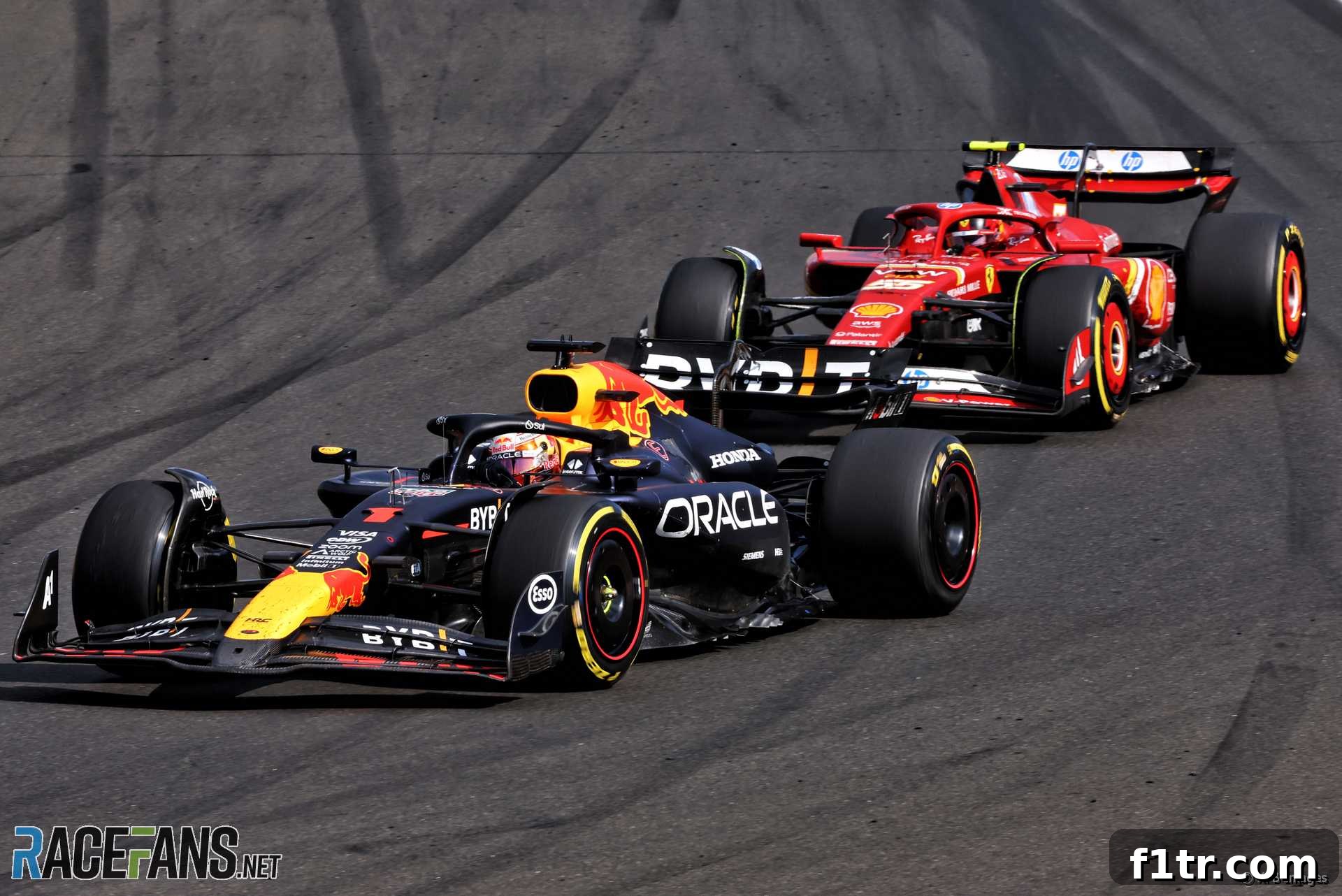
The FIA wants to reverse Formula 1’s long-term trend toward heavier cars. It plans to begin addressing this in 2026, although the minimum weight will reach a new peak before then.
Advert | Become a Supporter & go ad-free
The minimum weight limit for the 2025 season will be set at a record high: the milestone 800 kilogram mark will finally be reached.
F1’s regulations have pushed car weights upward for many years, raising concerns from drivers about how increased mass affects handling and, ultimately, the quality of on-track racing.
The largest single jump in the minimum weight over the last 15 years came in 2014, when the sport introduced the current V6 hybrid turbo power units. The addition of batteries, motor generator units and turbochargers created a significantly heavier generation of cars.
So while the FIA plans to reduce car weights from 2026, the presence of hybrid systems raises the question of how much can realistically be saved if the hybrid formula remains in place.
F1’s minimum weight limit, 1995-2025
NB. Separate minimum weight limits were enforced for turbocharged and normally-aspirated cars in 1987 and 1988.
Between 1995 and 2009, the minimum weight rose only slightly. That began to change as hybrid power was first allowed and then mandated, driving successive increases in the minimum weight limit.
2009: KERS
In 2009 the FIA permitted teams to use Kinetic Energy Recovery Systems (KERS) but did not initially adjust the weight limit to account for the added mass. As a result, some teams ran KERS while others chose not to, and some only used the system on one car when there were notable weight differences between drivers.
In 2010 the FIA increased the minimum weight by 15kg to encourage wider adoption, but teams largely held off to save costs. Adoption increased in 2011 after another 20kg rise to the minimum weight limit.
2014: V6 hybrid turbos
The introduction of the V6 hybrid turbo engines in 2014, which included the MGU-H and MGU-K, pushed the minimum weight up by 48kg. Much of that increase came from the new electrical components, though engine configuration choices also played a role.
The higher minimum led some teams and drivers to take extreme measures to save grams; a few drivers altered diets or experienced health impacts as they attempted to meet weight targets. The following year, teams were given another 12kg, pushing the minimum above 700kg for the first time. At the same time, the more efficient power units allowed reductions in fuel load thanks to the introduction of a fuel consumption limit.
2017: Wider cars
In 2017, aerodynamic rule changes widened the cars from 1.8 metres to two metres and permitted more complex bodywork, while tyre widths also increased. These changes added weight, prompting adjustments to the minimum weight limit. The FIA had also planned to introduce the Halo head-protection device around this time but postponed its introduction for a year.
Higher drag from the revised aerodynamics led to incremental increases in the maximum fuel allowance in subsequent seasons.
2018: Halo
When Halo was finally introduced in 2018, teams required another increase to the minimum weight. The structures needed to integrate and support Halo added weight that was often mounted high on the car, away from the ideal center of gravity, making its impact greater than the device’s headline mass alone.
Further small increases in 2020 and 2021 addressed various technical and regulatory needs, including measures intended to deter engine manufacturers from using costly, exotic materials to save weight and to accommodate additional fuel flow monitoring equipment.
2022: Ground effect
The 2022 ground effect regulations produced the second-largest rise in the minimum weight limit. Although cars had originally been targeted for a 790kg dry weight, development and regulatory realities pushed actual weights to around 798kg — nearly matching the uplift seen in 2014.
Several factors contributed: the switch from 13-inch to 18-inch wheels increased unsprung mass; a greater use of standardized parts often meant heavier components; and strengthened safety requirements introduced after high-profile incidents raised crash-test standards and mandated additional anti-intrusion panels.
An extra 2kg will be added for 2025 so the driver weight allowance can rise to 82kg. That allowance, introduced in 2019, helps reduce the disadvantage for taller or naturally heavier drivers.
2026: ‘Nimble’ cars?
The FIA aims to reverse the weight trend in 2026 by reducing car dimensions: overall width will drop to 1.9m, wheelbase will be shortened to 3.4m, and wheels will be narrower. These measures are intended to produce lighter, more agile machines.
However, hybrid power units will become heavier under the 2026 rules: the minimum weight for the power unit alone will rise from 151kg to 185kg. That 34kg increase makes the FIA’s stated goal of an overall 30kg weight reduction more challenging.
So long as manufacturers favour a hybrid engine formula, ultra-light F1 cars seem unlikely to return. The new engine rules have helped attract manufacturers such as Audi, Ford and Honda for 2026, demonstrating continued interest in hybrid technology.
The impact of rising weight is evident when comparing modern cars to older machinery. At the British Grand Prix, Jenson Button drove the Williams FW22 from his debut season, which weighed 600kg — roughly 200kg lighter than cars expected next year. Button has said hybrid systems and the resulting larger car packages are a major factor in the current cars’ reduced on-track racing characteristics.
While not all weight increases over the past 15 years stem from hybrid power units, hybrids have contributed significantly. Many other changes—especially safety-driven upgrades—were necessary and justified, but some were introduced in reaction to the heavier cars produced by hybrid integration. Reversing much of the weight gain will be difficult, and achieving meaningful reductions will require careful balancing of performance, safety and the continued presence of hybrid technology.
Miss nothing from RaceFans
Get a daily email with all our latest stories – and nothing else. No marketing, no ads. Sign up here:
Formula 1
- Grosjean felt Renault ‘told everyone I wasn’t good enough for F1’ before return
- There’s one 2026 change Verstappen will approve of: Zero penalty points
- Which F1 drivers have made the strongest start to 2026 against their team mates?
- “Not correct” to say Ferrari should have discovered Antonelli instead of Mercedes
- Vowles explains the mistakes behind Williams’ stumbling start to 2026
Browse all Formula 1 articles