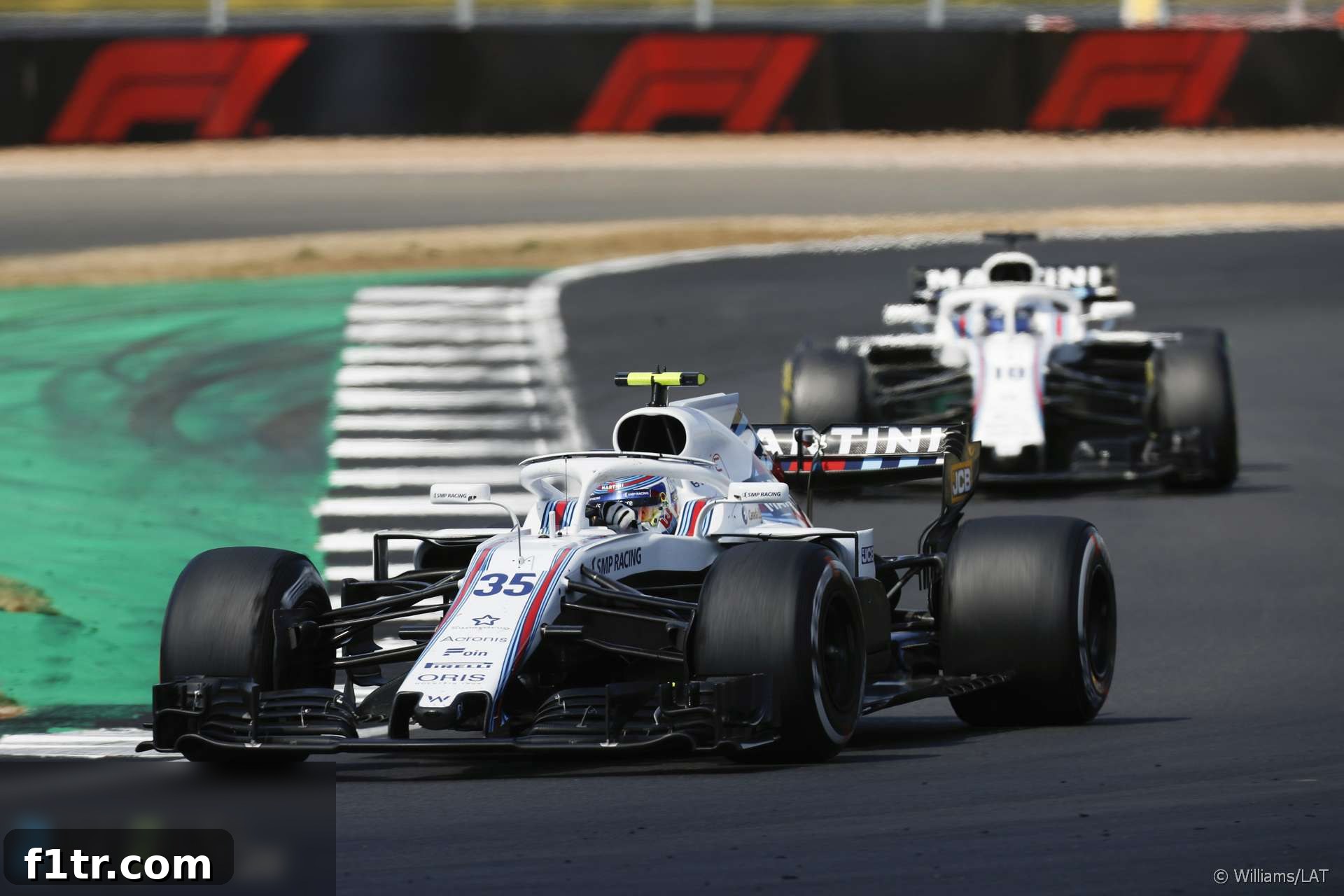
Williams F1 Stands Firm: Paddy Lowe Confirms Unwavering Commitment to FW41 Concept Despite 2018 Setbacks
In a season fraught with technical challenges and disappointing results, Williams F1’s Chief Technical Officer, Paddy Lowe, has firmly stated that the legendary British team will not abandon the fundamental aerodynamic concept underpinning their 2018 Formula 1 challenger, the FW41. This declaration comes despite the team’s ongoing struggles at the bottom of the Constructors’ Championship table and a particularly damaging setback at the recent British Grand Prix at Silverstone.
The FW41 has been a source of significant frustration for Williams, with the team managing to score points in only a single race thus far in the season. This stark reality underscores a period of profound difficulty for a team with such a storied history in Formula 1. The inherent complexities of modern F1 aerodynamics, combined with the fiercely competitive nature of the grid, have exposed weaknesses in the FW41’s design, leading to persistent performance deficits on track.
Navigating a Challenging Season: The FW41’s Performance Woes
The 2018 Formula 1 season has proven to be an arduous test of resilience for Williams. From the outset, the FW41 demonstrated a lack of consistent pace and inherent stability, leaving drivers Lance Stroll and Sergey Sirotkin battling at the rear of the field. The team’s struggles are evident in their championship standing, which sees them languishing at the very bottom, a position unfamiliar and unwelcome for a team that has historically competed at the pinnacle of motorsport.
Every Grand Prix presents a fresh challenge, with the engineering team tirelessly working to extract performance from a car that has proven to be aerodynamically temperamental. The gap to the midfield teams has often been substantial, making it incredibly difficult for Williams to compete for points on merit. This consistent underperformance inevitably puts immense pressure on all facets of the team, from the design office to the pit wall and the drivers themselves.
The Silverstone Saga: A Catastrophic Aerodynamic Puzzle
Unpacking the Rear Wing and Diffuser Dilemma
The British Grand Prix at Silverstone served as a stark reminder of the FW41’s underlying issues, culminating in both cars being forced to start from the pit lane. The catalyst for this drastic measure was a newly introduced rear wing upgrade, which, under certain conditions, caused a critical aerodynamic flaw. Specifically, the team belatedly discovered that the new rear wing was causing its diffuser to stall when the Drag Reduction System (DRS) was deactivated.
A diffuser stall is an extremely detrimental aerodynamic phenomenon. The diffuser, located at the rear underside of the car, is designed to accelerate airflow, creating a low-pressure area that generates significant downforce. When it stalls, this crucial low-pressure effect collapses, leading to a sudden and severe loss of downforce. In the context of the Silverstone incident, this meant that as the DRS closed, the interaction with the new rear wing was disrupting the airflow over the diffuser, effectively switching off a vital source of grip and stability. Such a sudden loss of downforce, especially at high speeds, can make a car extremely difficult and dangerous to control, compromising driver safety significantly.
Paddy Lowe’s Account: From Friday Evaluations to Qualifying Chaos
Paddy Lowe provided a detailed explanation of how the team diagnosed this “catastrophic” rear wing problem. He recounted that the team introduced new parts, most notably a redesigned rear wing, on Friday during practice sessions. As is standard procedure, initial evaluations were conducted to ensure the necessary aerodynamic stability, particularly around the rear end of the car. Following what appeared to be satisfactory data, these parts were adopted for the weekend.
However, overnight changes, typical for a race weekend – such as adjustments to cooling systems and the switch from heavier “Friday floors” to lighter “Saturday race floors” – introduced unforeseen complications. It was during qualifying that the insidious problem manifested itself. Lowe described the issue as intermittent yet “really quite catastrophic.” Intriguingly, on one car, the problem occurred in a specific DRS zone, while on the other, it appeared in a different zone. This intermittent nature made diagnosis particularly challenging, indicating a complex interaction between various aerodynamic elements and potentially external factors.
The severity of the issue, characterized by an “extreme loss of downforce,” rendered the cars genuinely unsafe to race with the new configuration. While the option of running without using DRS was considered, Lowe highlighted that this would be an untenable competitive disadvantage. Faced with an unknown exact cause and a critical safety concern, the team made the responsible decision to revert to a previously known and safe combination of parts for the race. This allowed both cars to compete without further issues during the Grand Prix, albeit from the pit lane start, underscoring the team’s commitment to safety and reliability even amidst a performance crisis.
Commitment to Concept: Why Williams Isn’t Giving Up on the FW41
Despite the litany of challenges and the Silverstone debacle, Paddy Lowe’s resolve remains unshaken regarding the FW41’s fundamental aerodynamic concept. When asked directly, Lowe emphasized, “I think we’ll just keep doing the best we can with this car. We do keep making steps. We will migrate these steps to make them more simply purely relevant to next year rather than things that are not only relevant to this car.”
This strategic approach reflects a deeper understanding of Formula 1 car development. Abandoning an entire car concept mid-season, especially one as complex as the FW41, is often a more detrimental path than persisting with development. Such a radical shift would effectively mean restarting from scratch, wasting vast amounts of resources – both financial and intellectual – that have already been invested. Furthermore, it would significantly delay any meaningful progress towards the following season’s car, as the fundamental lessons from the current design would be left unlearned.
Williams’ decision to stick with the FW41 concept is rooted in the belief that by thoroughly understanding its weaknesses and iteratively improving upon them, they can establish a more robust foundation for future designs. Every fix, every modification, and every new data point gleaned from the FW41 provides invaluable insight into what works and what doesn’t within their specific design philosophy. This continuous learning process is critical in Formula 1, where incremental gains and deep technical understanding are paramount.
Lowe further elaborated on the synergy between current and future car development: “You work more and more, even on the current car, with things that are relevant to next year. It doesn’t mean you stop doing anything because you can work on things with the current car that are just as relevant this year as next year.” This highlights the fluid nature of F1 engineering, where solutions or discoveries made for the current car can often be directly transferable or inform the design principles of the next generation vehicle. For instance, a better understanding of airflow management around a specific component on the FW41 could directly influence the design of a similar component on the 2019 car, the FW42.
The Road Ahead: Williams’ Development Strategy and Future Outlook
Williams’ path forward involves an intensive and highly integrated development strategy. The iterative nature of Formula 1 means that even during a difficult season, the focus is always dual-pronged: extracting maximum performance from the current package while simultaneously laying the groundwork for the future. The team will continue to bring upgrades to the FW41, not solely for immediate performance gains, but also as vital testing platforms for concepts destined for the 2019 car. This approach ensures that any breakthroughs or lessons learned from the FW41 are directly fed into the design and engineering of its successor.
Data acquisition and meticulous analysis are more crucial than ever for Williams. Every lap completed by the FW41, every sensor reading, and every driver feedback report contributes to a vast pool of information. This data will be rigorously analyzed by the technical team to pinpoint the exact sources of the FW41’s aerodynamic instability and performance limitations. Identifying these root causes is paramount to designing a more competitive and forgiving car for the next season, effectively turning the current struggles into invaluable learning experiences.
The pressure on the engineering department, led by Lowe, is immense. They must not only rectify the current car’s shortcomings but also deliver a significantly improved package for 2019 that can lift Williams out of its current slump. This requires not only technical ingenuity but also strategic foresight and effective resource allocation. The drivers, too, play a critical role, providing the nuanced feedback necessary to guide the development process, acting as the ultimate interface between the car’s design and its on-track behavior.
Broader Implications for Formula 1 and Williams’ Legacy
Williams’ current predicament serves as a potent reminder of the unforgiving nature of Formula 1. Even teams with a rich history and numerous championship victories are not immune to periods of struggle if they fall behind in the relentless technological arms race. Williams Racing, with its nine Constructors’ Championships and seven Drivers’ Championships, represents an era of unparalleled success. The desire within the team and among its global fanbase to return to competitive form is palpable.
The challenge for Williams lies in balancing immediate performance improvements with a long-term strategic vision. While securing points is vital for morale and championship standing, making fundamental changes that will ensure sustained competitiveness in the coming seasons is equally, if not more, important. Lowe’s commitment to the FW41 concept, despite its flaws, speaks to this long-term perspective – a belief that understanding and refining one’s own design philosophy, rather than constantly chasing external trends, is the true path to resurgence.
Conclusion: A Test of Resilience and Technical Acumen
Paddy Lowe’s statements paint a picture of a Williams team that, while facing significant adversity, is resolute in its technical direction. The FW41 may be proving a difficult beast to tame, but the intention is not to abandon it but to understand it more deeply, learn from its imperfections, and evolve its core concept for future success. The Silverstone incident, while damaging, provided crucial data and a stark lesson that will undoubtedly inform future design choices.
The road ahead for Williams will be challenging, demanding unwavering commitment, meticulous engineering, and a steadfast belief in their chosen technical path. As the season progresses and attention increasingly shifts towards the 2019 challenger, the lessons learned from the FW41’s journey will be pivotal. Williams’ ability to overcome these technical hurdles and translate their current struggles into future triumphs will be a true testament to their resilience and technical acumen in the highly competitive world of Formula 1.
Related Content: Delving Deeper into the 2018 F1 Season
Explore more articles and insights from the 2018 Formula 1 season to understand the context and events surrounding Williams’ journey and other key developments in the championship.
- F1 feared “death knell” for Drive to Survive after Ferrari and Mercedes snub
- McLaren staff told us we were “totally crazy” to take Honda engines in 2018 – Tost
- ‘It doesn’t matter if we start last’: How Red Bull’s junior team aided Honda’s leap forward
- Honda’s jet division helped F1 engineers solve power unit problem
- McLaren Racing losses rise after Honda split
Browse all 2018 F1 season articles