Lando Norris Calls for Critical Safety Upgrades at Singapore Grand Prix’s Turn 19
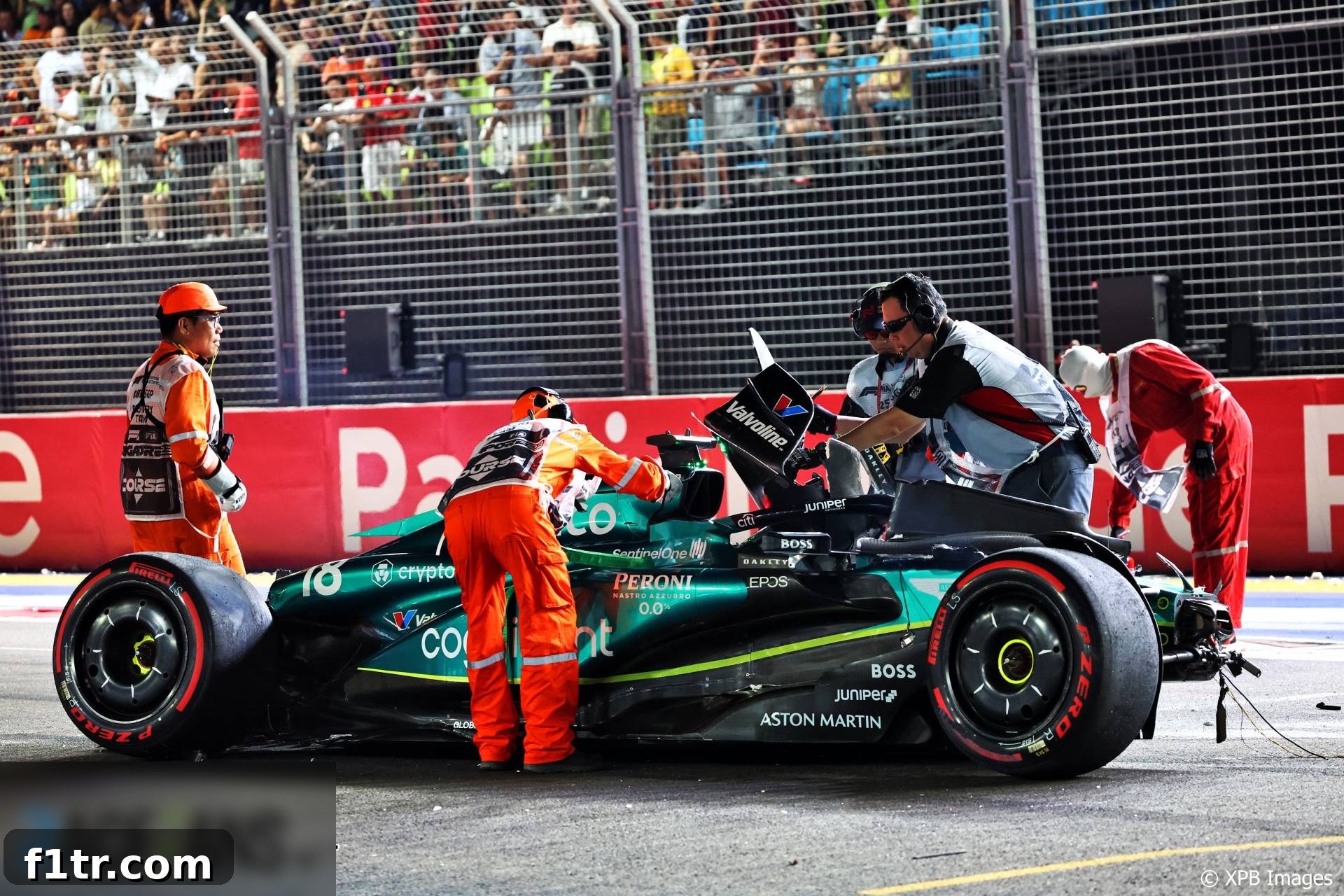
Following a harrowing crash involving Lance Stroll during qualifying for the Singapore Grand Prix, McLaren driver Lando Norris has vehemently called for immediate safety modifications to be implemented at the challenging Turn 19 of the Marina Bay Street Circuit. The incident, which saw Stroll’s Aston Martin suffer a heavy, nose-first impact into a barrier, highlighted pre-existing concerns about the corner’s unforgiving nature.
The dramatic conclusion to Q1 saw Lance Stroll’s Aston Martin careen into the concrete wall at the final turn, a high-speed left-hander, leaving his car severely damaged. Miraculously, Stroll emerged from the wreckage uninjured, but the severity of the impact was undeniable, leading to a significant delay in qualifying as circuit marshals worked to repair the compromised barrier. The incident served as a stark reminder of the inherent dangers lurking at the edges of Formula 1’s most demanding circuits.
Norris’s First-Hand Account: A Close Call at Turn 19
Lando Norris, who was running just moments behind Stroll, found himself in a precarious position as the Aston Martin rebounded onto the track directly in his path. His immediate proximity to the accident offered a chilling perspective on the rapid unfolding of events and the narrow margins within which F1 drivers operate.
“I got there before any yellow [flags] or anything, so I didn’t see it or know of it until the exit of the corner,” Norris explained in an exclusive interview. “You [could] see the smoke as I was coming around the corner, but it was impossible to know what was happening. He was still spinning and kind of coming back onto the track quite a bit, so I hit the brakes quite quickly because I didn’t know if he was going to come across a lot or what, but then there was just a lot of debris and a tyre so I ducked my head a little bit just in case.”
Norris’s quick reflexes likely prevented a secondary collision, underscoring the critical need for clear visibility and rapid hazard warning systems. His narrative vividly portrays the chaos and unpredictability that drivers face when an accident occurs at such high speeds, especially on a street circuit where escape routes are minimal.
The Perilous Nature of Marina Bay’s Turn 19
The McLaren star elaborated on why Turn 19 is particularly dangerous. Characterized by its high-speed entry and limited run-off space, any deviation from the racing line at this specific point inevitably leads to a significant impact. “The most important thing was he got out because it was a big crash. If you ever crash there it’s going to be quite a nasty one, so for him to get out as quickly as he did I think was a good sign,” Norris observed, highlighting the sheer force of the collision and the robust safety standards of modern F1 cars, which fortunately protected Stroll.
Norris specifically pointed out a subtle but crucial design flaw at the corner: a change in elevation or an imperfection in the track surface that can profoundly unsettle the cars. This anomaly, which drivers approach almost flat-out, introduces an element of unpredictability that can easily lead to a loss of control. “I don’t know if they can maybe make a small improvement to the track there for next year because there’s kind of like a bit of a dip or something, not smooth enough, and I think everyone’s a bit afraid to do it [flat out],” he stated, emphasizing a collective apprehension among drivers.
The feedback from drivers is invaluable in enhancing track safety, as they are the ones experiencing these critical conditions first-hand. “There’s been quite a few instances of as soon as you do it, you almost have to just get off the throttle and abort the lap because you try and commit and you’re going to end up doing what Lance did. So just from more of a safety point, I don’t think it’s the best exit kerb and up to the standard that it should be. That’s maybe something for next season,” Norris concluded, calling for a review of the kerb and track surface for future editions of the Singapore Grand Prix.
The Impact of Modern F1 Regulations on Track Sensitivity
Norris further expanded on the technical reasons behind the increased sensitivity of current Formula 1 cars to track imperfections. The advent of new regulations, particularly those emphasizing ground effect aerodynamics, mandates that cars run extremely low to the ground and with very stiff suspensions to maximize performance and downforce. While these design philosophies push the boundaries of speed, they introduce a significant vulnerability to bumps and uneven surfaces.
“It just feels like a bump where you’re driving, I don’t know what it really is or looks like or whatever. It kind of feels like either there’s a decent bump or the rest of the track is just a little bit lower, like the kerb is a bit lower than the actual Tarmac,” Norris explained. “So it just feels like when you come over it initially it’s okay, but then trying to come back onto the track it just really unsettles the car.”
This “unsettling” effect is precisely what can lead to a phenomenon known as “bottoming out,” where the car’s underbody scrapes against the track surface. “The cars, you have to run them so low nowadays because of the regulations, as soon as there’s a decent bump you hit the floor and you deck it and you’re gone, you’ve bottomed out and completely lose the car. So I’d say it’s kind of through no fault of his own.” This statement is critical, as it shifts some of the responsibility from driver error to the complex interaction between stringent regulations and track design.
Norris emphasized that such issues, while potentially exacerbated by current regulations, are often recognized within the paddock. “It’s a known thing because you know if you hit the kerb badly or something, things like this can happen. But it’s obviously just how these regulations are, you have to run the cars low and stiff and things like that.” He highlighted that what might have been an insignificant bump a few years ago has become a critical hazard with the current generation of F1 machinery. “We do that nowadays, and there’s a bump which probably didn’t even used to be a bump a few years ago but now it’s a significant bump. We just can’t stand the same things as what we had a few years ago.” This evolution underscores the constant need for tracks to adapt to the changing characteristics of the cars that race on them.
The Imperative of Continuous Safety Evolution in Formula 1
Lando Norris’s candid remarks underscore the continuous and iterative nature of safety improvements in Formula 1. While the sport has made monumental strides in driver and car safety over the decades, incidents like Lance Stroll’s crash at Turn 19 serve as potent reminders that vigilance cannot wane. Street circuits, by their very design, present unique challenges. Their temporary nature and integration into urban landscapes often mean inherent limitations in terms of run-off areas and the ability to drastically alter track layouts.
However, modern engineering and detailed analysis, combined with invaluable driver feedback, provide opportunities for targeted improvements. Resurfacing, reprofiling kerbs, or even minor adjustments to the track’s banking can have a significant impact on safety without compromising the circuit’s fundamental character or the challenge it presents to the world’s best drivers. The FIA, in collaboration with circuit organizers, routinely reviews incidents and driver input to ensure that safety standards keep pace with the ever-evolving technology and performance of Formula 1 cars.
The conversation initiated by Norris extends beyond just Turn 19 in Singapore; it highlights the broader philosophical debate within F1 regarding the balance between raw speed, demanding circuits, and the paramount importance of driver safety. While drivers are expected to push the limits, the tracks themselves must provide a reasonable and consistent environment where such limits can be explored without undue or hidden hazards. The sport’s history is filled with tragic lessons that have forged its current robust safety culture, a culture that must remain proactive.
Looking Ahead to a Safer Future at Marina Bay
The call for changes at Turn 19 of the Marina Bay Street Circuit is a pertinent example of how continuous dialogue between drivers, teams, and governing bodies can lead to tangible improvements. Ensuring the safety of the sport’s participants is a non-negotiable aspect of Formula 1, and every incident, no matter how minor, provides a learning opportunity. Lando Norris’s outspoken stance serves as a crucial voice in this ongoing effort, advocating for a safer racing environment for all.
As Formula 1 continues to evolve with increasingly sophisticated machinery and ever-higher performance thresholds, the dynamic relationship between car design and track integrity will remain a focal point. Addressing specific concerns like those raised about Turn 19 is not merely about preventing future crashes but about upholding Formula 1’s commitment to being at the forefront of motorsport safety. The hope is that proactive measures will be taken, ensuring that the spectacle of the Singapore Grand Prix can be enjoyed with renewed confidence in the safety of its demanding street circuit.
Bringing Expert Insights and Unbiased Analysis
Delivering in-depth coverage and nuanced perspectives on the world of Formula 1 requires dedication, extensive research, and direct engagement with the sport’s key figures. We believe in providing readers with informed, original journalism that goes beyond the headlines.
By engaging with high-quality, independent content, you contribute to a vibrant ecosystem of motorsport analysis. Your support helps cover the costs involved in producing thorough reports: from travel and on-site reporting to detailed writing, content creation, and technical development.
Independent journalism thrives on reader engagement. If you value comprehensive and unbiased coverage, consider how your interest helps sustain quality reporting. Explore more about how you can support insightful motorsport analysis:
- Support Independent Motorsport Journalism
- Learn More About Contributing
2023 Singapore Grand Prix Coverage
- Sainz’s Singapore win made Leclerc focus on improving his race pace – Clear
- Singapore and Austin retirements cost me top 10 championship place – Ocon
- How Ocon’s “extreme” height for an F1 driver is helping other tall racers
- Steward’s admission Verstappen should have had penalty frustrates his rivals
- Drivers back Singapore qualifying tweak as rule changes again for Japanese GP
Browse all 2023 Singapore Grand Prix articles