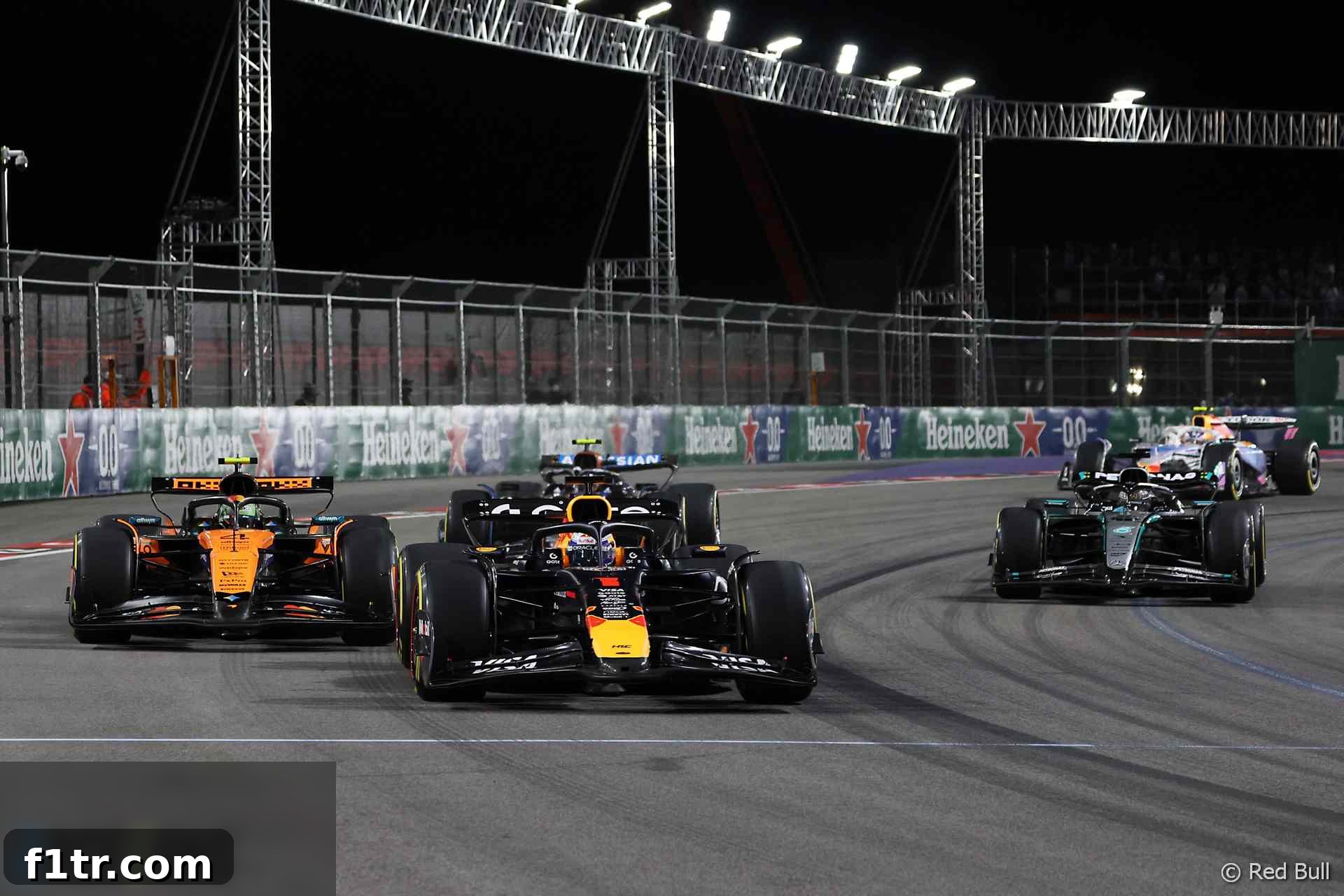
The glitz and glamour of the Las Vegas Grand Prix promised high drama, and for Lando Norris, it delivered a mix of immediate heartbreak and eventual satisfaction. Starting from a coveted pole position, the young McLaren driver found himself embroiled in an intense battle from the very first corner, a battle he ultimately admitted he “fucked up.” This candid confession came after a crucial error cost him the lead, setting the tone for a race that would reveal both the raw speed of McLaren and the persistent challenges they face against formidable rivals.
The Fateful Start: A Pole Position Squandered
Norris, having brilliantly secured pole position on the dazzling Las Vegas strip, knew the importance of a strong start. As the lights went out, his initial getaway was indeed commendable, positioning him perfectly to defend against the charging pack. Instinctively, he moved across the track, a common defensive maneuver aimed at denying Max Verstappen any opportunity to dart up the inside into the notoriously tight Turn 1. The stage was set for a thrilling battle for the lead, but the execution of the crucial braking zone proved to be Norris’s undoing.
Under immense pressure, with the roar of engines and the adrenaline pumping, Norris pushed the limits of his McLaren MCL38. He braked too deep into the first corner, a critical misjudgment that sent his car wide and off the optimal racing line. In Formula 1, such a momentary lapse is ruthlessly exploited. Verstappen, ever the opportunist, wasted no time in sweeping past the errant McLaren. The misfortune didn’t end there for Norris; the extended line he took out of Turn 1 also allowed George Russell to gain momentum on the subsequent straight, relegating Norris further down the order. What began with the promise of leading a Grand Prix under the dazzling lights of Las Vegas quickly turned into a recovery mission.
Norris’s Candid Admission: “I Fucked It Up”
In the aftermath of the race, Norris’s honesty was refreshing and characteristic. During the post-race podium interview, he didn’t shy away from self-criticism, bluntly stating, “I fucked it up. I just braked too late.” This direct acknowledgement resonates with fans and highlights the immense pressure F1 drivers face, where fractions of a second and inches on the track can determine victory or defeat. The mistake at Turn 1 was a clear demonstration of the fine margins in elite motorsport, especially on a new street circuit where track limits and grip levels are constantly evolving and pushing drivers to their absolute maximum.
Despite the initial disappointment, Norris’s ability to compartmentalize and focus on the bigger picture became evident. While the mistake was costly, his subsequent drive showcased his resilience and raw talent. The loss of the lead was a bitter pill to swallow for any driver, particularly one who had demonstrated such impressive qualifying pace to secure pole. However, Norris understands that in the cutthroat world of Formula 1, dwelling on errors is counterproductive. His focus immediately shifted to extracting the maximum possible performance from his car for the remainder of the race.
A Resilient Recovery: Salvaging a Strong Result
From that early setback, Norris embarked on a determined recovery drive. Navigating the demanding Las Vegas circuit, he steadily worked his way back through the field, demonstrating strong racecraft and consistent pace. His efforts were ultimately rewarded with a commendable second-place finish. This podium position was not just a testament to his driving skill but also a crucial outcome in his personal championship battle. By finishing second, Norris significantly increased his points lead over his closest championship rival, teammate Oscar Piastri, who also delivered a strong performance.
Reflecting on the result, Norris expressed a pragmatic satisfaction, acknowledging the circumstances. “I’ve obviously had a good run,” he commented. “I think the pace was still good today. Max just drove a good race and they were quick. I made the mistake into turn one. You’ve got to be punchy into turn one, I was just a bit too punchy and that cost me. So that’s the way it is sometimes. It’s still a good result, second, and still good points, so it’s not like I’m too disappointed.” This nuanced perspective illustrates the mindset of a top-tier athlete: self-critical yet capable of appreciating the positives in a challenging scenario.
Pace Discrepancy: Red Bull’s Unyielding Dominance
While second place was a strong recovery, Norris was under no illusions about the underlying pace differential, particularly concerning Red Bull Racing and Max Verstappen. He candidly admitted, “it wasn’t my best performance out there” and highlighted the stark reality when a competitor wins by a significant margin. “When a guy wins by 20 seconds it’s because he’s just done a better job and they’re a bit quicker. So a fun race out there, difficult as always, but good fun.” This acknowledgment underscores Verstappen’s continued dominance and the challenge facing McLaren and the rest of the grid.
Norris went further, expressing doubt that he would have won the race even if he had maintained his lead at the start. “They were just much quicker than us today,” he stated. “Not miles, but we certainly had our issues, and that made the gap probably bigger than it was. But otherwise they were just quicker. Even if I came out of turn one ahead, I don’t think we would have won the race today. So I still take P2 as a good result. I’m pretty happy because of it.” This perspective suggests that while his initial error was pivotal, the ultimate outcome was likely predetermined by the superior package of Red Bull Racing on this particular Sunday. The challenge for McLaren lies in closing this inherent pace gap, irrespective of driver errors.
McLaren’s Performance Paradox: Quali Pace vs. Race Pace
A recurring theme in McLaren’s recent performances, which Norris himself pointed out, is the intriguing paradox of their qualifying pace versus their race pace. While the team has consistently shown flashes of brilliance in single-lap performance, often securing strong grid positions, translating that into consistent long-run speed during the Grand Prix has proven to be a tougher nut to crack. Norris elaborated on this trend, stating, “Even when I thought I kept the tyres in a better condition than the others, kind of brought them in nicer, I was pushing flat-out, and Max was still pulling away.”
He drew parallels with previous races, specifically mentioning the Brazilian Grand Prix. “Even when you look at Brazil, our quali pace was very strong, but Max was still a little faster in the race. Similar this weekend, we were very, very good yesterday, incredibly strong yesterday, but just not good enough today.” This observation is critical for McLaren’s ongoing development. It suggests that while their car, the MCL38, possesses excellent raw speed for short bursts, it might struggle with tyre degradation management or overall balance over a full race distance compared to Red Bull’s RB20. Street circuits, with their unique demands on tyre warm-up and abrasive surfaces, can further amplify these characteristics.
Optimizing a Formula 1 car for both qualifying and race conditions is a delicate balancing act. A setup that delivers maximum grip and speed for one flying lap might compromise tyre longevity or stability when fuel loads are high and tyres are subjected to sustained heat cycles. McLaren’s focus, as indicated by Norris, will undoubtedly shift to understanding why their race pace has “taken a bit of a hit” recently. This involves deep dives into aerodynamic efficiency, suspension tuning, and how these factors interact with tyre performance across different compounds and temperatures. The insights gained from races like Las Vegas are invaluable in shaping future development directions and car upgrades.
Looking Ahead: The Road to Qatar and Beyond
The lessons learned in Las Vegas will be crucial for McLaren as they prepare for the upcoming Grand Prix in Qatar and the remainder of the season. Norris’s reflections underscore the continuous pursuit of perfection in Formula 1. “So we’ll see what’s maybe changed over the last few weeks and what we can improve on for Qatar,” he stated, signaling the immediate priority for the team’s engineers and strategists. Qatar, with its high-speed corners and demanding conditions, will present another unique challenge, further testing McLaren’s car development and race strategy.
For Norris, despite the self-admitted error, the Las Vegas weekend was ultimately a strong points haul that solidified his position in the drivers’ championship. His ability to recover from a significant early setback and secure a podium finish demonstrates not only his raw speed but also his growing maturity and mental fortitude as a top-tier Formula 1 driver. While the aspiration is always to win, securing valuable points when a victory is out of reach due to external factors or internal errors is equally important in the long game of a championship season. McLaren’s journey continues, with every race offering new data points and opportunities for refinement, all aimed at consistently challenging for wins against the best in the world.
The Las Vegas Grand Prix served as a stark reminder of the unforgiving nature of Formula 1, where a single mistake can have immediate and dramatic consequences. Yet, it also highlighted the resilience and analytical approach of drivers like Lando Norris, who, despite personal errors, contribute to the ongoing technical and strategic evolution of their teams. As the season progresses, McLaren will be keen to address the race pace deficit, turning their qualifying prowess into consistent Sunday victories, and supporting Norris in his quest for further podiums and, eventually, that elusive Grand Prix win.