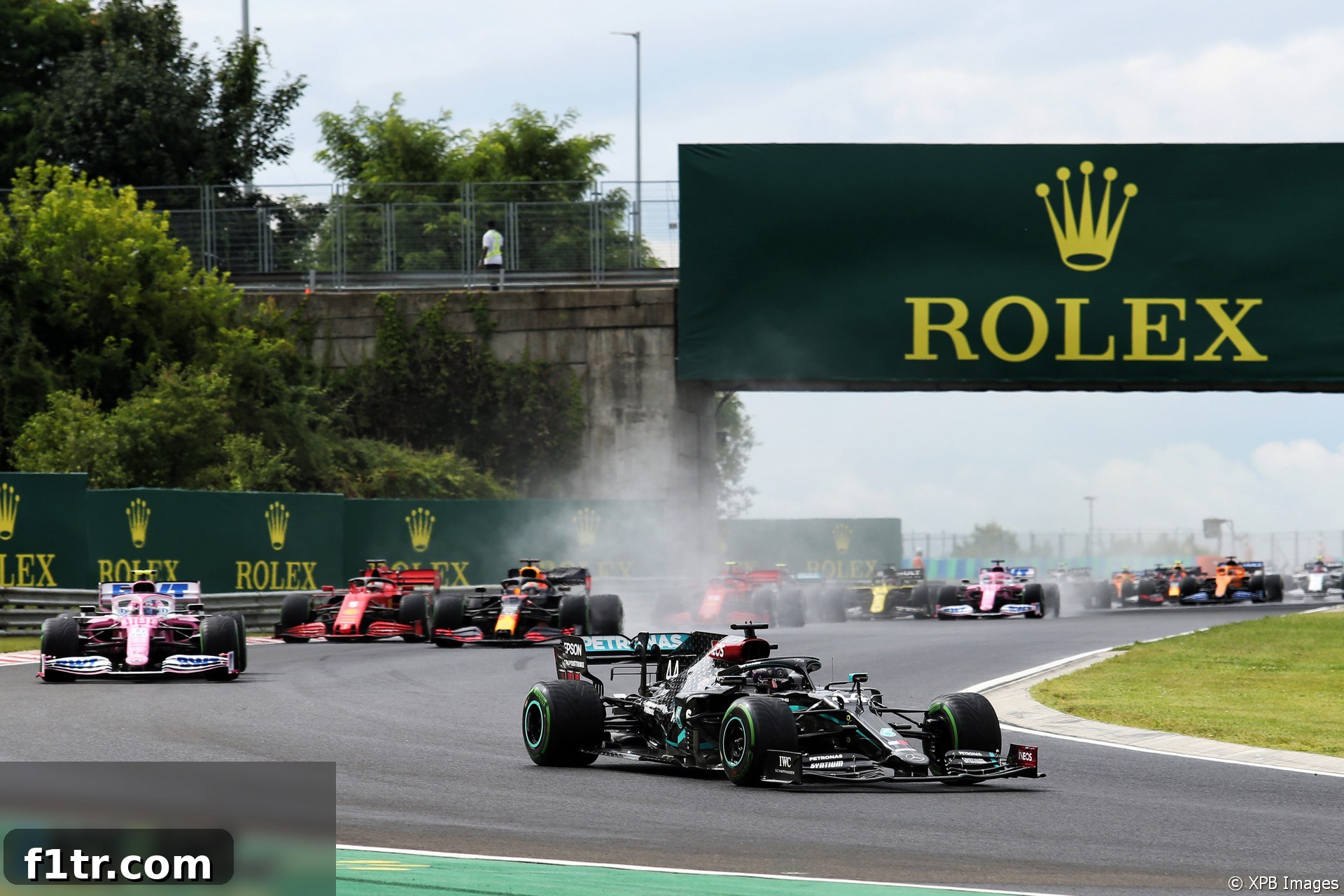
The 2020 Hungarian Grand Prix delivered a captivating spectacle, culminating in another dominant victory for Lewis Hamilton. The Mercedes driver showcased his unparalleled mastery of ever-changing conditions, controlling the race from start to finish to secure his second consecutive win and significantly extend his lead in the championship standings. This triumph at the Hungaroring was a clear testament to Hamilton’s exceptional skill, the strategic brilliance of the Mercedes pit wall, and the sheer performance advantage of the W11 challenger.
The pre-race atmosphere was charged with anticipation, dramatically heightened by a sudden downpour that drenched the circuit just before the start. This unexpected twist meant that almost the entire field lined up on the grid equipped with intermediate tyres, setting the stage for a dynamic and potentially unpredictable opening phase. Drivers and teams faced an immediate and critical strategic dilemma: how to manage the damp conditions on intermediates while anticipating the inevitable drying of the track and the opportune moment to switch to slick tyres.
As the lights went out, Hamilton executed a flawless start, immediately establishing a commanding lead that he would rarely relinquish throughout the 70-lap race. The track conditions, however, proved to be far more transitional than many had initially expected. The rain had ceased, and a clear dry line began to emerge rapidly. Within just a few laps, the circuit was dry enough to warrant a change to slick tyres, triggering a frantic rush to the pit lane for almost every car on the grid. Hamilton, with his substantial lead, navigated this chaotic period with serene confidence, ensuring his position at the front remained unthreatened by the mass pit stops.
Hamilton’s control over the race was absolute and unwavering. He systematically built a substantial advantage over the chasing pack, at one point stretching his lead to well over 20 seconds ahead of the intense battle for second place. This comfortable buffer allowed Mercedes the luxury of a strategic gamble in the latter stages of the race. To secure the bonus point for the fastest lap – a crucial addition in the fiercely competitive world of Formula 1 championship battles – Hamilton made an extra pit stop late on, fitting a fresh set of soft tyres. He then effortlessly clocked the fastest lap of the race, adding another valuable point to his tally and underscoring his complete command of the event.
While Hamilton cruised to victory, the true drama unfolded behind him in the relentless contest for second place. This intense battle primarily involved Valtteri Bottas of Mercedes and Max Verstappen from Red Bull Racing. Verstappen’s mere presence on the grid was, in itself, a monumental achievement, a direct result of the extraordinary efforts of his Red Bull mechanics. Just moments before the race, during his reconnaissance lap to the grid, Verstappen suffered a significant crash, damaging the front suspension and nose of his RB16. In a desperate race against time, the Red Bull crew performed an almost miraculous repair, getting his car ready just minutes before the formation lap, showcasing their incredible precision, speed, and teamwork under immense pressure.
Verstappen repaid his team’s heroic efforts with an absolutely immaculate start. Launching from seventh on the grid, he expertly navigated the chaotic opening laps and the subsequent pit stop frenzy to vault himself into a strong podium contention position. For the second consecutive race, however, he found himself under relentless pressure from Bottas as the final laps ticked down. Bottas, eager to recover from a less-than-ideal start where he dropped positions, and determined to secure a one-two finish for Mercedes, pushed relentlessly, closing the gap to Verstappen lap after relentless lap.
The closing stages of the Grand Prix were a nail-biting affair as Bottas honed in on Verstappen with every passing corner. Coming around the very last corner on the penultimate lap, Bottas managed to get within DRS (Drag Reduction System) range of Verstappen, setting up a thrilling final lap showdown. However, he wasn’t quite close enough to execute a decisive overtaking maneuver into the first corner. Adding to the complexity, both drivers had to expertly pick their way through lapped traffic, which momentarily disrupted Bottas’s rhythm and allowed Verstappen to maintain a slender lead. In a demonstration of exceptional defensive driving and steely resolve, Verstappen held on to clinch a hard-fought second place, a truly remarkable recovery given his pre-race incident and the pressure from a faster Mercedes.
Further down the field, other notable performances and incidents shaped the final standings. Lance Stroll delivered a strong performance for Racing Point, guiding his RP20 to a commendable fourth-place finish. Stroll’s race was a clean and consistent affair, allowing him to finish a significant 19 seconds ahead of his nearest competitor, Alexander Albon, who brought the second Red Bull home in fifth. Stroll’s result highlighted Racing Point’s growing competitiveness and their ability to extract strong points finishes from weekends with mixed conditions.
However, the finishing position of Alexander Albon remained under a cloud of uncertainty post-race. Red Bull Racing found themselves under investigation by the stewards for an alleged violation of technical regulations. The team was accused of drying Albon’s grid spot before the race started, a practice strictly prohibited by the rules as it can offer an unfair traction advantage during launch. The outcome of this investigation had the potential to alter Albon’s result, highlighting the meticulous scrutiny under which F1 teams operate and the strict adherence to regulations required at all times.
Sebastian Vettel managed to bring his Ferrari SF1000 across the line in a respectable sixth position. For the Scuderia, this was a somewhat salvaging result in what was proving to be a challenging and disappointing season for the Italian outfit. His teammate, Charles Leclerc, experienced a more difficult race. Leclerc embarked on a long and ambitious stint with hard tyres, a strategy that ultimately did not pay off as he lost out on the final championship point. The two Ferraris were separated by a trio of determined midfield contenders: Sergio Perez in the second Racing Point, Daniel Ricciardo driving for Renault, and Kevin Magnussen of Haas. Magnussen, in particular, benefited immensely from a bold strategic gamble by his team, opting to switch to medium tyres during the formation lap, a move that gained him significant track position when others pitted for slicks.
The race saw only one retirement: Pierre Gasly. The AlphaTauri driver was forced to bring his car to a smoky halt in the AlphaTauri pit garage, citing a “drivetrain” problem. It was a disappointing end to what had shown promise for Gasly, who had demonstrated good pace earlier in the weekend, but fortunately, he was able to safely park his car without causing a full safety car period, thus not disrupting the battles ahead.
This race further cemented Lewis Hamilton’s position as the leading contender for the 2020 Formula 1 World Championship. His consistent excellence, coupled with Mercedes’ unparalleled machinery, presented a formidable challenge to the rest of the grid. The Hungarian Grand Prix provided plenty of talking points, from the dramatic pre-race repairs to the intense midfield battles and crucial strategic decisions, ensuring it will be remembered as a pivotal moment in the season.
2020 Hungarian Grand Prix: Key Race Highlights and Strategic Analysis
The 2020 Hungarian Grand Prix was a fascinating blend of strategic gambles, mechanical heroics, and pure driving prowess, painting a vivid picture of the season’s unfolding narrative. While Lewis Hamilton’s victory might have seemed straightforward from the outside, the nuances of tyre strategy, the challenging conditions, and the fierce battles throughout the field made it an enthralling affair for fans and analysts alike. From the initial deluge that drenched the circuit to the frantic scramble for slick tyres, every decision and every lap held significant weight. Drivers had to demonstrate exceptional adaptability, not just in their driving but also in their communication with their respective pit walls to make the most of the rapidly evolving track conditions. The race served as a stark reminder that even in an era of dominant teams, Formula 1 remains a sport where human skill, quick thinking, and impeccable teamwork are paramount.
Championship Implications and Team Performances Assessed
Hamilton’s commanding performance further solidified his grip on the championship. Each victory, especially one achieved with such authority as seen in Hungary, contributes significantly to his historical legacy and strengthens his position against his rivals. Mercedes, as a team, continues to operate at an exceptionally high level, flawlessly executing complex strategies and providing a car that is both incredibly fast and remarkably reliable. Their ability to react to sudden changes, such as the pre-race rain, and make optimal decisions regarding tyre compounds, further underlines their operational excellence and strategic superiority.
Red Bull Racing, despite Verstappen’s phenomenal drive to second place, faced a mixed weekend. While the mechanics’ efforts in repairing his car were undeniably laudable and showcased the very best of an F1 pit crew, the pre-race crash highlighted the fine margins in Formula 1 and the constant pressure on drivers. The ongoing investigation into Albon’s grid spot also added an element of tension, suggesting that even minor infractions can lead to significant consequences in the tightly regulated world of motorsport. For Ferrari, the Hungarian Grand Prix was another illustration of their ongoing struggles. While Vettel managed a points finish, the team’s overall pace and strategic missteps with Leclerc underscore the considerable work ahead to challenge the front-runners. The midfield, however, proved to be a hotbed of competition, with Racing Point, Renault, and Haas all showcasing moments of brilliance, often propelled by audacious strategic calls that paid off handsomely, keeping the battle for constructor points incredibly tight.
Looking Ahead: The Trajectory for the Remainder of the 2020 Season
As the 2020 Formula 1 season progressed, the Hungarian Grand Prix provided crucial insights into the pecking order and potential trajectories for the remaining races. Mercedes, with Hamilton at the helm, appeared to be in a league of their own, setting a blistering pace that others consistently struggled to match. Their combination of aerodynamic efficiency, power unit performance, and strategic acumen made them a formidable force. Red Bull, while capable of individual flashes of brilliance, particularly from Verstappen, clearly had work to do to consistently challenge for race wins, indicating areas for development in their chassis or power unit. The midfield battle promised to remain intense and unpredictable, with teams like Racing Point demonstrating they could punch above their weight on merit. The unique challenges of the Hungaroring, with its tight and twisty layout, often reveal the true aerodynamic efficiency and chassis balance of the cars, making the results here particularly telling for upcoming tracks. Fans were left eagerly anticipating the next chapter in what was shaping up to be an unforgettable season, eager to see if any team or driver could break Mercedes’ formidable stranglehold.
Become a RaceFans supporter and go ad-free