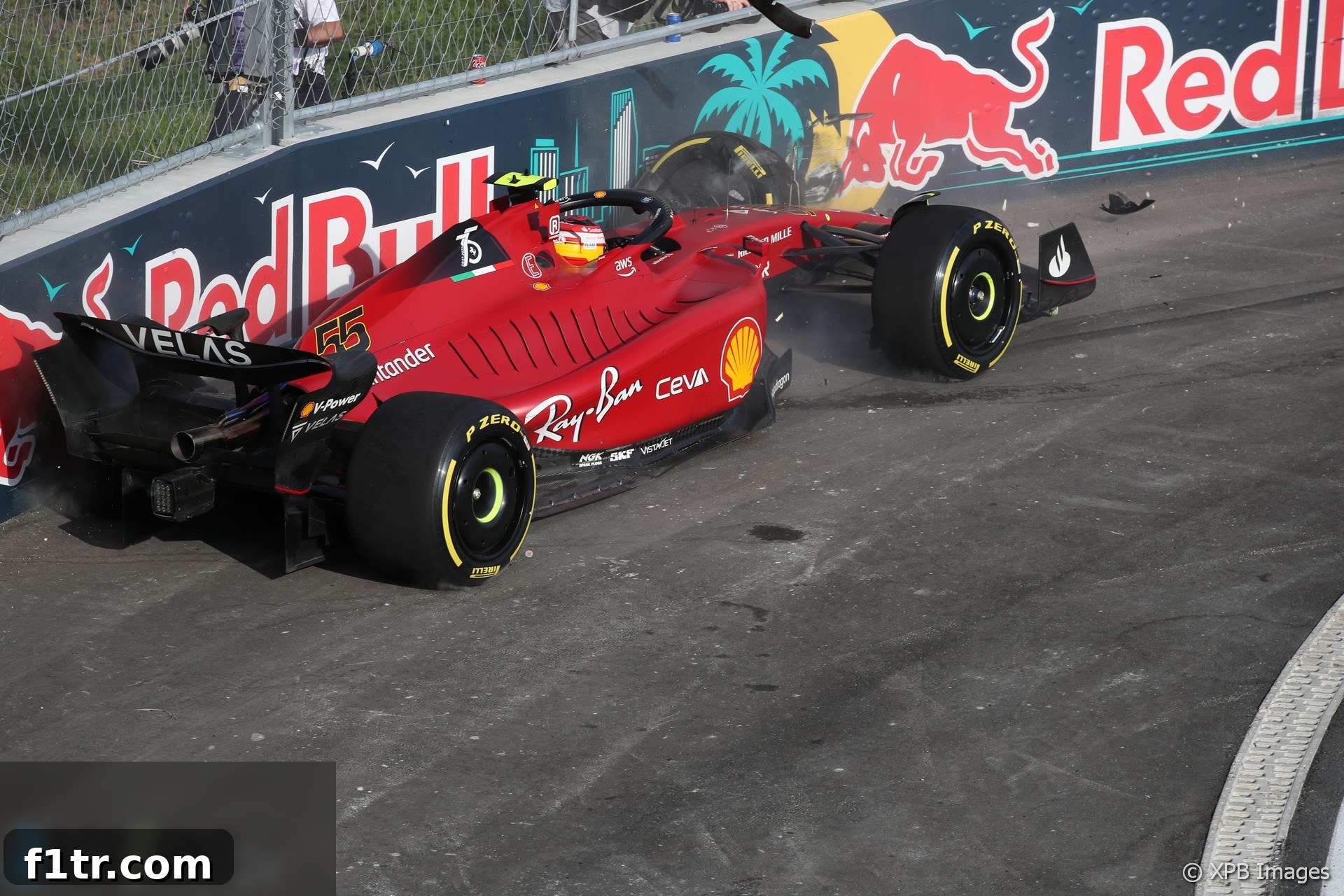
Carlos Sainz Jnr, the acclaimed Ferrari driver, recently opened up about the lingering physical toll from his significant practice crash at the Miami Grand Prix. The incident left him with a persistent “knot” in his neck, a condition he has been diligently training to overcome ahead of his home race, the Spanish Grand Prix.
Advert | Become a Supporter & go ad-free
The incident unfolded during the second practice session in Miami, as Sainz navigated the challenging and unforgiving tight chicane of Turns 14-15. Losing control, his car spun violently into a solid barrier, sustaining heavy damage. This wasn’t an isolated event at the newly introduced street circuit. The very next day, Alpine’s Esteban Ocon experienced an almost identical high-impact spin at the same corner, registering a jarring 51G impact into the wall. This severe collision ultimately forced Ocon out of the qualifying session that afternoon. Both drivers later confirmed that they were not in optimal physical condition, feeling well below 100-percent, during the physically demanding Miami Grand Prix race.
Carlos Sainz Jnr’s Grueling Recovery and Commitment to the Spanish Grand Prix
Speaking candidly in Barcelona, just days before the highly anticipated Spanish Grand Prix, Sainz detailed his rigorous recovery regimen. He acknowledged the persistent physical after-effects of his Miami accident, particularly focusing on intensive neck training to ensure he was fully prepared for the demands of a Formula 1 race weekend.
“This last week I’ve been training back at home,” Sainz explained, highlighting the dedication required to compete at the highest level of motorsport. “I’ve been trying to recover from the slight knot that I have in my neck from the accident in Miami to arrive here fully prepared.” This statement underscores the immense physical conditioning F1 drivers maintain, where even a minor injury can significantly impact performance, especially in a sport where millisecond differences can define success or failure.
The neck, a crucial area for F1 drivers, endures immense G-forces during braking, cornering, and acceleration. A “knot” – often indicative of muscle strain or soft tissue damage – can severely compromise a driver’s ability to control the car with precision and withstand the extreme forces involved. Sainz expressed cautious optimism regarding his recovery: “The knot should be done. I mean, you never know until you put 5G on it like I’m planning to do tomorrow. I feel recovered, but you never know until you jump into a Formula 1 car. I expect it to be fine. I’ve been training it and it’s been all good.” This sentiment reflects the unique challenge of Formula 1: a driver might feel ready, but the true test only comes under race conditions, where the body is pushed to its absolute limits, making full physical integrity non-negotiable.
The commitment shown by Sainz to be race-ready for his home Grand Prix is a testament to the resilience and determination inherent in Formula 1 drivers. Fans and competitors alike watched with keen interest as he prepared to tackle the Circuit de Barcelona-Catalunya, a track known for its challenging high-speed corners that further test neck strength and endurance. His rigorous rehabilitation program involved specific exercises designed to strengthen the cervical muscles, improve flexibility, and restore full range of motion, all critical for navigating an F1 car safely and competitively. This intense focus on recovery highlights the relentless pursuit of peak physical condition that defines a top-tier F1 athlete, even in the face of recent setbacks.
F1 Safety Under Scrutiny: The Miami Barrier Debate and FIA’s Role
Despite Sainz’s accident on Friday and Ocon’s near-identical high-G impact the following day, critically, no immediate changes were made to the barriers at the infamous corner. The lack of action, particularly the absence of impact-absorbing TecPro barriers, became a significant point of contention. Sainz, a vocal advocate for driver safety, expressed his profound unease to the FIA (Fédération Internationale de l’Automobile) regarding this oversight, especially after his own incident, and had reasonably expected prompt action following his raised concerns.
“I think it was pretty clear,” Sainz stated emphatically, recalling his initial feedback to the governing body. “I was pretty vocal about it on Friday night. ‘Look, I crashed. I was at a very low speed and it hurt. It shouldn’t have hurt compared to other crashes I had in my career. Let’s do something in this corner.’” His argument underscored a crucial point: the severity of the impact, even at relatively low speeds, indicated a deficiency in the existing safety infrastructure at that specific point on the track. In Formula 1, where safety standards are paramount, an injury from a “low speed” crash is a serious red flag, demanding immediate attention and preventative measures.
The FIA’s initial response, according to Sainz, was dismissive: “The response was ‘it was a very freaky crash. It shouldn’t happen again’. And it happened.” This immediate dismissal and subsequent failure to act were deeply concerning for the drivers. The recurrence of a similar, high-G impact incident involving Ocon, just hours after Sainz’s warning, unequivocally demonstrated that the initial assessment by the authorities was flawed and that the problem was not merely a “freaky” anomaly but a potential design flaw in the circuit’s safety provisions. Such events highlight the critical importance of responsiveness and continuous evaluation in track safety management.
Sainz further emphasized his frustration, highlighting the availability of superior safety equipment. “As far as I’m concerned, there was TecPro available to be put there and nothing happened. So we need a proper explanation to know exactly what’s the reason for not putting TecPro there to protect Esteban.” TecPro barriers are advanced safety systems made of high-density plastic modules designed to deform upon impact, significantly absorbing kinetic energy and reducing the deceleration forces experienced by a driver. Their purpose is to mitigate injuries and protect chassis integrity. The absence of these readily available and critical safety enhancements at a known hazard point raised serious questions about the decision-making process concerning track safety and the prioritization of driver welfare.
The ultimate outcome of this oversight was stark: “At the end we left that weekend with two drivers with a sore neck and nearly two broken chassis for a very slow crash. So there’s definitely something to review.” This pointed criticism from a prominent driver like Sainz serves as a powerful call to action for the FIA and race organizers. It highlights a clear discrepancy between perceived safety and actual driver experience, demanding a thorough investigation and revision of safety protocols for future events, particularly at new circuits like Miami. This situation emphasizes the need for a dynamic approach to safety, constantly adapting and improving based on real-world incidents.
The Evolution of F1 Safety: Learning from Incidents and Shaping Future Circuits
The incidents involving Carlos Sainz and Esteban Ocon at the Miami Grand Prix serve as a potent reminder of the continuous, evolving nature of Formula 1 safety. While F1 has made colossal strides in driver protection over decades, moving from a perilous era to one where serious injuries are increasingly rare, these events underscore that vigilance cannot waver. Every crash, regardless of its perceived severity, offers invaluable data and lessons for improving safety standards. The relentless pursuit of perfection in safety is a hallmark of modern Formula 1, driven by past tragedies and an unwavering commitment to driver well-being.
The deployment of TecPro barriers, tire barriers, and improved circuit run-off areas are all products of a long history of learning from accidents. The primary goal is always to dissipate energy upon impact, converting violent deceleration into a more gradual, less harmful process for the driver’s body. When such measures are readily available but not implemented, it rightly raises alarm bells within the paddock and among safety experts. This incident highlights that even with cutting-edge technology, implementation and adherence to best practices remain critical.
Furthermore, the physical toll on drivers, even from what might be considered “minor” crashes by historical F1 standards, is significant. Modern F1 cars are incredibly robust, but the human body, particularly the neck and spine, remains vulnerable to extreme G-forces. Drivers undergo intense, specialized training to build the necessary strength and endurance, but even they have limits. The fact that both Sainz and Ocon felt physically compromised for the race after their respective impacts emphasizes the seriousness of these “slow speed” incidents and the necessity for every conceivable safety precaution to be in place, demonstrating that even a seemingly minor crash can have profound physical consequences for an athlete.
This incident also brings into focus the crucial dialogue between drivers and the FIA. Drivers are on the front lines, experiencing the circuits and their safety features firsthand. Their feedback is indispensable for identifying potential hazards and ensuring that theoretical safety designs translate into practical, effective protection. A transparent and responsive process for addressing driver concerns is vital for maintaining trust and continuously enhancing the safety ecosystem of Formula 1. This collaborative approach ensures that safety protocols are not just theoretical but are grounded in the real-world experiences of those directly impacted.
The Miami International Autodrome, as a new street circuit, presented unique challenges and learning opportunities. Building a temporary circuit within an existing infrastructure often involves compromises. However, as Sainz’s comments highlight, certain safety standards, especially those pertaining to impact absorption, should be non-negotiable. The review called for by Sainz will likely examine the entire process: from initial track design approval to pre-event inspections and the responsiveness of race control and the FIA to driver feedback during a race weekend. This collaborative approach, integrating feedback from all stakeholders, is essential for Formula 1 to continue pushing the boundaries of performance without compromising driver welfare, reinforcing the sport’s commitment to continuous safety improvement.
Advert | Become a RaceFans supporter andgo ad-free
2022 Spanish Grand Prix: Insights and Developments
As the Formula 1 season progresses, developments around each Grand Prix continue to shape the championship narrative. The 2022 Spanish Grand Prix, particularly, served as a crucial juncture for many teams and drivers, following the dramatic events in Miami. For enthusiasts keen on delving deeper into the nuances of the season, here are some related articles from the 2022 Spanish Grand Prix:
- Q&A: Kubica ‘shocked’ by ‘completely different’ Alfa Romeo in Spain
- How heat and traffic trouble left F1 fans fuming after the Spanish Grand Prix
- Mercedes not yet certain their porpoising problem has “disappeared”
- Sticking to budget cap “pretty much impossible” due to rising costs – McLaren
- Ricciardo hoping to find an explanation for Spanish GP pace deficit to Norris
Browse all 2022 Spanish Grand Prix articles