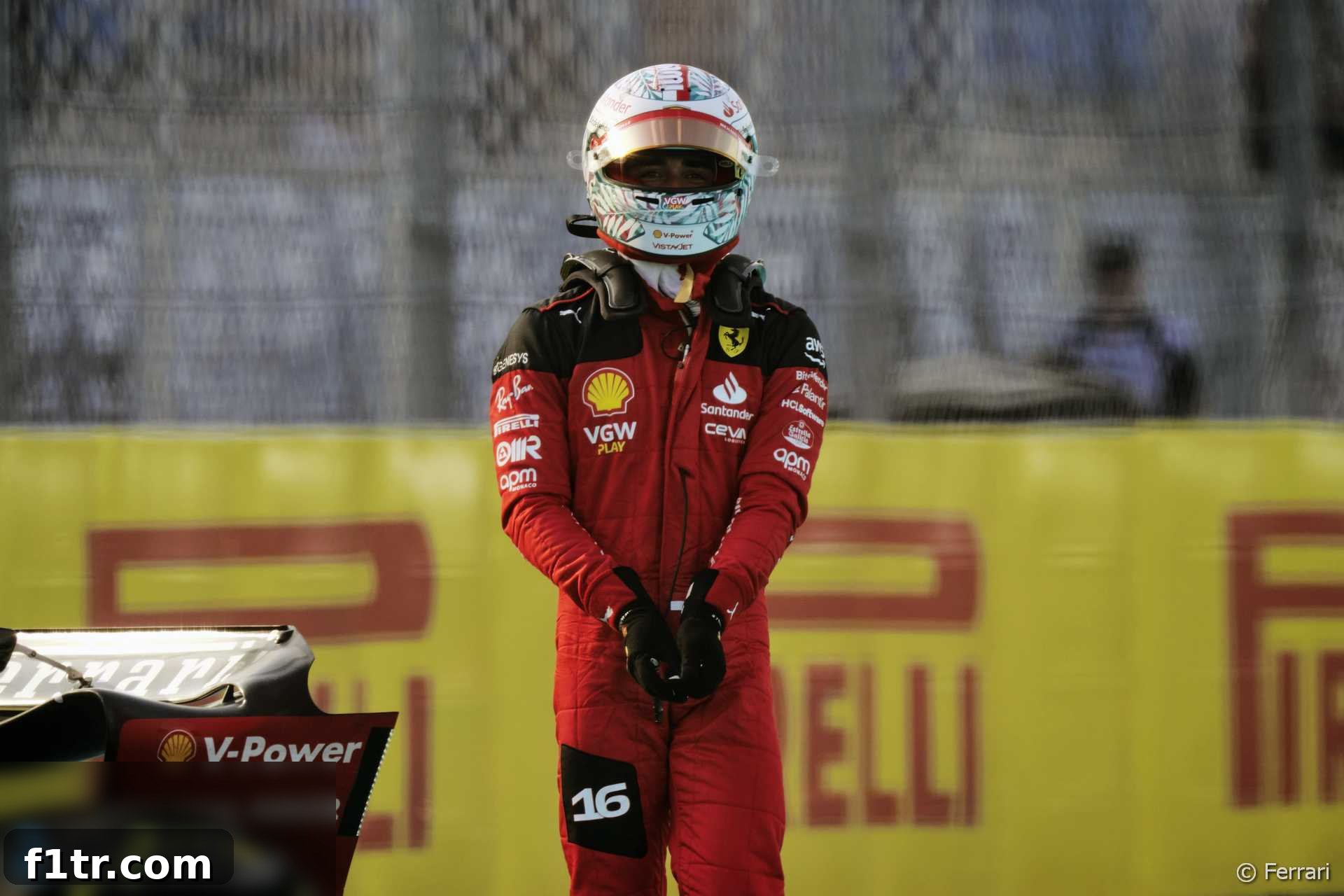
Charles Leclerc’s recent series of incidents, notably his qualifying crash at the Miami Grand Prix, has brought the inherent challenges of Ferrari’s SF-23 challenger into sharp focus. While the talented Monegasque driver finds himself a distant seventh in the championship standings, Ferrari engineers are discerning an unexpected, albeit somewhat paradoxical, positive from these setbacks: Leclerc’s unwavering resolve to push the car to – and occasionally beyond – its absolute limits. This intricate balance between blistering speed and unpredictable handling encapsulates the essence of Ferrari’s 2023 Formula 1 campaign.
Understanding the SF-23’s Enigma: The “Peakiness” Predicament
Both Charles Leclerc and his teammate, Carlos Sainz Jnr, have been vocal about their ongoing struggles with the Ferrari SF-23. The car undeniably possesses moments of exceptional pace, a fact underscored by Leclerc securing pole positions in Baku for both the sprint race and the Azerbaijan Grand Prix, subsequently translating these into a second and third-place finish respectively. However, underlying these flashes of brilliance is a persistent and often problematic characteristic: the car’s ‘peakiness’.
This term, commonly used within the Formula 1 paddock, refers to a car that operates within an incredibly narrow and unforgiving performance window. When conditions are optimal and every aspect of the setup aligns perfectly, the SF-23 can indeed demonstrate the fastest single-lap pace in the field. Yet, venturing even slightly outside this precise operating window leads to a drastic reduction in performance and, critically, a significant erosion of driver confidence. For any racing driver, predictability and consistency are paramount virtues. A “peak” car might deliver sensational lap times intermittently, but its unpredictable behavior across different corner types, speed ranges, or even varying fuel loads makes it exceedingly difficult to drive consistently at the limit, especially over a full Grand Prix distance. This inherent trait has not only been a source of frustration for Ferrari but has also emerged as a widespread complaint among drivers in this current era of ground effect regulations, highlighting a fundamental design challenge for numerous teams on the grid.
Ground Effect Aerodynamics: A Deep Dive into 2023 F1 Challenges
Ferrari’s performance engineer, Jock Clear, provided valuable insights at the Miami Grand Prix regarding why these specific handling characteristics are so prevalent in the current generation of ground effect cars. The reintroduction of ground effect aerodynamics with the 2022 regulations, which continued into 2023, means that cars rely extensively on their underfloor to generate downforce by creating a low-pressure zone beneath the chassis. This design philosophy renders the cars exceptionally sensitive to minute changes in ride height and the stability of the floor’s interaction with the track surface.
The off-season leading into the 2023 season saw teams grappling with subtle yet impactful modifications to the floor height regulations. “Of course, the height of the floor relative to the ground is a huge influence on the whole package of downforce,” Clear elucidated. “You generate so much downforce on the floor and the rear wing, but they’re interconnected, so that’s the area of most people’s development.” This intricate interconnectedness implies that even seemingly minor adjustments to one aerodynamic component can trigger a cascade of effects on other parts of the car, transforming car development into a delicate and complex balancing act. The overarching challenge lies in maximizing the benefits of ground effect while simultaneously ensuring a stable and predictable aerodynamic platform, thereby preventing sudden and potentially catastrophic shifts in downforce that can critically unsettle the car at high speeds.
Ferrari’s Strategic Upgrades: The Miami Floor Evolution
In response to the identified limitations of the SF-23, particularly its ‘peakiness,’ Ferrari introduced their latest floor update at the Miami Grand Prix. This was not a radical redesign but rather a series of precise, meticulously targeted modifications. Clear detailed the specific area of focus: “The section just ahead of the rear wheel where you’re controlling the flow that goes either outside the wheel or inside the wheel, and therefore under the into the diffuser area.”
These modifications, while often visually indiscernible to the casual spectator, possess substantial aerodynamic significance. “If you’re looking for the changes, they’re going to be quite difficult to spot,” Clear observed. “But actually in aerodynamic terms they’re quite powerful. So it’s just a response to the feedback we’ve had from the drivers through the first four races of the year in where the car is deficient.” The primary objective of these refinements was to address the consistent driver feedback concerning the car’s inconsistent balance and instability, especially when navigating medium and high-speed corners. By enhancing the floor’s interaction with the surrounding airflow, Ferrari aimed to broaden the car’s operational window, making it significantly more predictable and manageable for its drivers. This strategic intervention sought to mitigate the ‘peakiness’ that had previously hampered their overall race performance and driver confidence.
Benchmarking Against Excellence: Learning from Red Bull’s Dominance
Despite Ferrari’s commendable ability to match or even surpass Red Bull on single-lap pace this season – a consistent achievement unparalleled by any other team – they find themselves significantly adrift in the constructors’ standings, currently holding less than a third of the points accumulated by their dominant rivals. This stark disparity underscores a fundamental difference in overall package performance, particularly concerning race pace, tire degradation, and, crucially, driver confidence. The Red Bull drivers, Max Verstappen and Sergio Perez, are visibly thriving in the confident and consistent handling offered by their RB19, which also benefits from a clear advantage in straight-line speed.
Ferrari openly acknowledges Red Bull as the definitive benchmark in the current competitive landscape. “We can do overlays with the Red Bull, which is the benchmark at the moment. We can look at where we’re missing out on performance, and we can be quite specific on how to improve those areas,” Clear articulated. The ongoing engineering pursuit at Maranello remains fundamentally focused on achieving “more downforce and less drag,” a ubiquitous goal throughout Formula 1. However, the intricacies of this pursuit are profoundly shaped by the unique demands of the ground effect era. “The subtleties are very powerful these days, because you’re not going to find 2%, 3%, 4% of downforce just like that.”
Consequently, the primary focus has shifted towards optimizing the “balance window” – a concerted effort to make the car’s behavior more consistent and predictable across a diverse range of conditions. This involves subtly manipulating airflow dynamics to stabilize the car through medium-speed, high-speed, and low-speed corners, as well as under heavy braking and aggressive acceleration. By making the car “a bit more benign,” Ferrari’s strategic aim is to foster greater confidence in their drivers, empowering them to extract the maximum performance without the constant battle against an unpredictable machine. A broader, more consistent balance window translates directly into less guesswork and more assured driving, ultimately leading to superior and more consistent performance over the entirety of a race distance.
Leclerc’s Miami Crash: A Perplexing Paradox of Progress?
The recent sequence of Charles Leclerc’s crashes, most notably his third incident in eight days during Miami qualifying, might, at first glance, appear deeply alarming. However, Ferrari’s interpretation, as elucidated by Jock Clear, offers a rather counter-intuitive perspective. The performance engineer posited that the Miami incident could, ironically, be interpreted as a “testament” to the effectiveness of the new upgrades. The enhanced stability and consistency delivered by the revised floor were substantial enough to convince Leclerc that driving at the absolute, razor-thin limit was now a tangible possibility – a perilous yet ultimately essential exploration for any driver striving to maximize their car’s competitive potential. Unfortunately, in Miami, he simply overstepped that newly defined boundary.
“One of the reasons we brought [the upgrade] here is because the area it’s working on, which is predominantly the medium-speed, high-speed stability, this is a track that’s going to expose that. As we saw yesterday,” Clear explained on the morning of the race. Initial testing of the new floor proved highly promising: “We put it on one car on Friday, and we had a little bit of a back-to-back across the cars. We’re quite comfortable that it’s doing as we expected, so both cars migrated to it in the afternoon. And it has been performing as we expected it to, and indeed both drivers are much more comfortable with the car through the medium-speed, high-speed stability.”
The critical implication here is that the improved stability fostered a heightened sense of confidence in Leclerc, prompting him to attack corners – specifically the notoriously challenging high-speed Turns 4, 5, and 6 – with significantly increased aggression. His subsequent crash, therefore, is not necessarily indicative of a flawed upgrade but rather a driver actively exploring the newly expanded performance envelope of the car. Clear reaffirmed, “Maybe what happened yesterday with Charles is actually a testament to that. He was really, really going for it in those high-speed turns four, five, six curves, and what you saw was what you saw.” This nuanced perspective reframes the incident from a simple driver error to a calculated risk undertaken within the context of a continuously developing car, underscoring the vital, ongoing feedback loop between Ferrari’s engineers and their drivers.
Clear further expanded on Ferrari’s broader development philosophy: “It’s always a combination of both [aerodynamic and mechanical balance]. I think with a new aero package over the winter, we’ve taken a while to find the set-up, and we know that we made some progress in Australia and certainly we made some big progress in Azerbaijan. This floor contributes again to getting the car in a better window.” The ultimate strategic objective remains unequivocally clear: “The drivers were reporting earlier on that it is peaky. So we need to get rid of some of that peakiness and that’s probably the main focus at the moment, to make the car a bit more benign so the drivers have a bit more confidence.”
The Ground Effect Conundrum: Kerbs and the Limits of Confidence
The unforgiving nature of ground effect cars, particularly when interacting with track irregularities such as kerbs, was starkly illustrated at the Miami International Autodrome. Drivers, including the reigning world champion Max Verstappen, had previously voiced concerns about the Miami circuit’s aggressive kerbs as early as 2022. Verstappen himself experienced a precarious moment in the very same corner sequence where Leclerc crashed during qualifying, although he managed to narrowly avert contact with the barriers. Jock Clear highlighted Verstappen’s incident as compelling evidence that Ferrari’s challenges are not unique to the Scuderia but are instead symptomatic of the broader difficulties inherent to this generation of Formula 1 cars.
“Max’s first run in quali three, he had the same issue. Not quite so dramatically, but he aborted his lap having the same wobble over that kerb,” Clear elaborated. The fundamental problem stems from how a ground effect car reacts to such impacts: “Obviously a ground effect car when it hits the kerb, you’re shedding most of your downforce sort of instantly.” This abrupt and significant loss of aerodynamic grip renders the car exceptionally unstable and highly susceptible to snapping out of control, demanding unparalleled precision and lightning-fast reflexes from the drivers. “We saw Charles bottom out on the kerb in turn six. In that scenario, the car will be very tricky.” This shared vulnerability across the grid underscores that while Ferrari is intensely dedicated to improving their car’s handling, some of these “peakiness” characteristics are an intrinsic byproduct of the current aerodynamic regulations, affecting all teams to varying degrees.
Balancing Raw Pace with Race Predictability: Ferrari’s Ongoing Development Path
While the SF-23 has undeniably showcased impressive single-lap pace, especially under the masterful command of Charles Leclerc, the paramount challenge for Ferrari remains the consistent translation of this qualifying prowess into formidable race performance. The team readily acknowledges that optimizing their race pace may inherently necessitate certain trade-offs. Clear admitted that “what we can’t quite align is how those differences turn out to be so significant,” hinting at the profoundly complex relationship between car setup, aerodynamic configuration, and intricate tire management strategies over the duration of a Grand Prix. There is an implicit question lingering: will Ferrari “have to take a hit in qualifying” to achieve superior race day predictability and stability?
Despite these complexities, Team Principal Fred Vasseur maintains an unwavering confidence in the car’s ultimate potential, steadfastly believing that the SF-23’s race performance can indeed be elevated to mirror its impressive qualifying speed. This conviction underscores Ferrari’s profound commitment to developing a more versatile and unequivocally driver-friendly package. The current developmental trajectory is explicitly geared towards broadening the car’s operational window, making it significantly less ‘peak’ and decidedly more ‘benign’. This entails diligently working to reduce the extreme sensitivity that currently compels drivers to operate on a metaphorical knife-edge. The ultimate strategic goal is not merely a faster car, but fundamentally a more predictable one – a car that instills profound confidence in both Leclerc and Sainz, empowering them to consistently contend for podium finishes and pose a genuine challenge to the dominant Red Bulls, not just during the qualifying spectacle, but throughout the entire demanding race weekend. Charles Leclerc’s recent incidents, while undoubtedly costly, are thus viewed not as failures, but rather as invaluable data points within the rigorous, high-stakes process of relentlessly pushing the boundaries of Formula 1 engineering and unparalleled driver skill.
Ferrari’s journey through the 2023 season serves as a compelling testament to the intricate and multifaceted challenges inherent in modern Formula 1. The relentless pursuit of ultimate speed must be meticulously balanced with the critical imperatives of driver confidence and car predictability. Charles Leclerc’s recent incidents, while financially impactful and psychologically taxing, function as vital feedback mechanisms, meticulously guiding Ferrari’s engineers in their unyielding quest to transform the SF-23 into a consistent and formidable championship contender. The nuanced, strategic upgrades to the floor represent a significant and calculated step in this direction, promising a future that, while still fiercely fast, will ideally be far more stable and predictable for the iconic Scuderia.