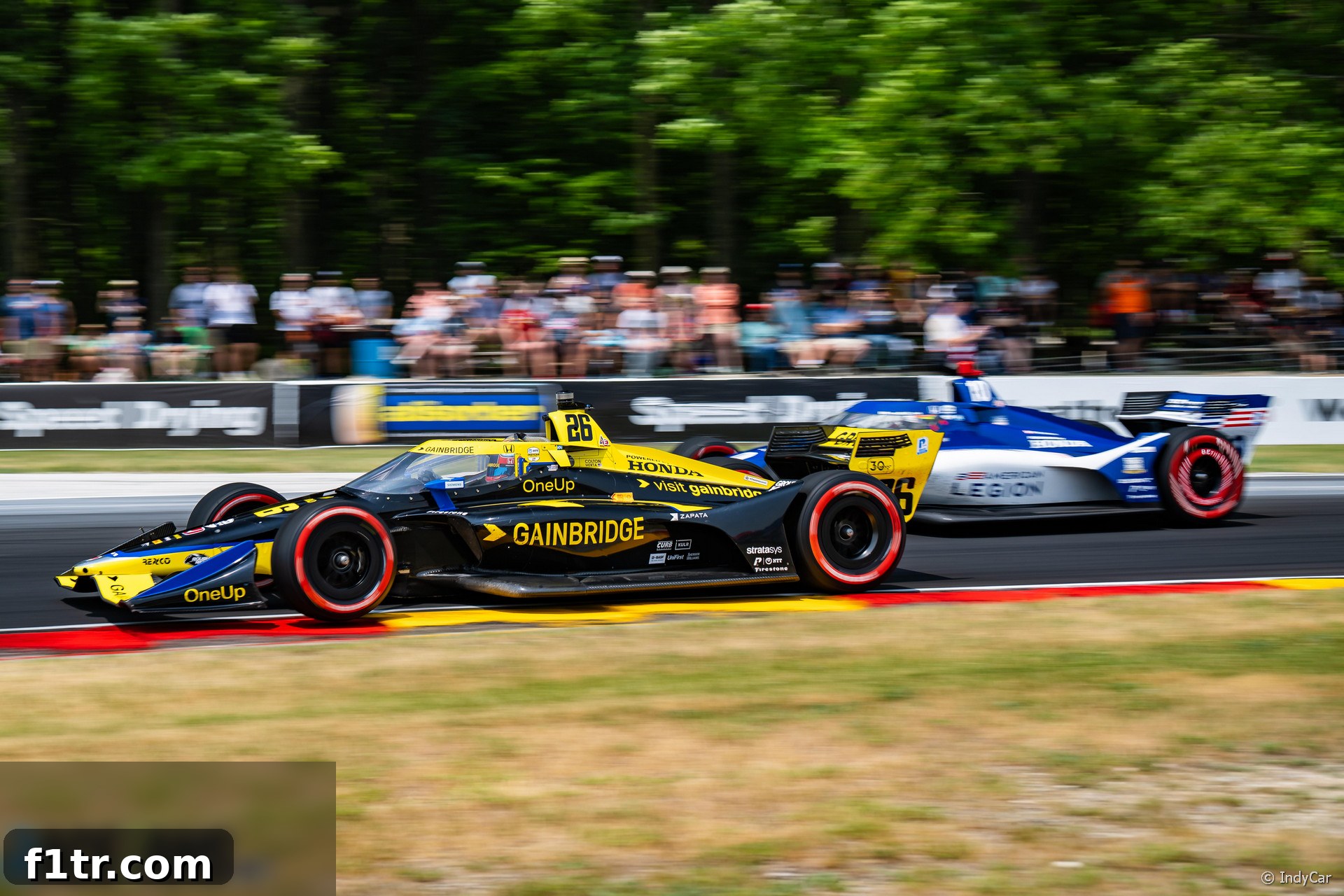
Colton Herta’s Road America Heartbreak: A Pole-to-Fifth Frustration
The roar of the engines and the cheers of the crowd at Road America often herald tales of triumph, but for Colton Herta, yesterday’s race unfolded into a narrative of intense frustration. Despite delivering arguably his strongest performance in over a year, leading the vast majority of the laps, his eventual fifth-place finish offered little solace. For a driver of Herta’s caliber, leading 33 of 55 laps only to cross the line in fifth is a bitter pill to swallow, highlighting the razor-thin margins and brutal strategic complexities that define NTT IndyCar Series racing.
Herta’s post-race comments echoed his palpable disappointment, a testament to the emotional rollercoaster of motorsport. “It’s a frustrating one,” Herta stated, his voice tinged with regret. “We had the best car, and we were cruising the whole time.” This assertion speaks volumes about the raw pace and exceptional setup of his Andretti Autosport machine. To feel such control and dominance throughout the race, only to see victory slip away in the final stages, is a unique kind of agony. He continued, “I had so much more in it, and we just never really got to show it because we were always saving fuel, trying to go that lap later.” This insight provides a crucial glimpse into the strategic tightrope walk that ultimately decided the outcome, underscoring the relentless demands of fuel management in modern IndyCar competition.
The Critical Turning Point: A Strategic Miscalculation or Unforeseen Circumstances?
The pivot point of Herta’s race, and arguably his chance at victory, arrived with his final pit stop on lap 40. This decision, made one lap earlier than championship leader Alex Palou, proved to be a decisive factor. While seemingly a minor difference in timing, in the high-stakes world of IndyCar strategy, a single lap can unravel an entire race plan. Herta’s explanation reveals the inherent uncertainty facing drivers and strategists alike: “It was unclear to me how the race was going to play out at that point. It was hard to say what was going to happen with fuel numbers.” This reflects the dynamic nature of racing, where variables like cautions, track conditions, and competitor strategies constantly shift the calculus.
The subsequent impact of this early stop forced Herta into a more aggressive fuel-saving mode than his rivals, particularly Palou. While 15 laps of fuel saving might typically be manageable, the specific circumstances of the Road America circuit and the intensity of the chasing pack amplified the challenge. “I knew it was about 15 laps to go and that’s usually a pretty reasonable fuel number. But it ended up being quite a bit more,” Herta elaborated. This ‘quite a bit more’ translated into crucial seconds lost per lap, allowing Palou, who executed a flawless overcut strategy, to close the gap and ultimately make the decisive overtake. The sight of rivals surging past in the closing laps, despite having commanded the race for so long, was visibly taxing for Herta. “That’s a killer,” he admitted, the frustration etched on his face as he watched his lead evaporate in the final seven laps.
The delicate balance between speed and fuel economy is a hallmark of IndyCar racing. Teams constantly monitor fuel consumption, tire degradation, and overall pace, making split-second decisions that can elevate a driver to victory or relegate them down the order. In Herta’s case, the early pit stop, intended perhaps to secure track position, instead placed him in a compromised fuel situation. Palou, renowned for his strategic acumen and ability to manage resources, capitalized perfectly, demonstrating why he currently holds the championship lead. His ability to extend his stint and run a lap longer before pitting allowed him to push harder with fresher fuel in the crucial final phase, a strategic masterclass that Herta’s team could not counter.
The Paradox of Dominance: From Pole Position to Fifth Place
Colton Herta’s performance throughout the weekend was, in many respects, exemplary. On Saturday, he captured the tenth pole position of his illustrious IndyCar career, a significant achievement that underscores his raw speed and qualifying prowess. Translating that pole into a dominant race lead, he went on to lead 33 of the 55 laps, a feat he hadn’t accomplished since his impressive victory at the rain-soaked Grand Prix of Indianapolis in May 2022. This statistic alone highlights the exceptional pace he and his team demonstrated at Road America, reaffirming his status as one of the fastest drivers in the series.
However, the stark contrast between leading so many laps and finishing fifth is a powerful reminder of the unforgiving nature of top-tier motorsport. While securing a top-five finish still yields valuable championship points, the feeling of letting a win slip away is far more impactful than the numerical result suggests. “We still got a fifth out of it,” Herta acknowledged with a shrug, trying to find a silver lining. “Which is nice. Not what we want though, and so for that reason, it’s pretty frustrating.” This candid remark perfectly encapsulates the high expectations that Herta places upon himself, and the disappointment of falling short of victory despite having the apparent machinery and talent to achieve it.
The last time Herta experienced such a significant lead was over a year ago, at the 2022 Grand Prix of Indianapolis, which also marks his most recent IndyCar win. This 13-month winless streak adds another layer to his frustration. The period since that victory has been eventful for Herta, including a high-profile, ultimately unsuccessful, bid to make the jump to Formula 1, thwarted by a lack of FIA Super Licence points. This experience, undoubtedly a difficult one for any aspiring F1 driver, might subtly contribute to the psychological pressure he faces, eager to re-establish his winning momentum in IndyCar.
Interestingly, Herta’s recent Road America race presented a stark inverse of his two previous IndyCar victories: at Long Beach in 2021 and the May 2022 Indy road course race. Both of those triumphs came from deep in the field, starting from a challenging 14th position on the grid. “But when you’re starting 14th, it’s a lot easier to move forward than when you’re starting first,” Herta astutely observed. This statement highlights a fundamental truth in racing: managing a lead from pole position often presents different, and sometimes more complex, strategic challenges than carving through the field with nothing to lose. From the front, every decision is scrutinized, every rival is a threat, and the pressure to execute flawlessly is immense. From the back, drivers can often take more risks and exploit chaos to their advantage, making forward progress more straightforward.
“It does suck,” Herta concluded, reflecting on the immediate aftermath of the race. “It’s a top-five in the end, which is nice points. But at the moment… I couldn’t care less about it.” This raw honesty reveals the competitive fire that burns within him. For elite athletes, the desire for victory often eclipses the appreciation for solid, but not dominant, results. The points are important for the championship, but the missed opportunity for a win leaves a more profound emotional scar.
Championship Aspirations and the Road Ahead for Herta
With eight races now complete in the IndyCar season, Colton Herta’s statistics paint a picture of frustrating inconsistency. While he boasts five top-ten finishes and only one retirement, the critical missing piece is a podium finish. For a driver who has demonstrated race-winning pace and pole-winning talent, the absence of a podium in the first half of the season is a significant concern. He currently sits ninth in the championship standings, a considerable 141 points adrift of the relentless championship leader, Alex Palou. This substantial deficit underscores the urgency for Herta and his Andretti Autosport team to find not just pace, but consistency and strategic perfection.
The Road America race, despite its disheartening conclusion, also offered glimpses of what Herta is capable of. His qualifying speed and dominant early-race performance serve as a powerful reminder of his potential. The challenge now lies in converting that potential into tangible results. To contend for the championship, Herta will need to eliminate the strategic missteps and capitalize on every opportunity. The IndyCar Series is notoriously competitive, with multiple race winners each season, and every point becomes crucial in the battle for the Astor Challenge Cup. The team’s strategy, the driver’s execution, and perhaps a touch of racing luck will all need to align for Herta to climb back into contention.
The mental game in motorsport is just as important as the physical and mechanical aspects. Dealing with the frustration of near-misses, managing expectations, and maintaining self-belief are crucial for any driver. Herta’s candid remarks after Road America highlight a healthy self-awareness and a fierce determination. While the immediate disappointment is raw, it also fuels the desire to learn from mistakes and come back stronger. The road ahead for Herta in the 2023 IndyCar season is challenging but not insurmountable. With several key races remaining, including ovals and street courses that could favor his aggressive driving style, there are still opportunities to turn the tide. Converting pole positions into victories and securing regular podium finishes will be paramount for Herta to close the gap to Palou and reignite his championship aspirations. His journey this season is a compelling narrative of immense talent grappling with the strategic intricacies and competitive ferocity of IndyCar racing.
IndyCar Insights and Further Reading
- IndyCar driver McLaughlin cleared of injury after crashing through barrier at Barber
- Schumacher says his IndyCar feels like ‘an F2 car, just with better tyres’
- IndyCar “way faster than Formula 1” in some corners, says Grosjean
- FIA to award more F1 superlicence points to IndyCar drivers from 2026
- Schumacher to race full-time in IndyCar with RLL in 2026
Explore All IndyCar Articles and News