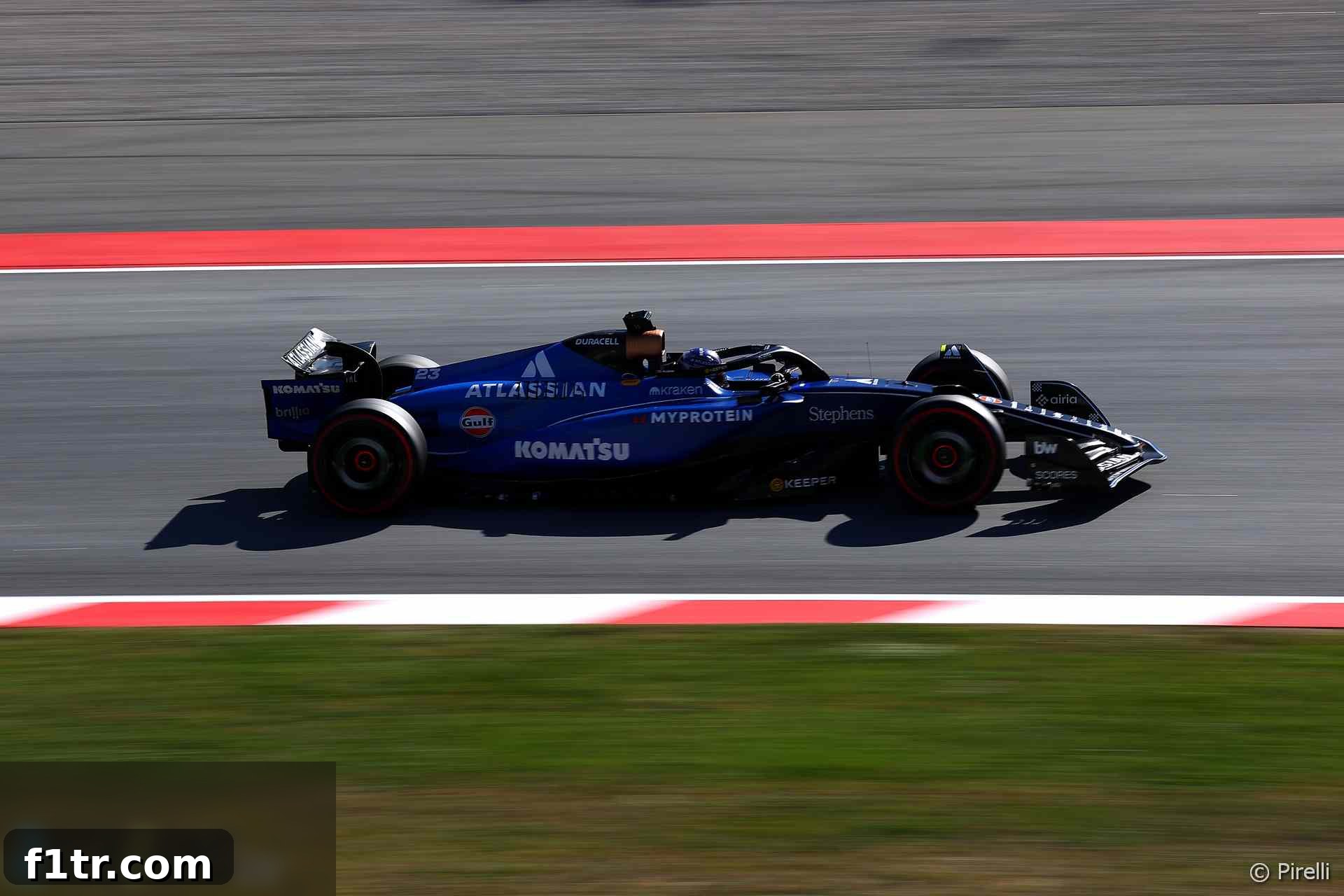
Alexander Albon’s Q3 Near Miss: The Haas Incident and Williams’ Promising Progress
Alexander Albon, the tenacious driver for Williams Racing, recently found himself at the epicenter of a classic Formula 1 qualifying dilemma: a near-perfect lap undone by the unpredictable variable of track traffic. During a critical Q2 session, Albon was on course for a potential entry into Q3, a significant achievement for his team, when his final flying lap was compromised by the presence of Oliver Bearman’s Haas car. This incident, which saw Albon miss the cut-off by an excruciatingly slim margin, sparked immediate frustration and highlighted the razor-thin boundaries between success and disappointment in elite motorsport.
Alexander Albon navigating the challenges of qualifying, pushing his Williams to the limit.
The Critical Q2 Lap: Frustration Behind the Haas
The decisive moment arrived as Albon powered through the long, sweeping Turn 12 right-hander, a corner that demands immense precision and speed to maximize lap time in the closing stages of the circuit. It was precisely here that he encountered the Haas, severely disrupting his rhythm and momentum. The immediate aftermath captured Albon’s raw emotion over the team radio.
“They were dirty, dirty, Haas,” Albon exclaimed to his race engineer after crossing the finish line, his voice laced with indignation. He continued, expressing a strong belief that the situation was not merely accidental: “They just – they knew what they were doing. Purposefully slow in sector three.” This pointed accusation reflects the high-stakes environment of qualifying, where every driver is fighting for track position and clear air. Albon’s frustration wasn’t limited to the Haas alone, as he added, “Yeah Haas, sorry, not good. Also Lewis [Hamilton] turn seven as well,” indicating a pattern of traffic encounters, though the Haas incident proved the most detrimental.
The impact of this encounter was quantified in the most brutal way: Albon missed a spot in Q3 by a mere three-hundredths of a second (0.03s). In Formula 1, where lap times are measured to thousandths of a second, such a fractional difference represents an eternity. Despite the setback, Albon remained confident in his car’s capabilities, stating post-session that the Williams was “definitely capable” of reaching the final top-ten shootout. “But that’s life, it’s fine margins,” he philosophically noted in an interview with the official F1 channel, acknowledging the inherent unpredictability and unforgiving nature of the sport.
Deconstructing “Dirty Air”: More Than Just an Obstruction
While Albon’s initial radio communication suggested an intentional act, his comments after qualifying provided a more nuanced explanation of the incident, shifting the blame from intentional impedance to an aerodynamic phenomenon. He clarified that Oliver Bearman did not actively contribute to worsening the situation. “Honestly, Ollie’s not in the way, I [didn’t] have to brake and I’m not getting disturbed by the object of his car, let’s say,” Albon explained. This crucial distinction highlights the difference between deliberate blocking and the unavoidable aerodynamic consequence of one car following another at high speed.
The true adversary, in Albon’s view, was “dirty air.” For those unfamiliar with the intricate aerodynamics of Formula 1, dirty air refers to the turbulent, disturbed airflow created in the wake of a preceding car. Modern F1 cars are masterpieces of aerodynamic engineering, designed to operate optimally within smooth, undisturbed airflow. When a car encounters dirty air, this turbulent flow significantly reduces the efficiency of its aerodynamic surfaces, such as the front and rear wings. The result is a substantial loss of downforce, which in turn reduces grip, compromises cornering speeds, and increases the risk of instability. In a qualifying session, where drivers push their machinery to the absolute edge, even a minor reduction in downforce can translate into critical tenths of a second lost, easily enough to account for a 0.03s gap.
“We just carry so much dirty air and the dirty air was a bit too dirty for sector three,” Albon elaborated, pinpointing the specific sector where this aerodynamic disruption proved most costly. The extended duration and high-speed nature of Turn 12, combined with the close proximity of Bearman’s Haas, created a perfect storm of aerodynamic turbulence. This robbed Albon of the crucial grip and stability required to maintain optimal speed and shave off those vital hundredths of a second, ultimately thwarting his Q3 ambitions.
A Weekend Plagued by Disruption for Williams Racing
The bittersweet outcome of Albon’s qualifying performance was further compounded by the challenging backdrop of the entire weekend for Williams Racing. His near-Q3 achievement was all the more remarkable given the team’s historical struggles at this particular circuit and the general expectations that they wouldn’t be challenging for the top ten. This context was made even starker by the fact that his teammate, Logan Sargeant (the article’s original mention of “Carlos Sainz Jnr” was an error; Logan Sargeant is Albon’s teammate at Williams), had been eliminated in Q1, underscoring Albon’s exceptional ability to extract performance under duress.
Albon’s preparation for qualifying was far from ideal, marked by a series of disruptions that would test the resolve of any seasoned driver. “The build-up to the weekend has been really disturbed,” he revealed, detailing the compounding issues. The challenges began early, with the team’s reserve driver (likely Franco Colapinto or another designated young talent, substituting for a race driver) taking the wheel during FP1. While this provides invaluable experience for emerging talent, it simultaneously deprives the primary race driver of crucial track time and data collection in the initial practice session, vital for understanding track evolution and car behavior.
The difficulties escalated into FP3. “Then we had some issues in FP3 so we only did, I think, two laps of low-fuel running before we went into qualifying so we were really on the back foot for most of the weekend,” Albon explained. Such a severe lack of low-fuel running is a significant handicap, forcing the team to enter qualifying with minimal data on how the car would perform at its peak speed. “We had an issue in FP3 that we fixed but we didn’t know where the balance of the car was going to be. We took a bit of a guess and it worked out to be okay but we had to use all the tyres in Q1 just to get me up to speed.”
This forced improvisation had a direct and detrimental impact on Williams’ qualifying tyre strategy. Being compelled to expend three sets of the precious soft compound tyres in Q1 solely to ensure Albon progressed meant their resources for Q2 were severely depleted. “We used three sets, and then it just put us on the back foot for Q2, so we only had one set to set the lap time.” In Q2, with only a single new set of soft tyres at his disposal, Albon had absolutely no margin for error. There was no opportunity for a second attempt if the first lap wasn’t flawless, or, as fate would have it, if an unforeseen traffic incident occurred.
A Glimmer of Hope: Williams’ Encouraging Progress
Despite the palpable frustration of missing Q3 by such a fine margin, Alexander Albon was quick to identify and articulate the significant positives for Williams Racing. His perspective, seasoned by years of high-level competition, allowed him to acknowledge the disappointment while simultaneously expressing genuine satisfaction, particularly given the historical context of the event’s venue. “It’s a shame to miss out on Q3 but at the same time I’m really happy, that’s the first time I’ve been through into Q2 with Williams [here], and almost in Q3.” This track has historically presented a formidable challenge for Williams, making this improved showing a clear and significant milestone for the entire team.
Over recent seasons, Williams has endured considerable struggles, often finding themselves at the very back of the grid. Albon’s consistent ability to elevate the car into Q2, and to be so tantalizingly close to Q3, speaks volumes about the progress being made at their Grove headquarters. It serves as compelling evidence that the developmental trajectory the team is pursuing, under the strategic leadership of Team Principal James Vowles and the dedicated technical staff, is beginning to yield tangible and measurable results. This performance, especially when viewed against the backdrop of their disrupted preparation and sub-optimal tyre strategy, provides invaluable data, boosts team morale, and reinforces the belief that their persistent hard work is indeed starting to pay dividends.
“It shows all of us that we’re going in the right direction. But we still have some work to do,” Albon concluded, offering a balanced and realistic assessment. This perspective is characteristic of a top-tier Formula 1 driver: celebrating the positive strides made while remaining acutely aware that the journey back to consistent competitiveness is an ongoing process demanding sustained effort and meticulous refinement. Albon’s pivotal role as the team’s primary points scorer and experienced benchmark is indispensable in this critical developmental phase. His invaluable feedback guides engineers, and his consistent ability to maximize the car’s potential serves as a crucial motivator for everyone involved.
The incident with Bearman’s Haas, while a source of immediate frustration, ultimately underscored Albon’s innate speed and the latent potential of the Williams car. It also reignited broader discussions within the Formula 1 paddock about the perennial challenge of managing traffic during the intense pressures of qualifying sessions. Drivers are pushing flat out on their hot laps, but simultaneously must navigate slower cars or those on cool-down laps, creating inherent risks. Such scenarios are a regular feature of Formula 1 qualifying, continually prompting debate among teams, drivers, and the FIA regarding optimal track etiquette, the potential for tighter regulations, or clearer communications from race control to prevent critical incidents from impacting vital lap times.
Looking towards the future, this qualifying performance, despite its bittersweet conclusion, provides a strong and optimistic foundation for Williams Racing. It offers genuine hope for improved showings in upcoming races and reinforces the team’s long-term vision for climbing the grid. The focus for Williams will undoubtedly be on minimizing external disruptions, perfecting car setup and balance, and refining their strategic approaches to ensure that, next time, those crucial three-hundredths of a second fall squarely in their favor, translating potential into concrete results.
Related Articles: 2025 Spanish Grand Prix
- Verstappen: Don’t blame Spanish GP penalty for hitting Russell if I narrowly lose title
- Russell’s radio comments influenced Red Bull’s decision to let him past Verstappen
- Verstappen says he won’t make any changes to his driving to avoid a ban
- ‘No issues’ with Verstappen but ‘it’d be different if he’d taken me out’ – Russell
- Ferrari “don’t want us to talk much” about “massive” Spanish GP problems – Hamilton
Browse all 2025 Spanish Grand Prix articles