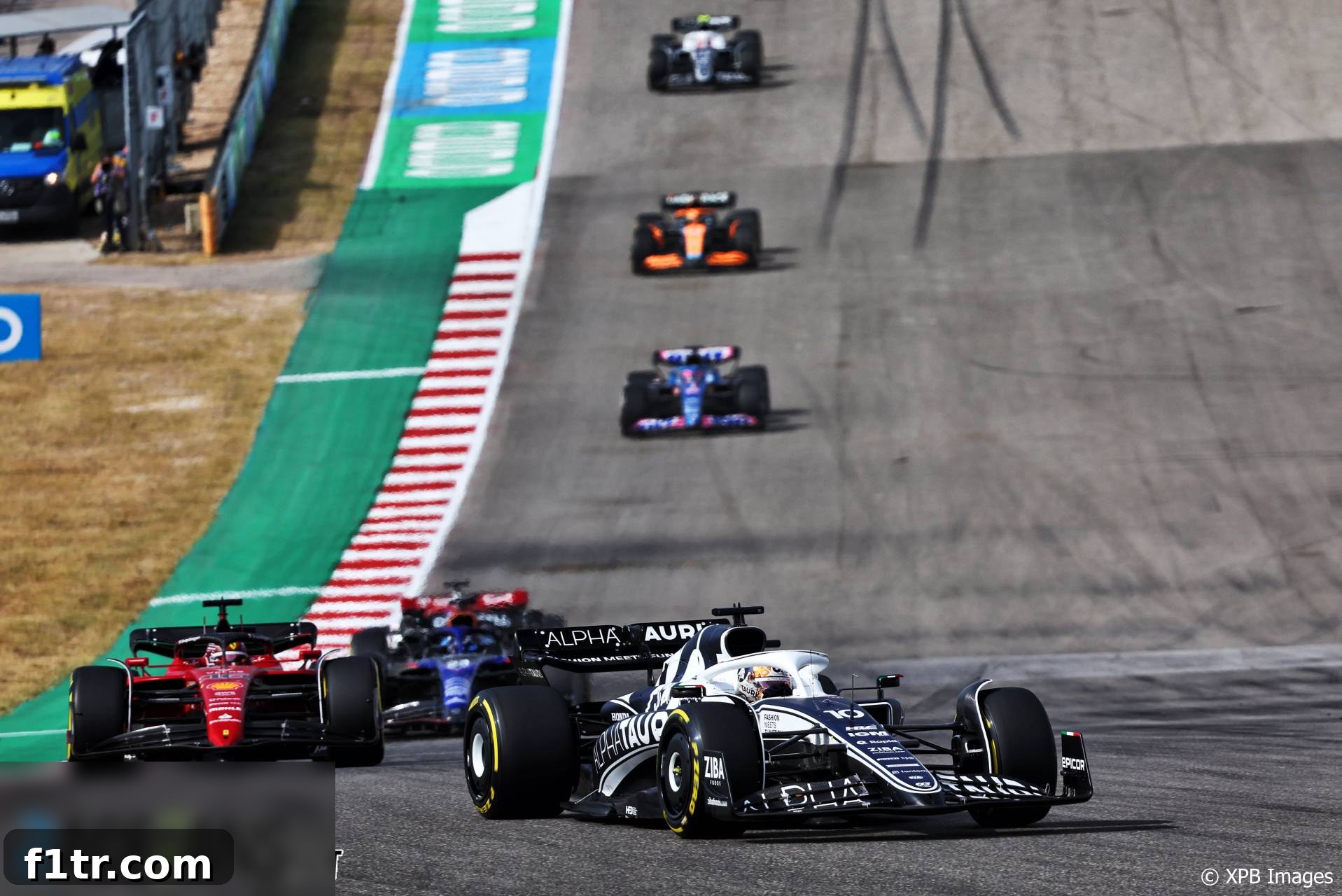
In a sport where precision, discipline, and adherence to regulations are paramount, Formula 1 drivers are constantly under scrutiny. For Pierre Gasly, the 2022 season proved to be particularly challenging in this regard, as he repeatedly found himself on the wrong side of the rulebook. The AlphaTauri driver’s penalty point tally reached a critical level following the United States Grand Prix, pushing him closer than ever to an automatic race ban – a scenario that casts a significant shadow over his impending move to Alpine for the 2023 season.
The FIA’s penalty point system is designed to ensure consistent enforcement of driving standards. Drivers accumulate points for various infractions, ranging from collisions to track limit violations and unsafe driving. A driver who accrues 12 penalty points within a 12-month period faces an automatic one-race ban. Gasly’s recent penalties have placed him perilously close to this threshold, once again reaching nine points on his superlicence. This precarious position highlights the immense pressure F1 drivers operate under and the severe consequences of even minor errors.
Gasly’s journey to nine penalty points has been a cumulative one throughout the 2022 campaign. Prior to the US Grand Prix, he had briefly reached nine points at the Japanese Grand Prix. This occurred after he was penalised for speeding under red flag conditions during a chaotic phase of the race. The infraction was deemed serious enough to warrant two penalty points, elevating his total to the worrying nine-point mark. However, a reprieve came almost immediately as two points from an earlier infraction in 2021 expired, reducing his total back to seven. This temporary relief, however, was short-lived.
The United States Grand Prix at the Circuit of the Americas (COTA) brought fresh challenges and, unfortunately for Gasly, more penalties. During the race, he incurred another two penalty points, once again propelling his total to nine. What makes this situation particularly concerning for the French driver is the timing: no further points are due to expire from his licence until May of next year. This means that Gasly will commence the highly anticipated 2023 Formula 1 season, embarking on a new chapter with Alpine, with at least nine penalty points hanging over his head. This unenviable position means he will be starting his tenure with his new team effectively on thin ice, with any minor misstep potentially leading to a suspension.
Let’s delve deeper into Gasly’s season-long accumulation of penalty points. His string of infractions began early in the year, with notable incidents contributing to his escalating tally:
- **Spanish Grand Prix:** Gasly was handed two penalty points for a collision with Aston Martin’s Lance Stroll. This incident, deemed the AlphaTauri driver’s fault, set the tone for a season marked by close calls and steward investigations.
- **Austrian Grand Prix:** This race proved to be particularly costly, as Gasly received three penalty points. These were a result of a combination of offences: a collision with Sebastian Vettel and repeated transgressions of track limits. Exceeding track limits is a common penalty, but combined with a collision, it significantly added to his record.
- **Japanese Grand Prix:** As mentioned, he picked up two points for speeding under red flag conditions, an infraction that carries serious safety implications.
- **United States Grand Prix:** The latest two points were incurred for dropping more than 10 car lengths behind the Safety Car. This specific rule is critical for maintaining safety and preventing excessive bunching or dangerous restarts.
This history illustrates a pattern of various types of infractions, each adding to the cumulative pressure on Gasly.
The incident at COTA concerning the Safety Car was meticulously reviewed by the race stewards. Utilising a combination of video evidence and sophisticated car position data, the stewards were able to definitively conclude that “it was clear from the evidence that car 10 was significantly more than 10 car lengths behind the car in front.” This violation is taken seriously as it can compromise safety and race integrity, particularly during Safety Car periods when drivers are expected to maintain a consistent gap and be prepared for potential restarts. As a result, in addition to the two penalty points, Gasly was also issued a five-second time penalty, to be served during his pit stop.
However, Gasly’s troubles at the US Grand Prix did not end there. A subsequent investigation by the stewards revealed a procedural error during his pit stop, where his AlphaTauri team failed to correctly serve the initial five-second time penalty. The specific transgression involved the timing of lifting the car from the ground. Stewards noted that “The front wheels were lifted at 4.54 seconds and rear wheels at 4.8 seconds.” According to the regulations, the car must remain stationary and on the ground for the full duration of a time penalty. Lifting the car too early is a clear breach of these rules, indicating that the team prematurely commenced the tyre change procedure before the penalty had been fully observed.
While acknowledging this as a “breach of the regulations,” the stewards also clarified that it was “not significant enough to warrant disqualification.” Crucially, they determined this to be a “team error,” meaning no additional driver penalty points were allocated for this specific infraction. Nevertheless, the consequence for the team’s misstep was a further 10-second penalty, which was subsequently added to Gasly’s total race time, further impacting his final result. This sequence of events at COTA underscored a challenging weekend for Gasly and his AlphaTauri team, highlighting the unforgiving nature of Formula 1 rules and the razor-thin margins for error.
Gasly was not alone in receiving penalties at the US Grand Prix. A total of six drivers collected penalty points during the event, reflecting a weekend of intense competition and strict enforcement by the stewards. These penalties demonstrate the FIA’s commitment to maintaining driving standards across the grid:
- **Nicholas Latifi:** The Williams driver collected two penalty points for a collision with Mick Schumacher. The stewards concluded that Latifi was responsible for forcing his rival off the track, an unsafe manoeuvre that merited the points.
- **George Russell:** The Mercedes star was also given two penalty points for his collision with Carlos Sainz Jnr. The stewards’ verdict was unequivocal, stating that the Mercedes driver was “wholly to blame for the collision,” an incident that significantly impacted the race for both drivers.
- **Lance Stroll:** Continuing the theme of collisions, Aston Martin’s Lance Stroll picked up two penalty points. More significantly, he also received a three-place grid drop for the subsequent race, the Mexican Grand Prix. This dual penalty underscores the severity of his infraction, as a grid drop directly impacts a driver’s starting position in the next event.
- **Mick Schumacher:** The Haas driver received a single penalty point for repeated track limits violations. The stewards’ report specified that he left the track “without a justifiable reason four times” during the race. Track limits are a consistent point of contention, and repeated breaches are met with penalties to ensure fair racing and prevent drivers from gaining an unfair advantage.
- **Alexander Albon:** The Williams driver also collected a single penalty point for leaving the track at Turn 12 and subsequently rejoining while maintaining his position ahead of a rival. This type of infraction is penalised because a driver must not gain a lasting advantage by leaving the defined track boundaries.
The collective penalties issued at the United States Grand Prix serve as a stark reminder of the uncompromising regulatory environment within Formula 1. Every decision, every manoeuvre, and every adherence to procedure is scrutinised, with the FIA and its stewards playing a crucial role in upholding the integrity and safety of the sport. For Pierre Gasly, his nine penalty points represent a significant challenge as he prepares for a new chapter with Alpine. The cumulative nature of these points means he will need to demonstrate exceptional discipline from the outset of the 2023 season, as any further misstep could see him sidelined for a race, a consequence that no driver, or team, wishes to face.
2022 United States Grand Prix Insights
- Steiner annoyed by lack of apology from race director over COTA protest error
- How many victory chances did Hamilton have in his first winless F1 season?
- Income from new title sponsor will bring Haas up to cost cap level – Steiner
- Mexico’s first home win or Verstappen’s record 14th? Six Mexican GP talking points
- Mercedes doubt tyre strategy cost Hamilton chance to beat Verstappen to win
Browse all 2022 United States Grand Prix articles