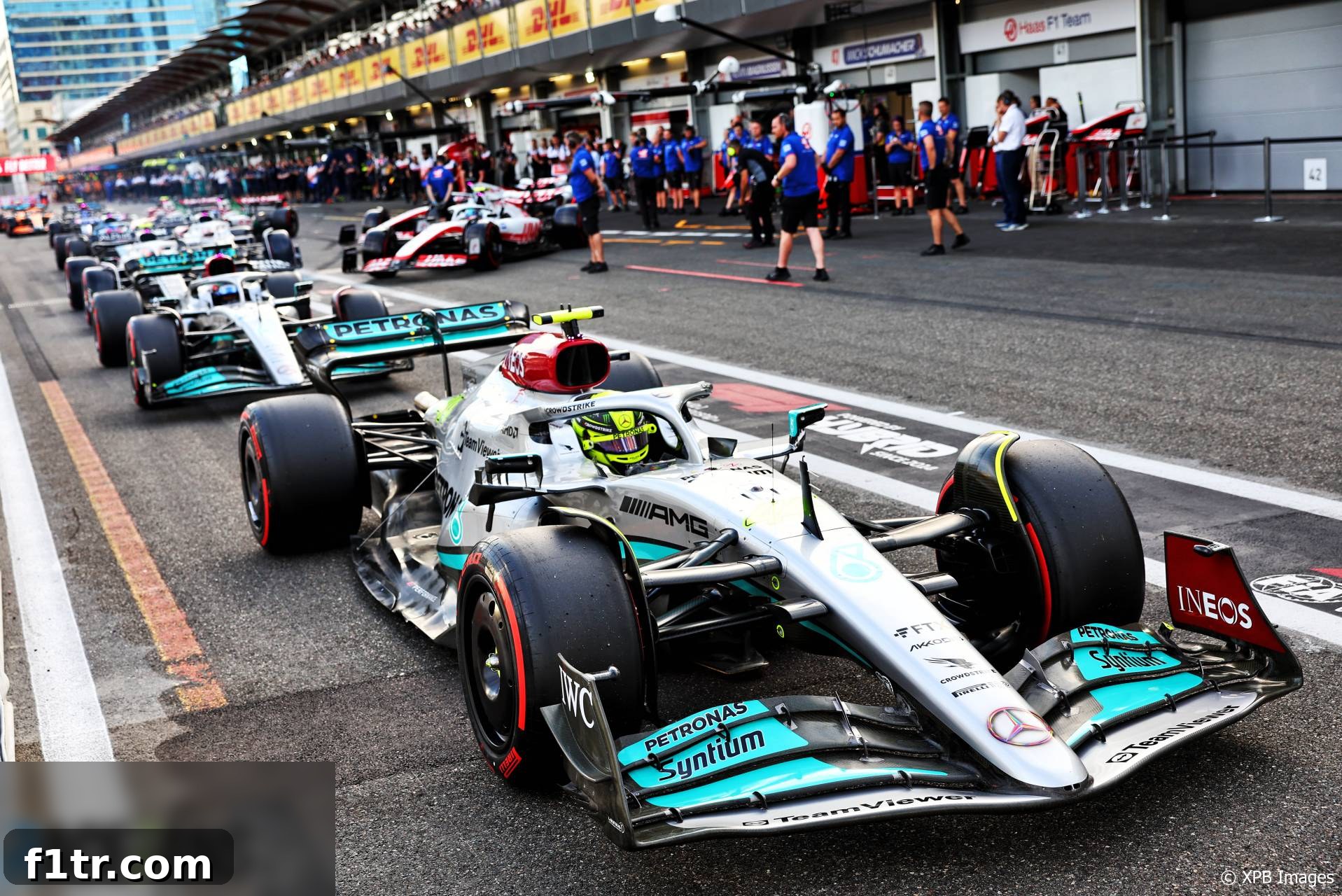
Unpacking Mercedes’ Strategy: Why Lewis Hamilton’s Pace Lags George Russell’s Amidst Porpoising Experiments
The 2022 Formula 1 season has presented unprecedented challenges for the Mercedes-AMG Petronas F1 Team, a squad that has dominated the sport for the better part of a decade. Central to their struggles is the persistent issue of ‘porpoising’ – a severe high-speed bouncing effect that has plagued their W13 car. This fundamental aerodynamic flaw has not only impacted the team’s overall competitiveness but has also, at times, created a notable performance disparity between its two highly talented drivers: seven-time world champion Lewis Hamilton and his rising star teammate, George Russell.
Team Principal and CEO Toto Wolff recently offered crucial insights into the reasons behind this fluctuating performance gap, directly linking it to the extensive and often high-risk experimental work Mercedes has been undertaking on their cars. According to Wolff, Hamilton’s struggles to consistently match Russell’s pace over the last three Grand Prix weekends are a direct consequence of these aggressive testing strategies. With stringent Formula 1 regulations severely limiting dedicated in-season testing, teams are compelled to conduct crucial developmental work during live practice sessions at race weekends, effectively transforming every session into a high-pressure, competitive laboratory.
The Porpoising Enigma: Mercedes’ Defining Challenge of 2022
The radical overhaul of technical regulations for the 2022 season, aimed at promoting closer wheel-to-wheel racing, inadvertently reintroduced the phenomenon of porpoising. This severe vertical oscillation, caused by rapid changes in aerodynamic downforce as the car travels at high speed, compromises not only driver comfort and safety but also significantly hinders outright performance by disrupting airflow and reducing effective downforce. The Mercedes W13 has demonstrably struggled more than many of its competitors with this issue, profoundly impacting its ability to compete consistently at the very front of the grid.
Mercedes’ quest to solve this complex aerodynamic puzzle is an all-consuming task that dictates much of their weekend strategy. Every Grand Prix becomes an urgent opportunity to gather data, test new components, and refine setups. This imperative to learn and adapt often necessitates that the two cars run different specifications or experimental adjustments. Wolff underscored the inherent difficulty of this approach: “Because the car is on a knife’s edge if you put a foot wrong in terms of experiments on the car, which need to be done in order for us to actually learn how to perform, where to put the car, there’s two or three tenths immediately between them.” These seemingly small margins are critical in Formula 1, often separating a podium contender from a midfield runner, and can drastically influence a driver’s perceived form.
Lewis Hamilton’s Role in High-Stakes Experimentation
While both Mercedes drivers are instrumental to the team’s ongoing development efforts, it appears that Lewis Hamilton has, on several occasions, been assigned the more radical and potentially riskier experimental setups. This is not uncommon in Formula 1; an experienced driver of Hamilton’s calibre is often tasked with evaluating cutting-edge or unproven components due to their profound feedback and ability to push the car to its limits. Wolff explicitly stated, “The last three races these experiments have gone wrong with Lewis and not with George,” suggesting a deliberate strategy that, while crucial for long-term learning, has come at a cost to Hamilton’s immediate qualifying and race results.
A prime example of this occurred when Hamilton’s car was fitted with a “different floor solution” – a critical aerodynamic component directly responsible for generating ground effect and controlling the severity of porpoising. Unfortunately, this particular experimental floor did not yield the desired improvements. Instead, it exacerbated the problem, causing the car to “porpoise more and bottoming out to a degree that it became dangerous and couldn’t extract the performance.” Hamilton himself openly confirmed these difficulties, commenting, “we tried something experimental on my car and it didn’t feel that great to be honest.” Such candid admissions highlight the practical and sometimes uncomfortable realities faced when fundamental car characteristics are altered in the urgent pursuit of a solution.
George Russell’s Consistent Adaptability and Rising Stock
In stark contrast, George Russell, who seamlessly transitioned into Mercedes from Williams at the start of the year, has consistently demonstrated remarkable adaptability and poise. His ability to extract strong performances from a challenging car, often out-qualifying Hamilton for three consecutive weekends, has been a standout feature of his debut season with the Brackley-based squad. While Russell undoubtedly faces his own set of struggles with the W13, the experimental divergences in car setup appear to have impacted his side of the garage less severely in these critical instances.
Several factors could contribute to this observed difference. It’s plausible that Russell’s car ran more conventional, known setups on those particular weekends, offering a more stable baseline for comparison. Alternatively, Russell’s driving style might be inherently more compatible with the current iteration of the W13, allowing him to mitigate some of its inherent flaws more effectively. Regardless of the exact reason, his consistent points finishes have proven invaluable for Mercedes in maintaining their position in the constructors’ championship standings. Wolff’s distinction is crucial: the variance in performance isn’t solely about inherent speed differences between the drivers, but rather the specific conditions and experimental parameters under which they are operating. The fluctuating nature of performance between sessions, where one driver leads only for the other to excel, vividly illustrates the team’s ongoing struggle with an unpredictable and finely balanced machine. The car’s “knife’s edge” characteristic means that even minor adjustments, if ill-judged or unsuited to track conditions, can dramatically alter its behaviour and a driver’s confidence.
Broader Implications for Mercedes’ Championship Hopes
Mercedes’ aggressive experimental approach, while sometimes detrimental to Hamilton’s immediate results, is a strategic necessity for the team’s long-term aspirations. Their overarching objective extends beyond individual race wins; it’s about fundamentally understanding and rectifying the W13’s core design flaws to unlock its full potential. Sacrificing some performance in individual sessions or races for one driver, in the pursuit of comprehensive car development, is a calculated and often unavoidable risk that top-tier Formula 1 teams frequently undertake. The ultimate goal remains to provide both drivers with a consistently competitive car capable of challenging for victories and, eventually, championships.
This period of intense experimentation places immense pressure on the entire Mercedes team, from the engineers making complex aerodynamic decisions to the strategists balancing crucial data collection with the pursuit of race performance. For Lewis Hamilton, a driver accustomed to fighting at the very front and contending for titles, these challenging weekends are undoubtedly frustrating. However, his unparalleled experience, profound technical understanding, and unwavering dedication make him an invaluable asset for this developmental phase, providing crucial and nuanced feedback on experimental parts. George Russell, on the other hand, is rapidly building his reputation as a formidable talent, showcasing his ability to deliver under pressure even with a difficult car, further solidifying his position within the team.
Looking ahead, Mercedes’ ability to comprehensively resolve the porpoising issue will define not only their 2022 season but also potentially lay the crucial groundwork for future campaigns under the current regulations. The stakes are incredibly high, as any breakthrough or significant performance gain found through these challenging experiments could be the catalyst needed to propel them back to the front of the grid. It’s a delicate balancing act, demanding immense patience, precise data analysis, and the unwavering commitment of both drivers and the entire technical team, as they navigate the complexities of modern Formula 1.
Further Reading: Insights from the 2022 Azerbaijan Grand Prix and Beyond
Stay informed with the latest developments and expert insights from the thrilling world of Formula 1. These related articles offer deeper context and analysis on the challenges faced by teams and drivers during the intense and unpredictable 2022 season, including discussions around porpoising and strategic decisions:
- FIA should black-flag cars if their porpoising engenders drivers’ safety – Horner
- Transcript: Why Norris reluctantly complied with McLaren’s Baku team orders
- Montreal is “going to hurt” in stiff 2022 cars say drivers hoping for bouncing fix
- Leclerc was heading to a ‘comfortable win’ before retirement – Ferrari
- F1 should penalise those who ‘obviously’ slow on purpose in qualifying – Norris
Browse all 2022 Azerbaijan Grand Prix articles
Enjoying our in-depth F1 analysis and want to support independent motorsport journalism? Become a RaceFans supporter and experience our content completely ad-free!