Perez Collision: Magnussen Calls Overtake ‘Desperate’ at Japanese Grand Prix
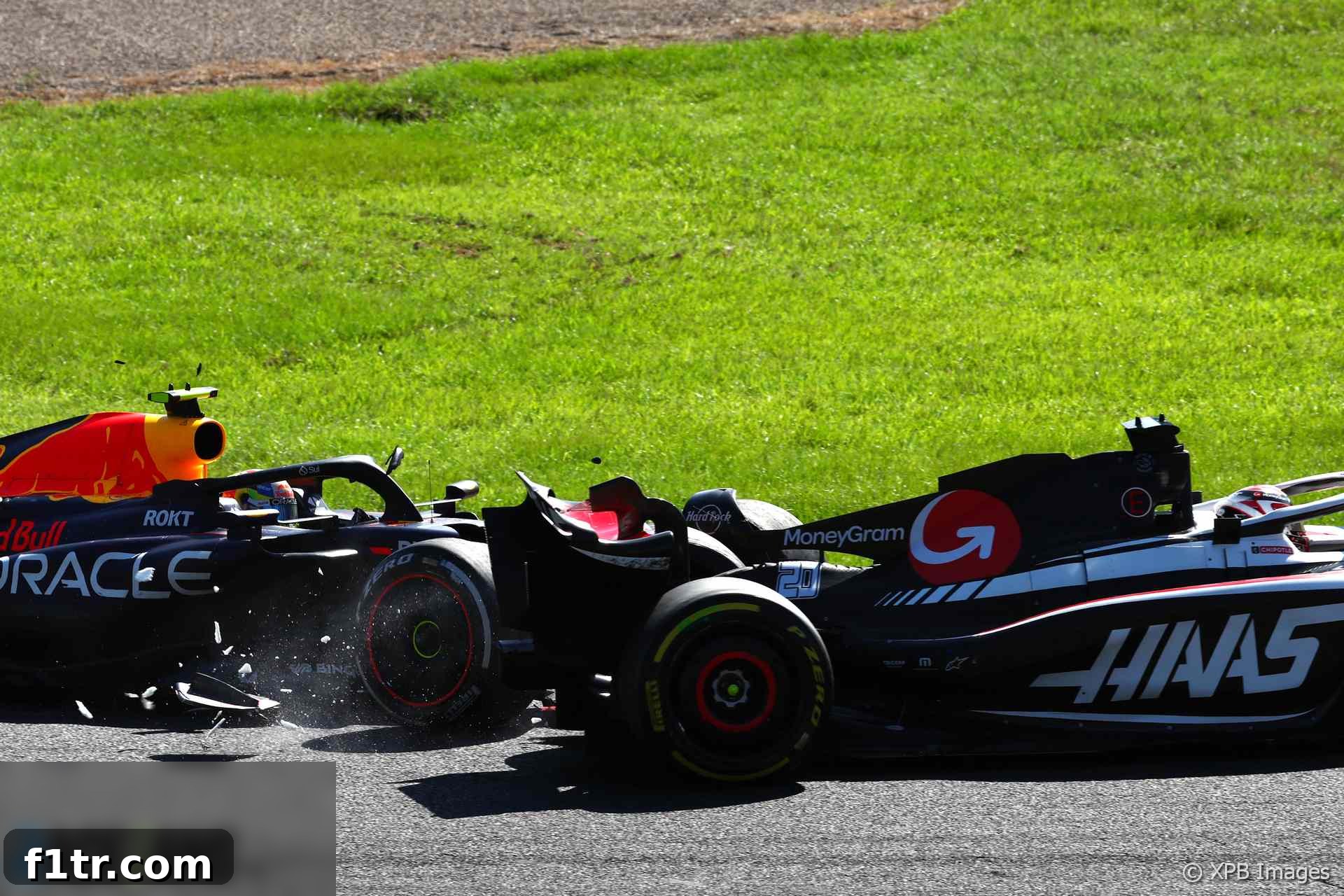
The intense and often unpredictable world of Formula 1 racing once again delivered high drama at the Japanese Grand Prix. A pivotal moment of the race unfolded at the iconic Suzuka circuit when Kevin Magnussen found himself involved in a significant collision with Red Bull Racing’s Sergio Perez. Following the incident, Magnussen didn’t mince words, describing Perez’s overtaking attempt as “desperate,” a move that ultimately compromised both drivers’ races.
The incident occurred early in the race, on lap 12, at the track’s challenging hairpin corner. Perez, known for his aggressive race craft, made a late lunge down the inside of the Haas driver. However, the maneuver proved to be misjudged, resulting in contact that sent Magnussen spinning. The Haas car, which had been holding a respectable 11th position, plummeted to the back of the field as a direct consequence of the collision. Meanwhile, Perez, whose Red Bull machine sustained significant damage, was forced to retire from the race on lap 15 after an earlier pit stop for a new front wing proved insufficient to resolve the car’s issues.
The Hairpin Hectic: Magnussen’s Perspective
Recounting the dramatic events from his cockpit, Kevin Magnussen expressed clear frustration. “I just got hit on my rear tyre,” he stated after the race, visibly disappointed with an outcome that saw him finish last of the remaining runners. His assessment of Perez’s move was direct and unequivocal: “It was a pretty desperate move, but it is what it is. I got spun around and then we had to pit.”
For a team like Haas, fighting consistently in the midfield and often relying on strategic brilliance or opportunistic points scoring, such an incident carries substantial weight. Magnussen had started the race on the medium tyre compound, aiming for a carefully planned two-stop strategy. The collision, however, forced an immediate and unplanned pit stop, drastically shortening his first stint. “That was too early for the two-stop strategy and the tyre degradation that we had on our car,” Magnussen explained, highlighting the domino effect of the collision. “So it made that situation a lot worse by having to pit at that point. It ended our race there – and his as well, of course.” The forced early stop disrupted Haas’s entire race plan, essentially condemning Magnussen to a difficult and ultimately unrewarding afternoon in Suzuka.
Perez’s Troublesome Japanese Grand Prix
Sergio Perez’s race was challenging from the outset, long before his encounter with Magnussen. The Red Bull driver, who started from fifth position on the grid, found himself embroiled in trouble almost immediately. A chaotic opening lap saw him tangle with multiple cars, most notably Lewis Hamilton. This initial skirmish resulted in damage to his front wing, necessitating an unscheduled pit stop for a replacement.
Perez openly admitted responsibility for the collision with Magnussen, acknowledging his error. “I was struggling quite a lot on the braking with the front end,” he confessed. “I tried to dive in, but then I just couldn’t stop in time and it was my mistake.” This candid admission underscored a difficult day for the Mexican driver, who has faced increasing pressure to deliver consistent, top-tier performances throughout the 2023 season.
Elaborating on his problematic start, Perez described the opening moments of the race as being largely out of his control. “I had a horrible start,” he added. “Basically going into turn one I was just a passenger. I had Sainz on my right, Lewis on the left, and they just took the whole front wing end plate.” This early damage set a tone for the remainder of his race, severely impacting his car’s handling and confidence behind the wheel. “It’s really hard to judge, but as soon as I went into turn two I had no front end,” he lamented. Even after changing the front wing, the underlying issues persisted: “We changed the front wing and still I had no front end. So I think there was a lot more things damaged on the car.” This suggests that the initial contact caused more profound aerodynamic or structural damage than initially perceived, leading to a cascade of performance issues that culminated in the subsequent incident with Magnussen and his eventual retirement.
The Implications for Drivers and Teams
For Sergio Perez, the Japanese Grand Prix represented another missed opportunity in a season that has seen its share of highs and lows. While Red Bull secured a dominant Constructors’ Championship title at Suzuka, Perez’s personal performance was below expectations. The DNF meant a loss of crucial points in his battle for second place in the Drivers’ Championship, a position he has been fighting fiercely to maintain against strong challenges from Mercedes and Ferrari drivers. His struggles with consistency and car control in key moments continue to be a talking point, especially given the formidable performance of his teammate Max Verstappen.
On the other hand, Kevin Magnussen and the Haas F1 Team left Suzuka feeling the sting of a promising start derailed by an external factor. For a team operating on a tighter budget and fighting for every position, being knocked out of contention through no fault of their own is a tough pill to swallow. The forced early pit stop and the subsequent loss of track position effectively ended their chances of scoring points, which are invaluable for Haas in the highly competitive midfield battle. Magnussen’s fighting spirit is well-known, and to have his race compromised in such a manner, particularly after showing decent pace, is a significant setback for the morale and strategic aspirations of the team.
Incidents like these are a stark reminder of the fine margins in Formula 1. The difference between an aggressive, successful overtake and a collision can be mere millimeters and fractions of a second. Stewards often face difficult decisions in assessing blame and applying penalties, as was the case with Perez’s five-second penalty for the Magnussen incident. While Perez accepted responsibility, the broader conversation around race craft, driver judgment, and the consequences of “desperate” moves remains a constant feature of F1 discourse.
The Suzuka circuit, with its high-speed corners and demanding layout, frequently tests drivers to their limits. While the Japanese Grand Prix delivered a celebratory moment for Red Bull’s championship triumph, it also highlighted the unforgiving nature of the sport for individual drivers like Magnussen and Perez, whose races were irrevocably altered by a series of unfortunate, yet intrinsically F1, events. As the season progresses, both drivers will be looking to put this incident behind them and focus on delivering stronger, cleaner performances in the upcoming races.
These kinds of racing skirmishes are a testament to the high stakes and relentless competition that define Formula 1, where every pass and every corner can dramatically alter the course of a race and, sometimes, an entire championship narrative.
2023 Japanese Grand Prix Coverage
- Norris: Red Bull’s dominance down to ‘small things which make a big difference’
- Mercedes must halve deficit to Red Bull before 2024 season starts – Hamilton
- Mercedes expect “tight” fight for second in championship after Ferrari gains
- Norris breaks Hulkenberg’s record for most points without a win in F1
- Transcript: What Alonso really meant by being “thrown to the lions” at Suzuka
Browse all 2023 Japanese Grand Prix articles