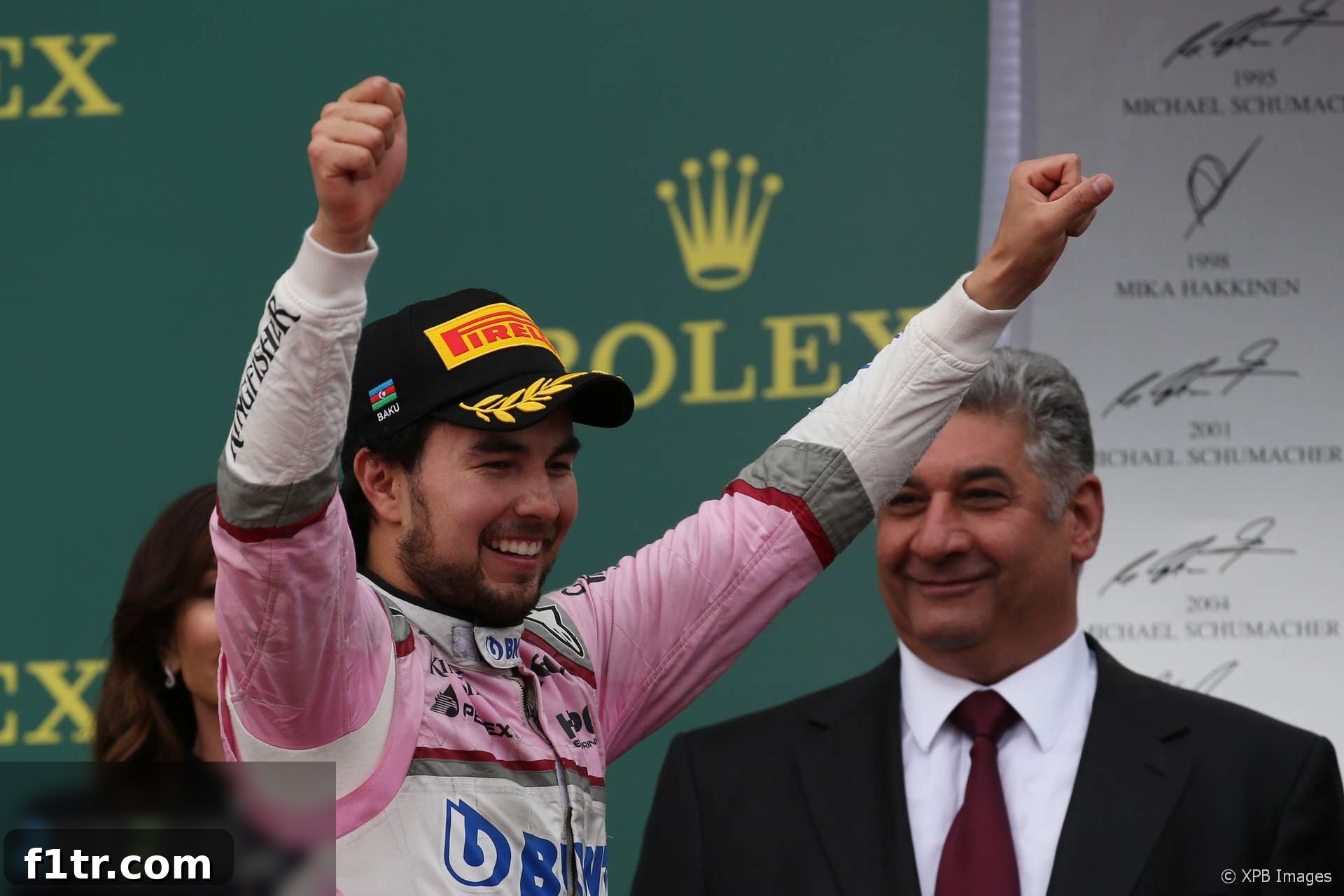
Sergio Perez Retains Azerbaijan Grand Prix Podium After DRS Investigation
In a sport where every millisecond and every rule is scrutinized, a podium finish is a hard-earned reward. For Sergio Perez, the 2018 Azerbaijan Grand Prix brought a thrilling third-place finish, but also a post-race investigation that cast a shadow of uncertainty over his achievement. The Force India driver found himself under the stewards’ magnifying glass for an alleged Drag Reduction System (DRS) infringement. However, following a thorough review, the stewards ultimately ruled in his favor, allowing him to proudly keep his well-deserved podium, confirming the integrity of his race and the fairness of the sport’s officiating process.
The Azerbaijan Grand Prix: A Race of Unpredictability
The Baku City Circuit is renowned for its unique blend of blistering straights and incredibly tight, historic sections, often leading to races filled with drama, safety cars, and unexpected outcomes. The 2018 edition was no exception, delivering a spectacle that kept fans on the edge of their seats from start to finish. The race saw multiple incidents, overtakes, and strategic plays that highlighted the challenging nature of the street circuit. Against this backdrop of high-octane racing and potential chaos, Sergio Perez demonstrated remarkable skill and resilience, navigating the pitfalls to secure a highly valuable third-place finish for Force India, a team often punching above its weight.
Understanding DRS: The Drag Reduction System
To fully grasp the nature of the investigation surrounding Perez, it’s essential to understand the Drag Reduction System (DRS). Introduced in Formula 1 in 2011, DRS is a movable part of the rear wing designed to aid overtaking. When a driver is within one second of the car ahead at specific detection points on the track, they are permitted to open the flap on their rear wing in designated activation zones. This reduces aerodynamic drag, allowing the car to achieve higher top speeds, thereby creating more opportunities for passing on straights. Its implementation has significantly impacted the dynamic of modern F1 races, fostering closer racing and adding an extra layer of strategy for both drivers and teams. Typically, the system is electronically controlled, automatically enabling or disabling based on pre-defined parameters and track positions.
The Incident: Manual DRS Malfunction
The 2018 Azerbaijan Grand Prix presented an unusual technical challenge for the teams and drivers concerning the DRS system. A problem with one of the crucial DRS detection points on the circuit meant that drivers could not rely on the automatic system throughout certain periods of the race. This forced teams to instruct their drivers to operate the DRS manually, a procedure that is less common and inherently more complex, requiring specific radio instructions and precise execution from the cockpit. It was during this period of manual operation that the infringements occurred, leading to the post-race scrutiny.
Perez’s Predicament and Others
The investigation specifically centered around Sergio Perez, who was found to have incorrectly activated his DRS twice during the race. Crucially, the stewards noted that these activations were brief and did not result in any overtakes. Perez was not alone in facing this challenge; Lance Stroll of Williams and Kevin Magnussen of Haas were also investigated for similar incorrect DRS activations. All three drivers encountered difficulties with the unfamiliar manual procedure, highlighting a potential vulnerability in the system when automation fails and human intervention becomes necessary under intense race conditions. The circumstances pointed towards a systemic issue rather than deliberate rule-breaking.
The Stewards’ Deliberation and Verdict
Following the race, the stewards initiated an investigation into the DRS activations. Their role in Formula 1 is critical: to interpret and enforce the regulations, ensuring fair play and the integrity of the competition. They examine evidence, listen to team and driver testimonies, and apply the rules impartially. In this specific case, the stewards delved into the intricacies of the manual DRS operation and the communication between teams and drivers. They acknowledged the inherent difficulty for drivers when switching to a manual override in the heat of battle, especially if it was an unfamiliar procedure.
The official statement from the stewards shed light on their reasoning: “It is apparent that to move to the ‘default’ setting if the DRS system malfunctions, requires the team to convey to the driver, by radio, a series of steps to adjust various settings.” They further elaborated on Perez’s situation: “In this case, the DRS light came on and as this was the first time the driver had experienced a default operation for the DRS, there was some misunderstanding of the procedure and the driver incorrectly activated the system manually. The system however, was only activated twice, each time for a short distance before the driver and team recognised the error.” The key conclusion, and the deciding factor in Perez’s favor, was that “The stewards are satisfied that no car was overtaken through this incorrect use.” This vital finding meant that no sporting advantage was gained, which is a fundamental principle in penalizing infringements.
Fairness and Precedent
The stewards’ decision to clear Sergio Perez, Lance Stroll, and Kevin Magnussen was widely seen as a fair and pragmatic outcome. It acknowledged the genuine technical issue that necessitated manual DRS operation and the subsequent human error under pressure, without punishing drivers for a mistake that did not yield an unfair advantage. This approach reinforces the idea that penalties are primarily aimed at deterring deliberate cheating or actions that significantly compromise competitive fairness. Had an overtake occurred as a direct result of the incorrect activation, the outcome would almost certainly have been different, likely resulting in a time penalty or grid demotion. The decision set a precedent for how such technical malfunctions leading to unintentional infringements would be treated, emphasizing the importance of intent and consequence in regulatory judgments.
Impact on Sergio Perez and Force India
Retaining the podium finish was a monumental relief and a significant boost for Sergio Perez and the Force India team. A podium in Formula 1 is a precious commodity, especially for midfield teams like Force India (now Aston Martin), where such results are relatively rare and hard-fought. This third-place finish brought crucial points for the Constructors’ Championship, aiding the team’s standing and financial prospects. For Perez himself, it was a validation of his driving prowess and a testament to his ability to perform under pressure. The outcome avoided what would have been a controversial disqualification or penalty, allowing the team to celebrate a genuine sporting achievement rather than being mired in regulatory dispute. It underscored the importance of diligent post-race investigations that consider all factors, not just the letter of the law but also the spirit of fair competition.
Looking Back at the 2018 F1 Season
The 2018 Formula 1 season was a captivating championship battle, primarily between Lewis Hamilton of Mercedes and Sebastian Vettel of Ferrari. It featured intense wheel-to-wheel action, strategic masterclasses, and moments of high drama across various circuits. While the championship fight dominated the headlines, the midfield battle was equally fierce, with teams like Force India, Haas, Renault, and McLaren vying for crucial points. The Azerbaijan Grand Prix incident, while significant for the involved drivers, was just one of many storylines that unfolded during a season characterized by evolving technical regulations and fierce competition. It was a season where every point mattered, and retaining a podium finish, even under investigative pressure, was a testament to the resilience and fighting spirit of teams like Force India.
For those interested in revisiting other key moments and narratives from this eventful year, a selection of related articles provides further context and insights:
- F1 feared “death knell” for Drive to Survive after Ferrari and Mercedes snub
- McLaren staff told us we were “totally crazy” to take Honda engines in 2018 – Tost
- ‘It doesn’t matter if we start last’: How Red Bull’s junior team aided Honda’s leap forward
- Honda’s jet division helped F1 engineers solve power unit problem
- McLaren Racing losses rise after Honda split
Browse all 2018 F1 season articles
Conclusion
The post-race investigation at the 2018 Azerbaijan Grand Prix served as a stark reminder of the rigorous scrutiny applied in Formula 1, even after the checkered flag waves. Sergio Perez’s eventual clearance to retain his hard-fought podium finish underscored the importance of balanced judgment from the stewards, who wisely distinguished between intentional rule-breaking and honest error compounded by unusual technical circumstances. It was a moment of relief for Perez and Force India, allowing them to fully savor a significant achievement in a season that provided no shortage of excitement and challenge. This incident stands as a testament to the meticulousness of F1 regulations and the ultimate commitment to fairness that underpins the sport.