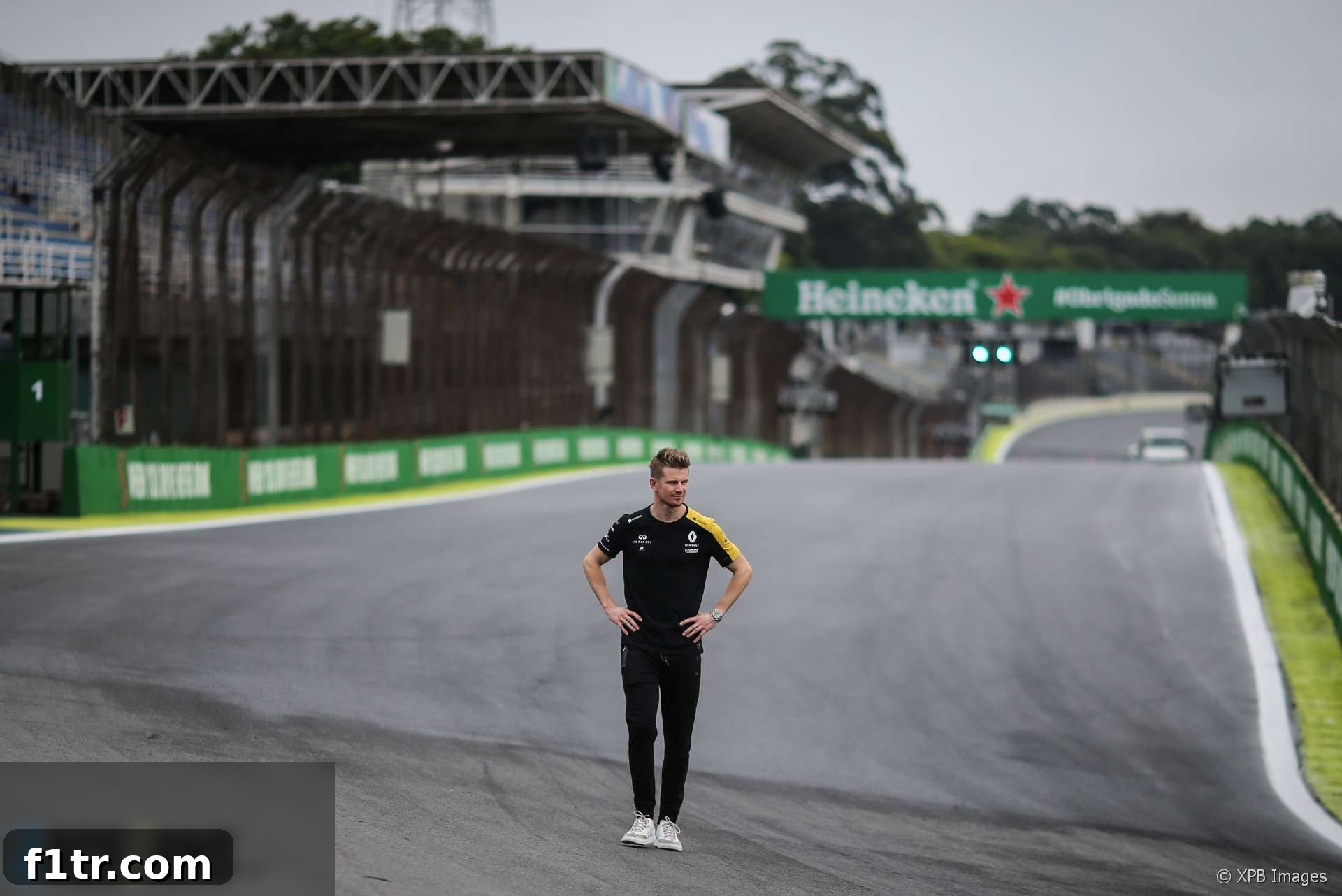
The highly competitive world of Formula 1 often presents perplexing situations, and few have been as mystifying to fellow drivers and fans alike as Nico Hulkenberg’s struggle to secure a seat for the 2020 F1 season. A sentiment eloquently expressed by his former teammate, Carlos Sainz Jnr, who openly voiced his confusion regarding why such a talented driver found himself without a guaranteed spot on the grid. Sainz’s comments highlight a broader discussion about talent, opportunity, and the relentless dynamics of the F1 driver market, which frequently sees experienced campaigners overlooked in favour of emerging young talent or specific team strategies.
Carlos Sainz Jnr’s Resounding Support for Nico Hulkenberg
Carlos Sainz Jnr, who shared the garage with Hulkenberg at Renault during the 2018 season, did not mince words when discussing the German driver’s predicament. Sainz underscored his belief that if Hulkenberg were not to feature on the grid the following year, it would represent “a very big loss for Formula 1.” This statement, coming from a respected peer, carries significant weight, reflecting the high regard in which Hulkenberg is held within the paddock. Sainz further elaborated on his admiration, stating, “I think he’s been one of the most talented drivers in the grid for the last 10 years or nine years that he’s been here. And I still don’t understand how some teams missed out on him.” This genuine puzzlement from a driver of Sainz’s calibre speaks volumes about Hulkenberg’s undeniable skill and consistent performance throughout his extensive career.
A Decade of Talent: Nico Hulkenberg’s Illustrious F1 Journey
Nico Hulkenberg’s career in Formula 1 spans nearly a decade, marked by consistent, often understated, excellence. Bursting onto the scene as a highly decorated junior driver, including a dominant GP2 Series championship victory in his rookie year, Hulkenberg quickly established himself as a formidable talent. His F1 debut in 2010 with Williams showcased his raw speed, notably with a sensational pole position in Brazil, a rare feat for a rookie. Throughout his tenure with teams like Force India, Sauber, and Renault, Hulkenberg consistently demonstrated an ability to extract maximum performance from his machinery, often outperforming expectations for midfield cars. Renowned for his strong qualifying pace, racecraft, and intelligent feedback to engineers, he earned a reputation as one of the most complete drivers not to have secured a podium finish – a statistical anomaly that often overshadowed his genuine abilities.
Despite his undeniable talent and consistent points-scoring performances, a coveted podium finish remained elusive for Hulkenberg, often due to circumstances beyond his control. This unique record, while often cited, has perhaps unfairly overshadowed a career built on reliability, adaptability, and an ability to perform under pressure. His experience across multiple teams and different eras of F1 regulations made him a valuable asset, capable of developing cars and leading a team’s technical progression. Such qualities are highly sought after, which is precisely why Sainz, and many others, found his absence from the 2020 grid so perplexing.
The Perplexing F1 Driver Market: Why No Seat for Hulkenberg in 2020?
The Formula 1 driver market is a complex web of talent, finance, politics, and strategic vision. Teams often weigh a multitude of factors when selecting their drivers, including raw speed, experience, sponsorship potential, and even nationality. For the 2020 season, several elements conspired to leave Hulkenberg without a drive. One significant factor is the increasing trend among F1 teams to invest in younger talent, often from their own driver academies. These young drivers, while sometimes lacking experience, offer a long-term prospect and are often more cost-effective. Another consideration is the stability some teams prefer, opting to retain existing line-ups even if a change might offer a slight performance advantage. The specific timing of driver market decisions also plays a crucial role; once key seats are filled, the domino effect can quickly limit options for those still seeking a contract.
Team-Specific Analysis: Missed Opportunities?
Several teams had opportunities to sign Hulkenberg, yet ultimately passed, contributing to the grid veteran’s unenviable situation. Sainz specifically mentioned Haas, Red Bull, and Alfa Romeo as teams that opted against securing Hulkenberg’s services since Esteban Ocon’s move to Renault was announced. Each team’s decision was likely rooted in its unique circumstances and strategic priorities for the upcoming season:
- Haas F1 Team: The American outfit, known for its pragmatic approach, ultimately chose to retain its existing driver pairing of Romain Grosjean and Kevin Magnussen. While Hulkenberg offered experience and consistency, Haas likely valued the established dynamic and continuity within their team, especially after a challenging 2019 season. Their decision might have been driven by a desire for stability rather than introducing a new variable into the team’s ecosystem, despite Hulkenberg’s proven ability to deliver solid performances. The financial aspect, and whether Hulkenberg’s salary demands aligned with their budget, could also have been a factor, as Haas typically operates on a more constrained budget than some rivals.
- Red Bull Racing: Red Bull’s driver philosophy is famously centered around its robust junior driver program. Their strategy is to nurture and promote talent from within their own ranks, as evidenced by their rotation of drivers between Red Bull and its sister team, AlphaTauri (formerly Toro Rosso). For 2020, Red Bull had options in Alexander Albon and Daniil Kvyat, both of whom were products of their academy. Introducing an external, experienced driver like Hulkenberg, who doesn’t fit into their long-term development pipeline, would have been a significant departure from their established model. Therefore, despite Hulkenberg’s clear talent, he was likely never a primary contender for a Red Bull seat, which is reserved almost exclusively for their own youth prospects.
- Alfa Romeo Racing: Alfa Romeo’s situation is closely linked to its partnership with Ferrari, which often influences its driver selections. For the 2020 season, they retained Kimi Räikkönen, providing invaluable experience, and Antonio Giovinazzi, a Ferrari junior driver. Giovinazzi’s re-signing was crucial for Ferrari, which aims to develop its young talent and ensure they have a path to Formula 1. While Hulkenberg could have offered a strong alternative to Giovinazzi, Alfa Romeo’s strategic alliance with Ferrari likely dictated the preference for a Ferrari-backed driver. The balance of experience (Räikkönen) and youthful potential (Giovinazzi) was deemed the preferred route for the team, leaving Hulkenberg on the outside.
Esteban Ocon’s Return and Williams’ Dilemma
The catalyst for Hulkenberg’s situation was ultimately the return of Esteban Ocon to the F1 grid. Ocon, a Mercedes-backed talent, had spent 2019 on the sidelines as a reserve driver and was eager for a race seat. His opportunity arose at Renault, where he replaced Hulkenberg for the 2020 season, creating a ripple effect in the driver market. This move underscores the power dynamics and political considerations that often play a role in F1, where manufacturer backing can be as crucial as raw performance.
Following Ocon’s deal, the only theoretical remaining slot for Hulkenberg was at Williams, a team he raced for in his rookie season. However, Hulkenberg himself admitted that he was unlikely to take that last possible place on the grid for next season. Williams was, and still is, a team grappling with significant financial and performance challenges. A move to Williams would have meant competing at the very back of the grid with little prospect of points, which for a driver of Hulkenberg’s calibre and ambition, was likely an unappealing prospect. His reluctance to join a struggling team further highlights the professional considerations drivers make, balancing the desire to race with the need for a competitive environment.
Nico Hulkenberg’s Future: A Potential Sabbatical
Facing the reality of being without a drive, Hulkenberg admitted he was resigned to spending a year on the sidelines if no late opportunity were to arise. He reflected on the demanding nature of a career at the pinnacle of motorsport, stating, “A decade of Formula 1 is intense living at that high pace. So that’s why I just need to see where once the new year starts, how I feel and how things develop and evolve.” This statement offers a glimpse into the immense mental and physical toll that nearly ten years in Formula 1 can take. The constant travel, the pressure to perform, and the intense scrutiny are aspects that few outside the sport truly comprehend. A sabbatical, in this context, might not only be a forced break but also an opportunity for reflection and rejuvenation.
Hulkenberg’s uncertainty about his future direction – “Which direction? Honestly, right now, I just don’t know. And I don’t want to think about it too much right now because for me, I’m still right here, right now” – is a natural reaction to such a significant career transition. Many drivers who have taken a break from F1 have found it challenging but also liberating. Some, like Kimi Räikkönen, returned stronger, while others transitioned to different motorsport disciplines. A year away from the relentless F1 schedule could allow Hulkenberg to recharge, assess his options, and perhaps even rekindle his passion for racing without the immediate pressures of the F1 circus, potentially paving the way for a strong return in the future.
The Enduring Value of Experience in Formula 1
The F1 grid’s decision to overlook Nico Hulkenberg raises important questions about the value placed on experience within the sport. While the influx of young, dynamic talent is crucial for F1’s future, the consistent performance, technical feedback, and invaluable racecraft of seasoned drivers like Hulkenberg are often underestimated. Experienced drivers bring a calm authority to a team, provide benchmarks for younger teammates, and offer a wealth of knowledge crucial for car development. Their ability to manage races, conserve tires, and navigate challenging conditions is honed over years of competition. Losing such a figure from the grid not only diminishes the depth of talent but also removes a valuable reference point for the sport as a whole, making Carlos Sainz Jnr’s lament all the more poignant.
Conclusion: A Loss for the Grid
Carlos Sainz Jnr’s mystification over Nico Hulkenberg’s absence from the 2020 F1 grid encapsulates the complex and often unforgiving nature of the sport. While the driver market is influenced by numerous factors, the fact that a driver of Hulkenberg’s consistent talent and experience could not secure a seat speaks volumes about the intense competition and evolving priorities within Formula 1. His potential sabbatical, while perhaps a necessary break, represents a significant loss to the grid, depriving fans of a highly capable and respected competitor. The hope remains that such a skilled driver will find a path back to the pinnacle of motorsport, enriching the competition with his enduring talent.
Stay Connected with Formula 1 Insights
Don’t miss out on the latest news, in-depth analysis, and exclusive content from the world of Formula 1. Follow us on our social media channels to stay at the forefront of every race weekend, driver transfer, and technical innovation.
- Join RaceFans on Facebook for daily updates and community discussions
- Follow RaceFans on Twitter for real-time news and instant reactions
- Get daily email updates directly to your inbox for comprehensive F1 coverage
Explore More from the 2019 F1 Season
Dive deeper into the events, stories, and controversies that defined the 2019 Formula 1 season with our extensive archives. From thrilling races to dramatic moments off-track, revisit key articles from a memorable year in F1 history.
- Crying in the Melbourne car park at 2019 grand prix was my career low – Ocon
- McLaren Racing reports reduced £71 million loss in 2019
- Kvyat: Hockenheim podium last year was “my biggest achievement” so far
- How the FIA’s new encrypted fuel flow meter targets Ferrari’s suspected ‘aliasing’ trick
- “He smashed my office door”: 23 must-see moments from ‘Drive to Survive’ season two
Browse all 2019 F1 season articles for in-depth coverage