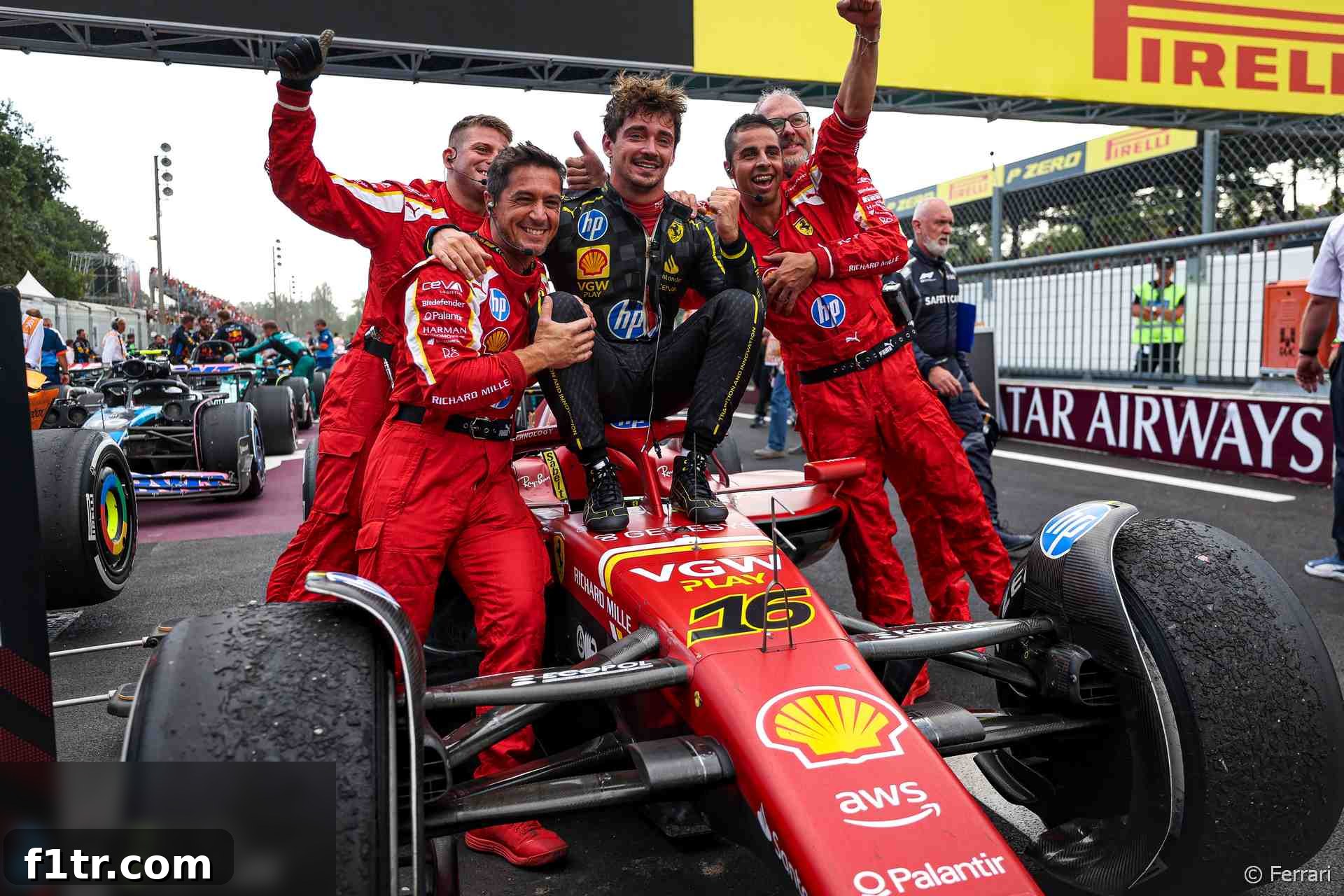
For decades, the 16th round of the Formula 1 World Championship traditionally signaled the grand finale of the season. This particular length, over the sport’s illustrious 75-year history, has consistently been its most frequent duration. However, in an unprecedented era, the 2024 season shatters this long-held tradition. Marking the longest championship schedule ever conceived, round 16 now signifies merely the conclusion of the European mid-season leg. With two-thirds of the championship already complete, an exhilarating eight Grands Prix still remain, setting the stage for a truly nail-biting finish.
The unfolding narrative of this season has been nothing short of captivating. While reigning champion Max Verstappen dominated the early stages, securing five victories in the initial eight rounds, his triumph count has since slowed, claiming just two wins in the subsequent eight races. This shift in momentum, notably fueled by Ferrari’s emphatic resurgence at the recent Italian Grand Prix, has dramatically reshaped the competitive landscape. We now find ourselves in a rare and thrilling scenario where four distinct teams can legitimately stake their claim as realistic contenders for victory on any given race weekend.
Indeed, this season stands out as an anomaly of modern Formula 1. Each of these four formidable teams – Ferrari, McLaren, and Mercedes – have each notched up three victories. Red Bull, while still leading the overall win tally with seven, has seen its once-unshakeable dominance visibly tested. This distribution of power, with four different teams securing at least three wins each, is a phenomenon not witnessed in the sport since the legendary 1978 season. It underscores a competitive equilibrium that has been sorely missed by fans and pundits alike, promising a thrilling conclusion to an already historic year.
Such widespread success across multiple constructors was, of course, an impossibility in the nascent years of the championship when calendars rarely stretched beyond a dozen rounds. The first instance of a 16-round season only occurred in 1968, marking a gradual expansion of the championship. Since that pivotal year, there have been only three instances – prior to the current season – where four different teams managed to secure three or more victories within a single campaign: 1974, 1977, and now, the compelling 2024 season. These years stand as monuments to periods of intense and varied competition, offering fascinating parallels to the present day.
Delving into the past, the 1977 season offers particular resonance. Two of today’s triple-winners, Ferrari and McLaren, were also key players then, winning four and three races respectively. However, the competitive landscape was notably different. Lotus enjoyed even greater success with five victories, while a relatively new entrant, Wolf, also made a significant splash, securing three wins in a remarkable debut year. Furthermore, that season saw two other emerging teams, Ligier and Shadow, achieve their maiden victories. This era starkly contrasts with the contemporary Formula 1 environment, where new team entries are often met with skepticism, sometimes even actively barred under the presumption that they might not be “competitive enough.” The openness of the past championship, which allowed fresh talent and innovative teams to quickly make their mark, highlights a fascinating evolution in the sport’s approach to new blood.
The recent Italian Grand Prix served as a joyous and historic occasion for Ferrari and its legion of Tifosi. The victory at Monza marked their 20th Italian Grand Prix triumph in the World Championship era, a testament to their enduring legacy and deep connection with their home race. This was their first win at the iconic Temple of Speed since 2019, breaking a four-year drought at Monza itself. While Ferrari has also competed at other Italian circuits like Imola and Mugello in the intervening years, success had remained elusive on home soil until this momentous occasion. The roaring crowd, bathed in a sea of red, celebrated a truly special moment for the Scuderia.
The architect of this unforgettable victory was Charles Leclerc, who delivered Ferrari’s second consecutive home win. This particular triumph marked the seventh victory of Leclerc’s promising career, but it held special significance: it was his first win ever achieved from outside the front row of the grid. This demonstrates not only his raw speed and qualifying prowess but also his growing racecraft and ability to fight through the field, adding another dimension to his impressive skillset. It’s a statistic that underscores his developing maturity as a top-tier Formula 1 driver, capable of converting challenging starting positions into monumental wins.
Leclerc’s Monza victory was achieved at an blistering average speed of 246.431 kph, in a race that ran without a single interruption from start to finish. This makes it the third-fastest Grand Prix of all time, a testament to the raw speed of modern F1 cars and the unique high-speed characteristics of the Monza circuit. It sits just behind two iconic victories from the V10 engine era, both also held at Monza: Juan Pablo Montoya’s dominant 2005 win, and the all-time record set by Michael Schumacher in 2003, at an incredible average speed of 247.586 kph. These statistics reinforce Monza’s reputation as the “Temple of Speed,” a place where records are shattered and legends are made.
Indeed, a deep dive into the top 10 fastest races in Formula 1 history reveals a striking pattern: only one of these high-speed epics did not take place at Monza. That solitary exception was Pedro Rodriguez’s final career victory, achieved on the daunting and legendary original Spa-Francorchamps layout, during the very last time F1 utilized that fearsome configuration in 1970. This remarkable fact underscores Monza’s unique contribution to the sport’s high-speed heritage and its consistent ability to produce races of incredible pace, pushing both man and machine to their absolute limits.
With this latest triumph, Charles Leclerc now boasts as many career wins as the charismatic Juan Pablo Montoya. This intriguing statistic also means that Monaco, Leclerc’s home nation, now shares the same number of race victories as Colombia, Montoya’s homeland, in the annals of Formula 1 history. Leclerc also draws level with the legendary Rene Arnoux, a driver renowned for his blistering qualifying speed. Arnoux accumulated a remarkable 22 pole positions during his career, yet he possessed one of the lowest ratios of wins to poles of any driver in the sport’s history. Despite his recent success, Leclerc still finds himself in a similar statistical predicament, currently holding the lowest ratio of wins to poles among active drivers, at just 28%. This highlights both his immense qualifying talent and the challenges he has faced in converting those pole positions into race victories, often due to strategic calls or external factors.
The highly competitive nature of the current season is further emphasized by another telling statistic: Charles Leclerc’s Monza win marks the fourth time this year that a driver has triumphed from outside the front row of the grid. This impressive feat has also been accomplished by Lando Norris at the Miami Grand Prix, George Russell in Austria, and Lewis Hamilton in Belgium. Such a spread of winners from varied starting positions underscores the unpredictable and open character of the 2024 championship, where strategic prowess, race management, and sheer driving talent can overcome a deficit in grid position, providing thrilling races for fans.
While McLaren’s season has been largely positive, one particular record continues to elude Lando Norris: he once again failed to lead the first lap of an F1 race after starting from pole position. Despite his undeniable speed and seven career pole positions across five Grands Prix and two Sprint races, Norris has yet to convert a pole into a first-lap lead. This intriguing statistic highlights a potential area for improvement in his race starts, or perhaps simply a streak of unfortunate circumstances. Nonetheless, Norris’s overall performance remains a cornerstone of McLaren’s resurgence, showcasing his consistent pace and fighting spirit.
Oscar Piastri, Norris’s McLaren teammate, demonstrated his growing consistency by taking the lead from Norris early in the Monza race, though he ultimately wasn’t able to hold off Leclerc’s charging Ferrari for the victory. However, Piastri’s performance was still highly commendable, as he extended his personal best run of consecutive points finishes to an impressive 10 races for the first time in his burgeoning Formula 1 career. This remarkable streak underlines his rapid adaptation to the sport and his consistent ability to deliver solid results for McLaren, making him a formidable component of the team’s strong lineup.
Lando Norris’s fifth career pole position at Monza now places him in an esteemed group of drivers. He now shares this milestone with his former teammate Carlos Sainz Jnr, as well as a selection of legendary figures including Giuseppe Farina, Chris Amon, Clay Regazzoni, Patrick Tambay, and Keke Rosberg. This illustrious company underscores Norris’s raw speed and his capacity to extract maximum performance from his machinery over a single lap. Despite leading the most laps of any driver over the last five Grands Prix, Norris did not officially lead at Monza. The Italian Grand Prix proved to be unusually dynamic at the front, with five different drivers taking turns in the lead – a rare occurrence. Intriguingly, the only other race this year to feature five leaders was at Spa, another event where Norris, despite his strong form, did not manage to lead a lap.
One driver who did briefly lead a lap at Monza was Sergio Perez. This moment, though fleeting, marked a significant personal achievement for the Red Bull driver, as it was the first time he had headed the field since the Las Vegas Grand Prix of the previous year. This statistic is particularly stark when contrasted with his teammate, Max Verstappen, who, in the same period, had led an astounding 534 laps. Perez’s single lap in the lead serves as a poignant highlight in what was otherwise a challenging weekend for the Red Bull team, underscoring the contrast in fortunes between their two drivers.
The brief lead for Perez was, unfortunately, the only real highlight in what transpired to be a rather poor weekend overall for Red Bull. McLaren’s exceptional performance at Monza meant they out-scored their Milton Keynes rivals for the sixth consecutive event, and for the ninth time out of the past ten races. This consistent swing in momentum has brought the Constructors’ Championship battle to a knife-edge. McLaren are now astonishingly just eight points behind Red Bull, and are poised to potentially seize the Constructors’ Championship lead at the very next round. This marks a dramatic shift in the competitive balance, putting immense pressure on the reigning champions.
The situation could indeed deteriorate further for Red Bull if Ferrari’s impressive resurgence continues its upward trajectory. The Scuderia are now only 39 points behind Red Bull, meaning that if current trends persist, the reigning Constructors’ Champions could realistically find themselves relegated to third position in the championship standings. Such an outcome, a fall from dominant grace to third place, would represent one of the most significant power shifts in recent Formula 1 history, making the remainder of the season an unmissable spectacle for all racing enthusiasts. The battle for supremacy has truly never been closer.
Finally, the Italian Grand Prix was notable for the official debut of Franco Colapinto as a Grand Prix driver, ending Argentina’s 23-year wait for a representative on the Formula 1 grid. The last Argentinian to compete was Gaston Mazzacane in 2001. This return to the grid, however, immediately evokes the rich heritage of South American motorsport, particularly the unparalleled legacy of the great Juan Manuel Fangio. Fangio, an Argentine legend, clinched the fourth of his five historic World Championship titles at the very same iconic venue where Colapinto’s promising F1 career officially began. This connection adds a layer of profound historical significance to Colapinto’s debut, linking him directly to one of the sport’s all-time greats and rekindling national pride in Formula 1.
Over to you
Did you notice any other interesting statistics, fascinating facts, or record-breaking moments from the recent Italian Grand Prix? Share your insights and observations in the comments section below! We’d love to hear your thoughts on what made this race so special and how it’s shaping the rest of the thrilling 2024 season.
Don’t Miss a Single Update from Formula 1 Insights
Get a daily email digest with all our latest stories and in-depth analysis – no marketing, no ads, just pure F1 content. Sign up here:
More from the 2024 Italian Grand Prix
- ‘I should have won last year but I did stupid stuff’: Norris out to avenge 2024 defeat
- Verstappen faces post-race investigation along with five other drivers and McLaren
- Red Bull lose constructors’ championship lead for first time in two years
- “Never had so much pain in a car”: How Colapinto impressed Williams on his debut
- F1’s most competitive season for 47 years? Four teams now have three wins each
Browse all 2024 Italian Grand Prix articles