In April 2009, an insightful suggestion regarding the start time of the Malaysian Grand Prix prompted a direct call from then-Formula 1 supremo, Bernie Ecclestone. My article had critically observed his decision to commence the race at 4 pm local time, a timing choice that inevitably pushed the event into encroaching darkness once a mid-race, hour-long downpour finally ceased at 6 pm. This set the stage for a compelling discussion about the delicate balance between commercial interests and sporting practicality in Formula 1.
“It could just as easily have poured at 4 pm or whenever,” Ecclestone protested during our call, defending his decision by pointing to the potential for increased TV viewership in western time zones due to the later start. His argument, while commercially sound, highlighted a persistent tension within the sport.
I acknowledged the validity of his point regarding western audiences but countered that an earlier race start, while potentially reducing eastern viewership, would have significantly improved the chances of resuming racing before darkness descended. As events unfolded, the race was aborted, leading to a substantial 50% loss in overall audience numbers – a commercial failure that belied the initial intention.
“Do you think we should start at 3 pm?” he queried, a hint of reconsideration in his tone.
“Yes,” I affirmed, “or even earlier.”
Without a formal farewell, the line went dead. Yet, a year later, the Malaysian Grand Prix indeed began at 3 pm, a practice that continued until the race’s eventual departure from the F1 calendar in 2017. Coincidentally (or perhaps not), this was the same year Liberty Media acquired the commercial rights to Formula 1, ushering in a new era with its own set of priorities and challenges.
That 2009 race marked the last occasion half points were awarded until the deeply controversial Belgian Grand Prix at Spa-Francorchamps in 2021. The conversation with Ecclestone echoed in my mind as I witnessed the clock agonizingly count down at Spa. Crucially, since taking the helm of F1, Liberty Media has consistently pushed race start times later, primarily driven by a desire to cultivate and expand US audiences, which, on a population basis, remain among the smallest, regardless of how statistics are presented.
The Legacy of Later Starts: A Compromise for Broadcast Viewership
This strategic shift to accommodate prime-time viewing in key markets, particularly North America, has necessitated adjustments within the sport’s regulations. To mitigate the resulting reduction in available daylight hours, F1’s sporting regulations were amended for 2021, shrinking the maximum event ‘window’ from four hours to three. This was a conscious sporting decision, one made in consultation with all F1 teams, Liberty Media, and the FIA, underscoring the profound influence of commercial imperatives on the very fabric of the sport.
The Unsung Cost: Spectators Bear the Brunt of Commercial Decisions
There are, undoubtedly, potent commercial arguments bolstering the case for later race starts – higher broadcast fees, larger global audiences, and expanded sponsorship opportunities. However, as the 2021 Belgian Grand Prix unequivocally demonstrated, these commercial aspirations come with considerable, and often overlooked, commercial risks. Significantly, this risk is predominantly borne by an unrepresented, yet indispensable, group: the spectators. These are the individuals who, after shelling out eye-watering sums for tickets and enduring often challenging conditions, are the ones who make the live race possible in the first place.
Formula 1’s underlying business model hinges on gate income and associated spending. This revenue provides race promoters and local authorities with critical funding to cover F1’s substantial fees – averaging around $35 million per race. These fees, in turn, empower promoters to stage the spectacular events that television broadcasters then transmit globally. In ‘normal times,’ without live audiences, there would simply be no F1 World Championship. Yet, fundamental decisions concerning the sport, such as race start times, continue to revolve almost exclusively around their impact on television broadcasters, often at the expense of the very fans who fuel the spectacle.
Consider the recent past: In 2020, F1 successfully staged 17 races, but only a handful were permitted to host spectators due to the global pandemic. The financial fallout was stark, transforming a budgeted profit into a staggering $400 million loss for F1. This deficit was primarily because race promoters found themselves unable to pay their exorbitant fees without the crucial income generated by ticket sales. Consequently, prize payments to teams plummeted, averaging $30 million less than in 2019. The bottom line, in every conceivable sense, is clear: F1 needs its fans far more than fans need F1. Yet, as the events at Spa brutally highlighted, fans remain the last to be genuinely considered in critical decision-making processes.
In early 2017, shortly after being appointed Liberty Media’s managing director of F1, Ross Brawn – the architect of serial successes as Ferrari’s technical director and whose eponymous team remarkably clinched both 2009 titles – declared that Formula 1 would, from then on, be prioritizing its fans. This was a beacon of hope for many disillusioned supporters.
Ross Brawn’s Vision vs. Reality: A “Fan-First” Promise Untested?
“We know what fans want: They want entertainment, they want close racing, they want to be able to understand what’s going on,” Brawn confidently stated to BBC Radio 5 Live. “I think everyone agrees on that… I think simplicity is a key objective for the future.” He further elaborated on F1’s historical shortcomings: “F1 tends to be reactive. It has a problem, it reacts and tries to find a solution. But [it] very rarely has the vision of looking forward three to five years and deciding where it wants to be. [The fans] want racing, and we haven’t seen too much of that…”
Yet, “three to five years” later, the unfolding farce at Spa 2021 suggested very little had changed. The sport’s aspiration to be “fan-first” seemed profoundly challenged. Matters are highly unlikely to improve unless F1 honestly identifies and addresses the core issues that led to what many consider one of the most farcical events in its long history. These causative factors were not merely the incessant rain, which, crucially, had been accurately predicted for at least two weeks prior, but rather the sport’s cack-handed and inflexible reactions to the adverse weather.
Ignoring the Forecast: F1’s Calendar Blind Spot
While the chances of rain at Spa-Francorchamps can never be entirely eliminated, a pragmatic shift in dates could significantly reduce risk without negatively impacting commercial rewards. Statistics paint a clear picture: since 2007, August 29th – the traditional date for the Belgian Grand Prix – has been battered by heavy rain on no fewer than nine occasions. Furthermore, three days were overcast, and only one was hot (27°C) and sunny. Statistically, holding a late August grand prix in the Ardennes was almost guaranteed to be rain-affected; it was merely a matter of when. That “when” tragically arrived on Sunday.
It’s imperative not to forget that just six weeks earlier, in mid-July, the circuit and surrounding region were devastated by catastrophic flooding that claimed over 200 lives, yet Formula 1 sailed blithely on, seemingly unaffected by the grave implications for local infrastructure and safety. F1 prides itself on being one of the most statistically driven sports in the world, yet its calendar planners appear to consistently ignore Spa’s historic rainfall records. These records clearly show that August ranks among the region’s wettest months, whereas April – traditionally the opener for F1’s European season – typically experiences average rainfall lower by almost 50%.
Despite these compelling statistical and historical arguments, F1 CEO Stefano Domenicali, in his post-race assessment, asserted: “You could have said in these conditions, is it like to throw the balls in the air [as to when the rain would fall heaviest]. It could have been pouring from 11 am or whatever it is. It’s really something that you cannot predict.”
This stance is difficult to reconcile with modern realities. Advanced weather models can now predict precipitation patterns to the minute, let alone the hour, while long-term statistics reliably forecast seasonal weather trends. F1 itself demonstrates this foresight by carefully avoiding, for example, Middle Eastern events in August when temperatures routinely exceed 50°C, and by not scheduling a German Grand Prix at the Nürburgring in December when snow is a near certainty. The lack of proactive planning for Spa’s well-known climate is thus a glaring inconsistency.
A Missed Opportunity: The Case for Programme Flexibility
I hold great admiration for Domenicali and was delighted by his appointment to the role late last year, but his arguments unfortunately gloss over the crucial fact that racing *was* demonstrably possible at Spa on Sunday, as proven by various support events which successfully navigated the conditions. With a modicum of programme flexibility – perhaps by shifting the F1 race start time, delaying the event, or even moving it to Monday as some suggested – Formula 1 could have raced properly. However, such changes would inevitably disrupt pre-arranged global broadcast schedules, a risk F1 was evidently unwilling to take. The sport chose to “wing it,” optimistically hoping conditions would miraculously improve, all at the substantial expense and disillusionment of its loyal fans.
Formula 1 rigorously mandates various safety measures, such as the Halo cockpit protection device and HANS devices, to minimize risk when accidents occur. It is logical and imperative that the same proactive approach to safety and risk mitigation be applied to F1 calendars – especially given the critical importance of live fan experiences to the overall show and the sport’s long-term sustainability.
The Tyre Conundrum: Pirelli’s Monopoly and Wet Weather Performance
There is no doubt that the ultimate decision to not proceed with a full-length race at Spa was the correct one, given the treacherous conditions, particularly the severe aquaplaning and critically limited visibility. One cannot help but wonder, however, whether some of these critical elements are, to a large extent, self-inflicted. For instance, a persistent question arises: are Pirelli’s wet weather tyres truly fit for purpose? This is a question made all the more difficult to answer definitively due to the absence of direct comparisons with other brands.
An experienced team engineer pointed out that intermediate tyres have become the default option for drivers as soon as conditions become wet, effectively sidelining the full wet tyres in all but the most extreme deluges. This suggests a potential performance gap. Under F1’s open tyre regulations, which were in place before 2007, there was a fierce imperative for manufacturers like Bridgestone, Goodyear, and Michelin to continually develop and improve their wet weather ranges, lest they risk being comprehensively beaten by a rival. Pirelli, as the sole supplier with a contract extending until the end of 2024, lacks this crucial competitive incentive for rapid innovation in a specialized area like extreme wet weather performance. The same engineer, possessing extensive experience with various wet weather tread patterns, remarked on Sunday that Bridgestone’s 2009 ‘Monsoon’ tyre was arguably the best he had ever worked with.
“It was developed during the ‘tyre war’ with Michelin,” he explained, adding his firm conviction that aquaplaning would have been significantly reduced – and that full racing would have been far more feasible – with improved water ‘dispersal,’ to apply his uniquely F1 term. Given the profound safety implications, it is perhaps high time for the FIA to thoroughly investigate this angle in conjunction with Pirelli, potentially opening the door to more robust and effective wet weather tyre solutions.
The Looming Visibility Crisis: 2022 Regulations and Enhanced Spray
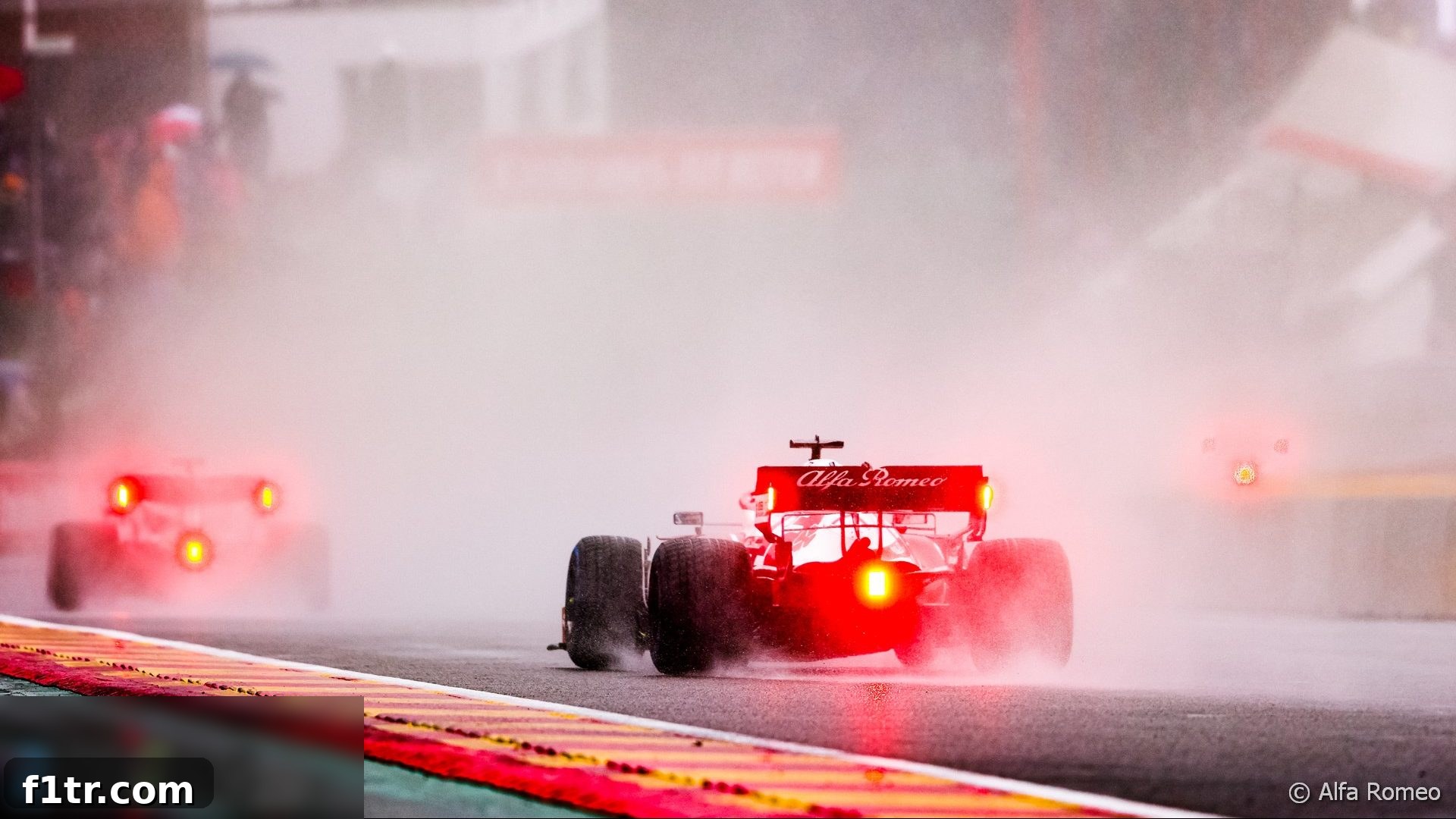
However, in the engineer’s informed opinion, the most significant contributor to the impossibility of racing on Sunday was the sheer volume of spray thrown up by the cars, which forced drivers to navigate effectively ‘blind’ at speeds approaching 300 kph. He estimates that approximately 60% of this dangerous spray is generated by the underbody’s ‘suction’ effect, which is then widely dispersed by the large rear diffusers, with the remaining 40% coming from the tyres. The concerning news is that this already critical situation is unlikely to improve for the following year; if anything, the opposite is true.
He further explained that current F1 cars generate roughly 25% of their total downforce from the front and rear wings respectively, with the underbodies accounting for the remaining 50%. With F1’s new 2022 regulations specifically designed to reduce the ‘dirty air’ generated by the front and rear wings – a key aim for promoting closer racing – there will be an even greater reliance on underbody ground effects for generating downforce. Consequently, the proportion of downforce generated by the floor is projected to rise to 60% (or potentially even more), inevitably intensifying spray and further drastically reducing visibility for drivers in wet conditions. This raises serious questions about the sport’s long-term ability to race in anything other than light rain.
Regulatory Lapses: The Grey Areas That Undermine Trust
F1’s current regulations are notoriously complex but frequently fail to anticipate extraordinary scenarios, leading to numerous ‘grey areas’ and confusion in critical moments. Sergio Perez’s car damage at Spa provided a perfect illustration of this systemic flaw: was his team permitted to repair the car after his heavy shunt on the ‘warm-up’ lap, given that it returned to the garage on a flatbed, seemingly in contravention of Article 38.1, which mandates a car to reach the grid under its own power after a reconnaissance lap? The confusion was palpable. No one seemed to know definitively. We reached out to a Red Bull team contact, who simply stated, “Checo confirmed not in this race,” after his car had been recovered.
Visuals later showed the Mexican’s mechanics toiling away, while sporting director Jonathan Wheatley – typically one of the most astute and aware individuals in the paddock – was seen tapping race director Michael Masi for advice. Masi subsequently referred the matter to the stewards, who eventually decreed that the car could indeed start from the pit lane. Crucially, Masi explained that if two laps were completed behind the safety car, then half points could be awarded, provided under 75% of the total race distance was completed. This clarification was made over an hour before the eventual (re)start, casting a long shadow over the proceedings.
Clearly, then, what had initially appeared to be a reconnaissance lap for Perez was, in the stewards’ interpretation, not officially a reconnaissance lap in the context of the rules. Similarly, if half points were to be awarded for a mere handful of laps behind the Safety Car, on the basis that these were official racing laps, why then were no points awarded for the fastest lap? The answer is straightforward: the regulations simply do not specify either way because no one had ever anticipated a Grand Prix being run solely behind a Safety Car. Consequently, scrapping the fastest lap point was the only available, albeit inconsistent, option.
These Safety Car ‘alibi’ laps rank among the most cynical spectacles ever witnessed in Formula 1. This highly questionable situation was further compounded by Masi’s earlier “two lap” comments and subsequent on-screen graphics that prominently repeated this information, which is precisely how the event ultimately unfolded. The logical, albeit unsettling, conclusion is that this was the intended outcome all along – a meticulously planned exercise to tick all necessary sporting and commercial boxes. If not, then Formula 1 was catastrophically underserved by pure coincidence, yet again.
Learning from ‘Freak Days’: A Call for Accountability and Fan Respect
It is now urgently clear that F1 needs to thoroughly review and fundamentally amend its regulations, a necessity that FIA president Jean Todt yesterday acknowledged. Even more critically, it needs to frame suitable anticipatory clauses that can effectively address unforeseen circumstances. Race weekends like Spa 2021 are highly unlikely to remain isolated exceptions for as long as Formula 1 steadfastly refuses to genuinely learn from Sunday’s debacle. Mercedes motorsport boss Toto Wolff’s post-race comments, dismissing the event as a “freak day,” rank among the most short-sighted of the entire weekend, even more misguided than earlier suggestions that the race should or could be delayed to Monday.
“I think this has never happened before, so you need to take it as a freak day where we would have all hoped to have a spectacular race [but] that didn’t happen,” the man once tipped to run F1 said post-race, exhibiting a concerning lack of introspection. He continued: “[Are] there any learnings? I’m not sure because we are dependent on the weather. Everybody tried hard to get a race underway and because of the rain it didn’t happen.”
The Ultimate Disrespect: The Refund Policy and “Alibi Laps”
Imagine paying €500 for a ticket, incurring double that for weekend accommodation, and then huddling in pouring rain all Sunday, only to witness two nominal laps behind a safety car, and subsequently reading such dismissive nonsense from a prominent figure within the sport. The undeniable fact is that thorough analysis conclusively proves Sunday was far from ‘freakish’; the sport has an abundance to learn from the entire weekend, from its calendar planning to its operational flexibility and its relationship with its audience. If it fails to convert this painful hindsight into meaningful foresight, Formula 1 does not deserve to retain a single fan.
In the final analysis, the promoter, Spa Grand Prix, working in conjunction with Liberty Media, should be ethically compelled to compensate fans in full. Both parties gambled on Spa’s August weather and ultimately lost, but not as heavily as the fans or F1 as a whole will in terms of reputation and trust. The inherent problem lies in Article 13 of Spa’s general ticket sales conditions, which boldly and unapologetically states: “NO REFUND AND NO CHANGE ON TICKETS WILL BE GIVEN UNLESS THE EVENT IS CANCELLED!” Which, thanks to those crafty and commercially motivated ‘alibi laps,’ it wasn’t.
Moving Forward: Realigning Priorities for F1’s Future
The core issues illuminated by the Spa 2021 debacle are undeniable: an overt prioritization of commercial imperatives over sporting integrity, a consistent neglect of the fan experience, and glaring shortcomings in the sport’s regulatory framework. F1’s future hinges on its willingness to make fundamental changes, including a more responsible approach to calendar planning that considers meteorological data and fan welfare, a renewed focus on tyre development that genuinely addresses safety and raceability in wet conditions, a critical re-evaluation of car design considerations in relation to spray and visibility, and a comprehensive overhaul of its regulations to eliminate ambiguities and anticipate complex scenarios. Only by genuinely prioritizing its fans and embracing accountability can Formula 1 hope to restore faith and ensure its long-term appeal as the pinnacle of motorsport.
RacingLines
- The year of sprints, ‘the show’ – and rising stock: A political review of the 2021 F1 season
- The problems of perception the FIA must address after the Abu Dhabi row
- Why the budget cap could be F1’s next battleground between Mercedes and Red Bull
- Todt defied expectations as president – now he plans to “disappear” from FIA
- Sir Frank Williams: A personal appreciation of a true racer
Browse all RacingLines columns