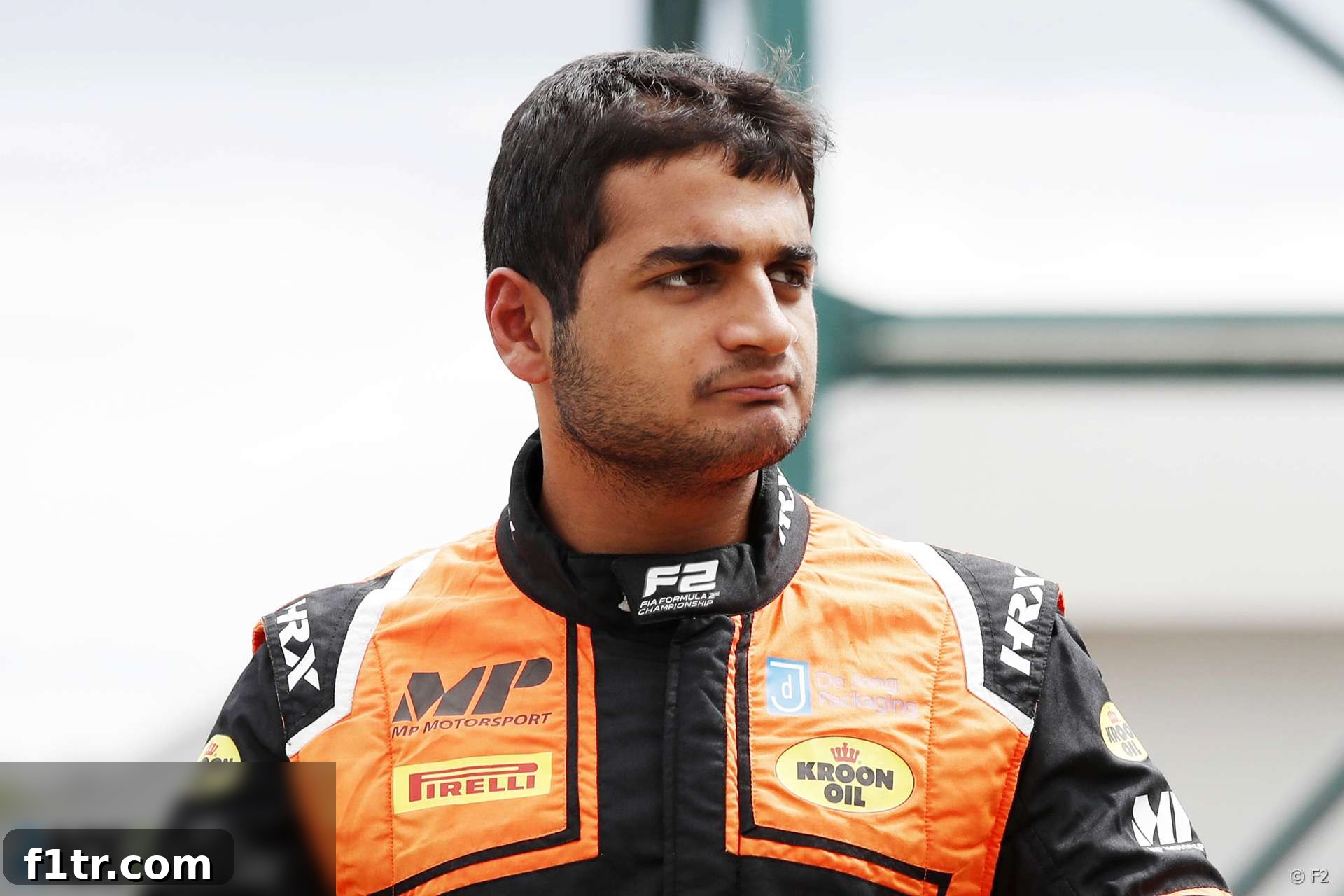
In the high-stakes world of Formula 2, where aspiring talents vie for a coveted spot in Formula 1, driver discipline and adherence to regulations are paramount. Every decision on track, every move against the rulebook, carries significant weight, impacting not just individual performance but also reputation and championship aspirations. One driver who has frequently found himself under the scrutiny of the stewards throughout the season is Mahaveer Raghunathan, whose recurring penalty points have painted a challenging picture of his campaign.
The MP Motorsport driver recently added another two penalty points to his super license during a qualifying session, bringing his cumulative total to eight points. This latest infringement occurred when Raghunathan was found to have set a fastest sector time despite passing through a yellow flag zone – a clear violation of safety protocols designed to protect drivers and marshals alike. This incident places him perilously close to another race weekend ban, a fate he has already experienced once this year.
Become a Supporter & go ad-free
Formula 2 operates a stringent penalty point system, mirroring its senior counterpart, Formula 1, to ensure fair play and driver safety. Accumulating twelve penalty points over a rolling period results in an automatic race ban, forcing the driver to sit out an entire event weekend, which in F2 typically comprises two races. Raghunathan previously faced such a suspension, missing the Austrian round of the championship after exceeding the twelve-point threshold during the initial nine races of the season. Following that ban, the twelve points were duly cleared from his record, offering a fresh slate, yet the pattern of infringements appears to have continued.
The series of transgressions committed by Raghunathan since the season commenced has been extensive and varied. His troubles began right from the opening round in Bahrain, where he incurred his first penalty for an unusual incident: passing the chequered flag twice. This early misstep set a precedent for a season plagued by regulatory issues. Baku proved to be another challenging venue for the Indian driver; he was penalised for failing to stop at the weigh bridge, a mandatory procedure for all competitors, and later, for overtaking a rival under Safety Car conditions – a serious breach that jeopardises safety and fairness within the pack.
Monaco, known for its tight confines and high-risk racing, added two further penalties to Raghunathan’s tally. These included an incident where he tangled with fellow competitor Jack Aitken, highlighting the difficulty of navigating the principality’s streets, and another for driving through the pit lane exit on the very first lap of a race, a procedural error that could have led to dangerous situations for other drivers and pit crew members. Each incident, though seemingly minor on its own, accumulates, demonstrating a consistent struggle to adhere to the complex rulebook governing modern motorsport.
Perhaps Raghunathan’s most significant and concerning infraction came at the Circuit Paul Ricard. There, the race stewards ruled that he failed to follow the Virtual Safety Car (VSC) instructions for three consecutive laps. The VSC system is a critical safety measure, designed to slow the entire field down uniformly without deploying a full Safety Car, typically in response to a hazard on track. Drivers are required to maintain a delta time, ensuring they do not exceed a certain speed. Raghunathan’s failure to comply for such an extended period was deemed a grave oversight, leading to an unprecedented penalty of three points for each lap of non-compliance, severely boosting his overall point count and underlining the gravity with which such safety violations are treated.
The recent qualifying error, where he set a fastest sector time under yellow flag conditions, not only added two penalty points to his licence but also resulted in an immediate three-place grid penalty for the upcoming race. This double consequence underscores the FIA’s unwavering commitment to safety, especially when trackside personnel might be at risk. Interestingly, his MP Motorsport teammate, Jordan King, received an identical penalty and licence endorsement for the very same infringement, suggesting a systemic issue or perhaps a shared lapse in concentration within the team. The stewards’ investigation into a similar incident involving Jack Aitken, however, concluded differently. Aitken was cleared when the stewards determined he “just entered the yellow flag sector in the moment the yellow flags came out, and taking into account that the relevant section includes a quick corner, the driver had no realistic chance to slow down more than he did.” This decision highlights the nuanced approach of the stewards, who carefully consider the specific circumstances and immediate reaction time available to a driver, rather than applying a blanket punishment.
Become a RaceFans supporter and go ad-free
The repeated accumulation of penalty points and the threat of further race bans can have a profound impact on a driver’s career trajectory in Formula 2. This series is not merely about winning races; it is a proving ground where drivers must demonstrate not only speed and skill but also consistency, maturity, and adherence to professional standards. A driver frequently clashing with the rulebook can send undesirable signals to potential Formula 1 teams, who seek reliable, disciplined individuals capable of performing under pressure without incurring unnecessary penalties. Each ban represents lost track time, missed opportunities for valuable points, and a dent in a driver’s championship aspirations, which are often crucial for attracting further investment and progression in motorsport.
Ultimately, Mahaveer Raghunathan’s journey through the Formula 2 season serves as a stark reminder of the rigorous demands placed upon young drivers in their quest for top-tier motorsport. While aggression and a competitive spirit are essential, they must be tempered with an unwavering respect for the rules and safety regulations. The penalty point system, while punitive, exists to maintain the integrity of the sport and ensure the safety of all participants. As Raghunathan navigates the remainder of his season, the focus will undoubtedly be on his ability to demonstrate improved discipline and avoid further infringements, proving that he can compete fiercely within the established boundaries of motorsport excellence.
Formula Two
- Formula 2 to debut in Miami and Montreal after Iran war cancellations
- Ex-McLaren junior Dunne’s move to Alpine finally confirmed
- Schumacher says his IndyCar feels like ‘an F2 car, just with better tyres’
- The Formula 2 team with an older driver line-up than almost half the F1 grid
- FIA to award more F1 superlicence points to IndyCar drivers from 2026
Browse all Formula 2 articles