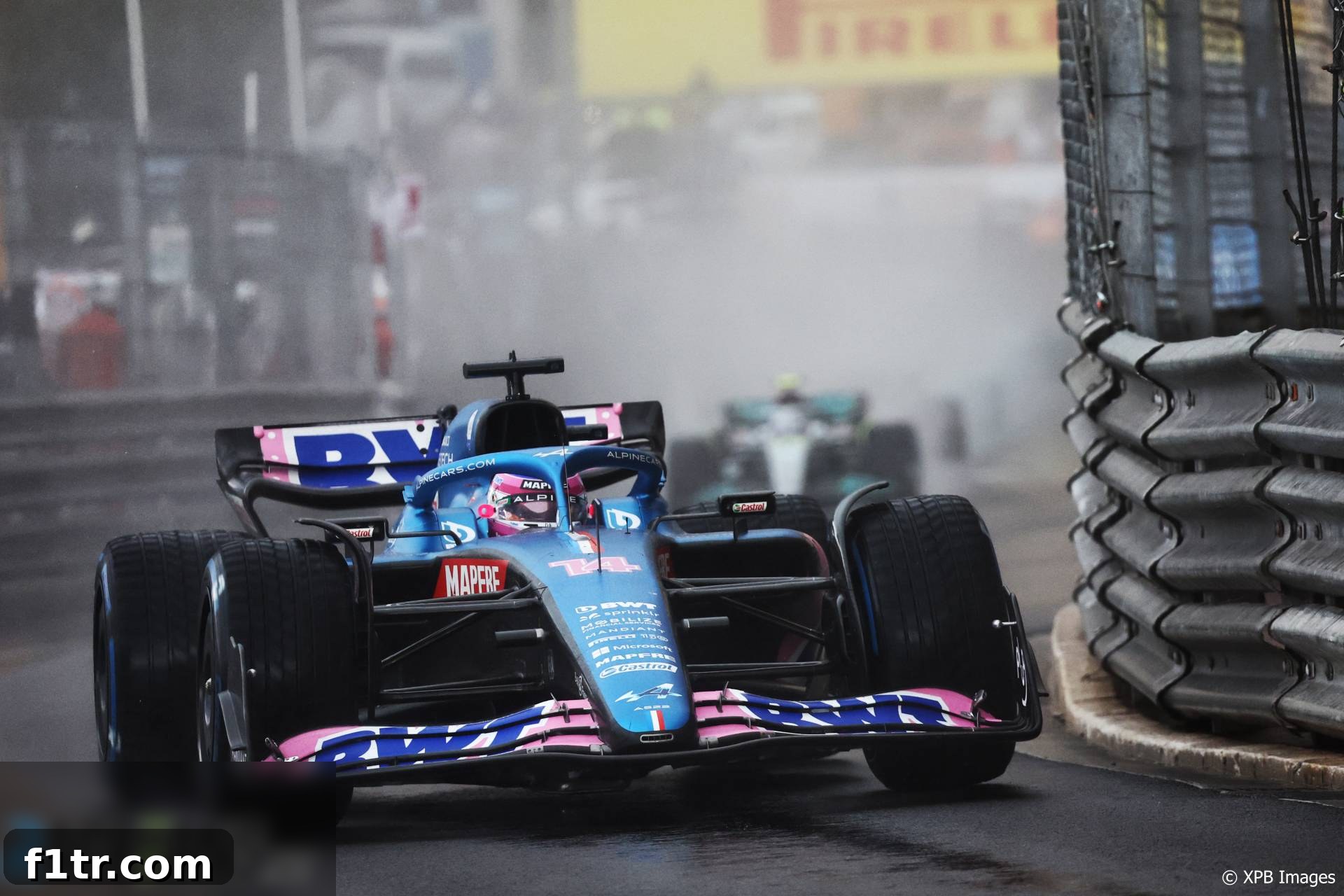
Fernando Alonso’s Monaco Masterclass: Strategic Pace and Holding Off Lewis Hamilton
The 2022 Monaco Grand Prix, a spectacle known for its high-stakes drama and unforgiving circuit, became the stage for a compelling display of strategic brilliance by Fernando Alonso. The two-time Formula 1 world champion, representing the Alpine F1 Team, found himself in a high-pressure situation, with seven-time champion Lewis Hamilton of Mercedes hot on his heels. Yet, despite running at a noticeably reduced pace during a critical phase of the race, Alonso unequivocally stated that he encountered no difficulty whatsoever in maintaining his position ahead of his formidable rival.
This remarkable assertion by Alonso underscores the profound strategic depth required to succeed on the unique streets of Monte Carlo. The principality’s narrow, twisting layout is notorious for making overtaking an exceptionally rare feat, thereby elevating the importance of track position, impeccable car placement, and cunning race management above raw speed. Alonso’s post-race insights offered a revealing glimpse into a meticulously planned strategy, one focused not on outright lap times, but on calculated tyre preservation and optimal race completion.
The Unpredictable Restart: Navigating Tyre Choices and Race Management
The Grand Prix had experienced a significant interruption following a severe incident involving Mick Schumacher, whose heavy crash at the Swimming Pool section necessitated a red flag. This stoppage led to a rolling restart, presenting all teams and drivers with a pivotal decision regarding their tyre compounds for the remainder of the race. For Fernando Alonso and his Alpine crew, the options were clearly defined: either revert to the hard compound tyres they had commenced the race on, or switch to a fresh set of medium compound tyres.
Alonso elaborated on the team’s strategic conundrum: “We had two choices. Repeat the hard tyres from the beginning of the race or put the medium tyre on.” The team ultimately opted for the medium compound, a decision that, while potentially offering initial grip, came with a considerable risk. Alonso candidly admitted the uncertainty, stating, “We put the medium tyres on but our life estimation was shorter than 33 [laps], so we didn’t know if we could finish the race.”
Confronted with the stark possibility of his chosen tyres not enduring the full distance if pushed to their limit, Alonso made a conscious and decisive move to significantly dial back his pace. This immediate alteration in strategy was palpable to observers, as the Alpine driver rapidly created a substantial gap to the car ahead of him. Lando Norris, who was running ahead of Alonso, ingeniously exploited this situation. He was able to execute an additional pit stop, rejoin the track still comfortably ahead of the Alpine, and even secure the coveted bonus point for the fastest lap of the race. This sequence of events vividly demonstrated the extent of the pace Alonso was intentionally sacrificing.
Hamilton’s Mounting Frustration Meets Alonso’s Unyielding Focus
As Fernando Alonso meticulously nursed his delicate medium tyres, a visibly frustrated Lewis Hamilton found himself inextricably linked to the rear wing of the Alpine. Hamilton’s exasperation was understandable; he had already spent a significant portion of the race trapped behind Alonso’s teammate, Esteban Ocon, only to encounter a similar, immovable obstacle in the form of the other Alpine. His radio communications throughout the latter part of the race conveyed a palpable sense of impatience and an earnest desire for more speed from the car directly in front of him.
However, the mounting pressure from one of Formula 1’s most decorated drivers left Alonso entirely unperturbed. When later questioned about Hamilton’s evident frustration and the perceived difficulty in holding him off, Alonso delivered a characteristic, defiant retort: “That’s not my problem.” His blunt remark perfectly encapsulated his singular focus on executing his predefined race strategy and the paramount importance of ensuring his chosen tyres lasted, irrespective of who was behind him or their level of discomfort.
The core of Alonso’s tactical approach was not merely defensive driving, but a precise and sophisticated preservation of his tyre integrity. In the demanding environment of Monaco, where high-speed cornering and aggressive inputs can rapidly accelerate tyre degradation, particularly with softer compounds, a sustained and carefully controlled pace often represents the only viable path to reach the checkered flag. Alonso’s disciplined methodology allowed him to extend the operational life of his medium tyres far beyond their initial estimated limit, showcasing his unparalleled experience and an intricate understanding of tyre dynamics.
The Ocon Penalty: A Catalyst for Alonso’s Late-Race Acceleration
The strategic landscape of the Monaco Grand Prix underwent another significant shift following an incident involving Esteban Ocon and Lewis Hamilton. Ocon was subsequently handed a five-second time penalty for an earlier collision with Hamilton, a development that held direct and immediate implications for Fernando Alonso’s ongoing race strategy.
Upon receiving notification of his teammate’s penalty, Alonso’s driving style and pace underwent an immediate and noticeable transformation. “I managed a lot the tyres for 15 laps and then I pushed for the remaining 15 when they told me that Esteban had a penalty,” he elucidated. This sudden and pronounced acceleration in pace during the concluding stages of the Grand Prix served as undeniable evidence of the immense potential Alonso had been deliberately holding in reserve. It conclusively demonstrated that his earlier, seemingly sluggish pace was not a consequence of any inherent lack of raw speed or car performance, but rather a meticulously executed strategic maneuver designed to guarantee tyre longevity and optimal race finish.
The capacity to seamlessly transition from a highly defensive, tyre-management-focused approach to an aggressive, attacking mindset on demand is a quintessential hallmark of an elite, experienced driver. Alonso unequivocally showcased an extraordinary understanding of his machinery and the dynamic race conditions, adapting his driving style with pinpoint precision to the evolving circumstances. This late surge not only solidified his track position but also brilliantly highlighted the untapped performance he had been shrewdly conserving throughout the earlier phase of the race.
An “Extremely Easy” Defense in the Monte Carlo Crucible
Despite the relentless and persistent pressure exerted by one of the greatest drivers in the history of Formula 1, Fernando Alonso adamantly asserted that maintaining his position ahead of the Mercedes around the convoluted and challenging Monte Carlo circuit had been “extremely easy.” This statement might initially appear counterintuitive, especially given the formidable talent of the driver pursuing him, but it profoundly illuminates the unique characteristics of racing in Monaco and Alonso’s unparalleled mastery of defensive driving techniques.
The inherent peculiarities of the Monaco track — its exceedingly tight corners, narrow passages, and the virtual absence of genuine overtaking opportunities — fundamentally alter the usual dynamics of a Grand Prix. Even with a significant theoretical pace advantage, a following car encounters immense difficulty in finding a viable path to pass without incurring monumental risks. Alonso, a seasoned veteran with countless Monaco Grands Prix under his belt, masterfully leveraged these intrinsic difficulties to his strategic advantage.
His defensive artistry was not predicated on sheer speed; instead, it relied on surgical precision, intelligent and anticipatory car placement, and an unwavering commitment to maintaining optimal track position. By consistently hitting his apexes, expertly closing off potential racing lines, and executing a flawless, error-free drive, Alonso made it virtually impossible for Hamilton to engineer an overtaking maneuver. His absolute control over the situation transformed what could have been a nerve-wracking, nail-biting encounter for lesser drivers into what he perceived as a routine exercise in controlled, strategic defensive driving.
Alonso’s Enduring Legacy as a Strategic Mastermind
This memorable episode at the 2022 Monaco Grand Prix further solidified Fernando Alonso’s already sterling reputation as one of Formula 1’s most astute and strategically brilliant drivers. His innate ability to meticulously read the unfolding dynamics of a race, his profound understanding of tyre degradation mechanisms, and his unflappable execution of a complex plan—even one that necessitates the deliberate sacrifice of apparent speed for long-term gain—are truly exceptional qualities. This performance serves as a powerful testament to his decades of experience and an almost intuitive grasp of the sport’s intricate strategic chess game.
The incident also served as a poignant reminder of the pervasive psychological warfare that is an inherent, albeit often unseen, component of Formula 1 racing. Alonso’s seemingly nonchalant attitude, perfectly encapsulated by his dismissive “that’s not my problem” comment, can often be as profoundly frustrating for a rival driver as any physical block on the track. Such a demeanor communicates an unshakeable sense of control, an unwavering confidence, and an absolute focus that can, over time, subtly erode the resolve of even the most determined chasing competitor.
In a sport that is increasingly governed by vast amounts of data analytics and sophisticated simulation models, Alonso emphatically demonstrated that raw driver instinct, nuanced race craft, and sheer strategic intelligence remain utterly invaluable assets. His performance in Monaco was not about possessing the fastest car on the grid, but rather about being the smartest driver on the circuit, consistently making the most judicious decisions under immense pressure, and ultimately, extracting the absolute best possible outcome for his team within the formidable constraints he faced.
The 2022 Monaco Grand Prix will undoubtedly be remembered for its array of chaotic moments and unexpected twists. However, Fernando Alonso’s calculated, defiant, and strategically masterful drive against Lewis Hamilton will forever stand as a classic example of profound strategic genius triumphing over raw pace in the unique and demanding crucible of Monte Carlo.
Related Articles: 2022 Monaco Grand Prix Insights
- Max Verstappen’s Team Defiance: Unpacking the Red Bull Saga
- Strategic Blunders: How Red Bull Snached Victory from Ferrari in Monaco
- Verstappen vs. Leclerc: Pole Positions, Wins, and Championship Dynamics
- The Impact of Rising Car Weight: Alonso on Mick Schumacher’s Monaco Crash
- Lando Norris’ McLaren Struggles: Driving Style vs. Performance
- 2022 Monaco Grand Prix: Full Race Report and Analysis
- F1 Tyre Strategy Explained: The Unique Challenges of Monaco
- Fernando Alonso’s Career Highlights: Top Strategic Drives
- Alpine F1 Team Performance: A Review of the 2022 Season
Browse all 2022 Monaco Grand Prix articles and insights