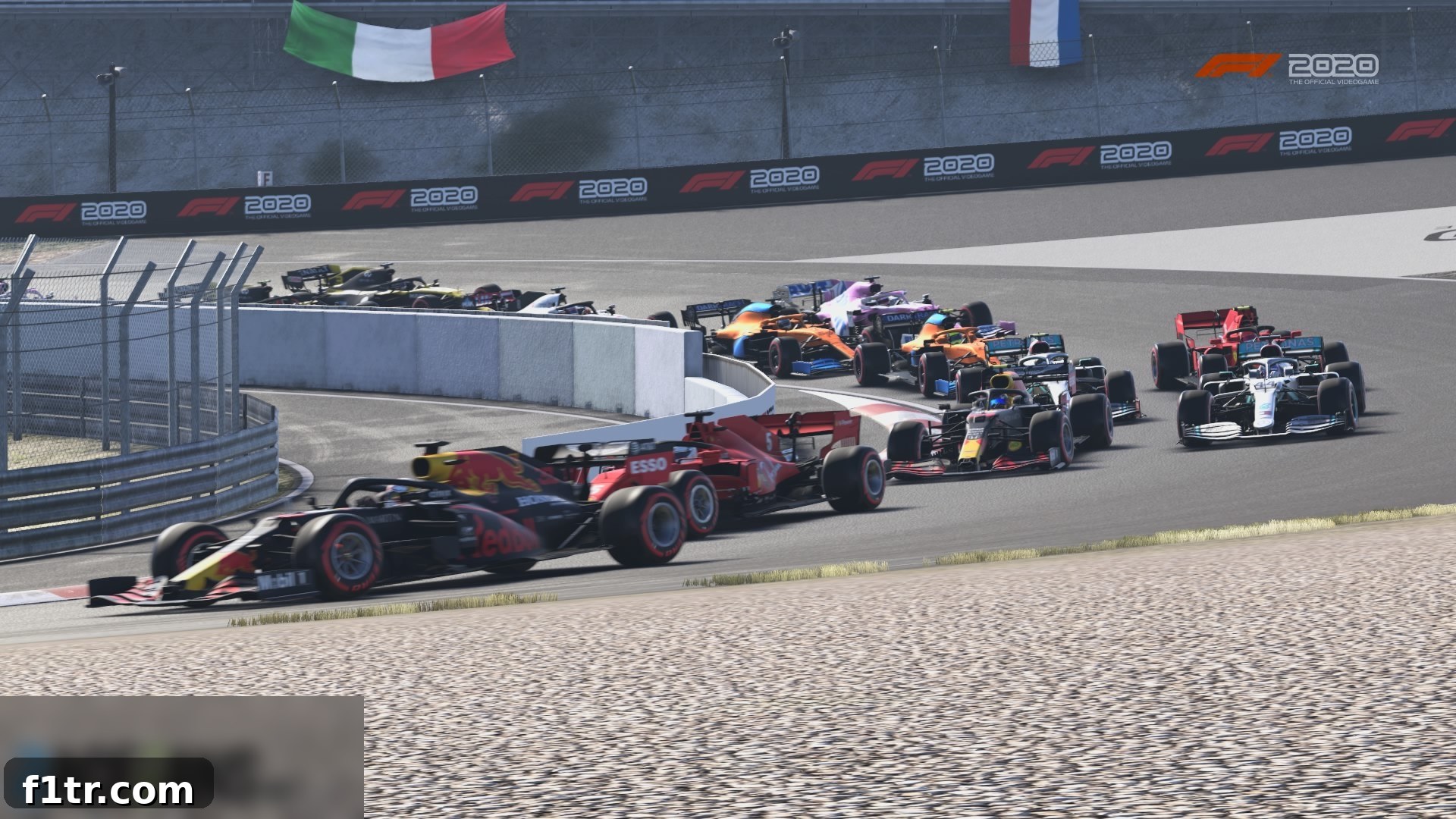
After an unprecedented hiatus, the roaring engines and thrilling spectacle of real-life Grand Prix racing returned to our screens with the 2020 F1 season beginning in Austria. This highly anticipated comeback perfectly coincided with the arrival of Codemasters’ latest official title, F1 2020, launched this week across PC, Xbox One, PlayStation 4, and Google Stadia. For many, this game isn’t just a digital recreation; it’s the only way to experience the 2020 Formula 1 World Championship as it was originally envisioned, untouched by real-world disruptions.
The global pandemic undeniably reshaped the actual 2020 racing calendar and its aesthetics. However, F1 2020 offers a captivating alternative, allowing fans to immerse themselves in a championship free from social distancing and altered schedules. With a groundbreaking new game mode dominating the headlines and a myriad of enhancements both on and off the track, the question on every fan’s mind is: does F1 2020 truly live up to the immense pre-release anticipation from its dedicated worldwide player base? This comprehensive review dives deep into every aspect to help you decide.
Reliving the Season That Was Meant to Be
F1 2020 meticulously presents a pre-pandemic vision of the championship, free from masks and social distancing protocols. Players can race through all 22 circuits of the initially planned, longest-ever calendar, in their intended sequence. This includes the highly anticipated debut of the Vietnam Grand Prix in Hanoi and the glorious return of Zandvoort with the Dutch Grand Prix, both of which had been eagerly awaited in the real world. The game features all ten official F1 teams, the complete 2019 F2 season, and an impressive collection of classic Formula 1 cars, offering a rich and authentic experience for any racing enthusiast.
Given the heavily disrupted and turbulent start to the actual 2020 season, Codemasters faced an unenviable task in depicting the Formula 1 grid as realistically as possible. While their efforts are commendable, there are a few understandable areas where the game’s initial release couldn’t perfectly mirror the rapid real-world changes. For instance, the striking new black Mercedes W11 livery and the updated McLaren scheme, which emerged from the sport’s ‘#WeRaceAsOne’ initiative against racial discrimination, came too late to be included in the launch version of the game. These last-minute livery changes reflect the dynamic nature of the sport, and Codemasters has assured players that these updates will be patched into the game as soon as possible, demonstrating their commitment to realism.
On a positive note, Codemasters’ vehicle artists managed to integrate the significantly revised Williams livery just in time for release day. This showcases their dedication to keeping the game as current as possible under challenging circumstances. Furthermore, the developers have used pre-season testing data to make their most educated guesses regarding car performance, with Mercedes predictably leading the pack and Ferrari positioned as a clear third behind Red Bull. To maintain accuracy as the real-life season unfolds, Codemasters has promised regular performance updates, ensuring the in-game experience evolves alongside the actual championship.
In a smart piece of forward-thinking design, F1 2020 offers players complete freedom when performance updates are released. You can choose whether to implement these changes into existing career mode saves, preventing any disruption to the consistency of your championship progression. This means you won’t suddenly find your finely tuned strategy altered halfway through a season, a detail that veteran players will undoubtedly appreciate.
Out on the track, F1 2020 introduces subtle yet impactful changes to the handling model that veteran players will likely notice immediately. The most prominent improvement is the brake response. If you’ve struggled with gauging brake feel in F1 2019, you’ll find significantly more confidence in your braking inputs in F1 2020. The initial braking phase is distinctly more effective, and the feedback for finding the limit of the brakes with ABS off feels more refined, particularly when using a controller. This enhancement contributes to a more precise and rewarding driving experience.
Additionally, there’s a noticeable sense that cars handle with less susceptibility to weight this season, especially with heavier fuel loads. While this isn’t intended to be a hyper-realistic physics simulation like “Assetto Corsa,” F1 2020’s handling modifications have garnered positive feedback from real F1 drivers like George Russell. Players will likely find themselves achieving greater lap-to-lap consistency compared to the previous iteration, leading to more enjoyable and competitive races.
Another significant change for this year, prompted by a valuable suggestion from Lando Norris, is the substantial simplification of the ERS (Energy Recovery System). This update aims to better reflect how the system operates in real Formula 1 racing. Energy management is now largely automated, freeing players to focus on strategic deployment. Instead, players are granted the exhilarating power of the new ‘overtake’ button. Pressing this button initiates maximum ERS deployment, providing a concentrated burst of power. This feature is invaluable for blasting past a stubborn opponent, defending your position, or pushing for that crucial quickest lap time. It’s incredibly satisfying to use, but as with any strategic element, judicious deployment is key; misuse it, and you’ll find yourself without harvested energy when you need it most.
The offline racing experience has consistently been a strong suit of the F1 series, and F1 2020 continues this tradition. The AI rivals are as challenging and enjoyable to race against as ever. Compared to F1 2019, they exhibit slightly less brutal behavior when you’re alongside them on corner exits, leading to fairer wheel-to-wheel battles. While they still might not make as many unexpected mistakes as they did in F1 2016, they do occasionally falter or misjudge moves when either attacking or defending, adding a welcome layer of unpredictability and realism to the single-player experience.
Stepping Up: Becoming the 11th Team
Without a doubt, F1 2020’s most significant and boldest new feature is the introduction of the ‘MyTeam’ mode. For the very first time in an officially licensed Formula 1 game, MyTeam grants players the unprecedented opportunity to create and manage their own personalized F1 team. This isn’t just a cosmetic addition; you will occupy the coveted 11th garage in the pit lane, competing directly against the established giants for the prestigious Constructors’ Championship, alongside your quest for the Drivers’ title.
MyTeam is an incredibly deep and eagerly anticipated addition, packed with so many intricate details that we’ve dedicated a separate, in-depth feature to covering all its nuances and gameplay elements. While inherently a driving-focused mode—meaning you can’t simply act as a team principal without getting behind the wheel—MyTeam empowers you with comprehensive control over your fictional new team. You’ll make critical decisions on various fronts, from securing lucrative sponsors and recruiting a competitive teammate to spearheading your car’s development and strategically investing money into upgrading your team’s facilities. This holistic approach adds an entirely new dimension to offline racing, transcending the traditional driver-only career path.
The dynamic driver market, a core component of MyTeam, further enhances the immersion. Building your team from a back-of-the-grid contender, frequently facing Q1 eliminations, into a championship-challenging force over several seasons is perhaps the most immersive experience the F1 series has offered to date. This mode truly captures the essence of long-term team management and driver progression. It’s a feature that Codemasters has clearly put significant effort into, and one that players will eagerly hope to see continued, expanded upon, and refined in future iterations of the game.
While MyTeam rightfully commands significant attention, the traditional career mode remains a core offering and is as enjoyable as ever. It benefits from many of the enhancements seen in MyTeam, such as the dynamic driver market and various perks. However, as a pure driver, your primary focus shifts solely to earning and spending resource points to develop your car, allowing for a more streamlined, driving-centric experience without the added management responsibilities of MyTeam.
F1 2020 also offers expanded options for how you can embark on your career. You now have the choice to complete a full season of Formula 2 before making the leap to Formula 1, providing a more natural progression path. Alternatively, you can opt for a shortened F2 season with just one race per weekend or tackle three short scenarios, similar to F1 2019, for a quicker entry. Your performance in F2 directly influences your reputation and the caliber of F1 teams interested in your services, adding a layer of consequence to your choices. However, for those eager to jump straight into the pinnacle of motorsport, the option to bypass F2 entirely is also available.
Given that the original 2020 season boasted a record-breaking 22-race calendar, completing a single season in either MyTeam or career mode could feel like a true marathon for many players. This is precisely why the new shortened calendar option in F1 2020 is such a welcome and essential addition. Instead of committing to the full, grueling schedule, players now have the flexibility to choose between a 16-race or even a 10-race season. Crucially, this comes with the freedom to hand-pick which Grand Prix events you wish to include in your customized championship, catering to individual preferences and time constraints.
This feature means if you can’t stand the unforgiving barriers of Monaco, you simply don’t have to race there. If you’re tired of the demanding Sochi circuit, you can omit the Russian Grand Prix from your calendar entirely, freeing you from a track you might not enjoy. The most appealing aspect of this customization is the ability to completely change the calendar each season. This allows for a fresh and varied experience every year, as you can rotate races in and out to keep the gameplay engaging and prevent monotony. The only minor quirk is that you cannot alter the order of the selected races; if you choose Albert Park, it will always be the opening round, and Monza will always precede Suzuka if both are included.
Despite this minor limitation, the shortened calendar option is a massive benefit. For players with limited free time or those who prefer longer race distances, this new flexibility transforms the experience, making a full season feel much less like a relentless grind and far more manageable and enjoyable. It empowers players to tailor the game to their lifestyle, enhancing accessibility and replayability.
Personalizing Your Journey: The Paddock Pass and Customization
Customization becomes a significant focal point in F1 2020 with the introduction of the Paddock Pass. This innovative new system offers a suite of unlockable, customizable cosmetic items including liveries, driver suits, helmet designs, and podium celebrations (often referred to as ‘emotes’). The Paddock Pass functions similarly to season passes found in popular games like Fortnite, encouraging long-term engagement through progression and rewards.
For those who might be wary of such systems, it’s crucial to clarify that everything unlockable through the Paddock Pass is purely cosmetic. These items have absolutely no impact on gameplay performance or competitive balance. While there is an option to spend real-world money to accelerate access to certain items, players can also earn sufficient in-game currency simply by playing the game and completing challenges. This ensures that all players, regardless of whether they choose to spend extra money, can access the customization options.
Throughout the year, various ‘seasons’ will be introduced, each bringing a new collection of unlockable items. Players can earn these items by completing a selection of in-game challenges, such as ‘complete six laps of Albert Park’. Successfully completing these challenges rewards you with in-game currency, which can then be spent on new items to further personalize the look of your driver avatar or your MyTeam car and branding. This provides a constant stream of short-term goals and rewards, adding replay value and a sense of progression beyond the core racing modes.
An additional ‘VIP’ tier is available, offering access to more exclusive and premium items each season. Players who pre-ordered one of the special editions of the game will receive enough currency to purchase the first VIP Pass. Furthermore, dedicated players have the ability to earn enough points through gameplay to acquire access to the VIP tier for subsequent seasons without additional real-money purchases. While some players might initially feel a slight unease about the potential for microtransactions, Codemasters has stated that the Paddock Pass, as it was not fully active during the review period, is designed to be relatively inoffensive to most. If implemented as promised, it should serve primarily as a mechanism to add extra longevity to the game by providing players with regular, achievable goals and fresh cosmetic content to work towards. For those uninterested in cosmetic customization, the system is designed to be easily ignored without impacting the core gameplay experience.
A Tribute to Greatness: Celebrating Schumacher
Classic cars remain a cherished feature in F1 2020, allowing players to step back in time and experience iconic machines from Formula 1’s rich history. However, it’s worth noting that the oldest class of cars, specifically those from the 1970s and early eighties, have unfortunately been cut from this new edition. This streamlining focuses the classic car roster, but fans of those older eras might feel their absence.
The notable new additions to the classic car roster this year are exclusively available either by purchasing the Deluxe Schumacher Edition of the game, winning a copy through the RaceFans F1 Predictions Championship, or as future downloadable content (DLC). As the name clearly suggests, these newly introduced historic models are all cars that played pivotal roles throughout the illustrious career of the legendary seven-time world champion, Michael Schumacher.
This special collection includes the exquisitely beautiful Jordan 191, the car in which Schumacher made his unforgettable Formula 1 debut at Spa-Francorchamps. It is joined by the controversial yet championship-winning Benetton B194, the machine that propelled him to his maiden world title in 1994. The Benetton B195, which saw Schumacher clinch his second successive championship in 1995, is also included, allowing players to experience the dominance of his early career. The final new addition is the iconic Ferrari F1-2000, the car with which he secured his first of an incredible five consecutive championships for Scuderia Ferrari, marking the beginning of an unparalleled era of dominance. These cars are not just vehicles; they are pieces of motorsport history, each offering a unique driving challenge and a direct link to Schumacher’s legacy.
Owners of the Deluxe Schumacher Edition also receive access to a selection of special themed liveries, race suits, helmet designs, a signature ‘Schumacher leap’ podium celebration, and even the option to give their avatar driver his likeness. While die-hard fans of the legendary driver will undoubtedly appreciate these heartfelt homages and the chance to fully immerse themselves in his world, it’s likely that the majority of players will prefer to stick with their own personalized gear and avatars, making use of the broader customization options available in the game.
We had the privilege of taking these iconic machines for a spin in a preview version of the game a few weeks prior, an experience that offered a tantalizing glimpse into the past glories of Formula 1:
Making Racing Accessible: Innovations for Everyone
For far too long, Codemasters’ F1 series, despite its many strengths, has been criticized for the absence of a split-screen local multiplayer mode. While online multiplayer offers plenty of excitement, there’s a unique joy and competitive spirit in battling a friend side-by-side on the same console. F1 2020 finally rectifies this longstanding oversight by reintroducing split-screen races, allowing two players to compete against each other and the AI simultaneously. As much fun as it is to grind through full-distance career mode races, nothing quite compares to starting at the back of the grid with a friend, challenging each other to see who can carve their way furthest through the field before the chequered flag falls. This feature significantly enhances the game’s social appeal and makes it a fantastic option for couch co-op or competitive sessions.
While Codemasters’ F1 series provides a compelling simulation, it has often presented a steep learning curve, particularly for complete beginners, younger children, or individuals with accessibility needs, even with all driving assists enabled. The intricate physics and demanding handling model could be a barrier to entry, preventing some from fully enjoying the experience.
F1 2020 directly addresses this challenge with the introduction of the new ‘casual’ handling mode. This thoughtful addition integrates a range of extra features specifically designed to assist players. These include a responsive steering assist that helps guide the car, an automatic reset-to-track function that places you back on the circuit at full racing speed if you veer wildly off course, and significantly increased grip on grass and other non-track surfaces, making minor errors less punishing. This mode lowers the barrier to entry, allowing a wider audience to enjoy the thrill of Formula 1 racing.
For many veteran players reading this article, it’s likely that this new casual handling model will neither be needed nor utilized. However, it is absolutely commendable and essential that developers provide such options to maximize the game’s accessibility. By doing so, they ensure that everyone, regardless of their skill level or physical capabilities, has a fair chance to engage with the game, enjoy themselves, and experience the excitement of Formula 1. This commitment to inclusivity is a testament to Codemasters’ desire to broaden the appeal of their acclaimed series.
In terms of overall game presentation, F1 2020 offers mostly minor, iterative changes compared to its 2019 predecessor. The core menu system remains fundamentally identical, as does the user interface within the game itself, albeit with an updated aesthetic incorporating extended use of the new F1 fonts and branding, giving it a fresh, modern feel. The familiar layout ensures ease of navigation for returning players while maintaining a professional appearance.
One particular new change that will be especially welcomed by players who prefer the immersive cockpit view is the introduction of the virtual wing mirror. This useful addition sits centrally at the top of the screen, providing a clear and immediate visual of what’s happening behind your car. With standard camera settings often cutting off the actual physical mirrors within the cockpit, players no longer have to constantly glance backward or rely solely on the radar to understand their surroundings. This significantly improves situational awareness and immersion.
Furthermore, console players have been granted the highly requested privilege of being able to fully edit and adjust every aspect of the on-screen display (OSD). This includes creating unique layouts tailored for practice, qualifying, and racing sessions. While this level of granular control might not appeal to every player, those who do make use of it will undoubtedly appreciate the ability to customize their HUD precisely to their preferences, optimizing their visual information intake during crucial moments of a race. The engine sounds have also received an update this year, with resampled audio leading to a greater, more distinct differentiation between the four engine suppliers. Players can also activate an audio mix specifically designed to better reflect the sound profile of a real TV broadcast of a Formula 1 race, further enhancing the immersion.
Is F1 2020 the Benchmark?
With such a wealth of new and compelling features to enjoy, it becomes easier to overlook the few areas of F1 2020 that might feel a little too familiar or could still benefit from additional attention. While the overall package is incredibly robust, a few minor omissions persist.
For example, there’s still no built-in way to save full race replays to watch back and analyze later; players are limited to highlights packages. Similarly, accessing detailed car telemetry still requires the use of a third-party application, which can be an inconvenience for serious sim racers. After the Safety Car’s inconsistent behavior proved frustrating for many players last year, it’s somewhat surprising to still experience an entire, fully wet race in China without a single accident or Safety Car deployment, raising questions about its continued implementation. These are admittedly small details, and pointing them out almost feels like nitpicking when the core racing experience and the comprehensive features offered this year are so overwhelmingly impressive and engaging. The sheer depth and quality of the gameplay far outweigh these minor imperfections.
Looking ahead, with the imminent arrival of next-generation consoles like the PlayStation 5 and Xbox Series X, boasting powerful solid-state drives and advanced processing capabilities, one can only imagine what the future holds for the F1 series. The potential for even greater realism, more dynamic physics, and expanded features is truly exciting.
Whatever innovations the future brings, the indisputable fact remains that despite the immense challenges posed by the coronavirus pandemic—disrupting their working lives and fundamentally altering the real-world sport they painstakingly aim to simulate—Codemasters has unequivocally delivered their finest F1 game to date. With the triumphant and deeply engaging introduction of the MyTeam mode, coupled with a raft of smaller, yet significant, touches that collectively lead to substantial improvements across the board, F1 2020 sets a new benchmark for the series. It has never been easier to wholeheartedly recommend a purchase, even for players who already own the previous iteration of the game. This title offers a truly comprehensive and immersive Formula 1 experience that will captivate both veterans and newcomers alike. We can only hope that the developers continue to actively listen to feedback from both the professional drivers and their dedicated player community for next year’s installment, further refining an already exceptional franchise.
F1 2020 Screenshots
RaceFans Rating
N/A
How We Tested F1 2020
Our comprehensive review of F1 2020 involved rigorous testing of both the PlayStation 4 and PC versions of the game. The PC version was put through its paces using the following high-performance hardware, ensuring we could experience the game at its maximum graphical fidelity and responsiveness:
- Fanatec Elite F1 Set steering wheel and pedals (Buy from Amazon)
- Logitech G29 steering wheel and pedals
- NVidia Geforce RTX 2080 Ti graphics card running the game’s maximum detail settings
Where to Purchase F1 2020
You can acquire your copy of F1 2020 through the following affiliate links:
- F1 2020 Deluxe Schumacher Edition (PS4)
- F1 2020 Deluxe Schumacher Edition (Xbox One)
- F1 2020 Seventy Edition (PS4)
- F1 2020 Seventy Edition (Xbox One)
- F1 2020 Seventy Edition (PC)
RaceFans may earn a commission on products sold via the links to our affiliate partners above, however, you are not charged any extra. See here for more information.
F1 2020 Product Details
Author: Codemasters
Publisher: Koch Media
Published: 2020
Price: £39.99-£54.99
More Reviews
- Controversies, Norris, Newey and more: Five new motorsport books reviewed
- Next new F1 game to arrive in 2027, EA to offer 2026 season as paid DLC
- “F1 Insider: Notes from the Pit Lane” – Ted Kravitz’s new F1 book reviewed
- “Rennsport”: The RaceFans review
- “Grid to Glory: 75 Milestone F1 Moments” – Alex Jacques’ new book reviewed
Browse all Reviews