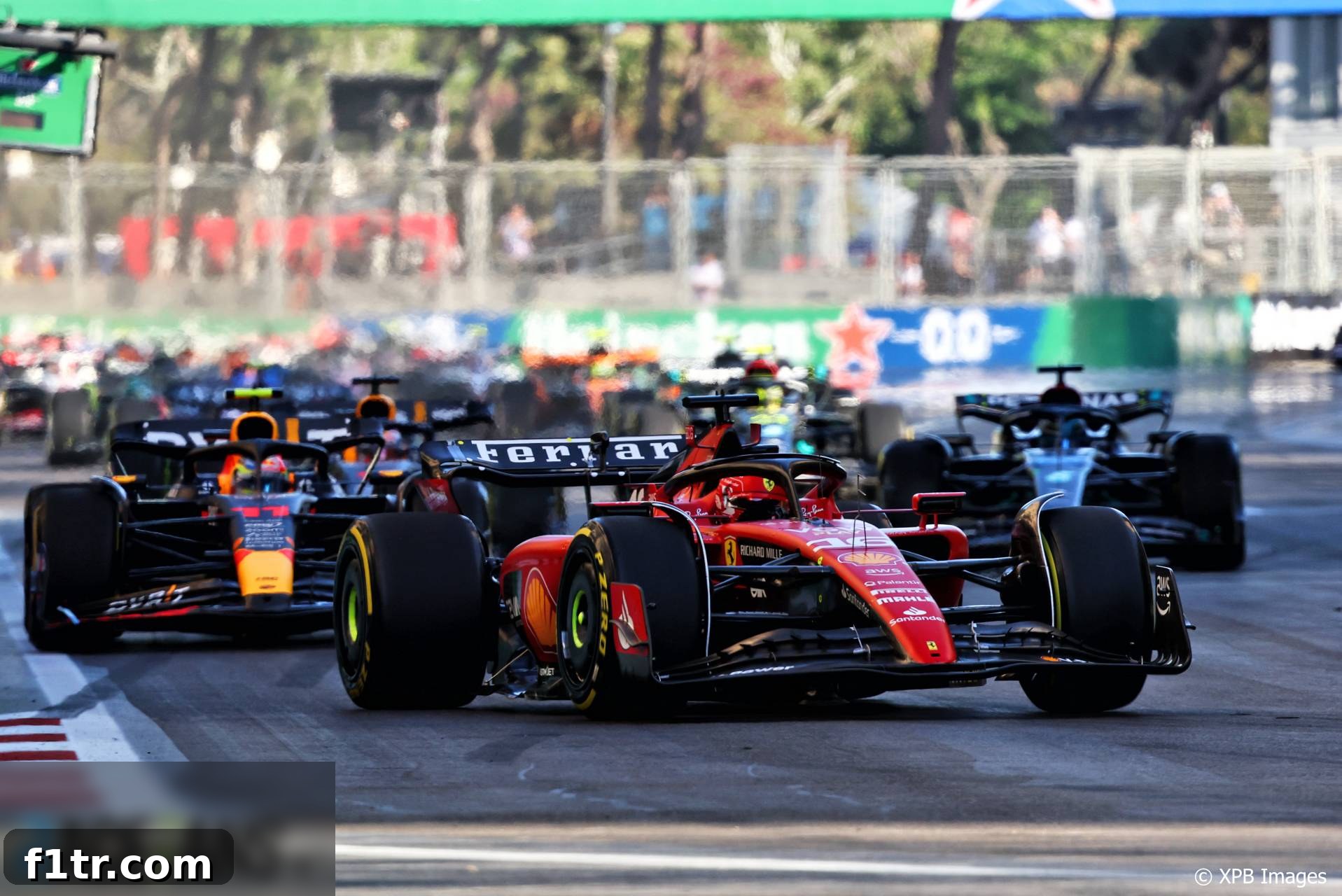
In a sport known for its high-octane drama and precision engineering, sometimes the most unexpected moments capture headlines. Such was the case during the adrenaline-fueled Azerbaijan Grand Prix sprint race, where Ferrari’s star driver, Charles Leclerc, and the ever-vigilant Safety Car driver found themselves navigating a truly bizarre obstacle: a stray cat on the track. This incident, an amusing yet stark reminder of the unpredictable nature of racing, quickly became a talking point, overshadowing some of the intense on-track battles at the Baku City Circuit.
The Feline Intruder: A Close Call on the Baku City Circuit
The 2023 Formula 1 season introduced a revised sprint race format, and Baku was one of the circuits chosen to host this fast-paced spectacle. The 17-lap sprint race saw Charles Leclerc start from pole position, a testament to Ferrari’s improved qualifying pace. The early stages of the race were immediately punctuated by a Safety Car deployment, not due to a racing incident, but to clear a significant amount of debris scattered across the challenging street circuit. This initial Safety Car period set the scene for the unforgettable encounter.
As the Safety Car, expertly driven by Bernd Maylander, led the field through the winding streets of Baku at the start of lap five, a peculiar sight unfolded. Rounding turn one, a corner that demands absolute precision and focus, Maylander was forced to take evasive action. His quick reflexes prevented a collision with a seemingly fearless feline that had wandered onto the active race track. Following closely behind, Leclerc witnessed the entire event unfold and promptly reported the presence of the stray cat over his team radio. However, the initial report on the world feed was comically misinterpreted as Leclerc reporting a “cut” on his car, leading to a moment of confusion and amusement among viewers and commentators alike.
Leclerc’s Account: “I Said a ‘Cat’, Which Is Different!”
The post-sprint race press conference provided the perfect platform for Leclerc to clarify the bizarre incident. With a wry smile, the Monegasque driver recounted, “I said a ‘cat’, which is different! There was a cat in the middle of the road and the Safety Car had to stop. But I think I was probably the only one who saw that.” Leclerc’s description vividly painted the scene: “In the exit of turn one, there was a cat and the Safety Car braked. It wasn’t too bad.” This rare occurrence highlighted not only the acute awareness required from F1 drivers and safety personnel but also the unpredictable elements that can creep into even the most meticulously planned sporting events.
The presence of an animal on a high-speed circuit like Baku, where cars routinely hit speeds exceeding 300 km/h, presents a significant safety risk. While incredibly uncommon in Formula 1 due to stringent trackside security measures, such incidents underscore the constant vigilance required by all involved in motorsport. Maylander’s swift reaction and Leclerc’s quick reporting ensured that no harm came to the animal, the Safety Car, or the following F1 cars, preventing a potentially dangerous situation from escalating further.
The Sprint Race Unfolds: Pole Position to P2
Beyond the memorable cat encounter, the Azerbaijan Grand Prix sprint race delivered plenty of on-track action. Once the circuit was clear and the Safety Car returned to the pits, the race restarted on the following lap. Leclerc, having held his pole position lead throughout the initial phase, found himself immediately under pressure from the Red Bull of Sergio Perez. The long main straight of the Baku City Circuit, combined with the activation of DRS (Drag Reduction System), proved to be Red Bull’s hunting ground.
Perez, known for his exceptional race craft and prowess on street circuits, wasted no time in capitalizing on Red Bull’s superior straight-line speed and tire management. He cleanly overtook Leclerc for the lead along the lengthy start-finish straight. Leclerc, driving his Ferrari SF-23, attempted valiantly to stay within striking distance of the Red Bull, utilizing every ounce of his car’s potential. However, as the laps ticked by, the inherent differences in race pace and tire degradation between Ferrari and Red Bull became increasingly apparent. Leclerc’s efforts, while commendable, were not enough to challenge Perez, who steadily pulled away to claim victory in the sprint race, finishing a comfortable four seconds ahead of the Ferrari driver.
Battle for the Lead: Perez’s Prowess and Ferrari’s Challenge
Leclerc candidly reflected on the race’s progression and Ferrari’s performance challenges in the sprint. “Basically, once you start with the tyre degradation, that’s where they started to go away or that Checo started to go away,” Leclerc explained. “So from that moment onwards, we had a little bit of a disadvantage.” This statement succinctly summarized Ferrari’s Achilles’ heel: while often sparkling in qualifying, converting that single-lap pace into consistent race performance, particularly over longer stints and with tire management, remained a significant hurdle for the Scuderia. Red Bull, conversely, showcased their exceptional ability to preserve their tires and maintain a strong, consistent pace throughout the race distance, a crucial advantage in the championship battle.
The Baku circuit, with its unique blend of slow, technical sections and extremely long, high-speed straights, places a premium on both aerodynamic efficiency and engine power, alongside tire conservation. Ferrari’s SF-23 demonstrated its improved aero efficiency in qualifying, allowing Leclerc to extract maximum performance over one lap. However, the Red Bull RB19’s ability to manage its tires effectively and maintain strong pace through the high-speed sections proved to be the decisive factor in the sprint race, especially once DRS was enabled, allowing Perez to exploit his car’s inherent advantages.
Looking Ahead to the Main Grand Prix: Pole Position Again
Despite finishing second in the sprint race, Charles Leclerc’s spirits remained high, buoyed by the prospect of starting the main Azerbaijan Grand Prix from pole position once more. This repeat pole was a clear indicator of Ferrari’s genuine progress, particularly in qualifying trim, compared to the opening rounds of the season. Leclerc acknowledged the intensity of the fight, even if the result wasn’t a victory: “I don’t know how much of a fight it was, but I tried my best.”
The challenge, as Leclerc openly admitted, lay in transforming that raw qualifying speed into race-winning pace on Sunday. “We are still lacking some pace in the race. This is definitely where our focus is at the moment. It’s been the case now since quite a bit, so we are working on that, trying to find something for the races. In qualifying, we seem to be okay.” This candid assessment highlights the ongoing development battle within Formula 1, where teams constantly strive to optimize their cars for every aspect of a race weekend. Ferrari’s efforts are clearly geared towards addressing this fundamental imbalance, aiming to close the gap to Red Bull during the grand prix itself.
Ferrari’s Progress: A Step Forward, But More Work Ahead
Leclerc articulated a sense of cautious optimism regarding Ferrari’s overall trajectory. “Having said that, I believe we did a step forward. I mean, if you look at Australia and here we are, we are better.” This improvement is vital for Ferrari, a team with a rich history and immense expectations. While the gap to Red Bull remains, the indication of progress provides a foundation for future development and boosts team morale. “We are not yet at the level of Red Bull, so still a lot of work to do,” he concluded, setting a realistic tone for the challenges that lie ahead.
The 2023 season has been a story of Red Bull’s dominance, particularly with Max Verstappen and Sergio Perez demonstrating consistent performance across various circuits. For Ferrari, the Baku Grand Prix weekend offered a glimmer of hope, proving their capability to challenge for pole positions. The strategic decisions made regarding tire compounds, race setups, and in-race management would be critical for Leclerc to stand any chance of fending off the Red Bulls and securing a much-needed victory in the main race. The long DRS zones and potential for safety cars or red flags always make Baku an unpredictable affair, offering Ferrari potential opportunities to play to their strengths.
The Unpredictable Nature of Formula 1: Baku’s Unique Challenges
Formula 1 is a sport that constantly balances precision, speed, and safety. Street circuits like Baku accentuate these factors, bringing the racing closer to urban environments and introducing unique variables. From sudden changes in track grip to the proximity of concrete barriers, every lap is a test of a driver’s skill and courage. The incident with the stray cat serves as a stark reminder that even in the most controlled and technologically advanced sporting environments, unforeseen elements can emerge, requiring split-second reactions and unwavering focus from everyone involved.
Baku’s layout, combining the longest straight on the F1 calendar with incredibly tight, medieval-city sections, demands a compromise in car setup. Teams must balance low-drag for top speed with high-downforce for cornering grip. This inherent compromise often leads to fascinating strategic battles and varying performance advantages between cars. The sprint race highlighted that while Ferrari has found a sweet spot for single-lap qualifying, Red Bull’s overall package, especially in race trim, remains the benchmark for consistency and effective tire usage.
Reflecting on Safety Protocols and Unforeseen Circumstances
The quick response of Safety Car driver Bernd Maylander in avoiding the cat underscored the vital role of safety personnel in Formula 1. These individuals are trained to react instantly to any hazard, ensuring the well-being of drivers and the integrity of the race. While animal intrusions are rare, track officials and marshals continuously monitor the circuit perimeter, and sophisticated camera systems are in place to detect potential issues. The incident, while lighthearted in its aftermath, could have been far more serious, highlighting the robustness of F1’s safety protocols and the professionalism of its operational teams.
Ultimately, the Baku Grand Prix weekend proved to be a blend of the expected and the extraordinary. Ferrari demonstrated significant qualifying pace, giving their fans hope for future success, while Red Bull reinforced their championship credentials with another strong race performance. And amidst all the high-speed action and strategic maneuvers, a small, intrepid cat managed to etch itself into the annals of Formula 1 history, providing a rare moment of unexpected charm and reminding everyone of the unpredictable theatre that is motorsport.
Bringing the F1 news from the source
RaceFans strives to bring its readers news directly from the key players in Formula 1. We are able to do this thanks in part to the generous backing of our RaceFans Supporters.
By contributing £1 per month or £12 per year (or the equivalent in other currencies) you can help cover the costs involved in producing original journalism: Travelling, writing, creating, hosting, contacting and developing.
We have been proudly supported by our readers for over 10 years. If you enjoy our independent coverage, please consider becoming a RaceFans Supporter today. As a bonus, all our Supporters can also browse the site ad-free. Sign up or find out more via the links below:
- Become a RaceFans Supporter
- RaceFans Supporter FAQ
2023 Azerbaijan Grand Prix Related Stories
- Aston Martin radio messages reveal how “older brother” Alonso helps Stroll
- How slashing practice to a single hour in Baku tripped up F1 teams
- Bottas: “Rapid improvement needed” at Alfa Romeo
- Red Bull could become first team to score 1,000 points in a season
- Aston Martin hoping DRS fix works in Miami after Stroll manages fault in race
Browse all 2023 Azerbaijan Grand Prix articles