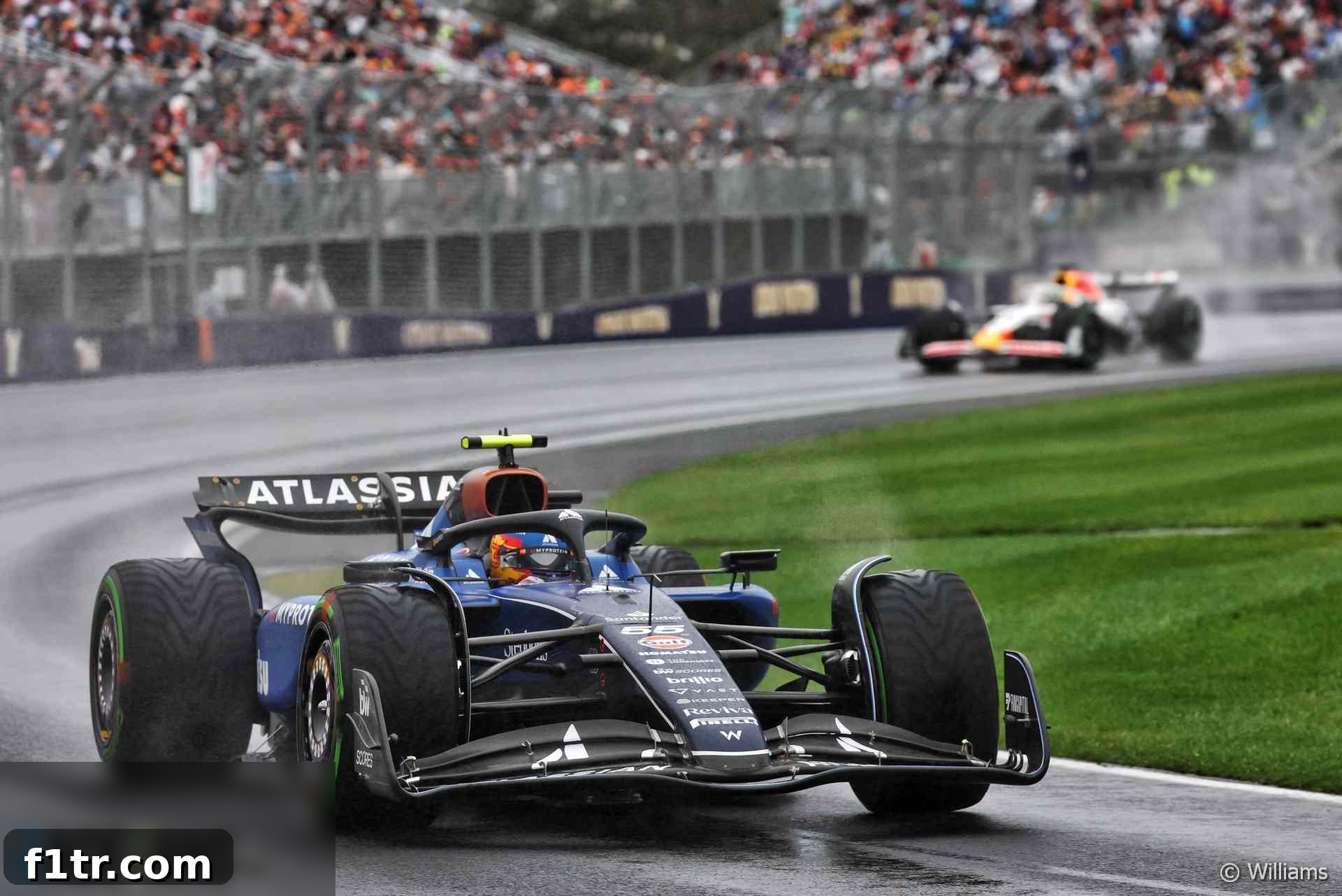
The Australian Grand Prix, often a stage for high drama and unexpected turns, delivered a particularly poignant moment on its opening lap with Williams driver Carlos Sainz Jr prematurely exiting the race. The incident, which occurred under challenging wet conditions, prompted an immediate and thorough investigation by the Williams Racing team. Team Principal James Vowles has since provided an in-depth analysis, shedding considerable light on the complex interplay of factors that led to Sainz’s unfortunate spin into the barrier at the final corner, ultimately triggering a Safety Car deployment just moments after an earlier incident involving Jack Doohan.
Vowles’ explanation highlighted a critical combination of treacherously low-grip conditions – a common characteristic of a rain-soaked track – and an unexpected power delivery characteristic of the FW47 while operating in its specialized Safety Car mode. This intricate blend of environmental challenge and technical nuance created a perfect storm, catching even a seasoned driver like Sainz off guard and illustrating the razor-thin margins that define Formula 1 racing.
Unpacking the Incident: A Technical Deep Dive
Detailing the sequence of events, Vowles explained, “He was coming through the last corner, he was in second gear, he held a fairly constant throttle position – actually a tiny bit lower, a percent or two lower – and pulled for an upshift into third gear, so it’s a part throttle upshift.” This description paints a picture of a driver executing a standard maneuver, albeit in a highly sensitive context. The core issue, Vowles elaborated, lay within the car’s operational mode at that specific juncture. “When he did so, what happens inside those conditions is we’re in a different mode, it’s a Safety Car mode, so that runs the systems in a very different way if we’re in flat out. And what happens is, as you would imagine, we have a disengagement of power and torque and then a re-engagement of power and torque.”
The transition between gears, particularly during a part-throttle upshift, requires precise management of power and torque to maintain stability and traction. In a standard racing mode, the engine and transmission control units are finely tuned for aggressive performance and seamless power delivery, even under immense load. However, the Safety Car mode, by its very design, prioritizes different parameters. Its primary functions include managing fuel consumption, optimizing engine cooling, and ensuring the car adheres to regulated speeds. This often involves altered engine maps, reduced power output, and a more conservative torque delivery strategy compared to full-race mode. The intention is to make the car more manageable and efficient during periods of reduced speed, not necessarily to provide instantaneous, high-traction response in treacherous conditions.
Vowles’ critical observation was that “there was a tiny bit more than would have been expected” during the re-engagement of power and torque. This “tiny bit more,” while seemingly negligible in dry conditions, became significant on a saturated track. When a driver upshifts, the powertrain briefly disengages power and then re-engages it in the higher gear. In wet conditions, the available grip is dramatically reduced. Tires struggle to evacuate water, leading to hydroplaning and a significantly smaller contact patch with the asphalt. Cold tire temperatures, exacerbated by slower Safety Car speeds, further diminish grip levels. A sudden, even slightly larger-than-anticipated surge of torque upon re-engagement can easily overwhelm the limited available traction, especially when the car is cornering. This would manifest as an abrupt loss of rear-end grip, leading to an uncontrollable spin.
The Team Principal aptly summarized the incident as an “accumulation of conditions.” It was not a single, isolated factor but rather a perfect storm where the low-grip environment amplified a minor, unexpected characteristic of the car’s Safety Car mode. The driver’s input, while standard, interacted with these specific conditions in a way that led to an unfortunate outcome, underscoring the relentless pursuit of perfection in Formula 1 engineering.
Williams’ Proactive Response and Mitigation Strategies
Recognizing the gravity of the incident and their commitment to continuous improvement, the Williams team immediately initiated a comprehensive review. Vowles outlined their priorities: “First and foremost, I think what we have to review is how and what we’re doing with those settings and that Safety Car mode in wet conditions. I don’t think we were optimum, and that’s on us as a team.” This candid admission highlights Williams’ internal accountability and their dedication to learning from every on-track event. The focus will undoubtedly be on refining the software algorithms and calibration of the Safety Car mode, particularly how it manages power and torque transitions in wet and low-grip scenarios. Engineers will meticulously analyze data logs, simulating the exact conditions to identify precise points of improvement in throttle mapping and torque delivery curves. The goal is to ensure absolute predictability and smoothness, regardless of track conditions, providing drivers with complete confidence in the car’s behavior.
Beyond the specific technical adjustments, Vowles also stressed the overall treacherous nature of the track: “The second is that it was treacherous out there. I really can’t state that enough. When you’re going slowly, your tyre temperatures are being lost, any small amount of additional grip loss will be accentuated, and I think that’s what we have there.” This observation underscores a fundamental challenge in wet weather racing under a Safety Car. While speeds are reduced, the tires cool down rapidly, falling out of their optimal operating window. This loss of temperature translates directly into reduced grip, making the car inherently more unstable. Even minute irregularities in track surface, standing water, or indeed, an unexpected power delivery, can trigger a dramatic loss of control. The team’s ongoing review will extend to understanding how these external factors can be better anticipated and managed through car setup and operational procedures, ensuring the FW47 is not only fast but also robustly predictable in the most challenging environments.
“We’re still ongoing in terms of reviewing because clearly we need to make sure that we’re improving in every single area and providing a car to the drivers that’s predictable and consistent,” Vowles affirmed. This commitment to predictability and consistency is paramount in Formula 1. Drivers operate at the absolute limit, relying instinctively on the car’s responses. Any unexpected behavior, no matter how minor, can be catastrophic. The team’s efforts will focus on ensuring that the car’s electronic systems, engine management, and chassis setup work harmoniously to deliver a stable and reliable platform, empowering drivers like Sainz and his teammate Alexander Albon to extract maximum performance with unwavering confidence, even in the most demanding circumstances.
Carlos Sainz Jr.’s Unforeseen Impact from the Pit Wall
In a testament to his professionalism and dedication, Carlos Sainz Jr. did not let his early retirement from the race deter him from contributing to the team’s efforts. Instead, he quickly transitioned from cockpit to pit wall, offering invaluable real-time insights to help the team navigate the ever-evolving conditions for Alexander Albon, who remained in the race. This immediate feedback proved instrumental in Albon’s strong performance, culminating in a commendable fifth-place finish.
Vowles was effusive in his praise for Sainz’s contribution: “What Carlos was doing was trying to provide as much information as possible, be that about car performance, the conditions, what was coming in on the weather radar. And his insight was fantastic. It was useful, it was clear.” A driver’s perspective, fresh from the cockpit, offers a unique and critical dimension to strategic decision-making. Sainz could articulate how the car felt, where the grip limits were, how the tires were behaving, and interpret the track conditions in a way that data alone might not fully convey. This direct, unfiltered feedback is gold dust for engineers and strategists, especially in a dynamic race where weather and track grip can change lap by lap. His ability to translate his recent experience into actionable intelligence for Albon’s car and the strategic calls made by the team demonstrated his maturity and intrinsic value beyond just his driving ability.
Adding a touch of humor and revealing the intense pressure of both roles, Vowles recounted Sainz’s personal reflection: “He actually said it was more nerve-wracking being up there on the pit wall, with the amount of information coming in, than driving around the car in those conditions, which I don’t believe for a second. But irrespective, it was still great to have him by our side.” While Vowles’ playful disbelief hints at the unparalleled demands of driving an F1 car at speed, Sainz’s comment highlights the different kind of pressure experienced on the pit wall. There, decisions must be made instantly, based on a torrent of live data, weather forecasts, competitor movements, and driver feedback, all with the race result hanging in the balance. It requires a different cognitive load, one that Sainz clearly embraced despite his disappointment. His presence was not just about data, but also about team morale and providing a cohesive, unified front in the face of adversity, ultimately contributing significantly to Albon’s unexpected points finish.
Future Outlook for Williams Racing
The Australian Grand Prix, while ending prematurely for one of its drivers, served as a crucial learning experience for Williams Racing. The incident with Carlos Sainz Jr. has illuminated specific areas for technical refinement, particularly concerning the car’s behavior in Safety Car modes under wet conditions. The team’s transparent and proactive approach to investigating the issue, coupled with their stated commitment to ensuring a predictable and consistent car, bodes well for their ongoing development. Moreover, the seamless transition of Sainz from driver to strategic advisor underscores the formidable teamwork and resilience within the Williams garage. As Formula 1 continues its relentless march of technological advancement and competitive intensity, incidents like these are not merely setbacks but vital data points that fuel innovation, refine engineering processes, and ultimately contribute to building stronger, more reliable racing machines capable of performing at the pinnacle of motorsport.
Formula 1
Browse all Formula 1 articles