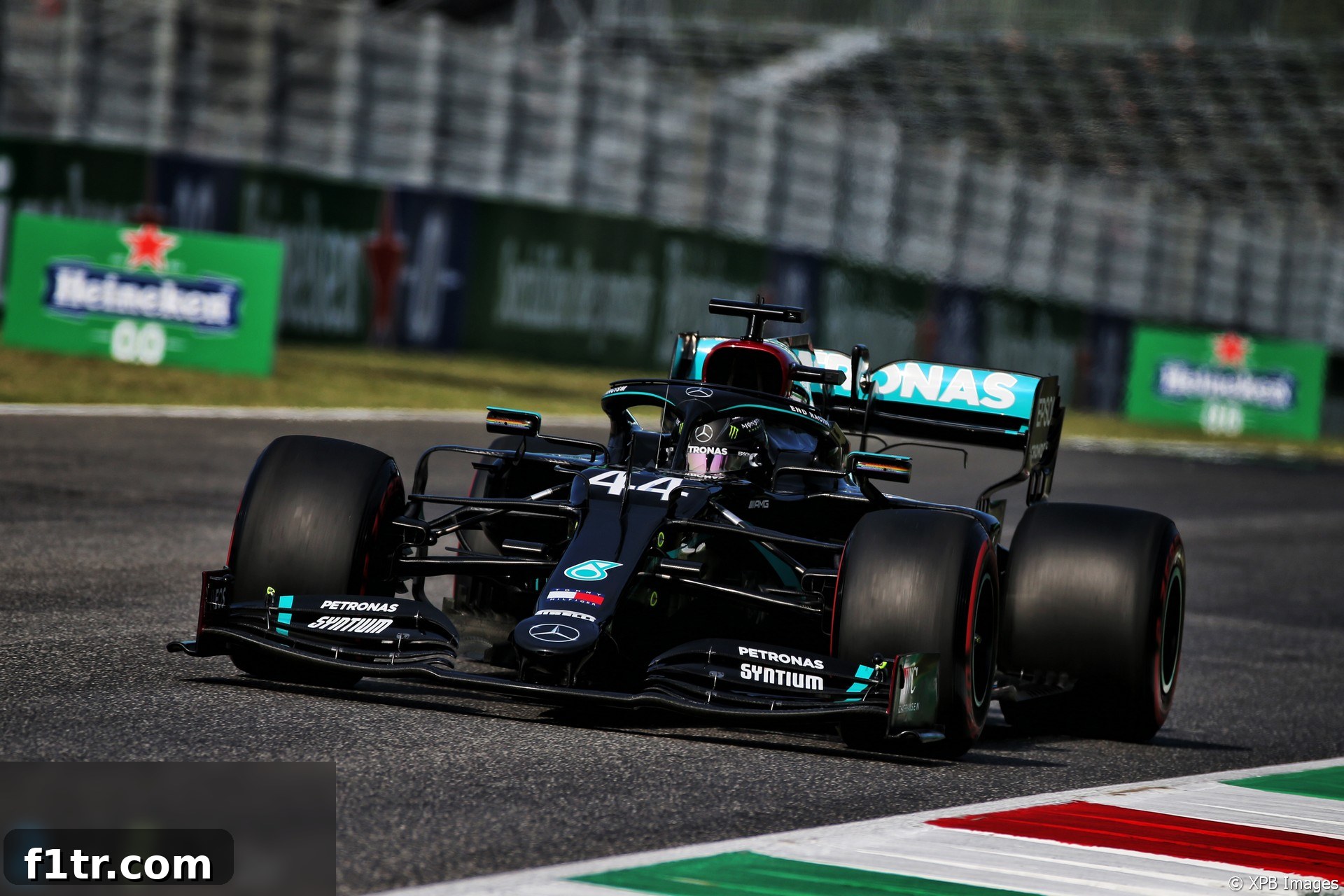
The inaugural Tuscan Grand Prix qualifying session at the picturesque Mugello Circuit delivered high drama and intense competition, culminating in Lewis Hamilton securing a hard-fought pole position. The Mercedes-AMG Petronas driver, a six-time world champion, demonstrated his prowess by narrowly overcoming his teammate, Valtteri Bottas, in a battle that kept fans on the edge of their seats until the very last moments.
The rivalry between the two Mercedes drivers was palpable throughout Saturday’s session, with mere hundredths of a second often separating their lap times. However, the ultimate outcome of the pole position fight was decided under frustrating circumstances for Bottas, when Esteban Ocon spun his Renault, bringing out crucial yellow flags. This incident forced Bottas to abort his final, potentially pole-winning lap, leaving Hamilton unchallenged for the top spot on the grid.
The Tuscan Grand Prix marked a significant milestone for Ferrari, being their 1000th Formula 1 race. The event, held at their owned Mugello circuit, added an extra layer of anticipation and expectation, with drivers pushing the limits on a track known for its high-speed corners and demanding nature.
Q1: Early Pace and Surprising Exits
Following a dominant performance in all three practice sessions, Valtteri Bottas entered qualifying as the clear benchmark, showcasing exceptional pace around the challenging Mugello Circuit. His initial flying lap in Q1, a blistering 1’15.749, immediately set the tone, though Lewis Hamilton was hot on his heels, trailing by an incredibly slim 29 thousandths of a second. The Mercedes duo quickly established their authority, hinting at the close fight that would unfold.
Hamilton’s race engineer, Peter Bonnington, offered precise feedback after the first runs, highlighting areas for improvement: “Losses are minimum speed turns two and three [Luco/Peggio Secco] and entry turn 12 [Correntaio].” This level of detail underscored the razor-thin margins at play, even in the initial stages of qualifying.
Max Verstappen positioned his Red Bull Racing machine in third, though he was a considerable half-second off Bottas’s blistering pace. The gap emphasized the Mercedes advantage, even as Verstappen looked to be the ‘best of the rest’. He was separated from his teammate, Alexander Albon, by the two Racing Point drivers. Lance Stroll, benefiting from the latest aerodynamic updates on his RP20, initially held an edge over his more experienced teammate, Sergio Perez. However, Perez, opting for an additional run, managed to improve his time and move ahead of Stroll, ensuring both Racing Points comfortably progressed to Q2.
The battle for survival in Q1 was intense, particularly in the lower midfield. Nicholas Latifi, enjoying one of his strongest weekends in the Williams, momentarily held an impressive 13th position ahead of the final runs. This put him ahead of unexpected names like Sebastian Vettel, Lando Norris, and even Monza race winner Pierre Gasly, highlighting the unpredictability of the session. Meanwhile, George Russell, who had faced a brake-by-wire failure in final practice, found himself in 18th ahead of the Haas pair as the crucial final laps commenced.
Russell showcased his characteristic determination, pushing his Williams to the absolute limit. Despite dropping two wheels off the track at Savelli, he maintained control and managed to improve his lap time. However, it wasn’t quite enough to propel him into Q2, though he did maintain his impressive record of consistently out-qualifying his teammate. “Not enough, not enough, sorry guys,” Russell lamented over the radio. “How the hell we finished that I have no idea. I think I damaged the rear.” He later added, “A bit of off-roading probably didn’t help that,” while expressing gratitude to his team for their swift repairs between sessions.
Sebastian Vettel, driving for Ferrari in their milestone 1000th Grand Prix, narrowly scraped into Q2, doing so at the expense of an agitated Pierre Gasly, who was visibly frustrated at failing to make the cut. Similarly, Romain Grosjean expressed his aggravation after being overtaken by both Alfa Romeos just as he was about to start his final flying lap, calling it “just not good” despite the lack of specific rules against it. While he did make it through to Q2, his mood was clearly soured. Kimi Raikkonen also progressed for Alfa Romeo, but his teammate Antonio Giovinazzi was eliminated, as was Kevin Magnussen for Haas.
Drivers eliminated in Q1
| 16 | Pierre Gasly | AlphaTauri-Honda | 1’17.125 |
| 17 | Antonio Giovinazzi | Alfa Romeo-Ferrari | 1’17.220 |
| 18 | George Russell | Williams-Mercedes | 1’17.232 |
| 19 | Nicholas Latifi | Williams-Mercedes | 1’17.320 |
| 20 | Kevin Magnussen | Haas-Ferrari | 1’17.348 |
Q2: Mercedes Continues to Dominate, Midfield Scramble
The intensity remained high in the second qualifying segment, with the Mercedes drivers once again setting a blistering pace. This time, Lewis Hamilton managed to edge ahead of Valtteri Bottas by an incredibly slim margin of just 13 thousandths of a second, signaling his growing confidence and mastery of the Mugello Circuit. Max Verstappen continued to be the closest challenger to the Silver Arrows, improving his lap time to within just over a tenth of a second of the Mercedes. However, his frustration was evident when his out-lap was compromised by being held up by Lance Stroll as he exited the pits, potentially costing him valuable tenths.
The midfield battle for a spot in the top 10 intensified significantly. Daniil Kvyat and Carlos Sainz Jnr found themselves in the provisional drop zone after their initial runs, having even set identical lap times of 1’16.854. Sainz voiced his displeasure over the team radio, complaining about time lost in traffic during his lap, which left him almost two-tenths adrift of his teammate and perilously close to elimination. The fight for the final Q3 spots was incredibly tight, with multiple drivers vying for every hundredth of a second.
With a clearer track and a strong final effort, Carlos Sainz Jnr significantly improved his time, vaulting into 10th position. This crucial improvement was enough to secure his place in Q3, albeit at the expense of his own teammate, who was subsequently knocked out. Daniil Kvyat, unfortunately, failed to improve on his time, after running wide at the very same corner that had troubled George Russell in Q1, highlighting the unforgiving nature of Mugello. Kimi Raikkonen matched Kvyat’s time but would start behind him due to setting his time later in the session, a cruel twist of fate.
Sebastian Vettel’s struggles continued, and he too failed to progress beyond Q2, a disappointing outcome for Ferrari at their special 1000th race event. However, his teammate Charles Leclerc delivered a stellar performance, ensuring at least one Ferrari would start inside the top 10, providing a much-needed boost for the Tifosi. Romain Grosjean, who had shown promising pace in final practice, ended Q2 in last place, visibly frustrated. His mood wasn’t helped by being called to the weigh bridge again, which he felt cost him crucial time at the start of his final lap. “I don’t know where the competitiveness from practice three has gone,” he remarked. “But starting the lap four-tenths down is never ideal is it?”
Significantly, all drivers in Q2 opted to run on the soft compound tyre. This strategic choice, which typically offers an improvement of around nine tenths of a second over the medium compound, meant that all ten drivers progressing to Q3 would start the race on the same, softer tyre compound, setting the stage for an intriguing opening stint on Sunday.
Drivers eliminated in Q2
| 11 | Lando Norris | McLaren-Renault | 1’16.640 |
| 12 | Daniil Kvyat | AlphaTauri-Honda | 1’16.854 |
| 13 | Kimi Raikkonen | Alfa Romeo-Ferrari | 1’16.854 |
| 14 | Sebastian Vettel | Ferrari | 1’16.858 |
| 15 | Romain Grosjean | Haas-Ferrari | 1’17.254 |
Q3: Dramatic Conclusion Seals Hamilton’s Pole
The final segment of qualifying, Q3, commenced with Lewis Hamilton holding a slender advantage, but the gaps between the frontrunners remained incredibly tight. Valtteri Bottas was marginally quicker through the first sector on his initial flying lap, demonstrating his relentless pursuit of pole position. However, Hamilton meticulously clawed back the advantage through the middle and final sectors of the lap. At the line, the two black Mercedes cars were separated by less than six hundredths of a second, illustrating the intense internal battle within the team.
Max Verstappen, despite his best efforts, couldn’t quite match his strong Q2 time on his first Q3 run. When asked about potential improvements to his car’s balance, Verstappen responded succinctly, “It’s fine, I just didn’t have grip,” indicating the limits of the Red Bull on the demanding Mugello track. His teammate, Alexander Albon, secured a commendable fourth place after the initial runs, showcasing improved form. Sergio Perez, strategically running later than the first group of drivers, managed to set the fifth-fastest time, putting his Racing Point firmly in contention for a strong grid slot.
As the drivers embarked on their crucial final runs, the tension in the pit lane and on the track was palpable. Lewis Hamilton didn’t get off to the strongest start on his last attempt, being fractionally slower in the first sector. However, he diligently improved his pace through the challenging middle section of the lap, seemingly poised to consolidate his provisional pole. But the battle for pole position was abruptly and dramatically decided by an unforeseen incident involving Esteban Ocon.
As Ocon navigated the exit of Poggio Secco, his Renault snapped sideways, causing him to spin and ultimately stop by the side of the track. This incident immediately triggered yellow flags in the sector, precisely as Valtteri Bottas arrived on the scene, pushing hard on his final, potentially pole-winning lap. Forced to back off and abandon his run due to the yellow flags, Bottas’s frustration was evident in his exclamatory “Shit!” over the team radio. The yellow flags meant no further improvements were possible for anyone in that sector, effectively securing Lewis Hamilton’s pole position without Bottas having a fair chance to respond.
Max Verstappen did manage to improve his lap time on his final attempt, solidifying his third-place position on the grid, once again leading the charge for Red Bull Racing. Alexander Albon backed him up superbly in fourth. Charles Leclerc delivered a superb performance for Ferrari, claiming an impressive fifth place for their home Grand Prix and 1000th race milestone, ahead of the Racing Point pair. Sergio Perez qualified ahead of Lance Stroll, although his one-place grid penalty (for an incident in practice) would ultimately drop him behind his teammate for the race start. Daniel Ricciardo and Carlos Sainz Jnr rounded out the top nine, with Esteban Ocon unable to set a time in Q3 due to his spin, but still placed tenth on the grid.
Top ten in Q3
| 1 | Lewis Hamilton | Mercedes | 1’15.144 |
| 2 | Valtteri Bottas | Mercedes | 1’15.203 |
| 3 | Max Verstappen | Red Bull-Honda | 1’15.509 |
| 4 | Alexander Albon | Red Bull-Honda | 1’15.954 |
| 5 | Charles Leclerc | Ferrari | 1’16.270 |
| 6 | Sergio Perez | Racing Point-Mercedes | 1’16.311 |
| 7 | Lance Stroll | Racing Point-Mercedes | 1’16.356 |
| 8 | Daniel Ricciardo | Renault | 1’16.543 |
| 9 | Carlos Sainz Jnr | McLaren-Renault | 1’17.870 |
| 10 | Esteban Ocon | Renault | No time |
2020 Tuscan Grand Prix Ferrari 1000
Browse all 2020 Tuscan Grand Prix Ferrari 1000 articles