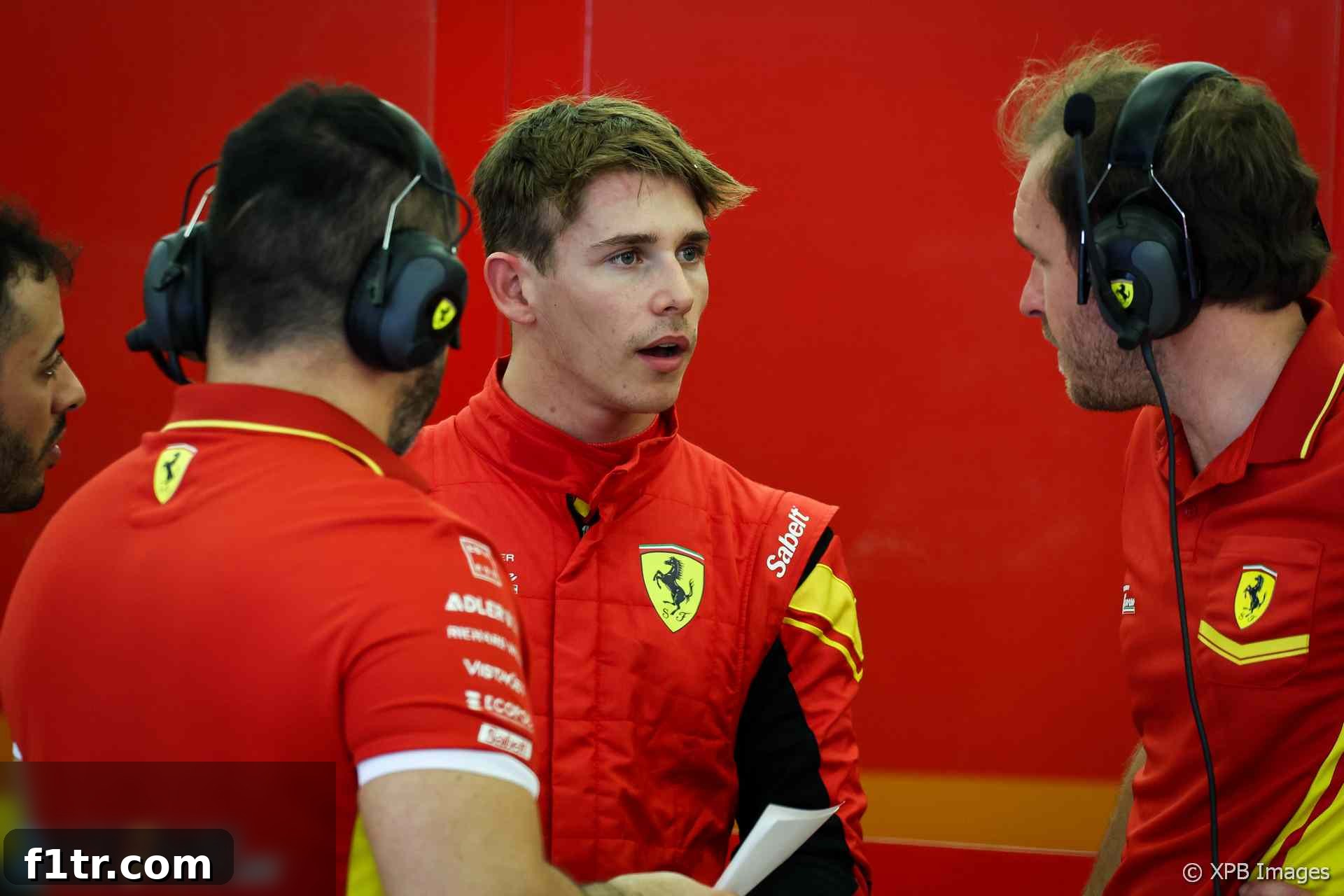
The upcoming Abu Dhabi Grand Prix will mark a significant milestone in the promising career of Arthur Leclerc, as he prepares to make his official Formula 1 practice session debut. This highly anticipated event will see the 23-year-old talent take to the track alongside his elder brother, Charles Leclerc, under the banner of Scuderia Ferrari. It’s a moment that underscores Ferrari’s enduring commitment to nurturing young talent and fulfilling its obligations under Formula 1’s evolving junior driver regulations.
Advert | Become a Supporter & go ad-free
Arthur Leclerc is scheduled to participate in Friday’s First Free Practice (FP1) session, where he will pilot Carlos Sainz Jnr’s car. This allocation is a direct result of Ferrari’s mandate to run two junior drivers in their cars over the course of the season, a rule designed to provide crucial experience to aspiring F1 talents. Following the FP1 session, Carlos Sainz Jnr will reclaim his seat for the subsequent second practice session, ensuring continuity for the team’s race preparations.
Arthur Leclerc’s Ascendant Journey to Formula 1 Practice
Arthur Leclerc’s path to an official Formula 1 practice debut has been a testament to his dedication and skill, building a robust foundation through various competitive motorsport categories. Hailing from Monaco, much like his world-renowned brother, Arthur began his racing journey in karting, where he quickly demonstrated a natural aptitude for speed and competition. His progression through the ranks of junior single-seater racing has been closely watched, particularly since joining the esteemed Ferrari Driver Academy (FDA).
Leclerc became a part of the FDA in 2020, a pivotal step that provided him with unparalleled access to Ferrari’s resources, engineering expertise, and development pathways. During his time with the academy, he showcased his capabilities in multiple championships. A notable achievement came in 2022 when he secured the Formula Regional Asian Series title, a victory that highlighted his consistency and ability to perform under pressure in a competitive international field. This triumph was a clear indicator of his potential to climb further up the motorsport ladder.
Following his success in Formula Regional, Arthur advanced to the FIA Formula 3 Championship, where he consistently demonstrated strong racecraft. His journey continued into the highly challenging FIA Formula 2 Championship for a single season, a crucial stepping stone often considered the final proving ground before Formula 1. While his Formula 2 campaign presented its own set of learning curves, the experience gained in such a demanding and fiercely contested series is invaluable for any driver aiming for the pinnacle of motorsport.
In a strategic move to broaden his racing experience and develop new skill sets, Arthur transitioned into sportscar racing in 2023. He joined Panis Racing in the European Le Mans Championship (ELMC), competing in an LMP2 prototype. This change allowed him to immerse himself in endurance racing, teamwork dynamics, and car development from a different perspective. Partnering with Manuel Maldonado (cousin of former F1 driver Pastor Maldonado) and Charles Milesi, Leclerc played a key role in the team securing a commendable fourth place overall in the championship standings, showcasing his versatility across different racing disciplines.
Further solidifying his connection with the Scuderia, Arthur recently participated in a test session for Ferrari’s World Endurance Championship (WEC) hypercar team in Bahrain. This experience, undertaken just last month, provided him with additional track time in a high-performance, technologically advanced machine, further preparing him for the unique demands of a Formula 1 car. These diverse experiences collectively built a comprehensive profile, making him a deserving candidate for this significant F1 practice debut.
The Significance of Sharing the Track with Charles Leclerc
For Arthur, making his F1 practice debut is not merely a personal accomplishment; it’s a moment imbued with profound family significance. Sharing the track in a Ferrari F1 car with his older brother, Charles, a multiple Grand Prix winner and a cornerstone of the Scuderia, is a dream realized for the Leclerc family. It symbolizes years of shared passion, mutual support, and the relentless pursuit of excellence that defines their racing journey. This unique sibling dynamic adds an extra layer of narrative and emotion to the Abu Dhabi Grand Prix, captivating fans and highlighting the powerful connection between talent and heritage within the world of Formula 1.
Ferrari’s Strategic Vision for Junior Driver Development
Scuderia Ferrari’s decision to provide Arthur Leclerc with this invaluable opportunity in Abu Dhabi is indicative of their meticulous and forward-thinking approach to junior driver development. As one of Formula 1’s most iconic teams, Ferrari recognizes that sustained success at the highest level requires a robust pipeline of emerging talent. The Ferrari Driver Academy (FDA) stands at the core of this strategy, serving as an elite program dedicated to identifying, nurturing, and guiding young racers through the challenging ranks of motorsport towards potential Formula 1 careers.
The allocation of FP1 slots to junior drivers is not merely a goodwill gesture but a mandatory requirement under Formula 1 regulations. These rules stipulate that each team must dedicate at least two First Free Practice sessions per car during the season to ‘inexperienced’ drivers. An inexperienced driver is defined as someone who has participated in two or fewer Formula 1 Grand Prix races. The primary objective of these regulations is clear: to bridge the gap between junior categories and Formula 1, offering crucial real-world track time and an immersive introduction to the operational complexities of an F1 team.
Navigating Rookie Driver Regulations: The Oliver Bearman Scenario
Ferrari’s meticulously planned junior driver schedule for the 2023 season faced an unforeseen but positive disruption, largely centered around the rapid progression of fellow Ferrari Driver Academy talent, Oliver Bearman. Bearman, an exceptionally gifted young Briton, gained significant attention and praise for his outstanding performances when called upon to substitute in various Grand Prix races throughout the season.
His impressive substitute appearances included stepping in for Carlos Sainz at Jeddah and for Kevin Magnussen in Baku. Crucially, Bearman’s third appearance in a Grand Prix at Interlagos last month, while showcasing his undeniable readiness for F1, meant he technically surpassed the ‘two Grand Prix races’ threshold. Consequently, under F1’s specific definition for rookie FP1 sessions, Oliver Bearman no longer qualified as an ‘inexperienced driver’. This unexpected ‘graduation’ from rookie status, though a testament to his burgeoning talent, necessitated a swift recalibration of Ferrari’s plans to ensure they met their mandatory junior driver FP1 obligations for the season. Arthur Leclerc, with his consistent development and diversified racing experience, emerged as the ideal candidate to step into this pivotal role, underscoring the depth and adaptability of Ferrari’s FDA program.
The Evolving Landscape of F1 Junior Driver Rules
The regulations governing junior driver participation in Formula 1 practice sessions are not static; they are periodically reviewed and refined to ensure they effectively support the development of future F1 stars. The current framework, requiring teams to allocate at least two FP1 sessions per car per season to inexperienced drivers, has proven instrumental in providing crucial track time and evaluation opportunities. These sessions allow teams to assess a driver’s raw speed, technical feedback, and ability to integrate with an F1 team’s highly specialized environment.
Recognizing the immense value these opportunities present, Formula 1 is poised to introduce even more robust regulations from the upcoming season. Starting next year (referring to the season after the 2023 Abu Dhabi GP, likely 2025 based on article context), teams will be mandated to dedicate two first practice sessions in each of their cars to junior drivers. This means that a two-car team will effectively need to run a rookie in four FP1 sessions across the season, a significant increase from the current minimum. This progressive enhancement is designed to provide more comprehensive exposure and accelerated experience for the next generation of Formula 1 talent. The aim is to make the transition from highly competitive feeder series to the pinnacle of motorsport more structured and accessible, thereby fostering a healthier and more diverse pool of potential F1 drivers for the future.
Other Teams Fulfilling Their Obligations in Abu Dhabi
Ferrari is not an anomaly in choosing the season-ending Abu Dhabi Grand Prix to fulfill its junior driver commitments. The Yas Marina Circuit often serves as a practical and popular venue for such debuts, offering a familiar track layout to many drivers and a relatively lower-pressure environment compared to early-season races. Several other teams on the grid are also utilizing this final round of the championship to provide their rookie talents with invaluable F1 experience.
Among these, Ferrari’s constructors’ championship rivals, McLaren, will also be fielding a junior driver. Japanese driver Ryo Hirakawa is set to take the wheel of Oscar Piastri’s car during the first practice session. Hirakawa, a highly accomplished endurance racer and a World Endurance Champion, represents another example of a team leveraging diverse talent pools. His participation, alongside Arthur Leclerc’s, further underscores the strategic importance that F1 teams place on these FP1 opportunities, not just for compliance but as crucial development steps for the sport’s future.
Advert | Become a RaceFans supporter andgo ad-free
The Profound Impact of an F1 Practice Session for a Rookie
For a rookie driver like Arthur Leclerc, an FP1 session in Formula 1 is far more than just an hour of track time; it’s an intense and comprehensive immersion into the world’s most technologically advanced motorsport. This experience offers an unparalleled opportunity to grasp the immense complexities, the sheer speed, and the unique demands of driving a contemporary F1 car.
During the 60-minute session, Arthur will be tasked with specific objectives that go beyond simply setting fast lap times. He will be crucial in collecting vital data for the team, testing new aerodynamic components, evaluating tire performance, and providing precise feedback to a cadre of highly specialized engineers. This requires exceptional concentration, rapid assimilation of information, and the ability to articulate minute details about car behavior under extreme conditions. He will experience the brutal G-forces, the intricate multi-function steering wheel, and the relentless pressure to perform flawlessly on a globally televised stage.
Beyond the physical act of driving, the session provides crucial exposure to the entire F1 ecosystem. This includes interacting with the global media, adhering to stringent paddock protocols, and understanding the meticulous scheduling and vast logistical operations that underpin every Grand Prix weekend. These elements are integral to the life of a full-time F1 driver, and an FP1 session offers a concentrated dose of this demanding reality, preparing them for future challenges and responsibilities.
For Ferrari, Arthur’s performance in Abu Dhabi will yield invaluable direct data and firsthand feedback regarding his capabilities under actual F1 conditions. It serves as a vital assessment opportunity for the team to evaluate his adaptability, technical acumen, and composure when faced with the demands of an F1 car and its operational environment. While a single session is unlikely to seal a driver’s long-term fate, it can significantly enhance their profile, solidify positive impressions, and open doors to further testing opportunities, simulator roles, or even a pathway towards a future F1 reserve or race seat within the Ferrari family or with customer teams.
What Lies Ahead for Arthur Leclerc?
Arthur Leclerc’s Formula 1 practice debut at the Abu Dhabi Grand Prix represents a pivotal moment in his burgeoning racing career. While a full-time Formula 1 race seat remains the ultimate aspiration for many young drivers, gaining official F1 track experience is an invaluable asset. This experience significantly enhances his professional profile, making him a more compelling candidate for future opportunities, whether those are further testing roles, a position as a reserve driver, or continued top-tier competition in sportscar racing.
His ongoing association with Ferrari, underscored by his recent hypercar test, suggests a strong and continuous relationship with the Scuderia. This connection could potentially lead to a dedicated role as a simulator driver, crucial for car development, or further track testing. Such roles provide continuous learning and keep a driver firmly within the F1 orbit. The unique perspective and benchmark gained from driving an F1 car, even for a single session, will undoubtedly influence all his future racing endeavors and inform his continued development as a professional driver.
Ultimately, Arthur Leclerc’s highly anticipated debut is a powerful affirmation of Ferrari’s unwavering commitment to identifying and cultivating the next generation of racing talent. It also highlights the challenging yet structured pathway that young drivers must navigate to reach and succeed at the pinnacle of motorsport. As the 2023 Formula 1 season draws to a close, this debut serves as a compelling reminder of the continuous cycle of talent discovery and development that is vital for the sport’s vibrant future.
Miss nothing from RaceFans
Get a daily email with all our latest stories – and nothing else. No marketing, no ads. Sign up here:
Related Articles: 2024 Abu Dhabi Grand Prix
- Did Tsunoda ‘destroy’ his team mates – and are Red Bull wrong to pick Lawson over him?
- McLaren were ‘0.7 seconds away from losing the title’ in Abu Dhabi – Brown
- Another name change for RB and new driver numbers revealed in 2025 F1 entry list
- Ranked: The Formula 1 cars of 2024, from slowest to fastest
- McLaren are world champions with fewest grand prix wins in 25 years
Browse all 2024 Abu Dhabi Grand Prix articles