Charles Leclerc Pinpoints Tyre Management as Ferrari’s Critical Hurdle Against Red Bull in F1
In the fiercely competitive realm of Formula 1, where every millisecond and every strategic decision can alter the outcome of a race, Scuderia Ferrari finds itself in a peculiar predicament. Despite boasting one of the grid’s most talented drivers, Charles Leclerc, and a car capable of blistering qualifying pace, a consistent challenge has emerged: tyre management. Leclerc himself has been candid about this issue, acknowledging the team’s progress in certain operational areas but stressing that their inability to consistently match Red Bull Racing’s tyre performance in varying track conditions remains a significant barrier to victory.
The 2022 Formula 1 season has been a testament to both Ferrari’s potential and its underlying vulnerabilities. Charles Leclerc has graced the podium in five of the most recent Grand Prix events, a commendable feat reflecting his raw talent and the car’s inherent speed. However, this achievement is starkly contrasted by Red Bull’s formidable dominance, securing victories in all of the last eight races. For Leclerc, this disparity is particularly poignant, as he has converted only two of his eight pole positions this season into actual race wins – a statistic that highlights the team’s struggle to translate Saturday’s speed into Sunday’s sustained race pace.
Prior to the United States Grand Prix, Leclerc openly identified tyre management as a crucial area requiring Ferrari’s unwavering focus. He noted that the team had been diligently working on aspects like communication and race strategy for several races, and he had already observed encouraging signs of improvement. “I think for communication, strategy et cetera, that’s been a few races now that we’ve been working on it, and I’ve already seen positive signs. So that is good,” he stated, indicating a positive trajectory for their operational effectiveness.
The Intricate Dance of Tyre Degradation in Modern Formula 1
At the heart of Formula 1 performance lies the delicate science of tyre management. It’s a complex interplay between the car’s aerodynamics, suspension setup, driver style, and the inherent characteristics of the Pirelli compounds. Optimal tyre performance demands operating within a very specific temperature window, outside of which grip can rapidly diminish, leading to increased wear and ‘degradation’. This degradation manifests as a loss of performance over a stint, making the car slower and harder to drive, and forcing earlier pit stops or compromising race strategy.
Leclerc further elaborated on Ferrari’s challenges in this critical domain: “Then there’s the tyre management, as we’ve seen in the last races where this is a bit more difficult. We need to identify all the causes of it. But this is continuous work that we are doing, and that we are getting better at.” This continuous effort underscores the multifaceted nature of the problem, suggesting that it’s not a single flaw but rather a combination of factors contributing to their tyre wear issues. While Ferrari has shown flashes of excellent tyre performance in certain races, Leclerc pinpointed their inconsistency in specific, often unpredictable, conditions.
“I think we’ve seen it this year, in some races we’ve been very good with tyre management, the only thing we need is to be good in very specific situations,” Leclerc explained. He cited the Japanese Grand Prix as an example, where cooler temperatures and rainy conditions created an “unexpected situation” that exposed Ferrari’s weaknesses. In such scenarios, Leclerc believes, “that’s where we probably are not as good as maybe Red Bull is. So on that we need to work.” This keen observation suggests that while the F1-75 might excel under ideal conditions, its adaptability to variable weather or track characteristics lags behind its primary rival.
Red Bull’s Dominance: A Masterclass in Tyre Preservation
Red Bull Racing’s remarkable success, particularly in the latter half of the 2022 season, is underpinned by an exceptional ability to manage its tyres. The RB18 chassis, engineered for aerodynamic efficiency and a finely tuned suspension, consistently allows drivers like Max Verstappen to push hard throughout their stints with minimal degradation. This fundamental advantage translates directly into strategic flexibility, enabling Red Bull to extend stints, execute powerful overcuts or undercuts, and maintain superior race pace when it matters most.
Many experts believe Red Bull’s car design offers a gentler touch on the tyres, generating stable downforce without inducing excessive sliding or scrubbing that can rapidly overheat the rubber. This contrasts with Ferrari, which sometimes appears to strain its tyres more aggressively to achieve lap times, leading to a steeper performance drop-off towards the end of a stint. This difference is particularly noticeable on high-energy circuits or in conditions that challenge tyre integrity, highlighting Red Bull’s more universally effective package.
Advert | Become a RaceFans supporter andgo ad-free
United States Grand Prix: A Podium Glimmer Amidst Persistent Challenges
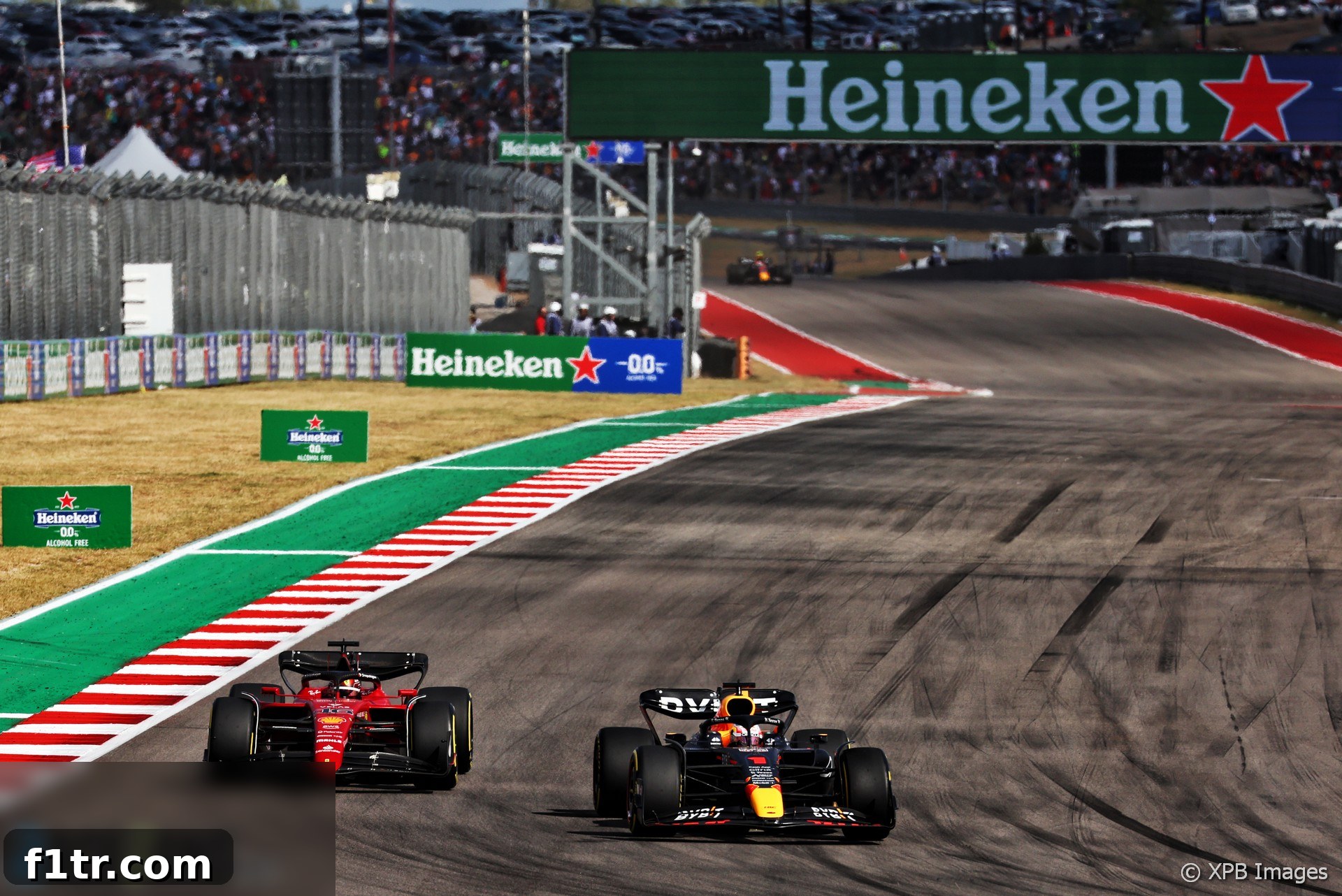
The United States Grand Prix at the Circuit of the Americas (COTA) provided another poignant illustration of Ferrari’s ongoing tyre saga. Starting from a challenging P12 on the grid due to a power unit penalty, Charles Leclerc executed a commendable recovery drive to secure a third-place podium finish. While this achievement was a testament to his skill and the car’s raw speed, his post-race reflections revealed a lingering sense of disappointment regarding the fundamental issues.
“I’m satisfied in a way because we started P12, so a podium is a good achievement,” Leclerc acknowledged. “But looking at the race, it’s obviously a little bit disappointing.” The familiar culprit, tyre degradation, reared its head once again in the crucial latter stages of the race. “We had the pace, but then we had a little bit too much deg towards the end of the race,” he explained. The physical demands on the driver were also compounded by this issue: “With the tyre deg you keep working with the steering wheel, which makes it even more difficult, but it was quite a nice battle with Checo [Perez] and then later on with Max [Verstappen],” he added, showcasing his fighting spirit despite the car’s limitations.
A mid-race Safety Car period, brought out after Valtteri Bottas crashed, briefly offered Ferrari a lifeline. It allowed teams an opportunity to manage their tyres or switch to fresh rubber without the usual time loss. Leclerc, who strategically pitted from the lead for new tyres during this intervention, rejoined the race in fourth place, effectively gaining two positions from his pre-Safety Car standing. Despite this stroke of fortune, the underlying tyre degradation issues persisted, preventing a further challenge. “We got a bit lucky with the Safety Car at the right time for us, which put us back into the race. But then unfortunately we suffered a little bit too much tyre degradation to fight for higher places,” he admitted, underscoring the deep-seated nature of the problem.
Leclerc concluded his analysis of the COTA race with a mixture of realism and unwavering determination. “It is an improvement but we need to do all the steps,” he asserted. He reaffirmed his belief in the team’s strategic execution during the race: “I was quite confident that a podium was possible if we were doing everything perfect. Looking back, I think communication strategy has been the right one.” Yet, the central theme remained paramount: “Tyre management, we still need to do a step as I said, but we are working in the right direction.”
The Road Ahead: Bridging the Performance Gap for Scuderia Ferrari
For Ferrari to truly bridge the performance gap with Red Bull and consistently challenge for Formula 1 championships, mastering tyre management across all conditions is non-negotiable. This is not a simple tweak but a profound engineering and strategic challenge. It necessitates an even deeper understanding of how the F1-75 interacts with various tyre compounds on diverse track surfaces and under fluctuating temperatures. This will involve relentless simulation work, meticulous data analysis from every single Grand Prix, and potentially even fundamental adjustments to the car’s aerodynamic philosophy and suspension geometry in future iterations.
The “specific situations” Leclerc referenced – whether they be cooler tracks, abrasive surfaces, or unexpected rain – are precisely the environments where championship contenders distinguish themselves. Red Bull’s remarkable adaptability in these scenarios allows them to maintain a crucial performance edge, forcing Ferrari into compromises that ultimately cost them invaluable points and potential victories. For the legendary Scuderia, the imperative is clear: develop a more versatile and forgiving car, one that can deliver consistent, optimal performance irrespective of external variables. Only then will drivers like Charles Leclerc be fully empowered to convert their sensational pole positions into dominant race wins and mount a sustained challenge at the pinnacle of motorsport.
Advert | Become a RaceFans supporter andgo ad-free
As the Formula 1 season draws to a close, Charles Leclerc’s insights remain a vital indicator of Ferrari’s true potential and ongoing challenges. His candid assessments, while often revealing frustrations, are also imbued with a strong sense of hope and the team’s unwavering determination. Ferrari is clearly committed to addressing its performance weaknesses, particularly in the nuanced and critical domain of tyre management. The path to ultimate glory in Formula 1 is always paved with such formidable challenges, and for Ferrari, overcoming this tyre hurdle is not merely an incremental improvement; it is an absolute necessity to reclaim their rightful place at the very top of the sport.
2022 United States Grand Prix Related Articles
- Steiner annoyed by lack of apology from race director over COTA protest error
- How many victory chances did Hamilton have in his first winless F1 season?
- Income from new title sponsor will bring Haas up to cost cap level – Steiner
- Mexico’s first home win or Verstappen’s record 14th? Six Mexican GP talking points
- Mercedes doubt tyre strategy cost Hamilton chance to beat Verstappen to win
Browse all 2022 United States Grand Prix articles