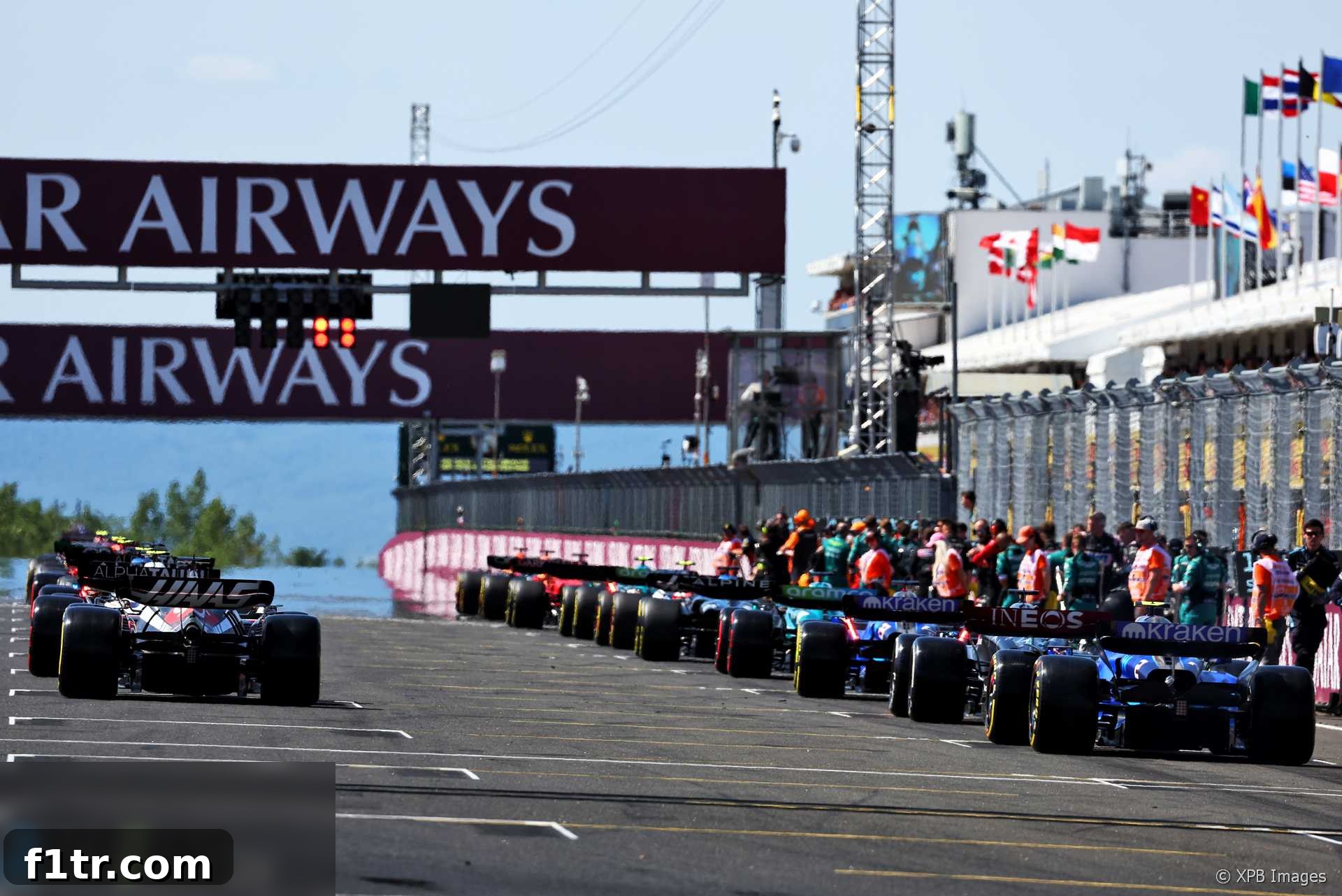
The global motorsport community recently received official confirmation from the FIA regarding the finalized entry list for the highly anticipated 2024 Formula 1 season. This announcement, while expected, brought with it an unprecedented situation that has sent ripples through the racing world: for the first time in Formula 1 history, every driver who competed in the concluding round of the previous championship will return for the opening race of the next season, and crucially, all will remain with their current teams.
This remarkable continuity, while offering stability to the sport’s pinnacle, presents a significant challenge for aspiring talents in feeder series such as Formula 2 and Formula 3. The doors to Formula 1, for now, appear firmly shut, leaving a generation of promising young drivers without any immediate prospect of advancing to the sport’s elite tier. This scenario sparks a vital debate: Is the 2024 Formula 1 grid truly comprised of the 20 most deserving drivers in the world? This article delves into the implications of this unchanged lineup, examines individual driver performances, and explores the wider discussion around talent, opportunity, and the future of the F1 driver market.
Formula 1 has always prided itself on being the ultimate proving ground, a championship where only the very best compete. The stability of the 2024 grid, with not a single seat swap or new entry, is an anomaly in a sport often characterized by fierce competition for coveted positions. This continuity can be attributed to several factors: the increasing length and complexity of driver contracts, teams prioritizing stability over risk, and perhaps a perceived lack of immediately F1-ready talent in the feeder series to displace existing drivers. Whatever the reasons, this unique situation compels us to critically assess each driver’s performance and their continued presence on the grid.
Advert | Become a Supporter & go ad-free
Evaluating the 2024 F1 Drivers: A Comprehensive Comparison
To fully understand the current landscape, let’s look at the career statistics of the drivers confirmed for the 2024 season. These figures offer a glimpse into their experience, success, and consistency over their Formula 1 careers, providing a foundation for evaluating their current standing and future potential.
| Driver | Starts | Best race finish | Best championship finish |
|---|---|---|---|
| Max Verstappen | 185 | 1 (x54) | 1 (x3) |
| Sergio Perez | 257 | 1 (x6) | 2 |
| Lewis Hamilton | 332 | 1 (x103) | 1 (x7) |
| George Russell | 104 | 1 | 4 |
| Charles Leclerc | 123 | 1 (x5) | 2 |
| Carlos Sainz Jnr | 183 | 1 (x2) | 5 (x2) |
| Lando Norris | 104 | 2 (x7) | 6 (x2) |
| Oscar Piastri | 22 | 2 | 9 |
| Fernando Alonso | 377 | 1 (x32) | 1 (x2) |
| Lance Stroll | 143 | 3 (x3) | 10 |
| Pierre Gasly | 130 | 1 | 7 |
| Esteban Ocon | 133 | 1 | 8 |
| Alexander Albon | 81 | 3 (x2) | 7 |
| Logan Sargeant | 22 | 10 | 21 |
| Yuki Tsunoda | 63 | 4 | 14 (x2) |
| Daniel Ricciardo | 239 | 1 (x8) | 3 (x2) |
| Valtteri Bottas | 222 | 1 (x10) | 2 (x2) |
| Zhou Guanyu | 44 | 8 | 18 (x2) |
| Nico Hulkenberg | 203 | 4 (x3) | 7 |
| Kevin Magnussen | 163 | 2 | 9 |
This table showcases a blend of multi-world champions, seasoned race winners, and emerging talents. While raw statistics don’t always tell the full story of a driver’s performance, they provide a valuable historical context for their current standing.
Advert | Become a RaceFans supporter andgo ad-free
Expert Opinion: Who’s Secure and Who’s Under Pressure?
The 2024 season brings with it a unique set of expectations for each driver, especially given the stability of the grid. While some drivers have firmly cemented their positions, others face increased scrutiny to justify their continued presence in the sport. Let’s delve into individual performances and the arguments for and against their retention.
Starting with the front-runners, drivers like Max Verstappen, Lewis Hamilton, Charles Leclerc, George Russell, Lando Norris, Carlos Sainz, and Oscar Piastri have delivered consistently strong performances. Their talent is undeniable, and their positions are well-deserved. The battle among these drivers, and their respective teams, will undoubtedly shape the championship narrative.
Sergio Perez, despite securing second place in the drivers’ championship, experienced a particularly turbulent 2023 season. His mid-season struggles, marked by a significant performance gap to his teammate Max Verstappen, raised questions about his consistency. However, considering his crucial role in Red Bull’s championship success in previous years and flashes of brilliance, his time in F1 doesn’t appear to be over just yet. Nevertheless, 2024 will be a critical year for him to demonstrate greater consistency and close the gap to Verstappen to secure his long-term future at Red Bull. Among the other leading teams, the drivers have performed with such consistent strength that there’s no reasonable case to be made for dropping any of them.
Further down the grid, the evaluations become more nuanced. Veteran driver Valtteri Bottas, now in the latter stages of his career, found it challenging to distinguish himself in 2023 as Sauber’s (formerly Alfa Romeo) form declined. The team’s lack of competitiveness made it difficult for him to showcase his true capabilities. Given the circumstances, it’s fair to afford him the benefit of the doubt, as his experience and prior track record speak volumes. The same consideration applies to his teammate, Zhou Guanyu, who showed clear signs of progress and adaptability throughout the season, demonstrating potential for future growth if the team can provide a more competitive package.
One of the standout returns to F1 has been that of Nico Hulkenberg at Haas. Many questioned his return, but his performances quickly silenced the doubters. He consistently outpaced his teammate Kevin Magnussen, displaying impressive pace and race craft. Hulkenberg’s strong season highlights his enduring talent and reinforces his place on the grid, putting pressure on Magnussen to elevate his own game.
Similarly, Alexander Albon has been a revelation since his return to Formula 1 with Williams. He has consistently extracted the maximum from his car, often dragging it into points-scoring positions that seemed improbable. His leadership and performance have been pivotal in Williams’s recent progress. However, the same cannot be said for his teammate, Logan Sargeant, who endured a difficult rookie season.
Sargeant managed to secure only a single point, which came under fortunate circumstances due to post-race disqualifications of other competitors, while he himself might have narrowly avoided penalties for track limits infringements. His debut year was characterized by numerous incidents and a significant gap to Albon. If Williams had chosen not to retain him for 2024, it would have been exceedingly difficult to argue against that decision. His retention, therefore, comes with an expectation of substantial improvement. His future in F1 hinges entirely on his ability to make a significant step forward in performance and consistency.
Another driver whose performance against his teammate warrants close examination is Lance Stroll. Throughout 2023, he was comprehensively outperformed by the vastly experienced Fernando Alonso. This pattern of being outshone by a teammate has, unfortunately, been fairly typical for Stroll since his entry into F1 seven years ago. While he has had moments of brilliance, the consistency and raw pace required at the top level have often seemed elusive. After such a long tenure, it’s reasonable to suspect that we may have already seen the best of what he has to offer in Formula 1.
Other drivers like Pierre Gasly and Esteban Ocon at Alpine, Yuki Tsunoda and Daniel Ricciardo at AlphaTauri, and Kevin Magnussen at Haas all face various levels of scrutiny. Gasly and Ocon had a challenging 2023 with an underperforming Alpine, but their individual talents are well-established. Tsunoda continues to show flashes of potential but needs to convert that into more consistent results. Ricciardo’s return was cut short by injury, and 2024 will be a crucial season for him to prove he can still perform at his previous high level. Magnussen, as noted, needs to reverse the trend of being outpaced by Hulkenberg.
Advert | Become a RaceFans supporter andgo ad-free
The Fans’ Verdict: Who Should Not Keep Their Seat?
The continuity of the 2024 grid sparks considerable debate among fans and pundits alike regarding who truly deserves a place in Formula 1. A recent poll conducted among fans asked which F1 drivers should NOT keep their seats for 2024. The results offer a compelling insight into public opinion:
Which F1 drivers should NOT keep their seats for 2024?
- Logan Sargeant (23%)
- Lance Stroll (28%)
- Kevin Magnussen (11%)
- Sergio Perez (10%)
- Zhou Guanyu (8%)
- Yuki Tsunoda (4%)
- Daniel Ricciardo (4%)
- Valtteri Bottas (4%)
- Pierre Gasly (1%)
- Esteban Ocon (2%)
- Nico Hulkenberg (1%)
- Fernando Alonso (1%)
- Alexander Albon (0%)
- Oscar Piastri (0%)
- Lando Norris (0%)
- George Russell (1%)
- Lewis Hamilton (1%)
- Carlos Sainz Jnr (0%)
- Charles Leclerc (0%)
- Max Verstappen (1%)
Total Voters: 115
The poll results clearly indicate that Lance Stroll and Logan Sargeant are the two drivers most scrutinized by fans, receiving the highest percentages of votes for not deserving a seat. This aligns with the expert opinions discussed earlier regarding their 2023 performances relative to their teammates. Kevin Magnussen and Sergio Perez also garnered significant percentages, reflecting concerns about their consistency and form. These numbers underscore the critical importance of performance in the hyper-competitive world of Formula 1, even in a season of unprecedented stability.
The dilemma of junior drivers is perhaps the most profound consequence of this unchanged grid. Talented individuals from Formula 2 and Formula 3, who are often knocking on the door of F1, now face an impenetrable barrier. Drivers like Theo Pourchaire, Frederik Vesti, and Liam Lawson (who already demonstrated F1 readiness in a substitute role) represent the next generation of F1 talent. Their path to the premier class is now complicated, potentially leading to stagnation in their careers or forcing them to look for opportunities elsewhere. This raises questions about the long-term health of the F1 talent pipeline and whether the sport risks becoming too insular.
The 2024 Formula 1 season promises an intriguing dynamic. With every driver returning to their familiar environment, the pressure to perform will be immense, particularly for those whose seats are perceived to be less secure. While stability can foster development and stronger team cohesion, it also means that any underperformance will be under an even brighter spotlight. For fans, it means a season where driver narratives – triumphs, struggles, and redemption arcs – will be more intense than ever, especially as the battle for future seats quietly rages behind the scenes.
Debates and polls
- What must Formula 1 fix with its new rules – and what should it leave unchanged?
- ADUO: Do F1 teams who fall behind deserve to get help to catch up?
- F1 is considering doubling its sprint races. Do you want more or fewer?
- Will this be a fight or a rout? 20 questions for the 2026 Formula 1 season
- Which Formula 1 team has the best-looking car – and the worst – for the 2026 season?
Browse all debates and polls