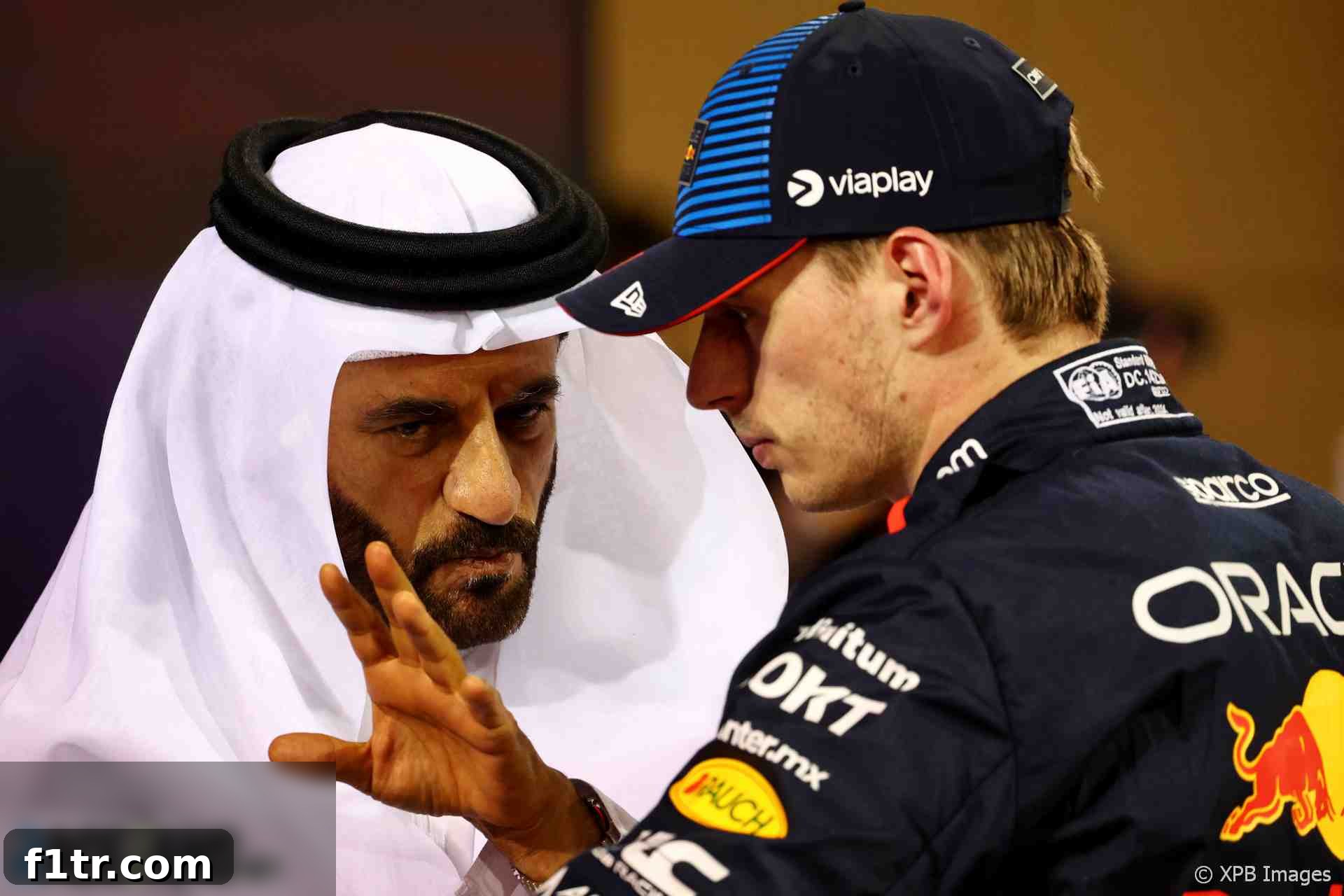
Max Verstappen’s Swearing Penalty: Unpacking F1’s Latest Unnecessary Drama
The recent controversy surrounding Max Verstappen’s use of a swear word and the subsequent penalty imposed by the FIA has cast a long shadow over Formula 1, sparking widespread debate and frustration. This incident, seemingly trivial on the surface, highlights deeper issues within the sport, ranging from the FIA’s inconsistent application of rules to the perceived overreach of its governing body under President Mohamed Ben Sulayem. The entire episode has not only drawn criticism towards the sport’s administration but also raised questions about driver professionalism and the often-absurd nature of modern sporting governance.
At the heart of this unfolding drama is FIA President Mohamed Ben Sulayem, whose public remarks often become a focal point for controversy. His stated desire to hear “less swearing from drivers’ radios” clearly indicated a new area of focus, echoing his previous crusade against drivers wearing jewellery in 2022. While the jewellery saga could, however clumsily, be framed as a safety concern, the current stance on profanity appears to be a matter of decorum, igniting discussions about what constitutes appropriate conduct in the high-octane world of F1.
The President’s Pronouncements: From Jewellery to Profanity
Ben Sulayem’s approach to driver conduct has frequently met with skepticism. His initial efforts to enforce rules against jewellery and non-compliant underwear were widely regarded as heavy-handed and misguided, creating unnecessary tension between the drivers and the governing body. Critics argued that these rules, while technically valid for safety reasons, were enforced with an unyielding rigidity that overshadowed more pressing issues in the sport.
The president’s foray into the realm of driver language, however, has proven even more contentious. His poorly-phrased reference to “rappers” when expressing his objection to swearing drew immediate criticism. For many, including prominent figures like Lewis Hamilton, this comment carried racial implications, deepening the concern beyond a simple preference for polite language. Such remarks only serve to alienate parts of the F1 community and divert attention from the core sporting competition, highlighting a broader communication challenge within the FIA leadership.
Max Verstappen’s Incident and the FIA’s Swift Retribution
Despite Ben Sulayem’s public warnings, whether seen or ignored, the stage was set for a confrontation. Max Verstappen, speaking at a Thursday FIA press conference, described his car as “fucked,” a word choice that, given the prevailing atmosphere, was almost guaranteed to elicit a reaction. True to form, the FIA swiftly announced on Friday that Verstappen would be required to perform “public work” as atonement for his “gaffe.” This penalty quickly became a talking point, fueling debates about the severity of the offense and the appropriateness of the punishment.
The concept of “public work” as a sanction for a linguistic transgression in a high-profile sport like F1 immediately struck many as disproportionate. While professional athletes are expected to maintain a certain standard of conduct, particularly in official settings, the nature of this penalty for a single expletive in a press conference has been widely seen as an overreaction. It implies a moralistic judgment rather than a pragmatic enforcement of professional decorum, especially when considering the intense pressure and raw emotions often associated with elite motorsport.
The Elephant in the Room: Inconsistent Rule Application
No discussion about FIA rule enforcement is complete without addressing the glaring issue of inconsistency. A compelling example that undermines the FIA’s stance on Verstappen’s penalty involves Charles Leclerc. Following the Monaco Grand Prix, Leclerc used the exact same word as Verstappen in an FIA press conference. The FIA transcribed his comments, published them on its official website, and they remained there for months without any apparent offense or subsequent penalty. This stark contrast raises critical questions: Why was one driver penalized while another, committing the identical offense, was seemingly ignored? The FIA’s silence on this specific discrepancy, despite inquiries, only exacerbates perceptions of unfairness and selective enforcement.
This lack of consistent application is not merely an academic point; it erodes trust and undermines the authority of the governing body. When rules are applied arbitrarily, it fosters an environment where drivers and teams are unsure of what to expect, leading to frustration and resentment. It also lends credence to the idea that certain individuals are singled out, or that enforcement is influenced by factors other than the rule itself. Previous instances, such as the penalties handed to team principals Frederic Vasseur (Ferrari) and Toto Wolff (Mercedes) for similar linguistic transgressions at the Las Vegas Grand Prix, show that the FIA does take such matters seriously. However, the inconsistency in enforcement – particularly when comparing Verstappen’s case to Leclerc’s – suggests a capricious approach that benefits no one.
Verstappen’s Unrepentant Reaction: A PR Misstep?
Following the penalty, a simple acknowledgment of a mistake from Verstappen could have diffused the situation. Instead, the world champion delivered a reaction that further inflamed the debate. According to the stewards, Verstappen offered the “risible argument” that “the word used is ordinary in speech as he learned it, English not being his native language.” This defense, particularly from a driver who has spent a significant portion of his life in an English-speaking environment and is represented by a highly professional Red Bull PR machine, strained credulity. Red Bull, a global marketing powerhouse, is renowned for its brand image; the notion that its most famous spokesperson would be ignorant of basic linguistic appropriateness in a public setting is highly dubious.
Publicly, Verstappen showed little sign of contrition. He decried his penalty as “ridiculous” and, in his next FIA press conference appearance, refused to provide substantive answers regarding the matter. While it is understandable for a driver to feel unjustly treated, this defiant stance only served to prolong the controversy and portray him as uncooperative. Professionalism dictates that participants in any organized sport, especially at the pinnacle like Formula 1, should conduct themselves with a certain level of decorum when representing the sport. Verstappen’s refusal to acknowledge this fundamental expectation does himself no credit and potentially damages his public image, regardless of the merits of his argument against the penalty itself.
The Broader Implications for F1 and Team Radio
The FIA’s stringent stance on swearing in official settings also raises questions about its broader policy implications, particularly concerning team radio communications during races. While the governing body has already begun prosecuting drivers for genuinely insulting or offensive statements made on the radio, attempting to penalize drivers for merely swearing under the immense stress of racing conditions would be a ludicrous overreach. The adrenaline, frustration, and intense focus inherent in motorsport often lead to unfiltered, emotional outbursts. Expecting drivers to maintain perfectly sanitized language while operating at the absolute limit of human and mechanical performance is an unrealistic and counterproductive expectation.
Furthermore, F1 already has an acceptable and effective status quo regarding team radio messages. Formula One Management (FOM) applies multiple levels of censorship, with messages broadcast on the world feed being ‘bleeped’ as required. This system effectively mitigates public exposure to profanity without penalizing drivers for natural, unscripted reactions in the heat of the moment. Trying to enforce a blanket ban on swearing, even bleeped, would represent an unnecessary and futile battle, distracting from the genuine excitement and drama of the sport itself. The focus should be on fair play, safety, and compelling racing, not on policing every utterance with an iron fist.
Conclusion: A Call for Pragmatism and Consistency
The entire saga surrounding Max Verstappen’s swearing penalty is a testament to an unnecessary and trivial furore. It has distracted from the core essence of Formula 1: incredible racing, strategic battles, and technological innovation. The FIA’s inconsistent application of its rules makes the governing body appear either bumbling or, worse, selectively punitive, undermining its authority and credibility. President Ben Sulayem’s pronouncements, while perhaps well-intentioned, often lack the nuance and communication effectiveness required for such a global sport, leading to more controversies than resolutions.
For the health and integrity of Formula 1, a more pragmatic and consistent approach is desperately needed. Drivers, as professional athletes, have a responsibility to conduct themselves appropriately, especially in official capacities. However, the governing body must also apply its rules fairly and transparently, avoiding arbitrary enforcement that fosters resentment. The existing mechanisms for managing profanity on team radio are adequate, and a focus on genuine safety and sporting integrity should always take precedence over moralistic crusades against minor linguistic transgressions. This needless, petty, and trivial argument has only served to sour the mood in F1, making many wish they could express their frustration with a good old swear word themselves.