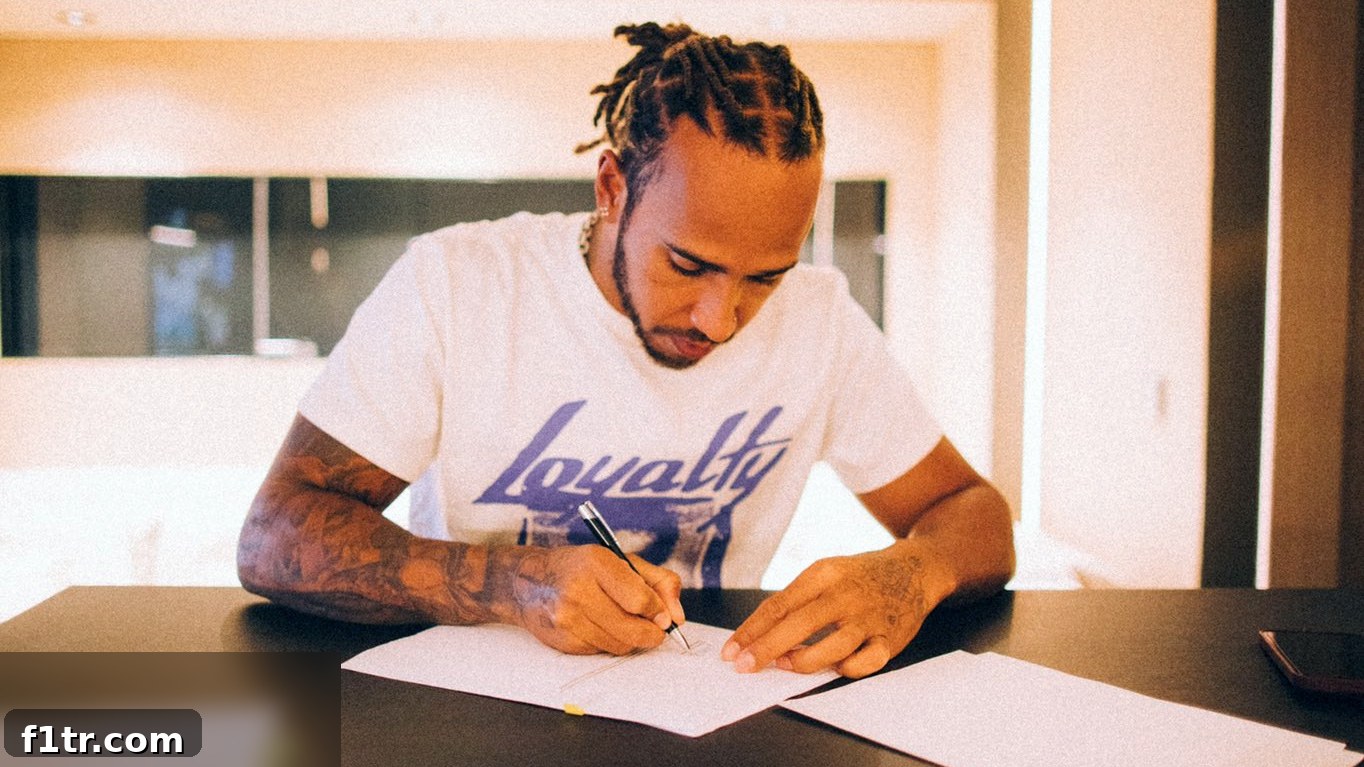
In a turn of events that underscores his enduring commitment to the pinnacle of motorsport, Sir Lewis Hamilton has officially inked his second Formula 1 contract extension within a remarkably short six-month span. This landmark agreement, which solidifies his presence on the grid for at least two more seasons, comes after his initial 2021 deal was only confirmed in February. While his return for the current season was largely anticipated, today’s announcement of a fresh two-year term with the Mercedes-AMG Petronas Formula 1 Team represents a profound commitment that is set to resonate across the entire sport.
The immediate outpouring of enthusiasm from the team, Hamilton himself, and his colossal global fanbase—a staggering 22.8 million followers on Instagram alone—is certainly expected. However, the most telling endorsement arrived from an unexpected quarter: Formula 1’s CEO, Stefano Domenicali. In an unusual but highly significant move, Domenicali promptly issued a statement welcoming the extension, highlighting the profound impact Hamilton has on the sport’s global standing and commercial appeal.
Lewis Hamilton: A Global Icon Beyond the Track
“This is fantastic news for Formula 1 and I am delighted that Lewis will stay in F1 for at least another two years,” stated Stefano Domenicali. “What he has achieved in this sport is incredible and I know he has more to come. He is a global superstar on and off the race track and his positive impact on Formula 1 is huge.”
The significance of Domenicali’s statement cannot be overstated. Hamilton transcends the traditional role of a racing driver; he is a genuine box office phenomenon, a status previously held by legends like Michael Schumacher. His continued presence for at least two more seasons is an invaluable asset that is poised to significantly boost F1’s commercial bottom line, an impact that tactical novelties such as Sprint races can only aspire to achieve. Hamilton draws in a diverse global audience, attracting new fans who are drawn not just to the racing spectacle, but to his powerful voice on social issues, his fashion influence, and his commitment to diversity and inclusion within a traditionally exclusive sport. This unique blend of on-track prowess and off-track activism amplifies Formula 1’s reach and relevance in an increasingly conscious global landscape, making him an unparalleled ambassador for the sport.
On the surface, it might seem counterintuitive to celebrate the extension of a driver who has, for the better part of a decade, dominated the sport. Hamilton has secured six of the last seven drivers’ championships, and in many of those seasons, the term “fight” was a generous descriptor for what often appeared to be an unstoppable march to victory. Indeed, had it not been for a single tardy start in 2016 or minor reliability issues, he might well have monopolized the championship silverware every single season since 2014, a feat of sustained excellence unprecedented in modern F1.
Given this overwhelming dominance, one might ponder if Formula 1 would not benefit from a new face at the top, a fresh champion to inject unpredictability. However, the answer is unequivocally no. The sport thrives on iconic figures, and Hamilton’s star appeal is a cornerstone of its global entertainment value. Furthermore, there are now undeniable indicators that the upcoming seasons will diverge sharply from the procession-like nature of some past championships, promising an era of intensified competition that makes Hamilton’s presence even more vital.
The Shifting Landscape of Competition: A New Era for F1
A Fiercer Fight on Track: The 2021 Season and Beyond
The early stages of the demanding 2021 F1 season have already painted a clear picture of this evolving competitive dynamic. Eight races into the calendar, Hamilton found himself 18 points adrift of his formidable rival, Max Verstappen, who, at that juncture, had already claimed more victories. This significant shift in performance can be directly attributed to the aerodynamic rule changes introduced during the off-season, which demonstrably impacted Mercedes’ advantage and effectively reset the competitive balance at the front of the grid.
Mercedes, the reigning constructors’ champions, now face a profound strategic dilemma, a true “horns of a dilemma” scenario. In the inaugural year of Formula 1’s restrictive budget cap, they must carefully weigh how much resource and development effort to pour into their current W12 car—in pursuit of the 2021 title—versus allocating crucial resources to developing their machine for the radically overhauled technical regulations set to debut in 2022. This complex decision-making process carries significant implications, as a misstep could jeopardize their chances in either season.
Regardless of how this strategic quandary is ultimately resolved, and irrespective of whether these chosen priorities might momentarily compromise Hamilton’s immediate title aspirations, his two-year extension signifies his unwavering faith and integral role in Mercedes’ long-term vision. Even if the elusive eighth title were to escape his grasp in the current campaign, it is almost inconceivable that he would not be a strong contender for further silverware and records over the subsequent two seasons, given his unparalleled talent and the team’s formidable infrastructure.
However, unlike the early years of the hybrid era, where Mercedes’ dominance was almost a foregone conclusion, Hamilton’s future success can no longer be taken for granted. In alignment with Formula 1’s explicit objective of leveling the competitive playing field through regulatory changes and the budget cap, Hamilton can anticipate the already arduous fight he faces this year to intensify exponentially in the coming seasons. This commitment to a harder fight, rather than seeking an easier path, further solidifies his status as a true champion.
The Rise of Formidable Challengers
The competitive landscape has undeniably evolved. Red Bull Racing has finally achieved a power unit package that can consistently challenge Mercedes, with Honda delivering significant performance gains. Ferrari, the sport’s most storied team, has clearly shifted its primary development focus to their 2022 car, signaling their serious intent to return to championship contention. Moreover, the customer teams are becoming increasingly potent threats: Mercedes-powered McLaren is demonstrating renewed vigor, and Aston Martin, with ambitious ownership and significant investment, is rapidly expanding its capabilities, posing a growing challenge to the established order.
Despite Hamilton’s repeated public statements expressing his desire for closer competition among teams, a cohort of detractors persistently insisted that he would retreat from the sport as soon as Mercedes’ unparalleled hybrid era dominance began to wane. Today’s announcement serves as a definitive rebuttal to that perspective, showcasing his unwavering dedication to the sport, even as the challenges mount. He is clearly motivated by the prospect of a true battle, rather than an easy victory.
An Intensified Rivalry and the Future of Mercedes
Even his most ardent critics should find reason to welcome this development, for it heralds a new chapter in Hamilton’s illustrious career where routine success appears to be a thing of the past. The pursuit of an unprecedented eighth world title no longer looks like a foregone conclusion, but rather a monumental challenge that will test his legendary skills to their very limit. The very timing of this contract extension, announced amidst a fiercely contested season, is strategic: it aims to liberate him from any off-track distractions as he focuses every fiber of his being on overcoming Max Verstappen, who, at the time of this writing, had just demonstrated a significant pace advantage, out-pacing Hamilton by half a second over the shortest lap time on the calendar.
Beyond the immediate rivalry, there is also the tantalizing prospect of Hamilton facing an even tougher internal test within his own team. By the time his current deal concludes, he will be 38 years old. Mercedes, ever forward-thinking, must inevitably begin to plan for a future beyond their current superstar. It is highly plausible that they have already earmarked George Russell, the highly-rated young British talent, as the long-term successor. Hamilton’s two-year extension could therefore serve as a crucial transitional period, allowing Russell to potentially integrate into the team alongside him, learning from the master before taking the reins.
A Win for Formula 1’s Present and Future
Whether your personal inclination is to cheer for Hamilton’s continued success, anticipate his defeat, or simply appreciate his immense contribution to Formula 1’s commercial vitality, the news of his two-year extension should be universally embraced. His presence guarantees not only captivating racing but also continued global interest, media coverage, and commercial opportunities that are vital for the sport’s health and growth. As F1 enters a new era of regulations, budget caps, and a renewed emphasis on competitive racing, having its biggest star committed for the long haul is an undeniable victory for everyone involved.
Hamilton’s unwavering dedication to the sport, coupled with his unparalleled ability to attract new audiences and spark vital conversations, ensures that Formula 1 remains a dynamic and relevant global spectacle. His journey to an potential eighth title, fraught with new challenges and formidable rivals, promises to be one of the most compelling narratives in recent motorsport history, securing the sport’s present excitement and future trajectory.
2021 F1 season
- FIA decision on track limits sparked controversy in early 2021 races.
- Strategic pit stop calls often decided the outcome of key Grands Prix.
- Technical directives played a crucial role in shaping car performance.
- Rivalries intensified between teams as championship battle heated up.
- Driver market rumors added intrigue throughout the challenging season.
Browse all 2021 F1 season articles and analysis