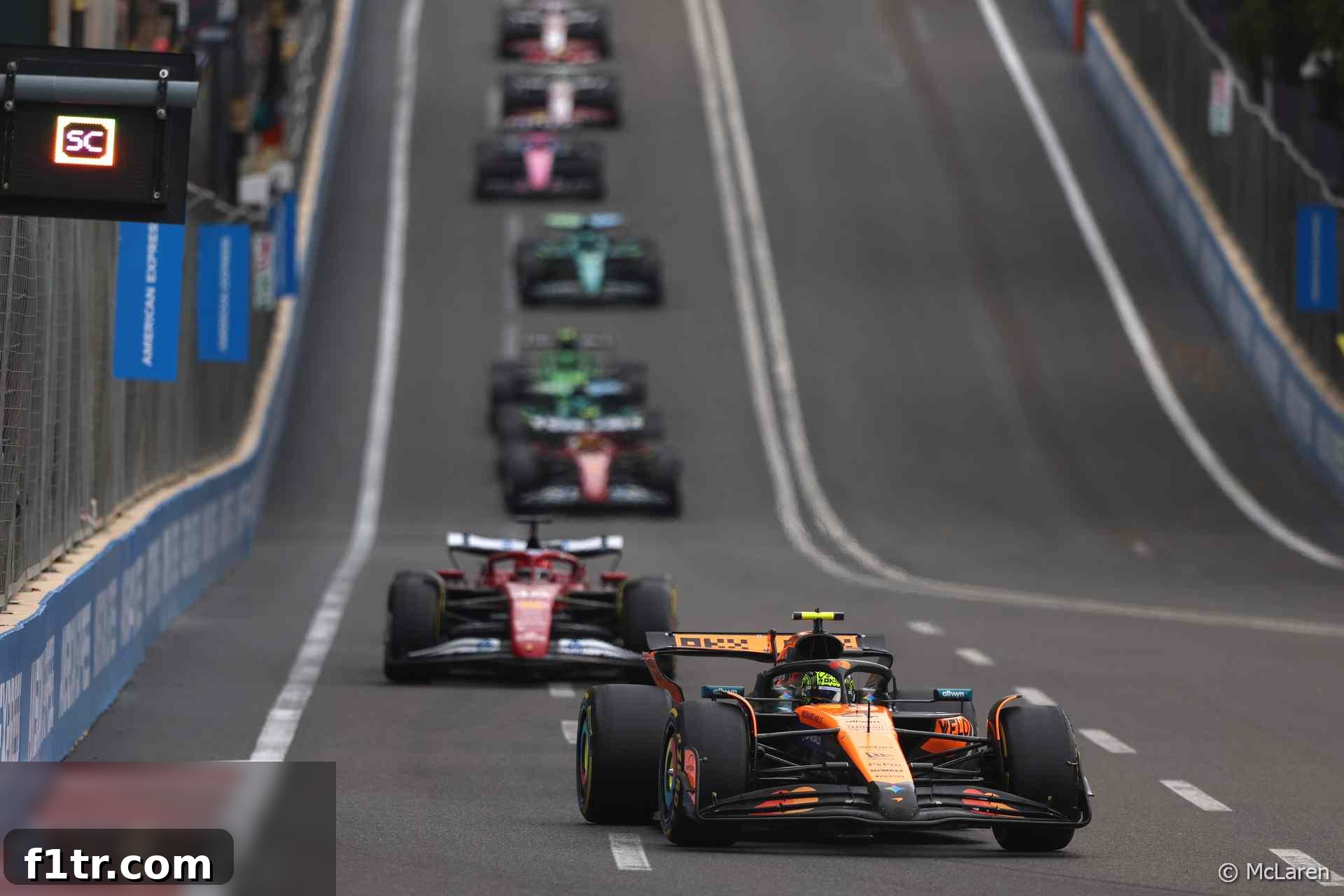
In the fiercely competitive realm of Formula 1, every Grand Prix serves as a crucial barometer of a team’s performance, challenging both machinery and strategy to their absolute limits. For McLaren, the recent Azerbaijan Grand Prix unfolded as a particularly demanding weekend, culminating in what team principal Andrea Stella forthrightly described as their worst result of the season. This candid admission from the Woking squad’s leader underscored a period of deep introspection and a pressing need for immediate improvements, as the team navigated the unforgiving streets of Baku.
McLaren’s Challenging Baku Outing: A Weekend of Missed Potential
The high-speed, barrier-lined Baku City Circuit is notorious for its blend of extreme demands, requiring precise driving, robust car performance, and flawless execution. McLaren’s aspirations for a strong showing were unfortunately undermined from the outset during the critical qualifying session. Both of their highly-rated drivers, Lando Norris and Oscar Piastri, encountered difficulties, each making contact with the unforgiving barriers. These incidents severely compromised their starting positions for Sunday’s main race, setting an arduous tone for the weekend.
Lando Norris, the team’s experienced British talent, managed to secure a seventh-place start, while the impressive rookie Oscar Piastri lined up ninth on the grid. While not entirely disastrous, these grid slots placed them squarely in the challenging midfield battle on a circuit where track position is often paramount, and overtaking can be a monumental task. Andrea Stella did not shy away from this reality in his post-race reflections, stating, “I think ultimately we finished in the position that we deserved, considering the job that we have done, even if the car was possibly slightly quicker. But we should have expressed this potential yesterday in qualifying and we didn’t.” This direct and accountable assessment highlighted the team’s collective failure to capitalize on their car’s inherent pace when it mattered most, effectively handicapping their race prospects before the lights even went out.
Lando Norris’s Arduous Race and Recurring Pit Stop Frustrations
Lando Norris’s race narrative in Baku was one of constant struggle and strategic misfortune. From his seventh-place start, Norris immediately conceded a position at the initial lights out, a critical setback on a street circuit where every inch of track is fiercely contested. The challenges compounded during a subsequent safety car restart, where he again lost ground, pushing him further into the densely packed midfield. Despite these early adversities, Norris demonstrated his characteristic resilience, working diligently to manage his tires and maintain a competitive pace, hoping for an opportunity to climb back up the order.
A planned pit stop was anticipated as a potential turning point, offering a chance to switch to fresh tires and push for higher positions. However, history, much to McLaren’s dismay, repeated itself. For the second consecutive Grand Prix, Norris endured a slow pit stop, costing him invaluable seconds and effectively derailing his charge. This recurring operational issue is a significant concern for the team, as pit stop efficiency is a fundamental aspect of success in modern Formula 1, where every millisecond counts. The delay left Norris exasperatingly trapped behind the AlphaTauri cars of Liam Lawson and Yuki Tsunoda for the remainder of the race, preventing him from utilizing the McLaren’s full potential in clear air. Stella’s comments directly addressed these operational shortcomings, indicating that the final result was a reflection of the team’s overall performance, acknowledging that “even if the car was possibly slightly quicker,” the execution ultimately dictated their finishing position.
The inherent difficulties of overtaking on the Baku City Circuit further complicated Norris’s race. While the circuit boasts incredibly long straights, offering theoretical slipstream opportunities, these are often followed by heavy braking zones into tight corners, making clean overtakes incredibly challenging and high-risk. “We didn’t have a fast enough car today to be able to overtake, so we spent all day in traffic,” Stella elaborated. This combination of compromised starting position, a costly pit stop, and a car lacking the decisive edge for overtakes on this specific track layout meant Norris spent much of his race battling for scraps of position, ultimately finishing where he started, in seventh place.
Oscar Piastri’s Baptism of Fire and Undoubted Potential
For Oscar Piastri, the Azerbaijan Grand Prix marked by far the most challenging weekend of his burgeoning Formula 1 career. After an impressive string of mature and consistent performances in his rookie season, Baku presented a harsh lesson in the sport’s unforgiving nature. His qualifying session saw him make an error, momentarily putting him into the barriers, a rare lapse for the young Australian. However, the true misfortune struck on race day, as Piastri’s Grand Prix came to an abrupt and premature end on the very first lap. Starting ninth, he became embroiled in the chaotic melee that frequently characterizes opening laps on street circuits, resulting in an incident that forced his immediate retirement. This unfortunate crash was a stark reminder of the fine margins and high stakes at play in Formula 1.
Despite the disheartening outcome, Andrea Stella was quick to voice his unwavering support for Piastri, emphasizing the team’s belief in his talent and resilience. “We had issues with Oscar, which are quite uncharacteristic,” Stella noted, highlighting that such incidents are not typical of Piastri’s usually composed driving style. “I’m sure we get the learning from it and come back stronger. He’s a very, very solid guy, very solid driver.” This vote of confidence from the team principal speaks volumes about Piastri’s character and the long-term potential McLaren sees in him. Formula 1 is an incredibly steep learning curve, and even the most gifted rookies are bound to encounter challenging weekends. The true measure of a champion often lies not in avoiding mistakes, but in the ability to analyze, learn, and rebound with renewed determination, a quality McLaren clearly identifies in Piastri.
The team will undoubtedly conduct a comprehensive debrief with Piastri, meticulously analyzing the data from his qualifying incident and the Lap 1 crash. For a driver of his caliber, such setbacks are viewed not as failures, but as invaluable educational experiences that contribute to long-term development. Piastri’s demonstrated speed, adaptability, and composure throughout the season provide ample evidence of his raw talent, and the team fully anticipates a strong return to form in upcoming races, further solidifying his reputation as a formidable presence on the grid.
Strategic Implications: McLaren’s Performance on Specific Circuit Architectures
The Azerbaijan Grand Prix represented a significant moment of reflection for McLaren, marking the first time all season that the team had failed to secure a victory in two consecutive races, following a similarly demanding performance at Monza two weeks prior. While this period might be a minor blip in a long championship campaign, it signals a crucial area for the team’s technical development and strategic focus. Andrea Stella explicitly identified a specific performance gap: their car’s suitability for circuits characterized by a unique combination of high-speed sections, very short corners, and heavy braking zones, such as Baku and Monza.
“Overall, there’s quite a lot of work for us to do to be performing in circuits like this in Baku, where the corners are short and there’s a lot of braking,” Stella articulated. This assessment is incredibly pertinent for McLaren’s engineering direction. It suggests that while the MCL38 might be exceptionally competitive on tracks that favor sweeping, high-speed corners and excellent aerodynamic efficiency, it appears to lose some of its inherent advantages when confronted with stop-start layouts that demand superior braking stability, rapid change of direction, and strong traction out of slow corners. This nuanced performance characteristic could be attributed to various factors, including the car’s suspension geometry, brake-by-wire system calibration, or even the aerodynamic profile under heavy braking and low-speed conditions.
Understanding and addressing these subtle differences in car performance across various track types is absolutely paramount in Formula 1. While every team strives to develop a versatile car that can excel on all circuits, real-world engineering often involves compromises, meaning strengths on one type of layout might translate into relative weaknesses on another. For McLaren, meticulously identifying and rectifying this specific performance deficit will be a key objective moving forward. The engineering team will undoubtedly delve deep into the data from Baku and Monza to develop targeted upgrades and refine setup philosophies, aiming to broaden the MCL38’s operating window and ensure it remains a front-running contender regardless of the circuit characteristics. This unwavering commitment to continuous improvement, even in the face of setbacks, is a defining characteristic of top-tier F1 teams, and McLaren’s readiness to “take it on the chin” and learn from defeat bodes exceptionally well for their long-term trajectory.
Moving Forward: A Culture of Learning, Adaptation, and Resilience
Andrea Stella’s pragmatic and forward-thinking leadership style was evident in his post-race analysis. His unwavering commitment to learning from setbacks, rather than succumbing to disappointment, encapsulates the very essence of McLaren’s ethos. “So lots of learning, we take it on the chin and we will come back stronger as a team and as drivers in Singapore,” he confidently affirmed. This proactive and growth-oriented approach is absolutely essential in the relentless pursuit of Formula 1 excellence, where every race provides invaluable data, insights, and lessons for the challenges that lie ahead.
The immediate focus for McLaren will be an exhaustive post-race debrief, meticulously dissecting every aspect of their Azerbaijan Grand Prix performance. This will encompass everything from analyzing driver feedback and operational missteps – such as the slow pit stops – to a thorough examination of the car’s specific handling characteristics on a circuit type where they seem to struggle. Engineers will pour over telemetry data, strategists will re-evaluate decisions, and drivers will provide their crucial insights. The overarching goal is not merely to identify what went wrong, but, more importantly, to implement immediate corrective measures and strategic adjustments that can be applied effectively for future races.
The next challenge for McLaren on the calendar is the Singapore Grand Prix, a circuit that, while different in its specific demands from Baku, is another demanding street circuit requiring immense precision, robust reliability, and peak driver performance. It presents an immediate opportunity for redemption and a chance to demonstrate that the lessons from Baku have been swiftly and effectively integrated into their preparation. The team’s collective resolve, as powerfully expressed by Stella, suggests an unyielding determination to overcome these recent hurdles. In the high-stakes world of Formula 1, true champions are not defined by an absence of failure, but rather by their profound ability to learn from adversity, adapt with agility, and consistently emerge stronger, a philosophy that McLaren is clearly embracing with renewed vigor as they navigate the remainder of this demanding season.
Related Formula 1 Insights
- Sainz Praises Dedicated Engineer After Emotional Baku Podium
- Norris Acknowledges Red Bull’s Gains Despite McLaren’s Pace
- Championship Dynamics: Analysing Key Points Differences
- Ocon’s Frustration Over Haas Team Orders in Baku Debrief
- Azerbaijan GP Stats: Verstappen Dominates Lap Count Over Norris
Explore More Azerbaijan Grand Prix Analysis