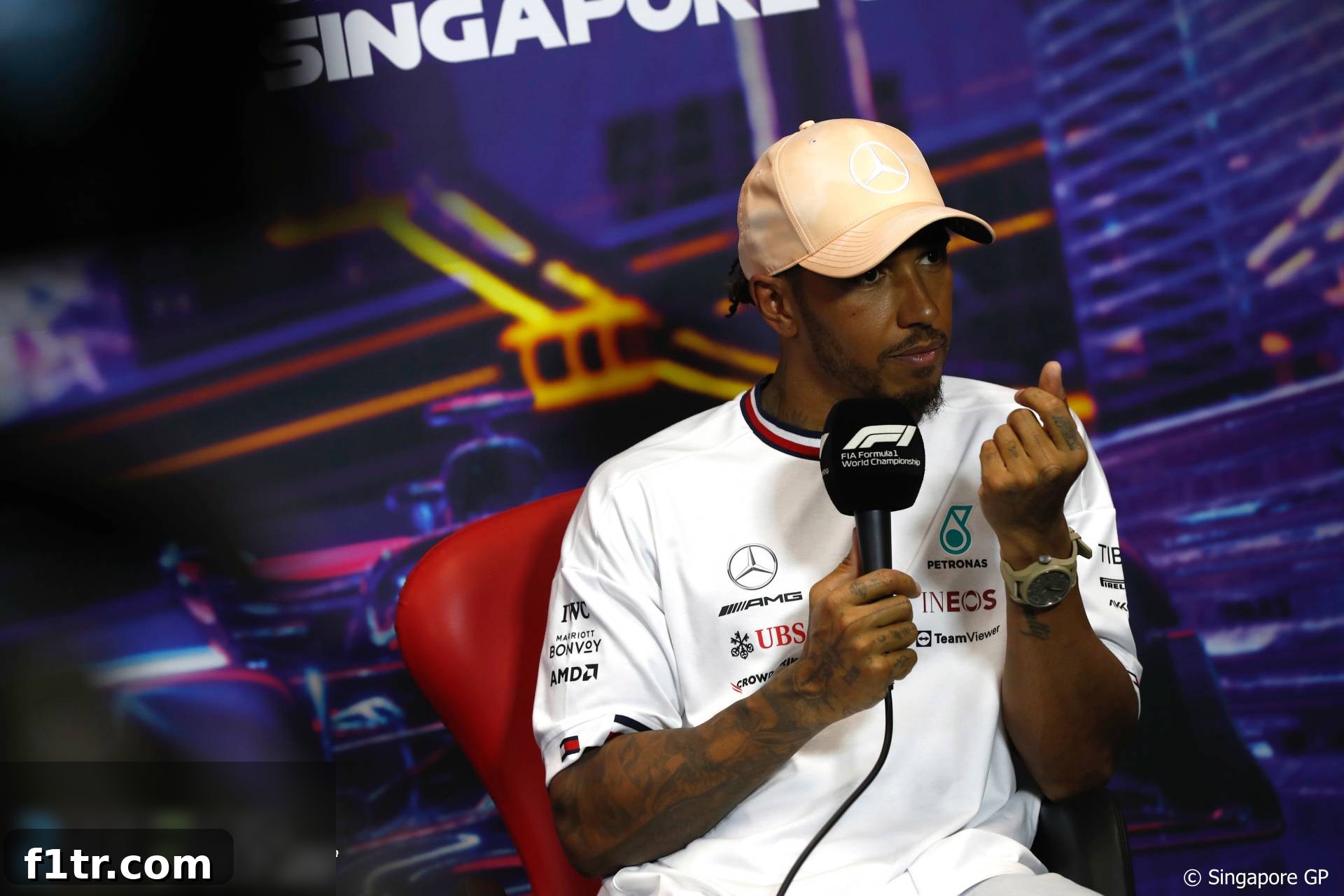
Lewis Hamilton’s Jewelry Standoff: Unpacking the FIA Ban and Driver Freedom
The exhilarating world of Formula 1 often brings with it thrilling races, strategic battles, and intense rivalries. However, sometimes the spotlight shines on controversies extending beyond the tarmac. One such recurring narrative involves seven-time world champion Lewis Hamilton and the FIA’s strict regulations concerning driver jewelry. The recent Singapore Grand Prix once again saw this debate reignite, as Hamilton found himself under investigation for wearing a nose stud, prompting a closer look at the complexities of personal expression against the backdrop of stringent motorsport safety protocols.
At the heart of the matter lies a directive from the sport’s governing body, the Fédération Internationale de l’Automobile (FIA), which has adopted a more rigorous stance on drivers wearing metallic adornments since the early part of the season. This intensified enforcement began around the fifth round of the championship in Miami, requiring teams to complete comprehensive scrutineering declarations. These declarations explicitly affirm that their drivers will strictly adhere to “article five concerning the wearing of jewellery,” signaling a clear intent from the FIA to leave no room for ambiguity regarding the rule.
The Singapore GP Incident: Medical Exemption Clears Hamilton
During the Singapore GP weekend, Hamilton was once again seen wearing his nose stud, which immediately attracted the attention of officials. However, following a stewards’ investigation, the British driver was ultimately cleared. The decisive factor in this outcome was a medical note submitted by Hamilton, providing a legitimate reason for the presence of his nose stud. He elaborated on the circumstances, explaining that the decision to wear the stud again was not an act of defiance but rather a necessity arising from medical complications.
Hamilton recounted that the removal of a previously permanent item of jewelry, undertaken to comply with the FIA’s updated edict, had led to unforeseen health issues. He stressed that his intention was far from making any sort of statement, but rather to manage a personal medical condition. This clarification aimed to dispel any notions of deliberate transgression, painting a picture of a driver prioritizing his well-being while navigating the complex regulatory landscape of Formula 1.
Hamilton’s Ordeal: A Detailed Account of Medical Complications
The medical complexities surrounding Hamilton’s nose stud trace back several years. “Obviously, I’ve had my jewellery and my nose stud for years,” Hamilton explained, referencing the “whole commotion” that erupted at the beginning of the year. He detailed how the original nose ring was “soldered in,” making it a permanent fixture that could not be easily removed. Consequently, the FIA had granted him an exemption for several races, allowing him time to find a suitable solution for its removal.
Upon finally having the fixed stud removed, Hamilton encountered a new set of problems. He tried various temporary solutions for compliance, but these attempts led to an infection. “It got infected because of that,” he stated. The infection persisted, developing into a “blood blister” and causing significant discomfort. “I was just continuing on with this infection and I had a blood blister, and I was going on about it so just had quite a sore on my nose,” he revealed, emphasizing that all these details had been communicated to the officials prior to qualifying in Singapore.
Further medical intervention became necessary to address the escalating issue. “Then I went back and had to have – disgustingly – the blood blister fixed because there was like pus and blood and stuff,” Hamilton candidly shared. After this procedure, he reinserted a stud, which aided in the healing process. “And then I put this in and the last two weeks it started to heal and they’ve asked that I keep it in,” he concluded, highlighting the medical advice underpinning his decision.
A Champion’s Frustration: Questioning the FIA’s Priorities
Despite receiving a medical clearance, Lewis Hamilton remains openly unimpressed by the FIA’s persistent efforts to enforce the jewelry ban. His frustration stems from what he perceives as a disproportionate focus on minor details, diverting attention from more critical aspects of the sport. “It’s crazy that we’re having to talk about something so small,” he commented, reflecting his sentiment that the issue is trivial in the grand scheme of Formula 1 racing. He emphasized his general compliance by adding, “I take everything else out. At this point, I don’t really care, to be honest.” This statement suggests a weariness with the ongoing debate and a desire to move past what he considers an unnecessary distraction.
The core of the FIA’s argument against jewelry in the cockpit centers on safety, specifically the risk of metal items melting onto a driver’s skin in the event of a fire, or potentially causing entanglement or injury during an impact. However, Hamilton remains unconvinced by this reasoning, often pointing out perceived inconsistencies in the regulations.
The Safety Argument: A Closer Examination
Hamilton has repeatedly challenged the validity of the FIA’s safety claims regarding metallic jewelry. He articulates his skepticism by drawing parallels between the banned items and other essential metallic components present in a driver’s safety gear. “I was just saying to Charles [Leclerc] one of the excuses that I was given a long time ago was about heat and if you’re in a fire, metal conducts heat,” Hamilton noted, acknowledging the stated rationale.
However, he swiftly countered this argument by highlighting the omnipresence of metal in critical safety equipment. “But our zip is metal, our buckle around our helmet is metal, the wires that we have have metal in there. So it’s a little bit silly,” he argued. This comparison serves to underscore his belief that if the risk of metal conducting heat is genuinely a paramount concern, then the regulations should logically extend to these other metallic components, which are arguably more integral to driver equipment than a small piece of jewelry.
From Hamilton’s perspective, the emphasis on jewelry seems misplaced, especially when viewed through the lens of genuine safety threats. He firmly believes that the stewards’ primary role is to ensure driver safety, and in this specific instance, the jewelry ban does not align with that core objective. “Hopefully they’ll be sensible. The stewards should be there to keep us safe, most importantly, but this is not a safety issue,” he asserted, suggesting that the rule goes beyond practical safety considerations and delves into an area that might be more about control or image.
Beyond the Ban: Driver Expression vs. F1 Regulation
The saga of Lewis Hamilton’s nose stud has evolved into a broader discussion about driver individuality and expression within the highly regulated environment of Formula 1. While safety is undoubtedly paramount in a sport where speeds exceed 300 km/h, the line between essential protection and arbitrary control can sometimes blur. Drivers, like any athletes, often express their personalities through various means, and personal adornments can be a part of that. For Hamilton, whose style and public persona often stand out, this rule feels particularly restrictive and perhaps even personal.
The FIA’s role has always been to uphold safety standards and ensure fair competition. Over the decades, F1 safety regulations have dramatically improved, saving countless lives and preventing severe injuries. From fire-resistant overalls to HANS devices and stronger chassis, every measure has been introduced with a clear safety imperative. However, when a rule like the jewelry ban is perceived by drivers as inconsistent or lacking clear, irrefutable safety evidence, it can lead to friction and questions about its true purpose. This ongoing dialogue between the governing body and its athletes is crucial for maintaining a healthy balance between necessary regulation and the allowance for personal freedom within professional sport.
Looking Ahead: What Does This Mean for Formula 1?
The resolution of the Singapore GP incident, granting Hamilton a medical exemption, provides a temporary reprieve but does not fully resolve the underlying tension. It highlights that while medical necessities can be accommodated, the general ban remains in effect. This raises questions about the future: Will the FIA revisit the specific wording or enforcement of Article 5? Could further medical cases emerge, challenging the blanket ban? Or will drivers simply adapt, removing all jewelry as a standard practice, even if some remain unconvinced by the safety arguments?
Ultimately, the saga serves as a microcosm of the ongoing push and pull in professional sports: the constant negotiation between strict governance designed for collective safety and the individual rights and expressions of its star athletes. For Lewis Hamilton, it’s a battle that reflects his broader persona – one that often challenges norms and advocates for greater freedom, even in the smallest details.
2022 Singapore Grand Prix and Related F1 Articles
Stay informed with more insights and news from the 2022 Singapore Grand Prix and the wider world of Formula 1:
- How many victory chances did Hamilton have in his first winless F1 season?
- Alfa Romeo expect another step from Zhou after confirming 2023 deal
- Closest three-team pole fight for almost 20 years in Singapore
- F1 teams back race control’s decisions on delayed start and DRS activation
- It’s “game over” if F1 fails first “vital test” of budget cap rules – Ferrari
Browse all 2022 Singapore Grand Prix articles