McLaren Seizes Dramatic One-Two Victory at 2010 Turkish Grand Prix as Red Bull Implodes
The 2010 Formula 1 season delivered one of its most electrifying and controversial races at the Turkish Grand Prix, a spectacle that saw McLaren drivers Lewis Hamilton and Jenson Button capitalize on a stunning mid-race collision between championship rivals Mark Webber and Sebastian Vettel to claim a sensational one-two finish. The Istanbul Park circuit, known for its challenging Turn 8, provided the backdrop for a race filled with high-stakes strategy, intense wheel-to-wheel action, and a pivotal moment that reshaped the championship narrative.
A Race of High Hopes and Early Battles for Red Bull and McLaren
From the outset, the Turkish Grand Prix promised a thrilling encounter. Red Bull, with their dominant RB6 chassis, locked out the front row of the grid, with Mark Webber leading the charge from pole position. As the lights went out, Webber maintained his lead effortlessly, while teammate Sebastian Vettel, starting from third, quickly muscled his way past Hamilton to establish a commanding Red Bull one-two. Their intention was clear: to assert their dominance and extend their lead in both the drivers’ and constructors’ championships.
However, the McLaren duo were not prepared to cede victory easily. Lewis Hamilton, who had started on the dirtier side of the track, initially slipped back but soon found his rhythm. Displaying exceptional skill and the raw pace of his MP4/25, Hamilton launched a determined comeback. He executed a masterful pass around the outside of Turn 3 on Sebastian Vettel, reclaiming second place and placing himself squarely between the two Red Bulls, much to the chagrin of the Milton Keynes outfit.
Jenson Button, Hamilton’s McLaren teammate, also had a challenging start. He lost a position to the returning legend Michael Schumacher, who momentarily moved into fourth. However, Button, known for his smooth driving and strategic prowess, quickly demonstrated the straight-line speed advantage of the McLaren. He expertly swung around the outside of Schumacher’s Mercedes at Turn 12, regaining fourth place and keeping McLaren’s two-pronged attack firmly in contention.
Webber Holds Strong, Vettel Makes His Move
With the early jostling settled, Hamilton now focused his attention on challenging Webber for the lead. Despite the MP4/25’s superior straight-line speed, Hamilton found it incredibly difficult to get close enough to the Red Bull in the corners, particularly through the notoriously fast Turn 8, where Webber consistently pulled away. Hamilton would close in on the straights, only to see the gap widen again through the high-speed section, denying him any realistic overtaking opportunities.
A crucial moment in this phase of the race came during the pit stops. A slow tire change for Hamilton, specifically due to a stubborn right-rear tyre, allowed Sebastian Vettel to leapfrog him back into second place. This turn of events was a dream scenario for Red Bull: a commanding one-two, with their drivers at the front, seemingly in control of the race and well-positioned to collect maximum points.
Initially, the only perceived threat to Red Bull’s dominance was an unexpected rain shower. Rumours of impending rain had not been forecast, creating a brief sense of tension and a flurry of activity in the pit lane as teams prepared for a potential wet-weather change. However, the weather front mercifully slowed down and ultimately dissipated before reaching the track, allowing the race to continue under dry conditions and preserving Red Bull’s precarious lead.
The Collision: Red Bull’s Dramatic Self-Destruction
As the laps ticked by, an internal battle began to brew within Red Bull. Gradually, Sebastian Vettel started to close the gap to his teammate, Mark Webber. The tension was palpable, as the two fiercely competitive drivers were known for their strong ambitions and often testy relationship. On lap 41, the inevitable, and unthinkable, happened.
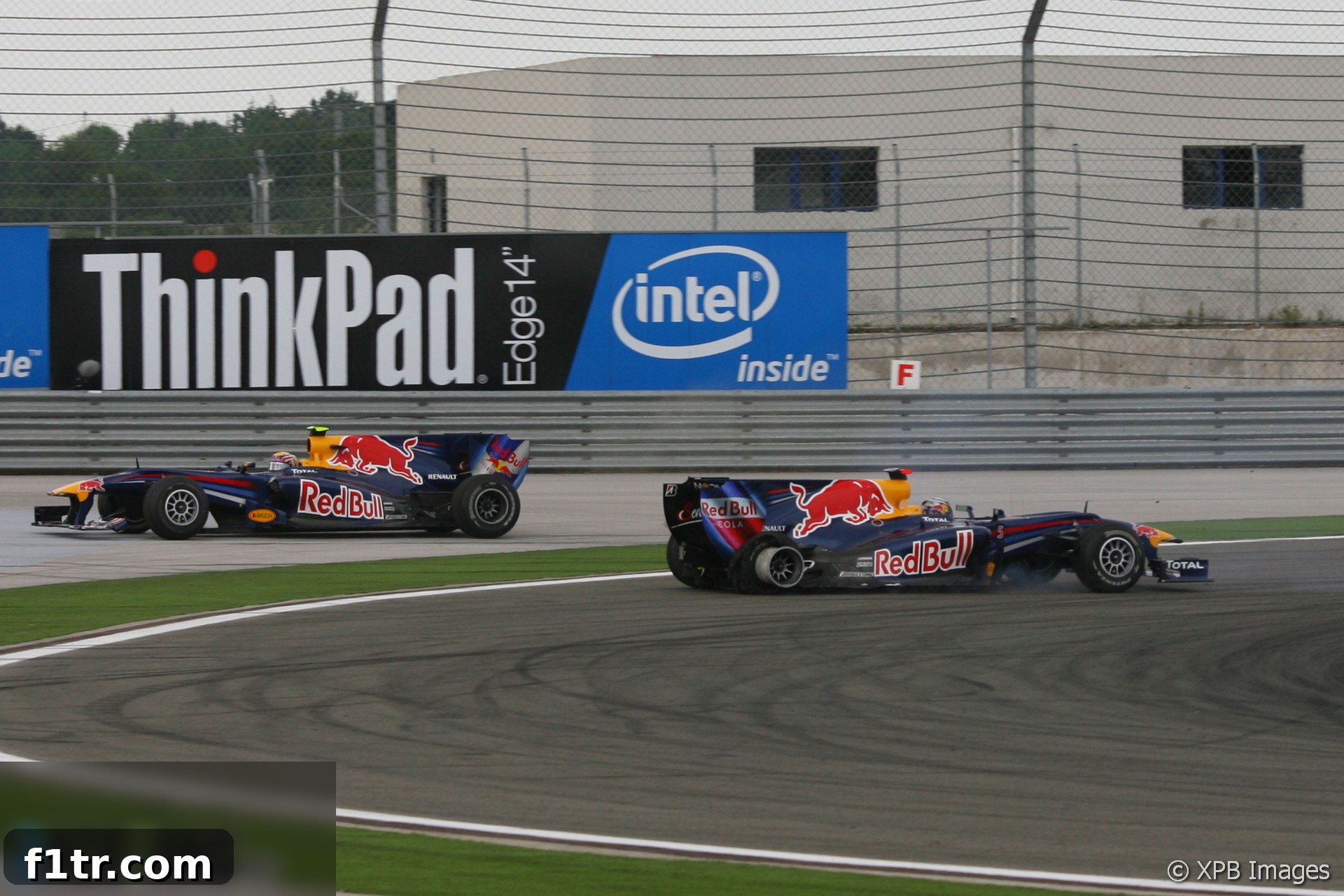
Vettel, sensing an opportunity, made his move. As they exited Turn 11 and headed down the long straight towards Turn 12, Vettel pulled alongside Webber. It was a high-risk manoeuvre, with both drivers holding their ground. They made contact, a devastating incident that sent shockwaves through the paddock and ignited a storm of controversy. Vettel’s right-rear tyre burst, sending his car spinning violently off the track and into retirement. Webber, though able to continue, sustained significant damage to his front wing, forcing him to make an unscheduled pit stop that plummeted him down the order.
The incident was a catastrophic blow for Red Bull, transforming a certain one-two into a calamitous loss of points and a public display of internal strife. The immediate aftermath saw widespread debate about who was to blame, with both drivers offering differing accounts and the team left to pick up the pieces of what could have been a dominant weekend.
McLaren’s Unbelievable Fortune and Internal Duel
For the McLaren team, the Red Bull collision was an almost unbelievable stroke of fortune. One moment, they were battling for third and fourth; the next, they were running first and second. Jenson Button, now elevated to second place, saw an unexpected opportunity for a third win of the season. He swiftly drew alongside his teammate, Hamilton, on the outside of Turn 12 and, with incredible determination, scrambled past to briefly take the lead.
However, the battle was far from over. Button’s move left him on the outside for the final corner, and Hamilton, leveraging his momentum and superior positioning, immediately fought back. The two McLarens dived into Turn 1 side-by-side, their wheels touching in a heart-stopping moment of pure racing. It was Lewis Hamilton who ultimately seized back the lead, demonstrating his fierce competitive spirit and unwillingness to concede victory, even to his teammate.
After the race, Hamilton admitted his surprise at Button’s proximity. He suggested that the fuel-saving targets issued by the team in the closing stages might have inadvertently helped Button close the gap. “The target they gave me was perhaps a bit slower than what they meant for me, and suddenly Jenson was with me,” Hamilton revealed, hinting at the fine margins and communication nuances within a racing team. Despite the brief but intense duel, Button never troubled Hamilton again, and the McLaren pair brought their cars home for a well-deserved, if fortunate, one-two finish.
The Best of the Rest: A Scrambled Finish
While the Red Bull incident and McLaren’s internal battle dominated the headlines, the rest of the field also delivered compelling racing.
Remarkably, Mark Webber, despite his unscheduled pit stop and front wing damage, managed to salvage a remarkable third place. His ability to recover so strongly after such a significant setback underscored the pace of the Red Bull car and his own tenacious driving.
Behind him, the two Mercedes cars finished in formation, with Michael Schumacher ahead of Nico Rosberg, securing valuable points for the German manufacturer.
Robert Kubica delivered another strong performance for Renault, expertly holding off Felipe Massa’s Ferrari throughout the majority of the race to finish close behind Rosberg.
Further down the field, Vitaly Petrov, Kubica’s teammate, put up a spirited defense against the charging Fernando Alonso for many laps. The Spanish double world champion eventually forced his way past Petrov in the dying stages of the race, but not without incident. The pair made contact, damaging Petrov’s car and forcing him to make a late pit stop, which cost him a valuable points finish. Despite the disappointment, Petrov showed impressive pace, setting the fastest lap of the race on his final tour.
This late drama promoted Adrian Sutil to ninth place for Force India and, significantly, Kamui Kobayashi into tenth for Sauber, earning himself and his team their first championship points of the year – a hard-fought reward for their efforts.
Eight cars ultimately finished outside the points, with both Lotuses and HRTs, along with the unfortunate Sebastian Vettel, being the only retirements from the race.
Championship Shake-Up and Future Implications
The 2010 Turkish Grand Prix proved to be a pivotal moment in the championship battle. Lewis Hamilton’s first victory of the season propelled him up to third place in the drivers’ standings, significantly closing the gap to leader Mark Webber, who was now just nine points ahead. Sebastian Vettel, who had entered the race jointly leading the championship, suffered a severe setback, plummeting to fifth place after his costly retirement.
This race highlighted the intense rivalry within Red Bull and showcased McLaren’s opportunism and competitive spirit. It set the stage for a thrilling second half of the season, with multiple drivers and teams firmly in contention for the coveted Formula 1 world titles. The memories of Istanbul Park 2010 would linger, a stark reminder of how quickly fortunes can change in the unpredictable world of Formula 1.
More on the 2010 Turkish Grand Prix
- Technical review: Turkish Grand Prix
- Kobayashi: ‘Q3 means more than a point’
- A brilliant race in Turkey shows F1 is on the right track (Making F1 better)
- 2010 Turkish Grand Prix – the complete F1 Fanatic race weekend review
- Turkish GP team-by-team: Mercedes
- Turkish GP team-by-team: Williams
- Turkish GP team-by-team: Renault
- Two-stop gamble fails to lift Toro Rosso (Turkish Grand Prix team-by-team)
- Turkish GP team-by-team: Lotus
- Turkish GP team-by-team: HRT
Browse all 2010 Turkish Grand Prix articles