The 2018 United States Grand Prix delivered a captivating spectacle of strategy, skill, and sheer determination, culminating in a historic victory for Kimi Raikkonen. His decision to start the race on ultra-soft tyres proved to be a masterstroke, a high-stakes gamble that few other drivers were willing to take. This bold strategic choice set the stage for a race filled with drama, unexpected twists, and an intense battle for championship points, captivating fans and pundits alike. The Circuit of the Americas (COTA) once again provided a fitting backdrop for an unforgettable Formula 1 encounter, showcasing the pinnacle of motorsport engineering and athletic prowess.
Ferrari’s underlying pace was undeniably strong throughout the event, a fact underscored by Sebastian Vettel’s remarkable recovery drive. Despite an early setback that saw him drop an astonishing ten places on the very first lap of the race, Vettel demonstrated the car’s potential by fighting his way back to finish one position higher than his starting grid slot. This resilience highlighted not only the robust performance of the Ferrari SF71H but also Vettel’s tenacity in challenging circumstances, ensuring he remained a factor in the unfolding drama despite his initial misfortune. His ability to navigate through the field after such a significant loss showcased the strategic flexibility and raw speed available to the Scuderia, reinforcing their competitive standing.
In stark contrast, both Mercedes drivers faced significant challenges, primarily struggling with tyre management throughout the race. Lewis Hamilton and Valtteri Bottas appeared to have greater difficulty keeping their Pirelli tyres in optimal operating condition, leading to premature degradation and blistering. Hamilton, initially in a strong position, strategically capitalized on an early Virtual Safety Car (VSC) period to make his first pit stop. However, his race was further complicated when his rear tyres began to blister severely, forcing him into an unscheduled second pit stop. While this late stop allowed him to fit fresh tyres and ultimately set the fastest lap of the race, it put him out of contention for the win. Despite possessing a clear performance advantage over Max Verstappen in the latter stages, the time lost due to the extra stop prevented Hamilton from making a successful overtake for second place. Mercedes’ struggles with tyre wear provided a critical strategic opening for their rivals, altering the complexion of the race dramatically and adding another layer of intrigue to an already thrilling contest.
The story of the race wouldn’t be complete without acknowledging the phenomenal drive from Max Verstappen. Starting from an unpromising 18th position on the grid due to a grid penalty, Verstappen embarked on a truly remarkable charge through the field. Displaying his signature aggressive yet controlled driving style, he carved his way past numerous competitors, demonstrating exceptional car control and race craft. His relentless pursuit culminated in a sensational second-place finish, a testament to his talent and the strategic decisions made by the Red Bull Racing team. This incredible comeback drive firmly established him as one of the standout performers of the Grand Prix, showcasing his ability to deliver under pressure and extract every ounce of performance from his machinery, delighting fans with his audacious overtakes and unwavering speed.
Beyond the podium battles, the 2018 United States Grand Prix also offered intriguing statistical anomalies. The ninth-fastest lap of the race was recorded by Sergio Perez, which, in itself, is not an extraordinary feat. What truly captured attention, however, was the incredible precision demonstrated by the Force India driver. After setting his fastest lap time of 1 minute 39.569 seconds on lap 36, Perez then managed to replicate that exact lap time – to within one-thousandth of a second – on the very next tour of the Circuit of the Americas. This astonishing consistency highlights the immense skill and focus required at the highest level of motorsport, illustrating a rare moment of perfect execution and machine control. Such an identical pair of fast laps underscores the fine margins and incredible precision that define Formula 1 racing, making Perez’s achievement a notable footnote in a memorable race.
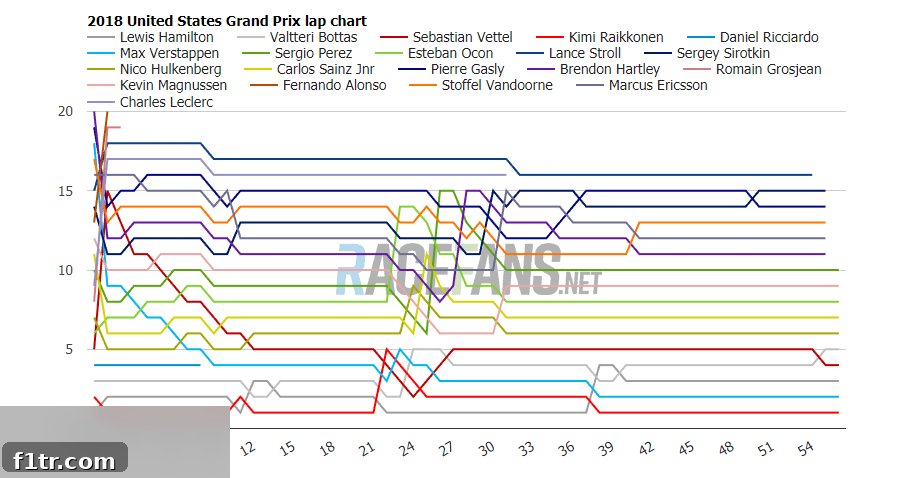
2018 United States Grand Prix Lap Chart Overview
The lap chart provides a visual representation of each driver’s position throughout every lap of the race. This dynamic tool allows fans and analysts to track the ebb and flow of the Grand Prix, observing overtakes, pit stop impacts, and strategic gains or losses in real-time. By clicking on a driver’s name, their specific race trajectory can be highlighted, offering insights into their individual performance against the backdrop of the entire field. Such a chart is invaluable for understanding the progression of the race and identifying key moments where positions changed dramatically due to on-track action or strategic calls.
2018 United States Grand Prix Race Chart Dynamics
The race chart offers a different perspective, illustrating the gaps between each driver relative to the leader’s average lap time on every lap. This provides a clear picture of how drivers gain or lose ground throughout the race, highlighting periods of strong performance or struggles. Very large gaps, often indicative of significant incidents or retirements, are typically omitted to maintain clarity. The ability to scroll, zoom, and pan across the chart allows for detailed examination of specific race phases, while toggling drivers helps focus on direct comparisons. This visual data is crucial for assessing long-run pace, tyre degradation effects, and the overall strategic deployment of speed by each team and driver, contributing significantly to a comprehensive post-race analysis.
Position Change Analysis at the 2018 United States Grand Prix
Analyzing the position changes from start to finish, as well as those occurring specifically on the first lap, offers valuable insights into the immediate impact of the start and the overall effectiveness of each driver’s strategy and pace throughout the Grand Prix. A quick glance at the table reveals dramatic shifts for some, highlighting their struggles or triumphs. For instance, Sebastian Vettel’s significant drop on lap one followed by a net positive change overall speaks volumes about his recovery drive. Conversely, Max Verstappen’s incredible gain of 16 positions demonstrates an exceptional performance from far down the grid. These figures underscore the dynamic nature of Formula 1 races, where every position gained or lost can have major implications for championship standings and team morale.
| Driver | Start position | Lap one position change | Race position change |
|---|---|---|---|
| Lewis Hamilton | 1 | -1 | -2 |
| Valtteri Bottas | 3 | 0 | -2 |
| Sebastian Vettel | 5 | -10 | 1 |
| Kimi Raikkonen | 2 | 1 | 1 |
| Daniel Ricciardo | 4 | 0 | |
| Max Verstappen | 18 | 9 | 16 |
| Sergio Perez | 10 | 2 | 2 |
| Esteban Ocon | 6 | -1 | |
| Lance Stroll | 15 | -3 | 1 |
| Sergey Sirotkin | 14 | 3 | 1 |
| Nico Hulkenberg | 7 | 2 | 1 |
| Carlos Sainz Jnr | 11 | 5 | 4 |
| Pierre Gasly | 19 | 5 | 7 |
| Brendon Hartley | 20 | 8 | 11 |
| Romain Grosjean | 8 | -11 | |
| Kevin Magnussen | 12 | 2 | |
| Fernando Alonso | 13 | -7 | |
| Stoffel Vandoorne | 17 | 4 | 6 |
| Marcus Ericsson | 16 | 0 | 6 |
| Charles Leclerc | 9 | -8 |
2018 United States Grand Prix Lap Times Overview
Detailed analysis of all lap times recorded by each driver during the Grand Prix offers granular insights into their performance throughout different stints and tyre compounds. By excluding exceptionally slow laps (which often indicate incidents, penalties, or unusual pit stops), the chart focuses on competitive race pace. This comprehensive data allows for a clear comparison of driver speed, consistency, and the impact of varying track conditions or strategic choices. The ability to zoom, pan, and filter by individual drivers makes this a powerful tool for understanding the nuances of race pace and how it evolved from the green light to the checkered flag.
2018 United States Grand Prix Fastest Laps Analysis
The fastest lap achieved by each driver is often a strong indicator of their car’s ultimate performance potential and their ability to extract maximum speed at a critical moment. In the 2018 United States Grand Prix, Lewis Hamilton’s fastest lap on lap 40, despite his tyre struggles, underscores the raw speed of the Mercedes W09. The gaps between the fastest laps also highlight the competitive margins across the grid. For instance, Max Verstappen and Sebastian Vettel were remarkably close, separated by mere hundredths of a second, demonstrating the intense battle at the front. Kimi Raikkonen’s fastest lap also being within a second of Hamilton’s shows the consistent pace Ferrari maintained, especially in the latter stages on older tyres. This table provides crucial data for understanding which cars and drivers truly had the pace when it counted, even if it didn’t always translate to victory due to other race factors.
| Rank | Driver | Car | Fastest lap | Gap | On lap |
|---|---|---|---|---|---|
| 1 | Lewis Hamilton | Mercedes | 1’37.392 | 40 | |
| 2 | Max Verstappen | Red Bull-TAG Heuer | 1’38.246 | 0.854 | 45 |
| 3 | Sebastian Vettel | Ferrari | 1’38.280 | 0.888 | 41 |
| 4 | Valtteri Bottas | Mercedes | 1’38.470 | 1.078 | 46 |
| 5 | Kimi Raikkonen | Ferrari | 1’38.482 | 1.090 | 45 |
| 6 | Kevin Magnussen | Haas-Ferrari | 1’38.963 | 1.571 | 32 |
| 7 | Stoffel Vandoorne | McLaren-Renault | 1’39.240 | 1.848 | 42 |
| 8 | Nico Hulkenberg | Renault | 1’39.548 | 2.156 | 51 |
| 9 | Sergio Perez | Force India-Mercedes | 1’39.569 | 2.177 | Set on 2 laps |
| 10 | Pierre Gasly | Toro Rosso-Honda | 1’39.646 | 2.254 | 38 |
| 11 | Carlos Sainz Jnr | Renault | 1’39.858 | 2.466 | 45 |
| 12 | Brendon Hartley | Toro Rosso-Honda | 1’39.915 | 2.523 | 52 |
| 13 | Esteban Ocon | Force India-Mercedes | 1’39.992 | 2.600 | 45 |
| 14 | Marcus Ericsson | Sauber-Ferrari | 1’40.098 | 2.706 | 33 |
| 15 | Lance Stroll | Williams-Mercedes | 1’40.433 | 3.041 | 49 |
| 16 | Sergey Sirotkin | Williams-Mercedes | 1’40.522 | 3.130 | 12 |
| 17 | Daniel Ricciardo | Red Bull-TAG Heuer | 1’40.933 | 3.541 | 5 |
| 18 | Charles Leclerc | Sauber-Ferrari | 1’41.982 | 4.590 | 12 |
| 19 | Fernando Alonso | McLaren-Renault | 2’13.811 | 36.419 | 1 |
| 20 | Romain Grosjean | Haas-Ferrari | 2’29.206 | 51.814 | 2 |
2018 United States Grand Prix Tyre Strategies in Detail
Tyre strategy was perhaps the most pivotal element of the 2018 United States Grand Prix. The choice of compound for the start, the timing of pit stops, and the selection of subsequent compounds profoundly influenced the race outcome for every driver. Kimi Raikkonen’s bold decision to start on the softer ultra-soft tyres contrasted sharply with many rivals who opted for super-softs, hoping for a longer first stint. His strategy worked flawlessly, allowing him to build an early lead before switching to durable softs. Lewis Hamilton’s two-stop strategy, forced by blistering on his soft tyres, showcases the delicate balance between pace and longevity. Max Verstappen’s charge from 18th was underpinned by a well-executed soft-to-super-soft strategy, giving him a crucial grip advantage in his second stint. This table not only lists the chosen compounds but also the number of laps completed on each, offering a window into the tactical battle that unfolded on the asphalt of COTA.
| Stint 1 | Stint 2 | Stint 3 | |
|---|---|---|---|
| Kimi Raikkonen | Ultra soft (21) | Soft (35) | |
| Max Verstappen | Soft (22) | Super soft (34) | |
| Lewis Hamilton | Super soft (11) | Soft (26) | Soft (19) |
| Sebastian Vettel | Super soft (26) | Soft (30) | |
| Valtteri Bottas | Super soft (23) | Soft (33) | |
| Nico Hulkenberg | Ultra soft (23) | Soft (33) | |
| Carlos Sainz Jnr | Super soft (24) | Soft (32) | |
| Sergio Perez | Ultra soft (25) | Soft (31) | |
| Brendon Hartley | Super soft (27) | Soft (28) | |
| Marcus Ericsson | Soft (30) | Super soft (25) | |
| Stoffel Vandoorne | Super soft (10) | Soft (30) | Soft (15) |
| Pierre Gasly | Super soft (10) | Soft (26) | Ultra soft (19) |
| Sergey Sirotkin | Super soft (10) | Soft (19) | Super soft (26) |
| Lance Stroll | Super soft (1) | Soft (4) | Ultra soft (33) |
| Charles Leclerc | Ultra soft (1) | Soft (30) | |
| Daniel Ricciardo | Super soft (8) | ||
| Romain Grosjean | Ultra soft (1) | Soft (1) | |
| Fernando Alonso | Super soft (1) | ||
| Esteban Ocon | Ultra soft (22) | Soft (34) | |
| Kevin Magnussen | Super soft (30) | Soft (26) |
2018 United States Grand Prix Pit Stop Times Breakdown
Pit stops are critical moments in any Formula 1 race, where seconds can make or break a driver’s chances. The efficiency of a pit crew, combined with the timing of the stop, can significantly impact a driver’s track position. The 2018 United States Grand Prix saw a wide range of pit stop times, reflecting both the precision of the top teams and the unfortunate setbacks faced by others. Lance Stroll’s initial stop, though quick, was part of a very early strategy. Max Verstappen and Valtteri Bottas both benefited from efficient stops from their respective teams, allowing them to remain competitive. On the other end of the spectrum, extended stops for drivers like Carlos Sainz Jnr, Charles Leclerc, and Romain Grosjean highlight moments where strategy or execution went awry, costing them crucial time and positions. This detailed breakdown of pit stop durations provides a clear picture of an often-overlooked yet vital aspect of Grand Prix racing, where every millisecond counts in the battle for supremacy.
| Driver | Team | Pit stop time | Gap | On lap | |
| 1 | Lance Stroll | Williams | 18.610 | 5 | |
| 2 | Max Verstappen | Red Bull | 23.446 | 4.836 | 22 |
| 3 | Valtteri Bottas | Mercedes | 23.478 | 4.868 | 23 |
| 4 | Sergey Sirotkin | Williams | 23.686 | 5.076 | 10 |
| 5 | Lewis Hamilton | Mercedes | 23.693 | 5.083 | 11 |
| 6 | Kimi Raikkonen | Ferrari | 23.714 | 5.104 | 21 |
| 7 | Sergey Sirotkin | Williams | 23.715 | 5.105 | 29 |
| 8 | Kevin Magnussen | Haas | 23.723 | 5.113 | 30 |
| 9 | Brendon Hartley | Toro Rosso | 23.819 | 5.209 | 27 |
| 10 | Pierre Gasly | Toro Rosso | 23.865 | 5.255 | 10 |
| 11 | Lewis Hamilton | Mercedes | 23.915 | 5.305 | 37 |
| 12 | Marcus Ericsson | Sauber | 23.940 | 5.330 | 30 |
| 13 | Stoffel Vandoorne | McLaren | 24.065 | 5.455 | 10 |
| 14 | Stoffel Vandoorne | McLaren | 24.195 | 5.585 | 40 |
| 15 | Pierre Gasly | Toro Rosso | 24.219 | 5.609 | 36 |
| 16 | Lance Stroll | Williams | 24.296 | 5.686 | 38 |
| 17 | Sebastian Vettel | Ferrari | 24.449 | 5.839 | 26 |
| 18 | Esteban Ocon | Force India | 24.534 | 5.924 | 22 |
| 19 | Nico Hulkenberg | Renault | 24.681 | 6.071 | 23 |
| 20 | Sergio Perez | Force India | 25.723 | 7.113 | 25 |
| 21 | Carlos Sainz Jnr | Renault | 29.319 | 10.709 | 24 |
| 22 | Charles Leclerc | Sauber | 34.812 | 16.202 | 1 |
| 23 | Romain Grosjean | Haas | 35.104 | 16.494 | 1 |
| 24 | Lance Stroll | Williams | 41.048 | 22.438 | 1 |
Additional Insights from the 2018 United States Grand Prix
The 2018 United States Grand Prix will be remembered as a race where strategy and tyre management were paramount. Kimi Raikkonen’s victory, his first in over five years, was a poetic moment for the veteran driver and a significant boost for Ferrari. It was a race that saw the raw pace of Mercedes challenged by their tyre woes, and the exceptional talent of Max Verstappen shine through with a drive that defied his starting position. Every team faced unique challenges and opportunities, making for a truly compelling narrative on track. From the nail-biting start to the strategic chess game that unfolded across multiple stints, COTA delivered a Formula 1 classic that continues to be discussed by enthusiasts.
- Verstappen leaving rivals breathless in Mexican altitude
- Raikkonen ends longest-ever wait between wins
- 300 team radio messages from the United States Grand Prix
- 2018 United States Grand Prix Star Performers
- Top ten pictures from the 2018 United States GP
Browse all 2018 United States Grand Prix articles