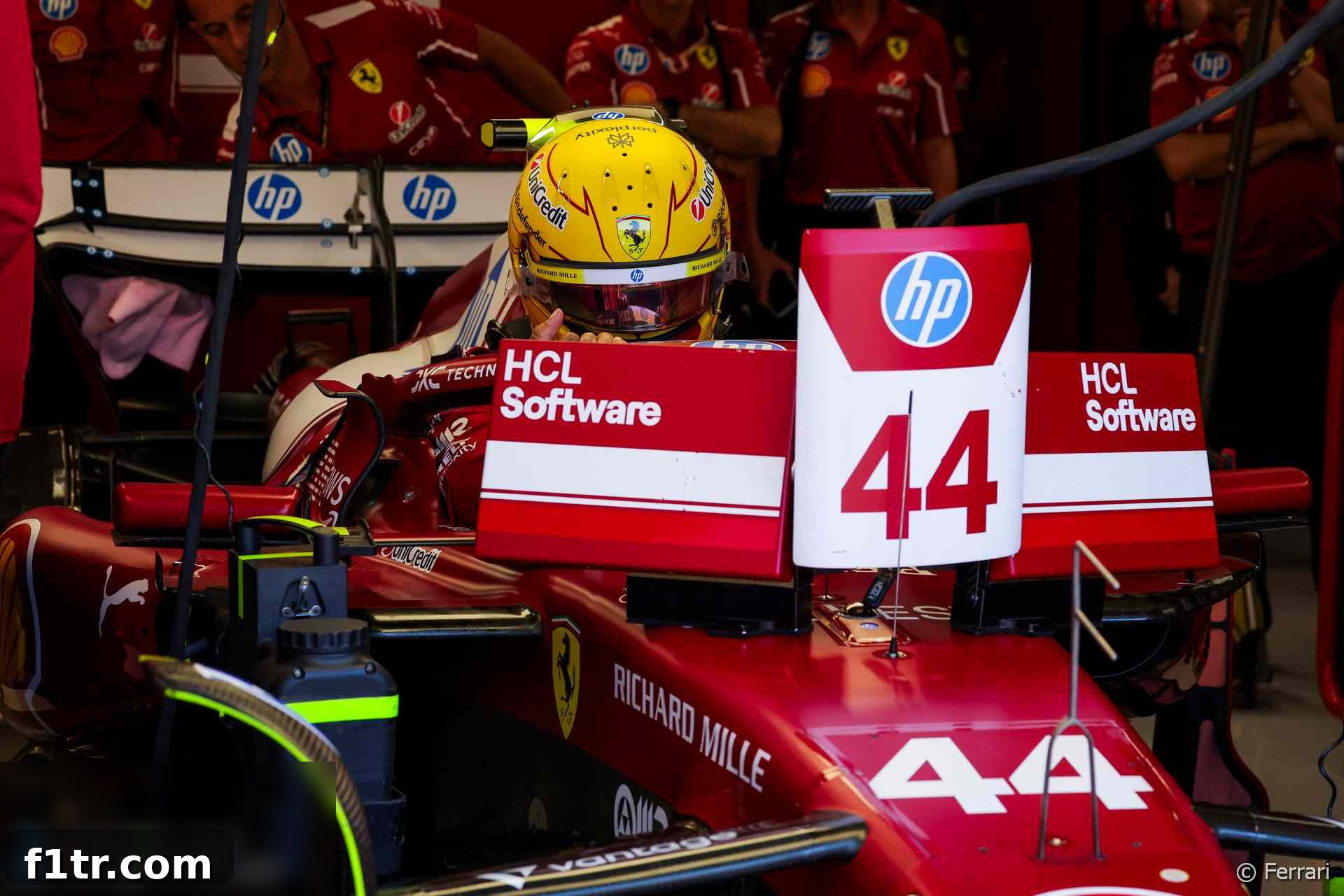
In a significant development that sent ripples through the Formula 1 paddock, Lewis Hamilton, one of the sport’s most decorated drivers, was handed a five-place grid penalty for the upcoming Italian Grand Prix. This decision stemmed from an incident that occurred during a reconnaissance lap at the preceding Dutch Grand Prix, where the Mercedes driver was deemed to have failed to slow down sufficiently under double waved yellow flags. The stewards’ verdict underscores the FIA’s unwavering commitment to safety regulations, particularly in critical track conditions.
The incident in question took place in the challenging final corner of the Zandvoort circuit, a section known for its demanding nature and proximity to the pit lane entry. Prior to the race, double waved yellow flags were explicitly deployed in this area as a crucial safety measure, designed to protect personnel and other cars potentially on the grid or entering the pit lane. This advanced warning was communicated to all participants by the race director, emphasizing the critical need for drivers to exercise extreme caution.
According to the official stewards’ report, the directive was clear: “Due to the nature of the track, the race director had informed all participants that the last corner before the pit lane would have double yellow flags waved. This was to ensure the safety of those on the grid and in the pit lane.” This proactive measure highlights the inherent risks in Formula 1 and the stringent protocols in place to mitigate them. Drivers are expected to be acutely aware of track conditions and respond immediately and appropriately to marshal signals.
While Hamilton did acknowledge the yellow flags and attempted to reduce his speed, the stewards concluded that his actions did not meet the required threshold as stipulated by the regulations. The FIA International Sporting Code (ISC) mandates that any driver traversing a double waved yellow flag marshalling sector must ‘reduce speed significantly.’ This specific wording is not merely a suggestion but a strict directive, designed to ensure that drivers are prepared to stop or take evasive action if necessary, safeguarding against potential hazards on track.
The stewards’ investigation involved a meticulous review of available telemetry data, both from the FIA system and directly requested from Hamilton’s team. This comprehensive approach, though time-consuming and resulting in a delayed decision, ensured a thorough and evidence-based assessment of the incident. Telemetry data provides invaluable insights into a car’s performance parameters, including speed, throttle application, and braking inputs, offering objective evidence of a driver’s actions on track.
Furthermore, the investigation extended to Article 44.1 of the regulations, which stipulates that drivers covering more than one reconnaissance lap must drive down the pit entry road at a ‘greatly reduced speed.’ This rule is designed to prevent excessive speeds in the congested pit lane environment, further enhancing safety for team personnel and other vehicles.
Analysis of the telemetry data revealed that Hamilton had entered the double yellow sector approximately 20 kilometers per hour (kph) slower than his speed at the same point during practice sessions. He had also reduced throttle application by about 10% to 20% and had initiated braking 70 meters earlier when entering the pit lane. While these actions indicated an attempt to comply, the stewards determined they were insufficient to meet the regulatory requirements. A 20kph reduction, in their judgment, did not constitute reducing speed ‘significantly’ in a double waved yellow sector. Similarly, his speed upon entering the pit entry road was not considered ‘greatly’ reduced according to the rules.
The stewards’ decision-making process took into account the gravity of the infringement, noting that the penalty guidelines for such an offense would typically entail a more severe sanction – a 10-grid-position penalty at the subsequent race. However, acknowledging Hamilton’s discernible effort to reduce his speed and brake earlier, these factors were considered mitigating circumstances. This nuanced approach allowed the stewards to impose a lesser, though still impactful, five-grid-place penalty, reflecting the balance between strict adherence to rules and the specific context of the incident.
Beyond the grid penalty, Hamilton also incurred two penalty points on his Super Licence. This marks his first penalty points in the current 12-month period, a remarkable statistic considering his consistent record of 51 consecutive race weekends without any such infractions. The penalty points system in Formula 1 serves as a progressive deterrent, with drivers accumulating points for various offenses. Accumulating 12 points within a 12-month rolling period results in an automatic one-race ban, underscoring the significance of each point received.
The incident at the Dutch Grand Prix also saw four other prominent drivers—Max Verstappen, Lando Norris, Carlos Sainz Jnr, and Nico Hulkenberg—come under scrutiny for a different, yet related, regulation: failing to adhere to the maximum time limit between the Safety Car lines during their reconnaissance laps. This rule is in place to prevent drivers from driving unnecessarily slowly, which could create dangerous closing speeds for following cars or impede track clearing operations. However, in each of these cases, the stewards found mitigating circumstances. It was determined that these drivers had slowed down to allow others to pass, a common practice during reconnaissance laps to manage track position or avoid traffic, and therefore did not do so unnecessarily. This distinction highlights the complexities of stewarding in Formula 1, where intent and context play a crucial role in the final judgment.
The imposition of a grid penalty on a driver of Lewis Hamilton’s stature serves as a stark reminder that no individual is above the regulations governing safety in Formula 1. Each rule, from flag procedures to pit lane protocols, is meticulously crafted to ensure the well-being of all participants, from drivers and marshals to team personnel and spectators. As the F1 circus prepares for the Italian Grand Prix at Monza, Hamilton will face an uphill battle, starting five positions lower than his qualifying performance. This penalty will undoubtedly add an extra layer of challenge to his race weekend, requiring a strategic masterclass to mitigate its impact and fight for a strong result at the historic Temple of Speed.
The continuous evolution of F1 regulations and the rigorous application of stewarding decisions are vital for maintaining the integrity and safety of the sport. While penalties can be controversial, they are fundamental to ensuring fair play and upholding the high standards expected in the pinnacle of motorsport. This incident at Zandvoort will be yet another example etched into the annals of F1, reinforcing the absolute importance of driver vigilance and adherence to safety directives at all times.
Miss nothing from RaceFans
Get a daily email with all our latest stories – and nothing else. No marketing, no ads. Sign up here:
2025 Dutch Grand Prix
- Williams’s Sainz penalty review success “will open the door to more challenges”
- Lawson now accepts Sainz collision was a “racing incident” after stewards’ U-turn
- Stewards’ U-turn over Zandvoort penalty shows ‘how far the FIA have come’ – Sainz
- The FIA’s stewards grabbed the chance to correct their mistake – unlike last time
- Sainz’s Dutch GP penalty points cancelled as stewards accept Williams’ request for review
Browse all 2025 Dutch Grand Prix articles