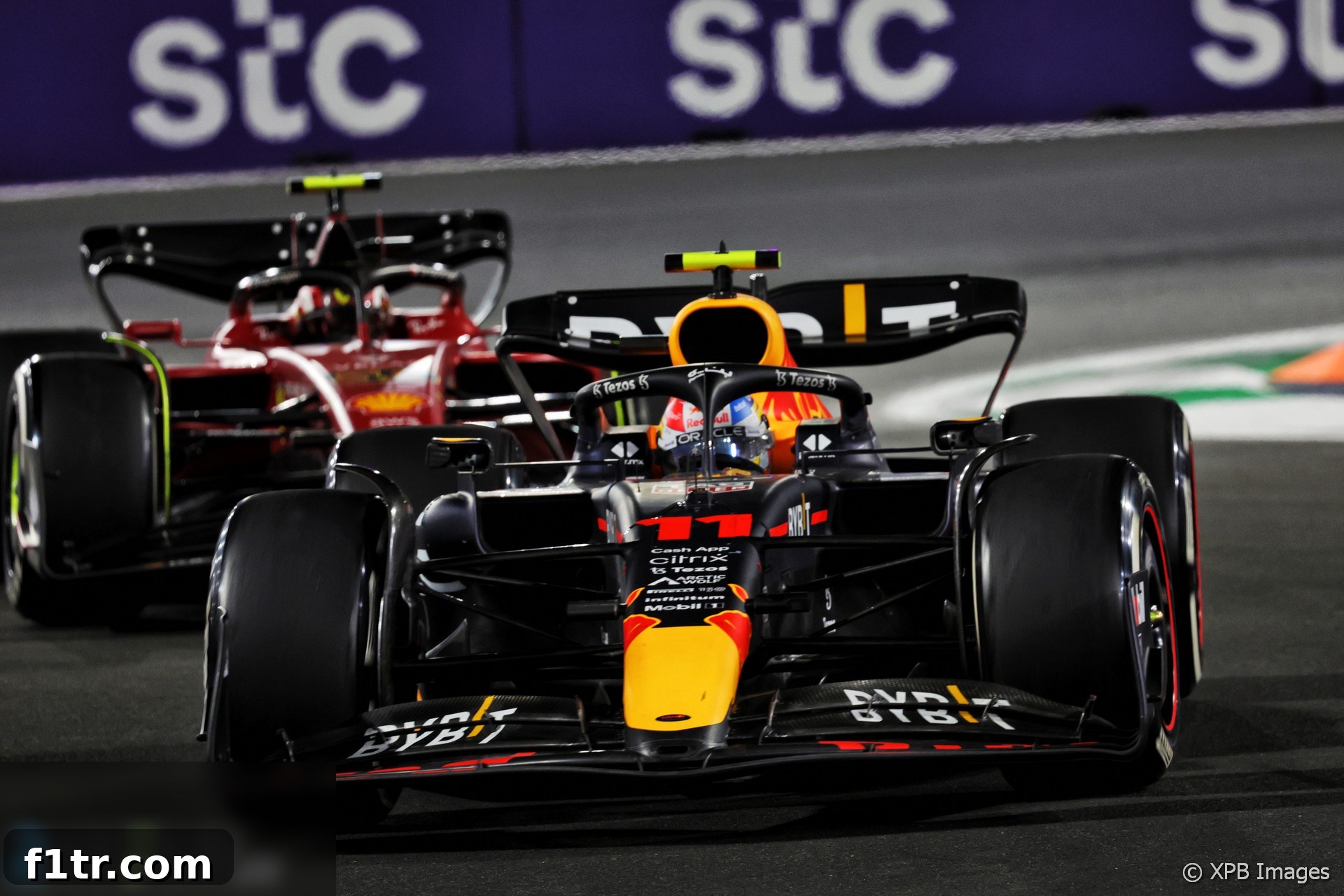
In the aftermath of the thrilling Saudi Arabian Grand Prix, Carlos Sainz Jnr voiced significant frustration and demanded a clear explanation from the FIA regarding a controversial incident involving Sergio Perez. The Ferrari driver expressed his dismay at being forced to wait until the conclusion of a Safety Car period before regaining a position that had been incorrectly seized by his Red Bull rival. This incident sparked a wider debate about the consistency and efficiency of Formula 1’s rule enforcement, particularly concerning driver conduct under Safety Car conditions.
Advert | Become a Supporter & go ad-free
The contentious moment unfolded on lap 16 of the race when Sainz executed a pit stop under the Safety Car. Emerging from the pit lane, he found himself fractionally ahead of Perez. However, to Sainz’s surprise and immediate concern, Perez subsequently moved past him, unlawfully taking over third place on the track. What followed was a period of suspense and confusion, as Perez maintained this illicitly gained position for four crucial laps, only relinquishing it just before the race was restarted.
This particular scenario was precisely what Sainz had highlighted as a potential issue earlier in the week. Prior to the Grand Prix, he had advocated for immediate action when drivers gain positions illegally, emphasizing the necessity for them to surrender those places without delay. Sainz’s pre-race comments underscored the importance of swift and decisive rule application to prevent prolonged disputes and maintain competitive integrity.
“You cannot lose three or four laps, then have to give up the position,” Sainz articulated firmly on Thursday, foreseeing the very situation that would transpire. “That’s why the rulebook needs to be super-clear, needs to be applied in a moment that there’s any friction.” His words now resonated with even greater significance, framing the incident with Perez as a stark example of the procedural shortcomings he had previously warned against. The Spaniard’s argument was clear: delayed justice on the track is, in many ways, an injustice itself, impacting race strategy and driver opportunities.
Speaking with palpable disappointment after the race, Sainz unequivocally stated that the incident with Perez was “a number one priority that we need to talk with the FIA.” His demand for discussion reflected not just his personal grievance but also a broader concern for the fair play and efficient management of competitive racing. Sainz felt strongly that the FIA’s handling of the situation had directly compromised his race and the overall spectacle.
Sainz further elaborated on the detrimental effects of the delayed decision. He pointed out that by the time Perez finally slowed to allow him past at the restart, both drivers found themselves significantly further behind the leading duo of Charles Leclerc and Max Verstappen than they would have been had the position been returned immediately. This cascade effect meant that precious time and track advantage were lost, diminishing their chances to challenge for the top spots. The strategic implication was profound; what could have been a direct battle for the podium was instead diluted by procedural delays.
“Basically Checo lost the opportunity to fight with me on the restart and I lost the opportunity to fight with Max for not giving up their position during the Safety Car,” Sainz explained, highlighting the dual impact of the FIA’s inaction. He emphasized that ample time existed during the extensive Safety Car period for the position swap to occur seamlessly, preserving the competitive dynamics of the race without penalizing either driver for the FIA’s slow decision-making.
Advert | Become a RaceFans supporter andgo ad-free
“We had a lot of laps to do it. The FIA didn’t allow us and I think for the sake of racing, for the sake of Formula 1, these kind of things, they need to happen quicker and they need to happen more efficiently.” Sainz’s plea was not merely for himself but for the integrity and excitement of the sport itself. He argued that drawn-out decision-making by race control directly undermines the spectacle and introduces unnecessary elements of chance and unfairness into what should be a clear-cut sporting contest.
Formula 1 regulations explicitly mandate that drivers must maintain their positions during Safety Car periods. However, recent history, ironically at the very same circuit, presented a precedent that seemed to contradict the FIA’s handling of the Sainz-Perez situation. During last year’s race, Max Verstappen, following a discussion with then-FIA F1 Race Director Michael Masi, allowed both Esteban Ocon and Lewis Hamilton to pass him prior to a restart. This prior instance showcased that swift, on-track resolution of position disputes under Safety Car conditions was indeed possible and had been implemented. The discrepancy between these two events only fueled Sainz’s arguments for greater consistency and clarity from race control.
Sainz acutely recognized the potential for even greater chaos stemming from the FIA’s delayed intervention. He highlighted a hypothetical but very plausible scenario where another driver, such as fifth-placed George Russell, could have capitalized on the ambiguity and passed him. Such a development would have further complicated an already intricate situation, raising difficult questions about subsequent redress.
“We created a mess that for me is unnecessary, given the fact that we did six laps behind the Safety Car and there were millions of opportunities for Checo to let me by and have a good fight at the restart,” Sainz asserted. He painted a picture of avoidable confusion that undermined the sporting integrity of the event. The protracted Safety Car period, in his view, offered ample time for race control to instruct Perez to yield the position, thereby preventing the entire protracted dispute.
Sainz then delved into the potential for cascading unfairness: “If I would have got passed by Russell for example, what would we have done? Would Checo have had to let by Russell and me, which would have been tremendously unfair for him too? Or then Checo doesn’t give me back the position because there’s Russell in between me and him and it’s tremendously unfair for me?” This intricate hypothetical perfectly illustrated the “mess” he referred to, demonstrating how one delayed decision could create a domino effect of unfairness for multiple competitors. It underlined the critical need for immediate resolution to prevent such complex, multi-layered injustices from occurring.
“So I don’t know, it’s just these kind of things that as a sport we need to keep getting better at because I think we need to simplify things and just make it more quicker and easier for everyone to understand and even for the drivers to go racing with a much clearer mind.” Sainz’s impassioned plea extended beyond the immediate incident, touching upon the fundamental need for Formula 1 to evolve in its rule application. He called for a simplification of procedures and an acceleration of decision-making processes, arguing that this would not only benefit the clarity for fans but also allow drivers to compete with a greater sense of certainty and fairness.
This was not the first time Sainz had publicly criticized the handling of crucial race situations by the FIA. He was notably vocal about the controversial final-lap restart at the 2021 Abu Dhabi Grand Prix. In that decisive race, Michael Masi made an unprecedented decision to only allow a selected number of lapped cars to unlap themselves under the Safety Car. Sainz, who was running in a strong third position, found himself strategically disadvantaged, trapped behind a pair of backmarkers. Simultaneously, the five lapped cars positioned between second-placed Max Verstappen and race leader Lewis Hamilton were controversially moved aside. Sainz firmly believed that this arbitrary decision directly cost him a genuine opportunity to fight for a maiden Formula 1 victory. The parallels between the Jeddah incident and his past experiences reinforced his conviction that systematic improvements in FIA race direction are urgently required to ensure consistent, transparent, and fair racing for all competitors.
Advert | Become a RaceFans supporter andgo ad-free
2022 Saudi Arabian Grand Prix
- Vettel will return to race for Aston Martin at Australian Grand Prix
- Mercedes “a second per lap” off Red Bull’s pace – Russell
- Transcript: How Verstappen fought Leclerc on his radio and on the track in Jeddah
- F1 intends to keep racing in Saudi Arabia despite missile attack
- Paddock Diary: 2022 Saudi Arabian Grand Prix
Browse all 2022 Saudi Arabian Grand Prix articles