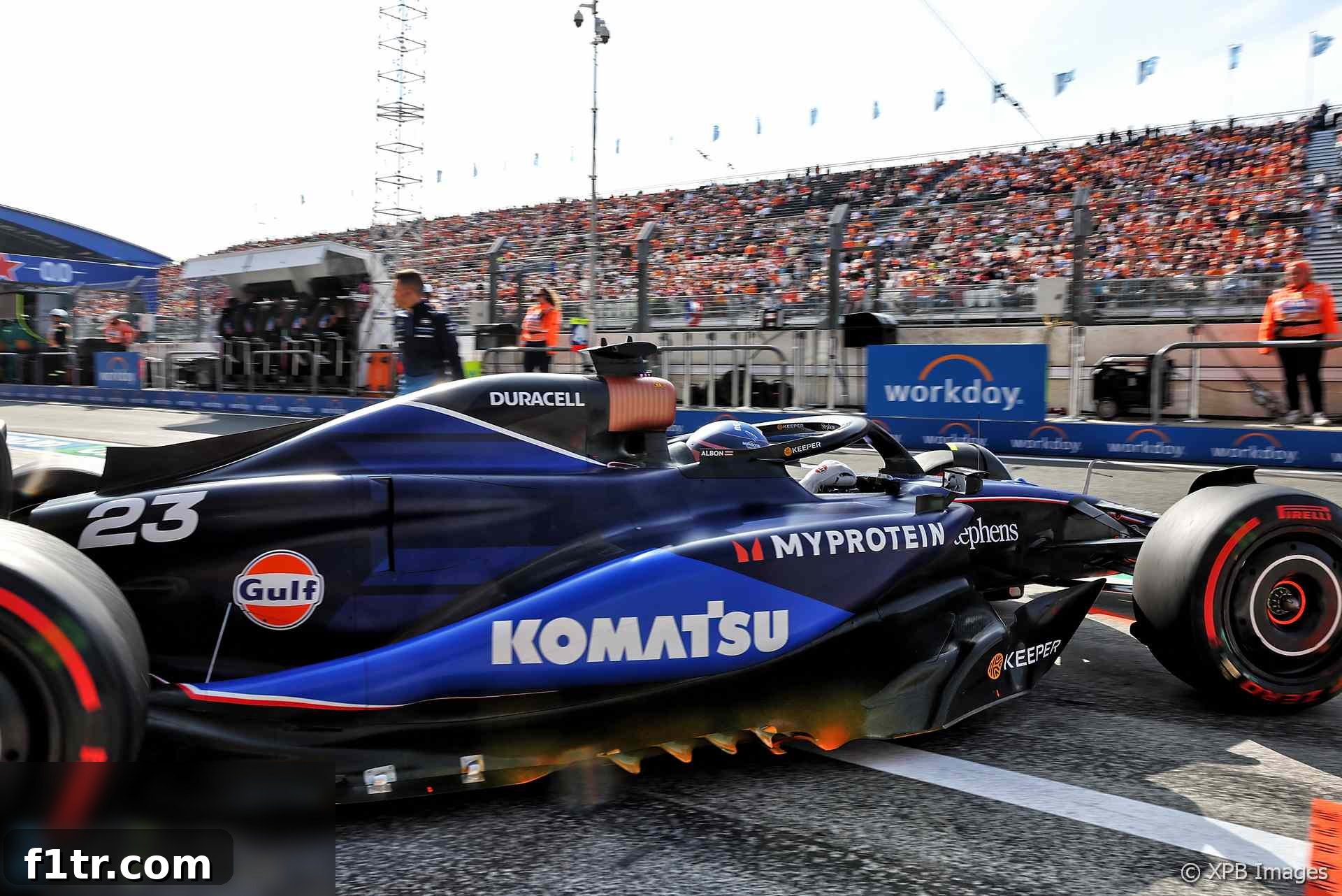
A significant setback struck the Williams Racing team at the highly anticipated Dutch Grand Prix as Alexander Albon was disqualified from qualifying. The decision came after post-session scrutineering revealed a critical non-compliance issue: the floor of his updated FW46 car was found to be too wide, exceeding the strict dimensions stipulated by Formula 1 regulations. This unfortunate incident stripped Albon of what was his best qualifying performance of the season to date, a P11 finish that had offered genuine hope for points in the race.
Williams F1 Disqualification: Unpacking Albon’s Illegal Floor and the Team’s Road Ahead
The technical infringement involving the FW46’s floor immediately cast a shadow over Williams’ weekend, despite strong on-track performance. Team Principal James Vowles confirmed the disqualification, stating, “We were disqualified for a floor that was too wide.” This concise statement, however, belies the complex technicalities and meticulous processes involved in modern Formula 1 car design and regulatory compliance. The floor, a critical aerodynamic component in the current ground-effect era of F1, plays a pivotal role in generating downforce. Even minor deviations from prescribed dimensions can significantly alter a car’s aerodynamic profile, leading to performance advantages and, consequently, regulatory breaches.
Advert | Become a Supporter & go ad-free
The Technical Breach: An Over-Dimensioned Floor and Its Implications
Williams had arrived in Zandvoort with an extensive upgrade package for the FW46, spearheaded by a revised floor design – a component often referred to as the ‘fifth element’ of an F1 car due to its profound impact on performance. The team had invested considerable resources and development time into this crucial update, aiming to close the gap to their midfield rivals and consistently challenge for points. However, the FIA’s rigorous post-session technical checks, designed to ensure a level playing field, flagged an issue with the new floor. Specifically, certain areas were found to exceed the maximum permissible width.
In contemporary Formula 1, the floor’s geometry is intricately linked to how the car interacts with the airflow, particularly in generating ground effect. The precise shaping and dimensions are crucial for optimizing airflow underneath the car, creating a low-pressure zone that sucks the car to the track. Even a millimeter can make a measurable difference in performance. This is why the technical regulations are so prescriptive and why the FIA employs advanced scanning techniques to verify compliance. The consequence of even a slight deviation, therefore, is severe, underscoring the razor-thin margins and uncompromising nature of F1’s rulebook.
Williams’ Internal Scans vs. FIA Adjudication: A Clash of Measurements
James Vowles elaborated on Williams’ internal procedures, explaining that the team was confident their design was compliant before bringing it to the track. “It’s not the first time they’ve been scanned,” Vowles noted, referring to the FIA’s scanning process. He emphasized Williams’ consistent adherence to these procedures since their introduction several years ago, never having fallen foul until now. This suggests a robust internal verification system, which makes the disqualification all the more perplexing for the team.
The team utilizes advanced scanning technologies similar to the FIA’s to measure intricate shapes, heights, and widths across the complex floor structures. Vowles confirmed, “Before we came here, we scanned the floor and the car multiple times. It happened back at the factory, in isolation with the floor, it happened back at the factory on the car. It happened here on Thursday as well.” Furthermore, Williams had reportedly presented these internal measurement results to the FIA, which, according to Vowles, indicated that their floor was within legal compliance. This raises questions about the potential for minute calibration differences between team equipment and official FIA systems, or perhaps a tolerance discrepancy in the interpretation of the regulations.
Despite their internal findings, Williams unequivocally accepted the FIA’s decision. Vowles stated, “But what matters is the adjudication of the FIA, their measurements and their systems, and that we entirely accept.” This stance highlights the principle of strict liability in F1; ultimately, it is the FIA’s measurements and judgment that prevail, irrespective of a team’s own data or intentions. This uncompromising approach is fundamental to maintaining sporting integrity and preventing any ambiguities in technical compliance.
Advert | Become a RaceFans supporter andgo ad-free
Immediate Action and Unwavering Accountability
Looking forward, Vowles expressed confidence that rectifying the issue would not be a significant challenge. He described the necessary changes as an “easy fix,” indicating that the non-compliant area is limited and can be quickly addressed. However, the focus now extends beyond merely fixing the part; Williams must delve into understanding *why* their own measurement processes failed to identify the discrepancy. “What we now need to do is understand how we could have been wrong in our own measurements and what we need to change in terms of process with immediate effect,” Vowles affirmed.
This incident serves as a stark reminder of the absolute precision required in Formula 1 design and manufacturing. A single mismeasurement, however minor, can negate weeks or months of development work and cost valuable championship points. Vowles took a firm stance on accountability, emphasizing that the responsibility rests squarely with the team. “There’s no one really accountable for that but ourselves. That’s on our shoulders. No one else outside of that has any responsibility. We need to address and get on top of that with immediate effect.” This leadership ethos, focusing on systemic improvement rather than individual blame, is crucial for fostering a culture of continuous learning and excellence within the team.
Performance Positives Amidst the Penalty: A Glimmer of Hope
Despite the sting of disqualification, Vowles drew significant encouragement from the underlying performance of the FW46 and Alexander Albon. Albon’s qualifying pace was genuinely competitive, placing him within a mere tenth of a second of quicker cars from Ferrari and Aston Martin – a remarkable feat for a team like Williams. “The performance of the car was positive,” Vowles confirmed. “We’re in a situation where the update is now producing good results and, in a very tight midfield, we’re able to put the car back into that qualifying three position, back into a points-scoring position for the race today.”
Furthermore, the positive signs extended beyond single-lap pace. The team’s long-run data from Friday practice also showcased promising improvements. “That’s also mirrored by a long run on Friday that, again, was positive. It had pulled clear of the midfield and we were in a situation in fact, at times, where our long run was overlaying with Ferrari, which is a very different situation to what we’ve been to the beginning of a season,” Vowles explained. This strong long-run performance is particularly encouraging, as it indicates genuine race pace and potential to compete consistently in the midfield, suggesting that the aerodynamic concept of the upgrade is fundamentally sound.
Advert | Become a RaceFans supporter andgo ad-free
Looking Ahead: Williams’ Season Prospects and Commitment to Perfection
The positive performance metrics, despite the regulatory breach, instill a sense of optimism for Williams’ future races. Vowles believes the upgrade package puts the team in a much stronger position for the remainder of the season. “Beyond this race weekend – where I feel we have a strong enough car to be able to fight through the field – I’m excited by the prospects of today because the car remains quick and we have opportunity in the race,” he stated. With nine more races on the calendar, the goal is clear: consistent, error-free delivery to maximize scoring opportunities and climb the Constructors’ Championship standings.
The disqualification at Zandvoort, while painful, serves as a sharp reminder of the exacting standards required in Formula 1. It underscores that even with significant performance gains, flawless execution across all aspects – from design and manufacturing to measurement and compliance – is non-negotiable. “This isn’t the standard I want us to hold ourselves to this weekend, but let’s now make it a process change to ensure that it doesn’t happen again,” Vowles concluded. Williams Racing, under Vowles’ leadership, faces the dual challenge of harnessing the newfound pace of their upgraded FW46 while simultaneously refining their internal processes to prevent any future technical compliance issues. Their ability to manage this will be critical in determining their success in the latter half of the 2024 season.
Gallery: The Updated Williams FW46 Floor
Miss nothing from RaceFans
Get a daily email with all our latest stories – and nothing else. No marketing, no ads. Sign up here:
Advert | Become a RaceFans supporter andgo ad-free
2024 Dutch Grand Prix Related Articles
Explore more news and analyses from the 2024 Dutch Grand Prix weekend and beyond:
- Previous technical hires no obstacle to Newey joining Aston Martin – Krack
- Mercedes still unsure whether Spa floor upgrade is working
- McLaren’s Dutch GP upgrade “nowhere near” as significant as Miami package
- “Very hard to pinpoint” why car has become harder to drive – Verstappen
- Only one F1 driver is making worse starts than Norris in 2024
Browse all 2024 Dutch Grand Prix articles