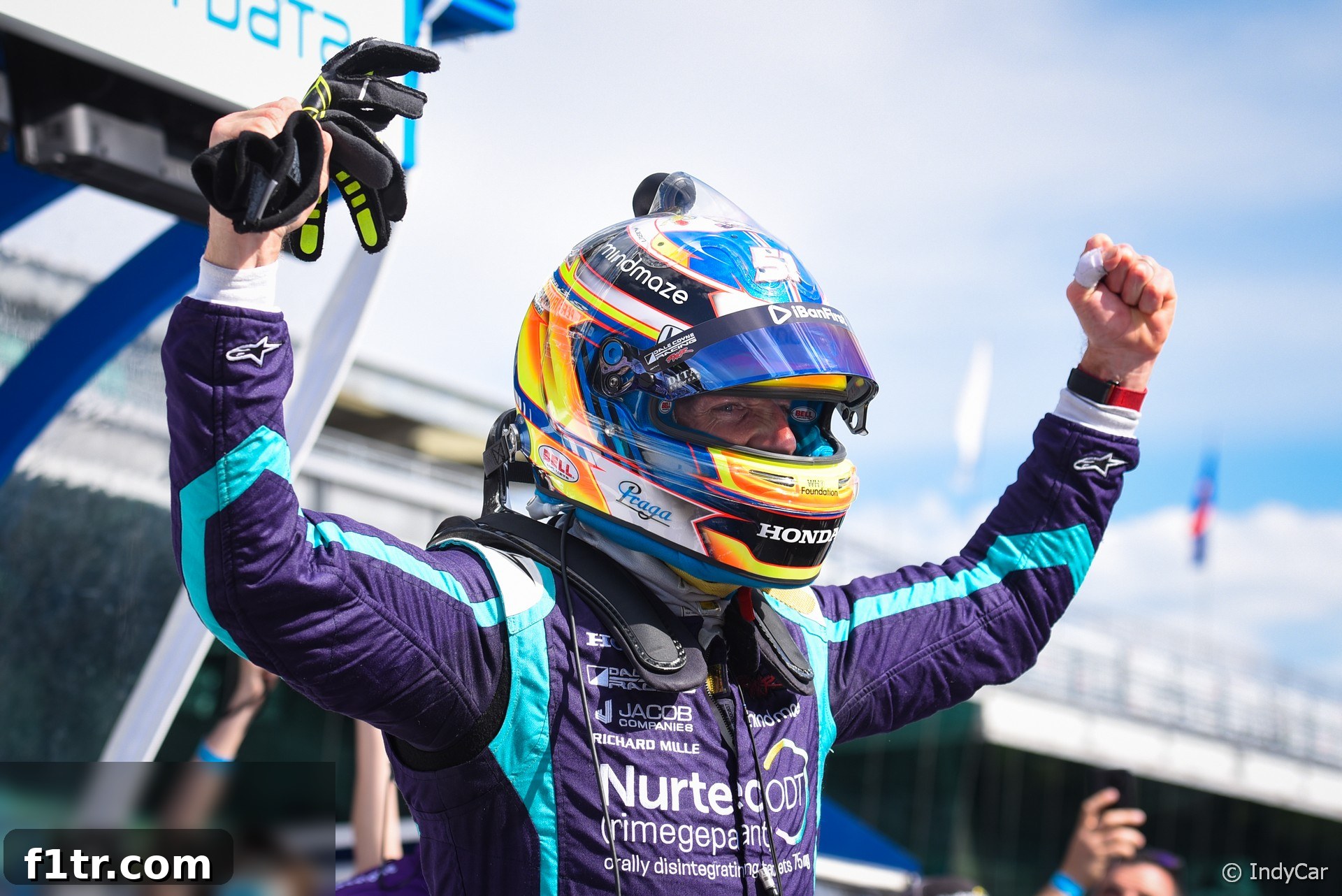
In a powerful testament to renewed passion and a fresh start, veteran racer Romain Grosjean has declared he feels “alive again” after securing his first pole position in a decade. The former Formula 1 driver will lead the field at the start of today’s highly anticipated IndyCar race at the iconic Indianapolis Motor Speedway. This significant achievement marks his first pole position since the opening race of the 2011 GP2 season, remarkably coming just three races into his inaugural IndyCar campaign.
Grosjean’s journey to this moment has been one of perseverance, challenge, and ultimately, reinvention. His career in Formula 1, while illustrious in its longevity, often saw him battling in the midfield, far from the consistent front-running positions he once enjoyed in junior categories. This pole position is not merely a statistical entry; it represents a profound emotional and professional triumph, signaling a vibrant new chapter in his decorated motorsport career.
Romain Grosjean’s IndyCar Resurgence: From F1 Struggles to Pole Position Glory
The exhilaration in Grosjean’s voice was palpable as he spoke to reporters, reflecting on his return to the sharp end of motorsport. “It’s like being alive again,” shared the driver for Dale Coyne Racing with Rick Ware Racing, perfectly encapsulating the immense satisfaction and joy of his newfound success. This sentiment stands in stark contrast to the latter years of his Formula 1 career, where opportunities for pole positions or race wins were virtually non-existent without a top-tier car.
During his extensive Formula 1 tenure, which spanned nine full seasons, Grosjean only managed to start from the front row on a single occasion: the 2012 Hungarian Grand Prix, his first full season in the premier championship. This stark statistic underscores the challenge he faced in F1, a championship where vehicle performance often dictates potential outcomes more than raw driving talent.
Grosjean articulated this reality clearly, explaining, “When you get to Formula 1, you’ve won every category that you competed in before, but you know when you get to Formula 1 if you don’t have the best car, it’s going to be very unlikely that you get to win races.” He recalled brief moments of glory, particularly in the early days with Lotus. “I was lucky early in my career to get a good Lotus and be in the front row, third spot quite a bit, which was great. But obviously there were the Red Bull of Sebastian Vettel at the time and just on another level.” These experiences solidified his understanding of F1’s hierarchical nature.
The transition to IndyCar has brought a refreshing change in perspective. “It feels really good to be in IndyCar on a field that everyone got a chance to go for it,” he beamed, highlighting the democratic nature of the series where driver skill and team execution often triumph over sheer budgetary power. This ethos of competitive parity is precisely what drew him to North American open-wheel racing after an abrupt and challenging end to his Formula 1 career with Haas at the conclusion of the previous year.
Closing the Formula 1 Chapter: A Quest for New Challenges
After a traumatic crash in Bahrain that prematurely ended his 2020 Formula 1 season, Grosjean made the difficult decision to close the F1 chapter of his life. This move was not made lightly but was driven by a deep desire for something different, a new challenge that would reignite his competitive spirit. “A lot of people are asking how I felt watching the first race, the Formula 1 race of the season, and I wasn’t there. I said ‘guys, the chapter is closed for me’. I’ve had a good time, now I want something else. That’s what I came looking for,” he revealed, emphasizing his complete commitment to his new path.
The Swiss-based driver has undertaken a significant logistical challenge this year, commuting across the Atlantic for the road and street course rounds of the IndyCar championship. This arrangement is part of a deliberate evaluation process to determine whether he will commit to the series for the long term. Despite the travel demands and separation from his family, Grosjean has found immense satisfaction in the IndyCar environment.
“I love the atmosphere between the drivers, I love the tracks,” he commented, praising the camaraderie that distinguishes IndyCar from the often more cut-throat environment of Formula 1. “The cars are fun to drive, we can go for some good stuff. I’m really happy.” This happiness is a recurring theme for Grosjean, despite the personal sacrifices. “Family-wise it’s a bit of a tough year because I’m away from them quite a bit. We knew what was going to happen this year before deciding for the future. I’m happier, I’ve said it for a few times, I’m happier than I’ve been for a very long time.” This raw honesty underscores the profound positive impact IndyCar has had on his overall well-being and professional outlook.
Rapid Adaptation and the Indianapolis Connection
Romain Grosjean’s transition to IndyCar has been nothing short of remarkable, characterized by a rapid learning curve and impressive on-track performance. Since his first IndyCar test just three months prior, he has demonstrated an innate ability to adapt to the unique demands of American open-wheel racing. He secured a commendable seventh on the grid for his debut race at Barber Motorsports Park, a challenging road course that quickly tested his skills. While the tight, unforgiving streets of St. Petersburg proved a tougher challenge, where he qualified 18th, his performance at Indianapolis showcased his exceptional talent and experience.
The Indianapolis Motor Speedway Grand Prix circuit, which famously hosted Formula 1 races between 2000 and 2007, held a particular familiarity for Grosjean. He described it as “the one that feels the most familiar” to the Formula 1 tracks he had raced on extensively. “I can tell it was actually designed for Formula 1 the way the curves are, the layout and the corners,” he observed, explaining why he clicked with the track so quickly. “I knew I was going to feel okay on the track quite quickly, whereas St. Pete takes a little bit more time to learn. Barber, a few tricks here that you need to understand. Here for me it’s a bit more straightforward.” This intrinsic understanding of the circuit’s characteristics undoubtedly contributed to his stellar qualifying performance.
Optimism for the Future: More Poles and the Return of the “Butterflies”
Having clinched his first IndyCar pole position in only his third attempt, Grosjean is radiating optimism for what lies ahead. His current schedule includes competing in at least nine further races this year, including a highly anticipated return to the Indianapolis Motor Speedway road course in August. This renewed confidence is a stark departure from the frustrations of his later F1 years.
“The good thing about being on pole today is that it may not be the only one,” he asserted, brimming with belief in his potential and that of his team. “We have a chance when we race again to do more. It’s not like a one-off because it was dry for one or wet for the other.” This statement hints at his conviction that this success is a foundation, not an anomaly, and that more front-row starts and competitive performances are within reach.
While Grosjean did find some satisfaction in specific results towards the end of his Formula 1 career, such as a ninth-place finish with Haas at the German Grand Prix and an impressive charge to sixth from 12th in Germany in 2018, he openly admitted he deeply missed the sheer excitement of competing at the very sharp end of the field. “Even though you’re not winning, you’ve got that feeling,” he reflected, recounting those rare moments of F1 satisfaction. “Days that I completely forgot about is when you get to race weekend, you got those butterflies because you know if you do everything right, you may end up on pole or trying to win the race. That’s definitely something I had no chance to do over the last few years.” This profound longing for the thrill of true competition, the “butterflies” of possibility, has been unequivocally fulfilled by his IndyCar experience.
As he prepares for today’s race, which will be his third attempt at a rolling start in IndyCar, the stakes are higher than ever, but so is his confidence. This time, he won’t be navigating the pack; he will be leading it. “I’m just going to go through the rule book one more time before going to bed,” he admitted with a hint of humor, demonstrating his meticulous preparation and respect for the intricacies of IndyCar racing. Romain Grosjean’s pole position at Indianapolis is more than just a qualifying result; it is a powerful narrative of resilience, reinvention, and the enduring human spirit in pursuit of passion and competitive fulfillment.
IndyCar
- IndyCar driver McLaughlin cleared of injury after crashing through barrier at Barber
- Schumacher says his IndyCar feels like ‘an F2 car, just with better tyres’
- IndyCar “way faster than Formula 1” in some corners, says Grosjean
- FIA to award more F1 superlicence points to IndyCar drivers from 2026
- Schumacher to race full-time in IndyCar with RLL in 2026
Browse all IndyCar articles