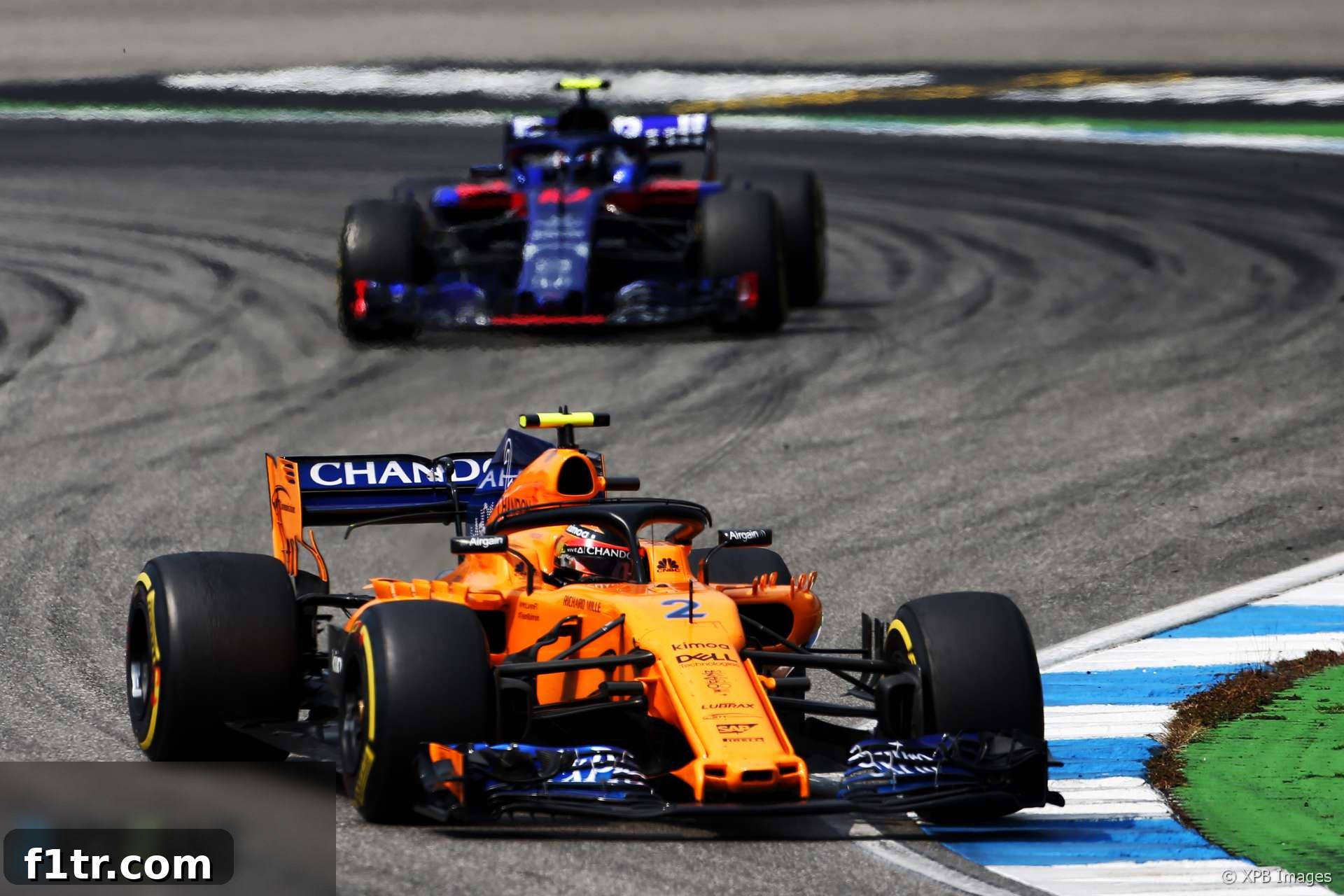
Stoffel Vandoorne’s German GP Drama: A Race of Near Retirements and Strategic Masterstrokes
The 2018 Formula 1 German Grand Prix at Hockenheimring was a race fraught with tension, unpredictable weather, and dramatic twists, particularly for the McLaren-Renault team. For Belgian driver Stoffel Vandoorne, it was an afternoon that swung wildly from the brink of early retirement to a hard-fought finish, showcasing both resilience and quick thinking from his team.
As the race unfolded, Vandoorne found himself in a precarious situation when his power unit began to falter. A critical engine issue struck the McLaren MCL33, leading the driver to believe his race was over prematurely. “It was a very strange race,” Vandoorne recounted, reflecting on the mid-race scare. “A terrible first part. The engine suddenly decided to give up.” This sentiment of impending doom is all too familiar in the high-stakes world of Formula 1, where a single mechanical failure can bring a promising weekend to a grinding halt.
The Power Unit Predicament: From Retirement Threat to Revival
The severity of the problem was such that Vandoorne was instructed to prepare for retirement. “We had to retire the car,” he stated, describing the grim reality. The car was even making its way towards the pit lane, a clear indication that the team believed the issue was terminal. However, in a testament to the sophisticated diagnostic capabilities and rapid problem-solving skills within an F1 garage, McLaren engineers made a last-ditch attempt to salvage the situation. A flurry of commands and setting changes were communicated to Vandoorne, who meticulously applied the adjustments from his cockpit.
Miraculously, these crucial parameter changes breathed new life into the ailing power unit. “The team made a call to change a lot of settings and try again, and everything seemed to work again,” Vandoorne explained. While the engine didn’t fully recover to its optimal performance, operating with “a bit lower power than normal,” it was enough to keep him in the race. This critical intervention turned what appeared to be a definite DNF into a chance to continue fighting, underscoring the relentless pursuit of performance and problem-solving that defines Formula 1.
McLaren’s Sporting Director, Gil de Ferran, later confirmed the technical challenge Vandoorne faced. “He had an issue halfway through that we are still investigating and which lost him a lot of time,” de Ferran noted. The investigation into the precise nature of the power unit glitch would be paramount for the team, highlighting the constant battle against technical frailties in the demanding environment of Grand Prix racing. Despite the setback and the significant time lost battling the malfunctioning engine, Vandoorne’s perseverance and the team’s ingenuity allowed him to push on.
Weathering the Storm: A Bold Tire Strategy
Adding another layer of complexity to the German Grand Prix was the sudden onset of rain. Hockenheim is known for its changeable conditions, and this race proved no exception. As the heavens opened, the pit lane sprang into action, with many drivers opting for intermediate wet weather tires to cope with the slippery track. However, Stoffel Vandoorne, guided by his race engineers, made a bold and ultimately rewarding strategic call.
Unlike his illustrious teammate, Fernando Alonso, Vandoorne decided against pitting for intermediates. He chose to tough it out on his slick tires, a high-risk, high-reward strategy that demands exceptional car control and a keen understanding of track conditions. “We had two great calls with the rain coming in,” he proudly stated. “We didn’t box, toughed it out on the slicks in the wet.” This decision paid dividends, allowing him to gain track position on those who had pitted and then struggled to find pace as the rain eased off.
This particular strategic gamble highlighted the fine margins in Formula 1. While intermediates offer better grip on a wet track, changing to them often incurs a time penalty in the pit lane, and if the rain doesn’t last long, their performance quickly degrades compared to slicks on a drying track. Vandoorne’s ability to manage the car on slicks through the tricky, damp sections showcased his skill and composure under pressure, earning him valuable time and positioning in the chaotic mid-race period.
A Solid Finish Amidst Adversity
Despite the earlier power unit drama and the treacherous wet conditions, Stoffel Vandoorne managed to cross the finish line in 13th position. For a McLaren team that was enduring a challenging 2018 season, marked by a transition to Renault power units and ongoing struggles to optimize their chassis, this was a result that spoke volumes about the effort expended. “It was probably the best we could have done – at least we got ourselves back in the race,” Vandoorne reflected, acknowledging the limitations of his package but also the satisfaction of overcoming significant obstacles.
Gil de Ferran echoed this sentiment, commending Vandoorne’s tenacity. “He drove a solid race,” de Ferran remarked, emphasizing the driver’s consistent performance despite the technical issues that plagued his car. The 13th-place finish, while not in the points, represented a morale booster for a team that had battled through a weekend of adversity. It demonstrated the fighting spirit within McLaren and the ability to extract every ounce of performance even when faced with significant setbacks.
Alonso’s Unfortunate Retirement: A Double Blow for McLaren
While Vandoorne managed to salvage his race, the German Grand Prix concluded with a stark contrast for his teammate, Fernando Alonso. The two-time world champion’s race also ended prematurely, but for different reasons. Alonso was forced to retire his car late in the Grand Prix, bringing it back to the pits due to a mechanical issue that proved insurmountable. This meant a double dose of technical problems for McLaren, underscoring the difficulties they faced during the 2018 season.
“There were some concerns over his gearbox, and we had to retire his car,” confirmed Gil de Ferran, shedding light on the nature of Alonso’s retirement. A gearbox failure is a critical and often race-ending mechanical problem in Formula 1, necessitating the immediate withdrawal of the car for safety and to prevent further damage. This unfortunate incident highlighted the ongoing reliability challenges McLaren contended with, dampening what could have been a slightly more positive outcome for the team had both cars finished.
Reflecting on McLaren’s 2018 Season and the Road Ahead
The 2018 season marked a significant transitional period for McLaren as they switched from Honda to Renault power units, hoping for a return to competitiveness. However, the season proved to be a challenging one, with the team often struggling to match the pace of their rivals and battling persistent reliability concerns, as vividly illustrated at Hockenheim. The German Grand Prix served as a microcosm of McLaren’s year: moments of strategic brilliance and driver resilience, intertwined with frustrating technical failures.
For Stoffel Vandoorne, who was in his second full season with McLaren, these were crucial races to demonstrate his capabilities. His performance at Hockenheim, battling a compromised power unit and executing a brave tire strategy, undoubtedly showcased his potential and fighting spirit. Despite the overall team struggles, his ability to bring the car home in difficult circumstances provided valuable data and reinforced his commitment. The season continued to be a learning curve for both driver and team, as they tirelessly worked to understand and rectify the underlying issues with their package.
The challenges faced by McLaren in 2018 ultimately led to a period of restructuring and strategic recalibration within the team. The consistent technical issues and the gap to the front-runners highlighted the necessity for significant improvements across all departments, from powertrain integration to aerodynamic development. While the results on track were often frustrating for the passionate McLaren fanbase, races like the 2018 German Grand Prix, with its dramatic twists and displays of human and mechanical resilience, provided glimpses into the unwavering spirit of an iconic Formula 1 team determined to claw its way back to the pinnacle of motorsport.
2018 F1 season
- F1 feared “death knell” for Drive to Survive after Ferrari and Mercedes snub
- McLaren staff told us we were “totally crazy” to take Honda engines in 2018 – Tost
- ‘It doesn’t matter if we start last’: How Red Bull’s junior team aided Honda’s leap forward
- Honda’s jet division helped F1 engineers solve power unit problem
- McLaren Racing losses rise after Honda split
Browse all 2018 F1 season articles