The high-octane world of Formula 1 often delivers thrilling on-track duels, but sometimes these battles spill over into post-race analysis and driver frustration. The recent Mexican Grand Prix was no exception, as two separate incidents involving emerging talent Liam Lawson drew significant attention from both his peers and the race stewards. From a heated exchange with local hero Sergio Perez to a controversial clash with fellow rookie Franco Colapinto, Lawson found himself at the heart of the action, showcasing both his aggressive racing style and the unforgiving nature of top-tier motorsport.
The incidents served as a stark reminder of the intense pressure faced by drivers, especially those fighting for crucial points or trying to establish themselves in the sport. The fine line between assertive driving and exceeding track limits, or causing avoidable contact, is constantly debated, and the Mexican Grand Prix provided ample fodder for discussion among fans, teams, and the FIA’s judicial body.
Perez vs. Lawson: A Home Race Clash for Position
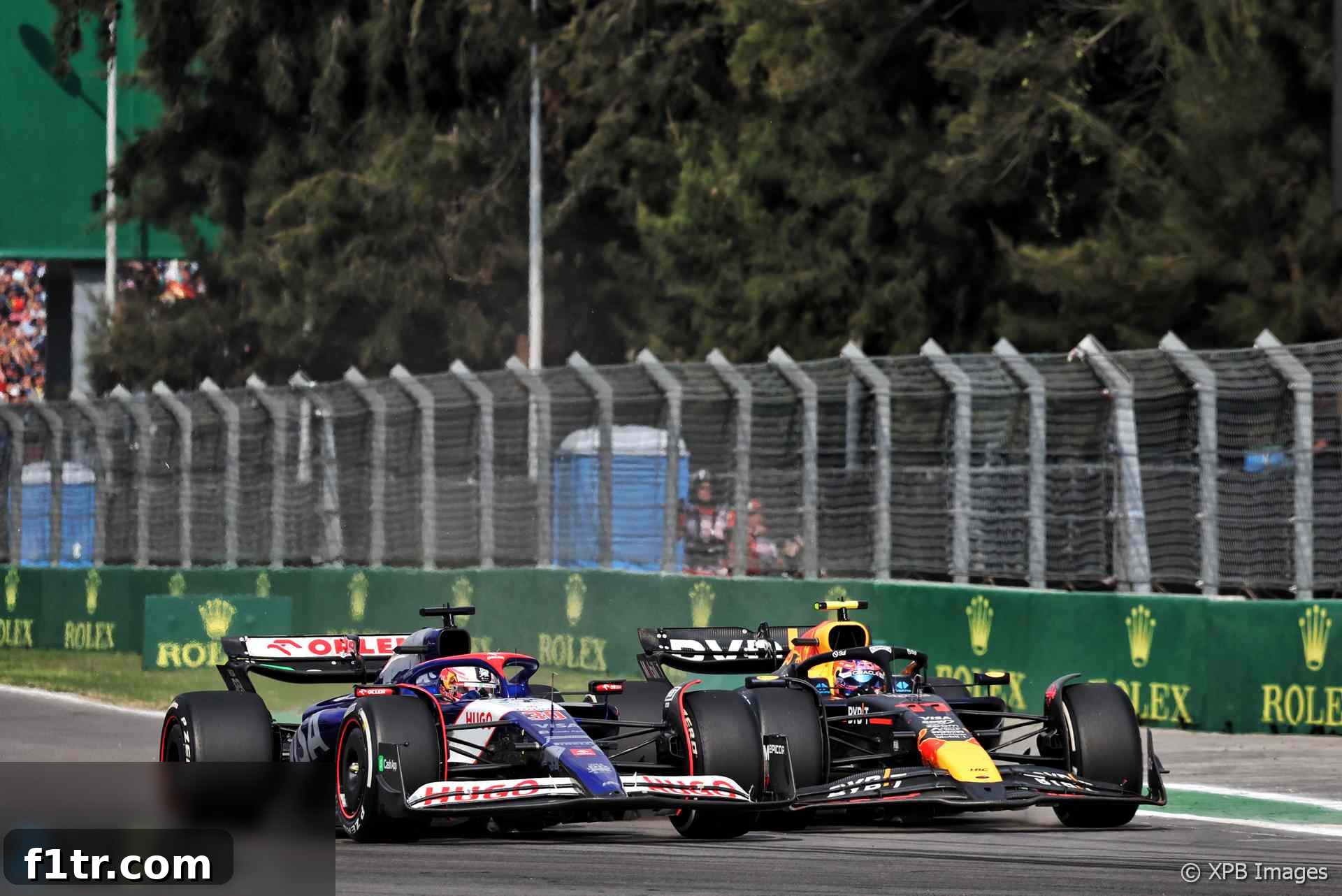
One of the most talked-about moments involved Red Bull Racing’s Sergio Perez and Liam Lawson, driving for the RB team (formerly AlphaTauri). Their entanglement on lap 18, while battling fiercely for tenth place, left both drivers lamenting the outcome and sharing differing views on culpability. The incident began when Perez, eager to make progress in front of his home crowd, launched an aggressive lunge down the inside of Lawson at Turn 4.
Perez successfully made the apex, but the momentum carried him wide on the exit, forcing Lawson off his intended line. Instead of yielding completely or taking to the grass, Lawson demonstrated his tenacity by holding his ground, sticking to the inside of Perez as they approached the subsequent right-hander at Turn 5. It was here, with both cars side-by-side, that contact occurred at the apex. The impact resulted in noticeable sidepod damage to the right side of Perez’s Red Bull, a costly blow in what was already proving to be a challenging race for the Mexican driver.
Stewards’ Verdict and Driver Perspectives
Race stewards, after reviewing the telemetry and video evidence, opted not to take any action against either driver, declaring it a “racing incident.” Their reasoning highlighted Perez’s “late” move into Turn 4, which necessitated Lawson taking evasive action to avoid an initial collision. They deemed the subsequent contact as an unavoidable consequence of two drivers pushing the limits in close quarters. However, this ruling did little to quell Perez’s frustration, who felt Lawson’s defense was overly aggressive.
“I think we ruined both [our] races,” a visibly disappointed Perez stated after the event. “I was ahead, there was no need to come together at that point. It was lap 18 of the race, [it was] just compromising our race, both of us. I don’t think it was a very clever move.” Perez’s comments alluded to the high stakes of a points-paying position and the potential strategic ramifications of such contact. During the race, he had reportedly expressed his displeasure over team radio, labeling Lawson an “idiot” – an emotion he later discussed with the young driver.
Lawson, for his part, offered a robust defense of his actions, explaining his post-race conversation with Perez. “He was obviously upset,” Lawson acknowledged. “I don’t know where he wanted me to go. I gave him space in [Turn] 4, he came in super-late. At that point of the race, we’d just got some clean air and honestly our pace wasn’t bad. So I’m not just going to get out of his way. I gave him space in four, he drove me off, and then he didn’t give me space in five. I was on the lock-stop trying to turn the corner and avoid a collision. But I had nowhere to go. So it’s frustrating. It wasn’t my intention.” Lawson’s perspective underscores the competitive instinct of a driver fighting to maintain track position and the difficulty of predicting an opponent’s every move in such tight racing scenarios.
Lawson vs. Colapinto: Another Contested Encounter
Later in the race, Liam Lawson found himself in another heated battle, this time with Williams rookie Franco Colapinto, as they vied for 12th position. This incident, occurring at Turn 2, proved to be even more impactful on Lawson’s race, resulting in a mandatory pit stop for repairs. The duel unfolded after Colapinto attempted an ambitious pass around the outside of Lawson at Turn 1.
The two cars ran side-by-side through the first corner, with their front axles virtually level. As they exited Turn 1, Colapinto ran wide, briefly exceeding the white lines. This slight deviation, however, put him on the inside line for the upcoming left-hander at Turn 2. As both drivers attempted to navigate Turn 2, Colapinto ran deep into the corner, while Lawson, turning into the apex, clipped the Williams, sustaining damage to his front wing. The unfortunate contact forced Lawson into the pits for a replacement wing, effectively ending any hopes of a strong finish. He ultimately crossed the line in 16th place.
Stewards’ Judgement and Colapinto’s Dissent
Colapinto went on to finish 12th, but the stewards were not finished with the incident. After a thorough review, they handed Colapinto a 10-second post-race penalty, though it did not alter his final classification position. Additionally, he was assessed two penalty points, his first since joining the grid at the Italian Grand Prix in September. The stewards’ detailed explanation highlighted Colapinto as “predominantly at fault” for the collision.
“He [Colapinto] was not quite fully alongside at the apex and through the exit and was thus not ‘entitled’ to racing room at the exit,” the stewards explained. “Lawson defended aggressively through to the exit of turn 1, but stayed on the track and left just enough room for Colapinto to remain on track from the exit of turn one, through to turn two, although ultimately Colapinto did leave the track. Both cars were on a compromised line approaching turn two, Colapinto more so. Lawson gave Colapinto room at the apex of turn two. Colapinto stayed on power which ultimately forced him wide at the exit of turn two and caused him to collide with Lawson’s front wing. While the stewards consider most of this sequence to be fair racing, the fact that Colapinto forced the issue when he was not able to complete the pass through either corner meant that he was predominantly at fault for the collision.”
Despite the stewards’ clear reasoning, Colapinto expressed his disagreement with the decision, drawing parallels to a contentious incident between Lando Norris and Max Verstappen at the United States Grand Prix. “I think it’s something similar to what happened with Lando and Max in Austin,” Colapinto told the official F1 channel. “It’s one of those that the one that is inside pushes you off the track. I was, I think, slightly ahead at the apex and then he braked on the dust and ran wide and pushed me off and then he broke his front wing alone.” Colapinto’s perspective, much like Lawson’s in the earlier incident, highlights the subjective nature of racing judgments and the fine margins separating clean racing from penalized contact.
Implications and the Art of F1 Racing
These two incidents involving Liam Lawson at the Mexican Grand Prix underscore several critical aspects of Formula 1. Firstly, they demonstrate the immense pressure on drivers, particularly rookies like Lawson and Colapinto, to prove themselves and fight for every inch of track. Their aggressive approach, while sometimes leading to contact, is often born out of a desire to maximize every opportunity and not be easily intimidated by more experienced rivals.
Secondly, the differing opinions between drivers and stewards, and even among drivers themselves, illustrate the inherent complexities of race officiating. What one driver perceives as a legitimate defense or attack, another might see as an unfair or dangerous maneuver. The stewards’ role is to apply the rules consistently, yet the dynamic nature of wheel-to-wheel racing often presents unique scenarios that challenge precise interpretation.
Ultimately, the Mexican Grand Prix was a microcosm of the intense competition that defines Formula 1. It showcased the ambition of young talent, the unwavering determination of seasoned professionals, and the ongoing debate surrounding the boundaries of fair play. As the season progresses, such incidents will continue to fuel discussion, reminding us all of the thrilling, yet unforgiving, nature of elite motorsport.
Miss nothing from RaceFans
Get a daily email with all our latest stories – and nothing else. No marketing, no ads. Sign up here:
2024 Mexican Grand Prix
- McLaren have no regrets over pitting Norris shortly before red flag came out
- Leclerc fined, avoids same penalty as Verstappen after apologising for swearing
- Leclerc not in the clear over swearing as Verstappen claims he went unpunished
- Majority of drivers wanted racing rules to change “straight away” – Russell
- Verstappen was “over the limit” with Norris but others would do same – Leclerc
Browse all 2024 Mexican Grand Prix articles