The high-stakes world of Formula 1 racing is a constant theatre of precision, speed, and aggressive competition. Every millisecond, every inch of track, and every decision made by a driver or race steward can drastically alter the trajectory of a Grand Prix weekend. In an environment where the margins are razor-thin, incidents involving track limits and racing conduct frequently ignite heated debates among drivers, teams, and the global fanbase, prompting scrutiny of the sport’s complex penalty system. Recent events have particularly highlighted the strategic calculus drivers employ when confronted with potential sanctions, questioning the consistency and fairness of F1 officiating.
Alexander Albon’s Calculated Risk: Navigating the Edge of the Rules
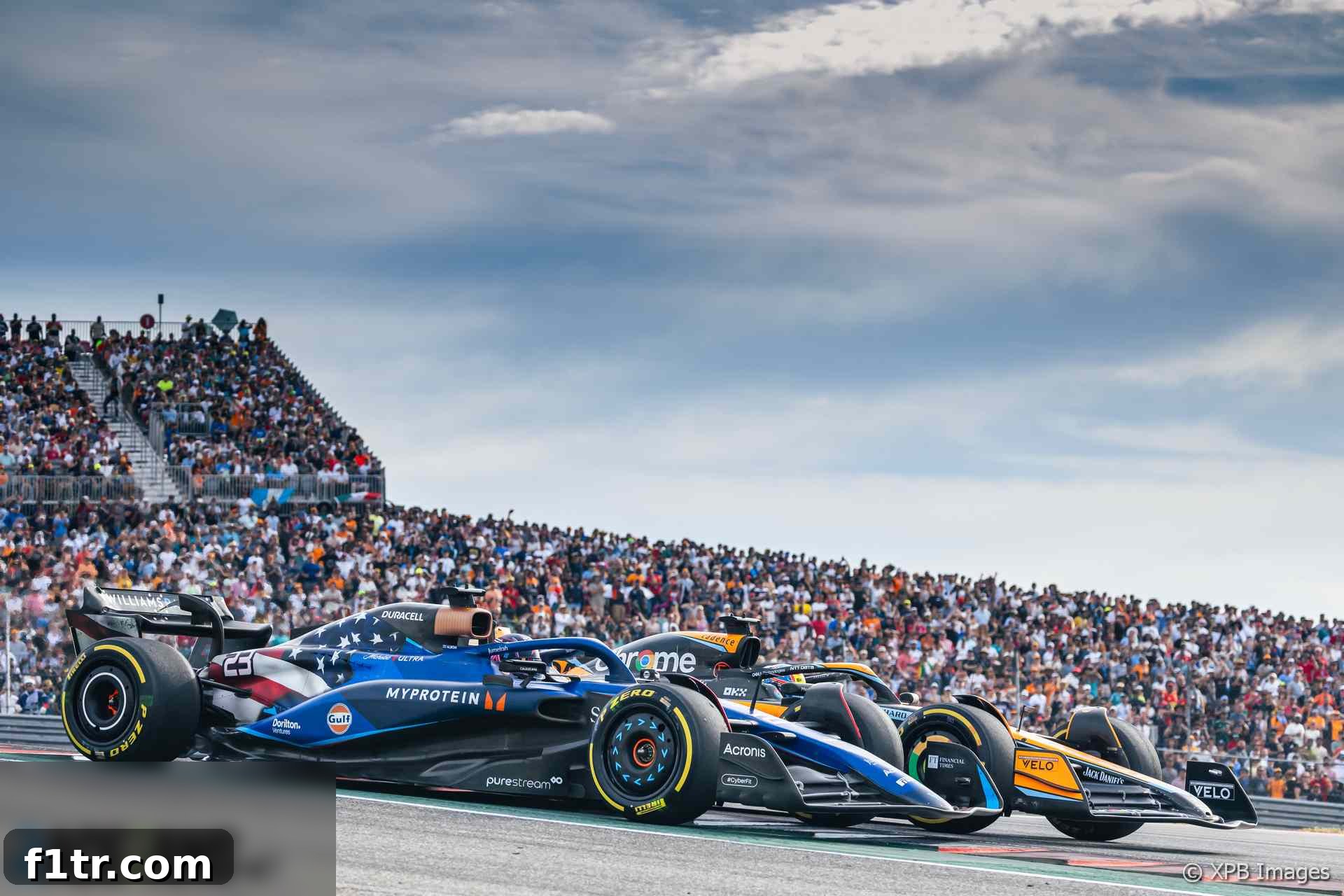
A prime example of a driver pushing the boundaries, and ultimately escaping penalty, involved Alexander Albon during a thrilling encounter with Oscar Piastri. The Williams driver openly confessed to taking a deliberate risk by momentarily leaving the track to maintain his position, a gamble that ultimately paid off as the stewards, after reviewing the incident, decided against issuing a sanction. Albon’s candid remarks offered a rare glimpse into the strategic mindset prevalent among F1 drivers, suggesting that the perceived leniency or interpretation of penalties can occasionally embolden them to test the very limits of the regulations.
The incident unfolded during an intense wheel-to-wheel duel where Car 81 (Piastri) attempted a very late and aggressive move up the inside into Turn 1. This manoeuvre inevitably forced Car 23 (Albon) off the circuit at the exit. Crucially, the stewards provided a detailed rationale for their decision, noting: “Due to the track layout in that part of the track, Car 23 was able to stay alongside and maintain his position, essentially resulting in both cars ending up in the correct order.” This specific interpretation was paramount to Albon avoiding a penalty, as the stewards concluded that no lasting advantage was gained and that Piastri’s initial aggressive action was the primary cause of Albon’s off-track excursion.
Albon’s post-race comments were particularly illuminating regarding a driver’s perspective on such scenarios. “I knew it was on the edge,” he stated, fully acknowledging the precarious situation. However, his subsequent justification was even more revealing about the broader context within the sport: “To be honest with you, it’s been happening a few times now.” This suggests that Albon, and likely other drivers, have observed a pattern where the benefit of preserving track position, even through a brief off-track excursion, often outweighs the potential consequences of a minor penalty. It points to a calculated risk assessment that drivers undertake in the heat of battle, weighing the strategic gain against the perceived cost of a sanction.
The “Silly Penalty” Debate: Albon’s Critique of F1’s Sanction System
Albon’s insights didn’t stop at explaining his own actions; he extended his critique to the fundamental structure of Formula 1’s penalty system, particularly as it pertains to track limits and the concept of gaining an advantage. He drew a compelling parallel to a similar incident involving Piastri and George Russell. In that instance, Russell was handed a five-second time penalty, yet he still managed to finish ahead of the McLaren driver, perfectly illustrating Albon’s central argument regarding the inadequacy of certain penalties.
“You see it with George as well, the penalty isn’t big enough. It’s a silly penalty,” Albon emphatically stated. He elaborated on this viewpoint, one he candidly admitted to having voiced “a few times before,” pointing out a critical perceived flaw: “It punishes the slower car and it helps the quicker car. I’m sure George knew he was off track, but he thought ‘I can pull this five seconds quicker than being stuck behind him’. That’s how it is.”
This stark perspective from an experienced F1 driver underscores a significant and ongoing debate within the sport. If a driver can gain a competitive advantage, even for a short period, by exceeding track limits, and the subsequent time penalty is so easily absorbed or nullified by the gained position, then the deterrent effect of such penalties is considerably undermined. This raises serious questions about whether the current regulatory framework truly upholds the principle of fair play and effectively discourages drivers from exploiting what they perceive as loopholes for strategic gain. In such a scenario, the “strategic calculation” Albon describes risks becoming a legitimate racing tactic rather than a deterrent for breaches of sporting conduct, potentially compromising the integrity of on-track battles.
Zhou Guanyu’s Penalty: A Distinct Case of Gaining Lasting Advantage
In stark contrast to Albon’s exoneration, Zhou Guanyu experienced a different outcome in a separate incident involving Kevin Magnussen. Zhou was issued a five-second time penalty for exceeding track limits at Turn 15 during an overtaking attempt, which the stewards deemed resulted in him gaining a “lasting advantage.” This ruling provided a clear demonstration of how nuanced and context-dependent penalty decisions can be in Formula 1.
The stewards’ detailed explanation for Zhou’s penalty illuminated the intricacies of their adjudication process: “Car 24 [Zhou] tried to overtake Car 20 [Magnussen] on the inside into Turn 15, but was not able to complete the overtaking manoeuvre on-track, left the track and gained a lasting advantage.” Furthermore, they clarified Magnussen’s involvement, stating: “The stewards noted that Car 20 also went off track at the same time, but determined that this was a result of Car 24 preventing Car 20 from turning in.” This crucial detail indicated that Zhou’s move was not merely an illegal off-track pass; it also unfairly compromised Magnussen’s ability to maintain his racing line and stay within track limits, thus compounding the infringement.
This incident offers a clear distinction from Albon’s situation. In Zhou’s case, the attempted overtake was judged to be incomplete within the confines of the track, and his subsequent off-track excursion directly resulted in a clear, measurable “lasting advantage” over Magnussen. Albon, conversely, maintained his position after being forced off track by Piastri, with the stewards concluding that the “correct order” was ultimately preserved. The key difference lies in the active initiation of an overtake that could not be completed legitimately on-track by Zhou, leading to a direct benefit from his off-track excursion, which was not the case for Albon.
The Nuances of Track Limits and F1 Officiating
The series of incidents involving Albon, Russell, and Zhou collectively underscore the complex and frequently contentious nature of track limits and penalty enforcement in Formula 1. The inherent challenge for race stewards lies in consistently interpreting nebulous concepts such as “gaining a lasting advantage” and discerning between involuntary excursions caused by the actions of another driver versus deliberate actions taken to gain an unfair advantage.
Adding another layer of complexity, a separate incident involving Zhou Guanyu and Kevin Magnussen at Turn 1, early in the race, further exemplified the subtleties of officiating, yet ultimately led to a clearer resolution. Zhou was initially investigated for forcing Magnussen off the track, but he was ultimately cleared because he demonstrably “ceded the position to his rival on that occasion.” This act of immediately returning any potentially gained advantage is often a significant mitigating factor, if not an outright reason, for a driver to avoid a penalty altogether. This highlights another critical aspect of the intricate F1 rulebook: proactive self-correction by a driver can often preempt a formal sanction from the stewards.
The extensive debate surrounding these penalty decisions frequently revolves around several fundamental principles that underpin fair competition in motorsport:
- Fair Play and Sporting Integrity: A core question is whether the rules and their subsequent enforcement genuinely foster fair racing or inadvertently create opportunities for strategic exploitation.
- Driver Intent versus Objective Outcome: Should penalties consider the driver’s deliberate intention to gain an advantage, or should decisions be based solely on the objective outcome of their actions, regardless of intent?
- Consistency in Decision-Making: Drivers, teams, and fans frequently advocate for greater consistency and predictability in stewarding decisions across various races and incidents, to ensure a level playing field.
- Deterrence Effectiveness: A crucial aspect is whether the penalties imposed are sufficiently robust to deter drivers from exceeding track limits or engaging in dangerous, unsportsmanlike maneuvers.
Broader Implications for the Evolution of Formula 1 Racing
The discussions ignited by the incidents involving Albon, Piastri, Russell, Zhou, and Magnussen are not isolated occurrences but rather integral parts of an ongoing dialogue within Formula 1. This dialogue seeks to strike a delicate balance between encouraging aggressive, thrilling racing that captivates audiences, and strictly adhering to the sporting regulations that define fair competition. Drivers, by their very nature, are constantly pushing the boundaries of what is permissible, relentlessly seeking even the most marginal gains, which inevitably leads to close calls and contentious decisions.
The race stewards, equipped with increasingly sophisticated telemetry data and high-definition video evidence from multiple angles, face an unenviable and often thankless task. They are mandated to make swift, high-pressure judgments that must simultaneously uphold the integrity of the sport, ensure driver safety, and preserve the spectacle of competitive racing. Their interpretations of complex rules, such as “gaining a lasting advantage” or “forcing another driver off track,” are absolutely critical to shaping driver behavior, influencing race outcomes, and maintaining public confidence in the sport’s officiating.
Albon’s pointed comments about penalties not being “big enough” resonate deeply with a segment of the Formula 1 community that believes the current system sometimes falls short in adequately punishing breaches of regulations, thereby inadvertently incentivizing risky behavior. If a five-second time penalty can be easily absorbed or overcome through strategic on-track positioning, the perceived risk associated with an infringement diminishes significantly. This could potentially lead to more drivers attempting similar “calculated risks,” which, in turn, could degrade the quality of racing by encouraging off-track maneuvers over clean, skillful on-track overtakes. This creates a moral hazard where the reward outweighs the punishment.
Conversely, an overly strict or draconian penalty system risks stifling aggressive, wheel-to-wheel racing and diminishing the excitement that is central to Formula 1’s appeal. Finding this incredibly delicate balance is an eternal challenge for the FIA and the sport’s administrators. The continuous introduction of highly specific track limit rules at various corners, along with the deployment of advanced technologies like inductive loop sensors and sophisticated video analysis, represent ongoing efforts to bring greater objectivity and consistency to these inherently subjective decisions, striving for a framework that is both fair and conducive to exciting competition.
Conclusion: The Evolving Landscape of F1 Rules and Racing Integrity
The recent controversies surrounding penalties and track limits, exemplified by the experiences of drivers like Alexander Albon, Oscar Piastri, George Russell, Zhou Guanyu, and Kevin Magnussen during the 2023 United States Grand Prix, vividly underscore the dynamic and often contentious nature of Formula 1 officiating. Albon’s successful defence of his track position, which saw him escape a penalty, stands in clear contrast to Zhou’s five-second sanction. This dichotomy brilliantly highlights the fine lines drawn by the stewards, whose decisions are meticulously based on the specific circumstances of each incident – crucially considering who initiated the manoeuvre, whether an advantage was definitively gained, and if that advantage was lasting or swiftly ceded.
The ongoing debate about the efficacy, fairness, and consistency of the current penalty system strongly suggests that it remains a perpetually evolving framework. As the pinnacle of motorsport continues its relentless evolution, characterized by increasingly competitive cars, aggressive driving styles, and shrinking margins for error, the role of consistent, transparent, and appropriately deterrent officiating becomes ever more paramount. Ultimately, striking the optimal balance between allowing thrilling, hard-fought racing and upholding the fundamental principles of fair competition and sporting integrity will remain the perpetual quest for Formula 1’s governing bodies.