‘The smell of rubber and melting asphalt / I cheer when Max passes one again’
‘His overtaking is special / He is a boss, a wonder of the world’
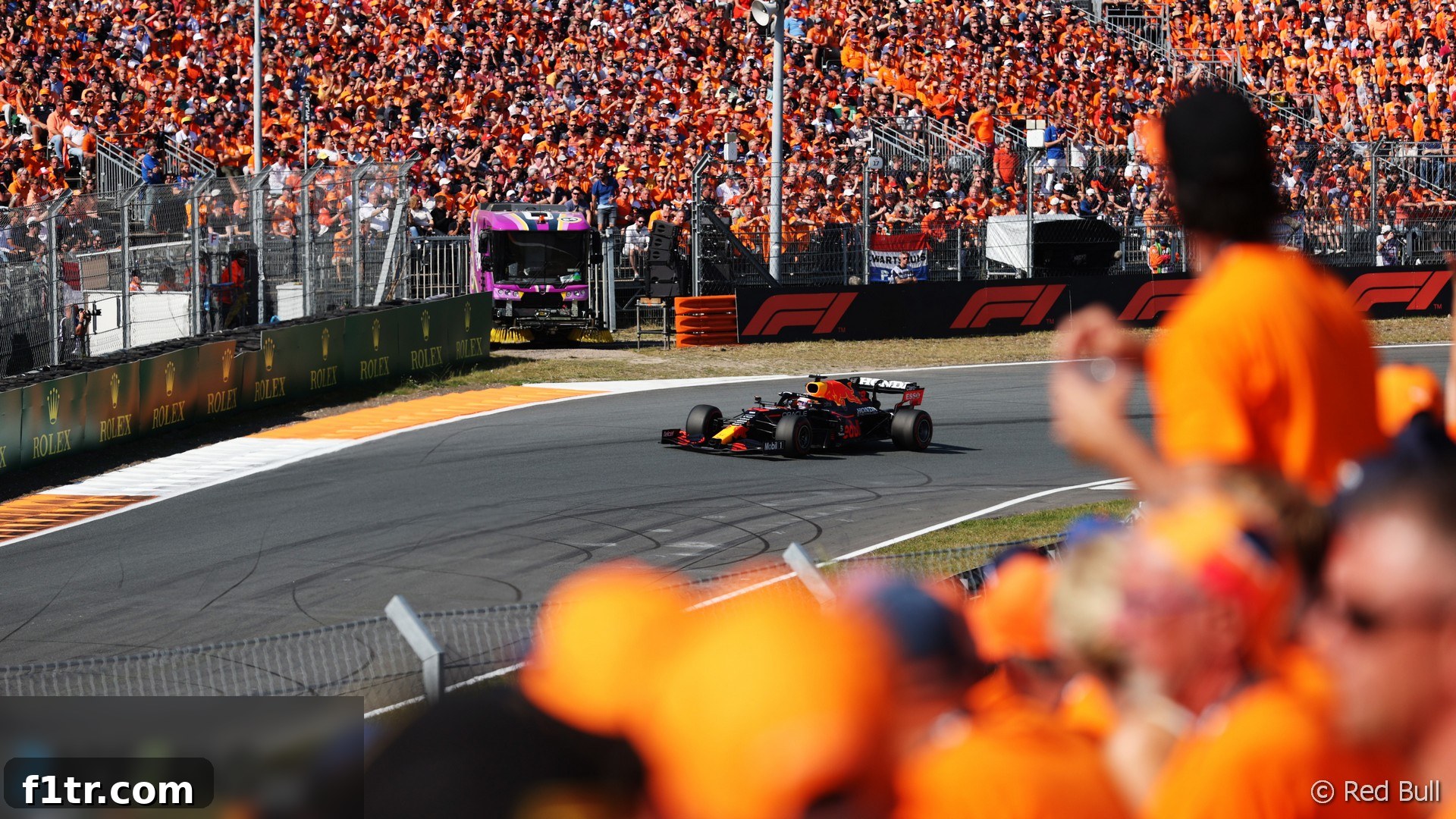
As thunderous Euro-beats pulsed through the PA system, electrifying the tens of thousands of enthusiastic ticket holders at the Zandvoort circuit into a euphoric frenzy, the man they had all gathered to celebrate displayed a starkly contrasting demeanor. Amidst the vibrant orange sea of cheering fans in the grandstands, Max Verstappen remained a picture of serene focus, his concentration unwavering.
Throughout a Formula 1 career that has already consumed nearly a third of his young life, Verstappen has consistently expressed gratitude for the unparalleled devotion shown by his Dutch compatriots. Yet, in this pivotal season, where the coveted world championship title had transformed from a distant dream into a tangible possibility, the 23-year-old Dutchman exuded pure professionalism. He was acutely aware that the stakes had never been higher, and every ounce of his energy needed to be channeled into his singular mission.
Unlike legendary champions such as Nigel Mansell, Ayrton Senna, or even Lewis Hamilton, who famously drew strength and inspiration from the roaring energy of their home fans to push them to superhuman feats behind the wheel, nothing seemed capable of distracting the Dutch Grand Prix pole-winner from the formidable task ahead. His approach was clinical, methodical, and entirely dedicated to extracting maximum performance.
“I’ve never seen a nation get behind a driver in this manner,” remarked Christian Horner, Verstappen’s team principal, after the race. His words underscored the truly extraordinary atmosphere that permeated Zandvoort that weekend.
“From the moment we’ve arrived, the music’s been going, the build up, the intensity… and the one person that hasn’t felt it has been Max. He’s focused on his own job. He’s gone about his business in exactly the same way as he does at other races.” Horner’s observation highlighted Verstappen’s unique ability to compartmentalize, to filter out the overwhelming external pressures and concentrate solely on the complex demands of racing at the pinnacle of motorsport.
This unwavering focus proved absolutely essential. Verstappen found himself in a precarious position, tasked with fending off a relentless barrage of attacks from two formidable Mercedes drivers over a grueling 72 laps, all while effectively battling on his own. His Red Bull team mate, Sergio Perez, had suffered an unfortunate qualifying session and was forced to start from the pit lane, leaving Verstappen without the crucial strategic support a second car could provide against Mercedes’ dual assault. Thus, his primary allies in this high-stakes contest were his exceptional driving skills and the collective roar of 70,000 impassioned fans, creating an aural shield around him.
The Crucial Start: Verstappen’s Masterclass Amidst Chaos
As plumes of orange flare smoke ascended around the historic Zandvoort circuit, so too did the tension. The 18 drivers on the grid – with Nicholas Latifi also starting from the pits – faced a relatively short, high-speed dash down to Tarzan corner, marking the first Grand Prix start at Zandvoort in 36 years. The anticipation was palpable, a mixture of exhilaration and anxiety hanging heavy in the air.
Verstappen knew that if his fellow front-row starter, Lewis Hamilton, managed a sufficiently strong getaway, there would be ample room for a potential pass on either side into the challenging Tarzan bend. But when the five red lights extinguished, Hamilton could only watch as the Red Bull rocketed forward, expertly positioning itself to cover the inside line even before reaching the braking zone for the first corner. Verstappen’s start was nothing short of phenomenal; he had already established a four-car length lead over the championship leader as he powered out of Tarzan, a decisive move that immediately put him in control.
The front of the field maintained its grid order as they charged through Gerlach and around the iconic banked Hugenholtz corner for the first time in anger. Verstappen confidently led Hamilton, with Valtteri Bottas holding third. Pierre Gasly impressed by staying ahead of the two Ferraris of Charles Leclerc and Carlos Sainz Jnr., showcasing the competitive nature of the field even behind the dominant front-runners.
Midfield Mayhem and Early Race Incidents
Behind the leading pack, the action was significantly less orderly and far more dramatic. Fernando Alonso, ever the opportunist, found himself initially squeezed by his Alpine team mate Esteban Ocon on the exit of Turn 1 – Ocon seemingly oblivious to Alonso’s close proximity. Not deterred, Alonso then executed a daring ‘wall-of-death’ maneuver around the outside of Hugenholtz, attempting to overtake both Ocon and Antonio Giovinazzi, who had qualified an impressive seventh for Alfa Romeo. This audacious move set the tone for a spirited midfield battle, as Ocon later described, “It was also quite close for both of us in the run-up to when we overtook Giovinazzi on the outside of turn six and entering seven. We both hit a bump and Fernando almost lost it, we were side-by-side. So it was quite a fun battle.” Thankfully, the trio managed to avoid significant damage in their thrilling exchange.
The same could not be said for the two Haas drivers, Mick Schumacher and Nikita Mazepin. Their already strained relationship, having deteriorated dramatically after a qualifying disagreement the previous day, ignited into an on-track confrontation. Mazepin, clearly determined to assert dominance, aggressively attempted to pass Schumacher on the opening lap. He pushed his car to the very edge of the track as they approached Scheivlak, eventually diving past his team mate into Masterbocht. Schumacher, however, refused to yield easily. He held onto Mazepin’s rear, skillfully utilizing the slipstream for a powerful run as they rounded the banked final corner. But as Schumacher pulled out to attempt a pass along the pit straight, Mazepin veered sharply to aggressively cover the inside line. The inevitable contact left Schumacher’s front wing wounded, forcing him into an early pit stop for repairs. “I think you saw what he still thinks about [qualifying] and about the whole situation,” Schumacher later theorized, “because I think otherwise you don’t react the way he did in this race today.”
As Schumacher headed for repairs, Mazepin’s mirrors were quickly filled by the charging Sergio Perez. The Red Bull driver, starting from the pit lane, had taken just four laps to catch the Haas. As Perez drove up to the back of Mazepin’s car, entering the braking zone for Tarzan at the start of lap five, he locked up his right-front tire so severely that a cloud of grey smoke momentarily eclipsed the familiar orange haze from the flares. This heavy lock-up completely ruined Perez’s hard tires, rendering them incapable of lasting the required distance for his strategy. Consequently, he was forced to pit at the end of lap eight, effectively reinforcing his status as a non-factor for Red Bull in their direct battle with Mercedes that afternoon.
The Strategic Chess Match: Mercedes’ Undercut Attempts
Verstappen, likely unconcerned by his team mate’s misfortune, had successfully navigated the most dangerous phase of the race with his lead fully intact. He was now comfortably three seconds ahead of Hamilton, consistently lapping in the 1’15s. However, Red Bull’s strategists remained vigilant. Their caution proved well-founded when Hamilton suddenly picked up his pace, signaling a shift in Mercedes’ tactics. “Okay Max, Hamilton’s potentially switching to a two-stop,” Verstappen was informed by his race engineer, Gianpiero Lambiase. “Looks like he’s been given a hurry-up.”
Red Bull’s hunch was correct. Hamilton eventually became the first driver on soft tires to make his intended pit stop at the end of the 20th lap, switching to the medium rubber, a compound that prior running had indicated the Mercedes W12 preferred. Verstappen was immediately called in to respond the very next lap, a crucial move to counter the undercut. While Red Bull successfully defended his lead, Hamilton’s early stop on fresher rubber had allowed him to shave Verstappen’s lead from 3.5 seconds to less than two, demonstrating the potency of Mercedes’ strategic thinking.
Now, Mercedes began to exercise their strength in numbers, keeping race leader Bottas out for an extended opening stint. The Verstappen faithful in the grandstands roared their encouragement as their hero began to rapidly close the gap to Bottas. Yet, a collective sense of apprehension was also palpable; they were acutely aware of how much closer Hamilton now was to Verstappen than at any other point in the race, intensifying the championship battle unfolding before their eyes.
It took just eight relentless laps for Verstappen to catch the back of Bottas. Any hopes Mercedes had of Bottas acting as a significant roadblock to slow Verstappen were quickly dashed. While Bottas was undeniably demonstrating his worth to Mercedes by holding up Verstappen, it was ironically Hamilton who lost crucial time behind the driver widely expected to replace Bottas next year: George Russell. The Williams driver exited the pit lane directly in front of Hamilton, costing the championship leader a vital second of time to Verstappen, a moment of misfortune that could prove decisive.
As Bottas rounded the final corner, Verstappen was already tucked neatly under his rear wing, making any attempt to defend almost futile. Verstappen deployed DRS, effortlessly breezing back into the lead as his legion of cheerleaders bellowed in thunderous approval from the stands. As a reward for his efforts, Bottas was called in for a fresh set of mediums the following lap, now solidly on course for a one-stop strategy. Mercedes, however, could ill-afford for Bottas to lose too much time to the leading duo if they harbored any hopes of goading Red Bull into an early second stop, thereby bringing their second car back into play.
Drama in the Pack and Mercedes’ Final Gamble
Further back in the field, Sebastian Vettel in the Aston Martin found himself racing with Robert Kubica – the one-time Grand Prix winner who had been called back into action on very short notice after Kimi Räikkönen tested positive for Covid-19. Vettel, attempting an audacious dive up the inside on the Hugenholtz banking, lost control and spun, directly into the path of Bottas, who was attempting to lap them. Bottas was forced to take evasive action, losing over a second-and-a-half to the leaders. This incident likely sealed his fate, ensuring he would play no further significant part in the direct contest between Verstappen and Hamilton ahead.
It wasn’t long until Mercedes brought Hamilton in for a second, desperate attempt at an ‘undercut’ strategy. The theory was sound: Hamilton possessed an additional fresh set of medium tires, unlike Verstappen, who would either have to revert to worn softs or gamble on a set of hard tires, a compound teams had little experience running effectively at Zandvoort. This represented Mercedes’ final, calculated risk to wrestle control of the race.
However, when Hamilton rejoined the fray after pitting for a second time at the end of lap 39, his frustration was palpable. He found himself immediately behind a trio of lapped cars. “Why would you pit me with these guys, man?” he lamented over the team radio, his tone betraying his annoyance at the strategic misjudgment. As expected, Verstappen pitted immediately in response. He was able to rejoin on a fresh set of hards, comfortably maintaining his lead, this time with his advantage fully intact. Despite the theoretical performance advantage offered by the medium tires Hamilton was now on, he quickly communicated his doubts over the radio about whether this set of tires could truly last until the end of the race.
Pressure, Perseverance, and Perez’s Redemption
If any of the ecstatic fans around the circuit had assumed that their favorite driver was now home and dry, their nerves would surely have flared when Hamilton began to relentlessly close the gap, bringing it to within just under two seconds of the leader with less than 20 laps remaining. The intensity of the championship battle was etched on every face in the grandstands, the tension almost unbearable.
But as has been demonstrated frequently this season, Verstappen possesses an uncanny ability to extract even more speed from his RB16B when it is most critically needed. As Christian Horner noted after the race, Red Bull enjoyed a fractional, but decisive, performance advantage at Zandvoort. “It’s still very, very tight with Mercedes, particularly with Lewis, but we just seem to have a tenth, I would say, in hand, maybe two, that Max is able to use when he needed to build up a three-second gap.” This slender margin, combined with Verstappen’s precision, proved insurmountable.
As Verstappen seemingly consolidated his control of the race out front, his team mate, Sergio Perez, was orchestrating a remarkable recovery drive. Having started from the pit lane, he had methodically worked his way up through the field to seventh place before making his second pit stop on lap 48. His comeback continued as he executed a beautifully judged move around the outside at Tarzan to pass Daniel Ricciardo for tenth place, before setting his sights on the second McLaren of Lando Norris ahead.
Perez caught Norris on lap 66 and attempted a similar, bold maneuver around the outside of the first turn. But just as had happened in Austria, Norris fiercely refused to yield to the Red Bull on the outside, attempting to squeeze Perez out at the corner exit. The inevitable collision jolted Norris hard enough to momentarily dislodge his foot from the pedals in the cockpit, allowing Perez to seize the position, his Red Bull bearing the visible scars of the contact, a testament to the hard-fought battle.
The Final Lap, Championship Implications, and a Historic Victory
With Bottas steadily falling further adrift with each passing lap, and Hamilton unable to break into DRS range of Verstappen, it became increasingly clear that only a Safety Car intervention or an unforeseen stroke of misfortune could prevent Hamilton from losing both the race and, crucially, the championship lead to his relentless rival. As the stark reality finally dawned on Mercedes that they simply could not beat Verstappen and Red Bull, given the dominant form they had displayed all weekend, their attention shifted to securing the bonus point for the fastest lap of the race. After a rather awkward moment where Bottas briefly claimed the fastest lap inadvertently, Hamilton eventually snatched the honor on the very final lap, a small consolation in a race dominated by his adversary.
That the highly anticipated return of the Dutch Grand Prix proved to be somewhat less eventful in terms of on-track overtakes at the very front mattered little to the 70,000 fervent fans. They had collectively created the most raucous, vibrant, and unparalleled atmosphere the sport had ever witnessed for a single race weekend. Verstappen was able to savor the crazed cacophony of sound and color as he rounded the Hans Ernst Bocht for the final time, before scaling the banking and taking the chequered flag, realizing the greatest moment in the history of motorsport in the Netherlands. It was a triumph that cemented his place in the hearts of his nation.
Despite Hamilton securing the fastest lap on the final tour, the points swing was significant enough for him to lose his coveted place at the top of the standings. Verstappen welcomed the return of the lead of the drivers’ championship to his possession with a quiet sense of satisfaction, almost as if he were bemused that it had ever been taken from him to begin with. “What was crucial today was, first of all, the start and then throughout the race, just managing that gap that they couldn’t undercut us,” he reflected. “But it’s an incredible feeling, of course, to win in front of the fans.” His words captured the essence of his flawless performance and the deep connection he shares with his supporters.
Hamilton, ever the sportsman, had to accept the undeniable truth: no matter what strategies they tried, Mercedes simply could not overcome Verstappen and Red Bull on what was unequivocally their day. “I think today we probably needed everything to be perfect, to even have the slightest chance of getting past them through strategy,” he admitted, acknowledging the sheer dominance displayed by his rival. Bottas secured his customary third place on the podium and could be forgiven for wondering if he might ever step foot on the middle step again, such is the formidable prowess of the two championship contenders and the near-certainty that this would be his final season in a Mercedes.
Pierre Gasly’s seemingly lonely race to a superb fourth place completely undersold just how complete and flawless a race weekend he had meticulously put together over the three days at Zandvoort. Remarking after the race that he had enjoyed such an abundance of performance, his AlphaTauri team had even asked him to slow down for fear he was pushing too hard on his tires – a testament to his exceptional pace and control. Charles Leclerc secured a solid fifth place for Ferrari, a result that saw them collect strong points, gaining an advantage over rivals McLaren. Fernando Alonso, ever the master of racecraft, demonstrated his unquestioned talent once more by snatching a hard-fought sixth from Carlos Sainz Jnr on the very final lap of the race, a move that delighted his fans, even though he had come perilously close to crashing his Alpine at Turn 3 just a few laps earlier.
Sergio Perez ultimately took the chequered flag in eighth place after a truly remarkable race. He had staged an impressive comeback from a pit lane start with no Safety Car interventions to aid his recovery through the field, showcasing his fighting spirit. However, he was understandably frustrated with how another weekend had been unnecessarily compromised on Saturday due to qualifying issues, and then further compounded by his early error in the race. Esteban Ocon secured another valuable double points finish for Alpine in ninth, with Lando Norris taking the final point after starting from 13th on the grid, completing a challenging but rewarding weekend for McLaren.
Championship Battle Intensifies: A Legendary Status Awaits
Max Verstappen’s most successful season of his career so far has also undeniably proved to be his most challenging. The heavy setbacks and misfortunes at Silverstone and the Hungaroring had cruelly robbed him of the championship lead he had so richly earned through sheer talent and perseverance. However, thanks in no small part to his laser-like focus on the job at hand, Verstappen has emerged from the summer break with a perfect record of wins and pole positions, a testament to his resilience and determination, allowing him to retake his rightful position at the summit of the drivers’ championship standings.
Prevailing in a season-long battle against a seven-time world champion like Lewis Hamilton was always going to involve intense adversity and moments of extreme pressure. With Red Bull anticipating that Mercedes will likely hold the performance advantage in the upcoming two rounds at Monza and Sochi, there is undoubtedly plenty more of that challenge to come for the championship leader in a fight which is still far from over. The narrative of this epic season continues to unfold, promising more twists and turns.
But should Max Verstappen manage to be victorious when the final chequered flag falls in December, securing his maiden Formula 1 World Championship title, it will only enhance his already mythical standing in the eyes of his passionate Dutch supporters, elevating him beyond the hero status he already commands. Then, we can expect to see far more than just pop songs named in his honor; his legacy will be etched into the annals of Dutch sporting history forever.
2021 Dutch Grand Prix
- “So many people love him”: Raikkonen’s rivals pay tribute to retiring champion
- Alonso studied junior series, not IndyCar, for Zandvoort banking clues
- 2021 Dutch Grand Prix Star Performers
- Paddock Diary: Dutch Grand Prix part two
- Verstappen makes the Netherlands 12th country to produce a home F1 winner
Browse all 2021 Dutch Grand Prix articles
F1 race reviews
- Antonelli lucks in for second win and becomes youngest F1 championship leader
- Emotional Antonelli grabs first Formula 1 victory in Chinese Grand Prix
- Russell sees off Ferrari threat to lead Mercedes one-two in Melbourne
- Norris clinches F1 title by two points as Verstappen wins finale at Yas Marina
- McLaren strategy blunder in Losail hands Verstappen crucial win and shot at title
Read all F1 race reviews