Advert | Become a Supporter & go ad-free
George Russell Seizes Dramatic Austrian Grand Prix Victory Amidst Verstappen-Norris Clash
Fresh from clinching the fiercely contested 2018 Formula 2 championship, Mercedes prodigy George Russell embarked on a challenging journey through 60 arduous Grand Prix races with Williams. His perseverance eventually led him to a coveted spot alongside Formula 1’s most successful driver at the factory Mercedes team in 2022. Yet, despite his unwavering optimism, Russell could hardly have anticipated that his initial 29 months and 55 rounds with the multiple world champions would yield only a solitary victory.
The return to the iconic Red Bull Ring for Round 11 of the 2024 season marked a somber anniversary for Mercedes. It had been a year since McLaren had definitively surpassed them, relegating the Silver Arrows to the status of the grid’s second-fastest Mercedes-powered team. While both Mercedes and Ferrari had demonstrably chipped away at Red Bull’s commanding advantage over the previous season, McLaren had not only maintained but extended their lead. Now, it was McLaren that consistently shared top billing for each Grand Prix with Max Verstappen, leaving Mercedes to play a supporting role, at best, in the championship narrative.
Just a week prior in Barcelona, Russell had momentarily tasted the lead, skillfully sweeping past both Verstappen and Lando Norris at the start. However, his tenure at the front was fleeting, lasting only two laps before Verstappen reasserted his dominance. In Austria, Russell again found himself on the second row, strategically positioned behind the two championship front-runners. His third-place grid slot was a slight improvement, benefiting from a penalty incurred by Oscar Piastri for exceeding track limits during qualifying.
Saturday’s sprint race offered a tantalizing glimpse of McLaren’s potential to challenge the reigning world champion, Max Verstappen. However, it also underscored the immense difficulty of actually overcoming him, particularly at a circuit like the Red Bull Ring, which has historically been a stronghold for Verstappen and Red Bull Racing.
Race Day Dynamics: Tyre Strategy and Early Race Incidents
Sunday brought hotter temperatures than earlier in the weekend, promising to amplify the challenge of managing the softest tyre compounds throughout the race distance. Consequently, it came as no surprise that 19 of the 20 cars on the grid opted for medium tyres at the start, with only Zhou Guanyu choosing the hard compound from the pit lane. This unanimous choice highlighted the teams’ concerns about tyre degradation and the strategic implications of a two-stop race.
The race start itself was a moment of high tension. The five lights on the starting gantry held for an unusually long almost four seconds, a new test of drivers’ discipline under the recently revised jump-start regulations. When the lights finally extinguished, Max Verstappen launched cleanly, successfully repelling both McLarens, much as he had done in the sprint race. Lando Norris, despite his best efforts, was unable to mount a serious challenge on the run to the first right-hander. Russell, attempting to outmaneuver the McLaren from the outside, found Norris holding a resolute line into the braking zone, denying him any opportunity to gain a position.
Further back, the opening lap quickly descended into chaos. Charles Leclerc, caught in a perilous squeeze between Sergio Perez to his right and Oscar Piastri to his left, made contact with Piastri’s right-rear wheel. The unfortunate clip damaged Leclerc’s front wing, forcing him into an early pit stop at the end of the very first lap. This incident effectively ruined his race, turning what could have been a strong points finish into a desperate struggle from the back of the field.
Advert | Become a RaceFans supporter andgo ad-free
Russell’s wide line out of turn one allowed him to tuck in closely behind Norris through turn two and all the way to turn three. As Norris committed to the right, Russell instinctively darted left, but Norris, with superior braking, held his ground and maintained the inside line, forcing the Mercedes wider. The drama continued at turn four, where Perez and Piastri found themselves in another side-by-side battle. This time, the contact was more significant. Piastri suffered a temporary setback, briefly losing a place to Leclerc, but Perez’s car sustained permanent damage. The Red Bull emerged with a gaping hole in its left-hand sidepod, a critical compromise that severely hampered his race pace for the remaining 71 laps, effectively ending his hopes of a strong finish.
Mercedes Intra-Team Battle and Strategic Divergence
Having been unable to advance his position during the frenetic start, Russell quickly settled into a rhythm focused on tyre management. However, his third place was under constant threat from his teammate, Lewis Hamilton, who remained consistently within DRS range. Russell initially chose not to defend aggressively into turn three, granting Hamilton the inside line. This seemingly yielded position but was a calculated move, as it allowed Russell to immediately counter-attack using his own DRS on the exit of the corner. The added speed from the Drag Reduction System proved decisive, enabling Russell to clear Hamilton well before the braking zone for turn four and reclaim his third place. This short but sharp intra-team battle showcased Mercedes’ efforts to maximize their collective performance while navigating the early stages of the race.
Meanwhile, Oscar Piastri, running behind the wounded Red Bull of Perez in seventh, also faced concerns about his car’s condition. His engineer, Tom Stallard, informed him of “some rear damage” following the earlier contact with Leclerc at turn one. Crucially, however, Stallard reassured Piastri that there was “no significant performance loss” as a result, allowing the young Australian to push on. On lap seven, Piastri capitalized on Perez’s compromised pace, drawing alongside the Red Bull on the exit of turn four before executing a masterful move around the outside of turn six to snatch sixth place, all while meticulously staying within the demanding track limits.
The Pit Stop Phase: Penalties and Contrasting Tyre Choices
A two-stop strategy was widely predicted to be the optimal approach for the Austrian Grand Prix, even in the prevailing warm conditions. This was confirmed when Hamilton became the first of the front-runners to pit for hard tyres at the end of lap 21. However, a crucial misstep occurred as he snapped into oversteer on the pit entry road, breaching the white line – an infringement quickly spotted and reported by Piastri. Hamilton emerged in sixth with new hard tyres, but also with a five-second penalty to serve, a significant blow to his race. His teammate, Russell, pitted on the very next lap, skillfully avoiding any attention from the stewards. Piastri, driving an impressive race, was the last of the leading pack to make his first scheduled stop on lap 25.
In a notable strategic divergence, Russell opted for a fresh set of medium tyres instead of the harder compound chosen by his rivals and teammate. While theoretically offering quicker pace, this gamble did not immediately pay off. Russell, rather than closing the gap, gradually drifted further back from Norris ahead, slipping from within two seconds to over 12 seconds adrift by the time he was called in for his final stop.
Advert | Become a RaceFans supporter andgo ad-free
“I don’t think it helped at all, to be honest,” Russell later admitted about the medium tyre stint. “I think we split the strategies with Lewis just to try something. You never know how the race is going to pan out.” This candid reflection highlighted Mercedes’ ongoing search for optimal performance and their willingness to experiment with divergent strategies to find an edge.
After his extended run on mediums, Russell finally pitted for hard tyres at the end of lap 46, setting him up for a manageable 26-lap final stint. He rejoined the track ahead of Perez in sixth and, with fresh rubber, quickly became the fastest driver on track, demonstrating the potential of the hard tyre in the cooler track conditions of the race’s latter stages.
Ahead, Piastri continued his charge, displaying exceptional pace on the hard compound, rivaled only by his teammate and Max Verstappen at the very front. This relentless performance saw Hamilton, hampered by his penalty and an earlier car issue (which later transpired), slowly fall into Piastri’s clutches. The McLaren driver executed a decisive move, coming from a significant distance to overtake the Mercedes under braking for turn three, moving up into fourth on the road, effectively fifth overall once penalties were applied.
RaceFans Newsletter Subscription
Don’t miss a single story from RaceFans. Get our latest articles delivered daily, straight to your inbox, with no marketing or ads. Sign up below:
The Verstappen-Norris Collision: A Defining Moment
Out at the front, Max Verstappen found himself unexpectedly struggling on his hard tyres, with Lando Norris in relentless pursuit and rapidly gaining ground. The tension was palpable, and the leader knew he was under immense pressure. Both drivers made their second and final scheduled pit stops simultaneously at the end of lap 51, with Piastri also called in on the same lap. However, a slow left-rear tyre change severely delayed Verstappen, costing him over twice as long in the pits as his rival. Rejoining the track, Verstappen felt Norris breathing down his neck, a growing pressure evident when he locked up and ran deep into turn three, a rare mistake from the typically unshakeable Dutchman.
In third, Russell’s primary concern shifted from catching the leaders to managing the gap to Carlos Sainz, who was just a handful of seconds behind him. The real drama, however, was unfolding ahead, where Norris and Verstappen engaged in an intense, sustained battle for the lead over several laps once Norris entered DRS range. Norris’ speculative look around the outside of turn three served as a warning shot, and his subsequent complaints about Verstappen’s subtle defensive movements under braking set the combative tone for what would become a highly controversial contest.
Norris’s audacious late lunge on lap 59 visibly rattled the world champion, but it had the unintended consequence of earning the McLaren driver a five-second penalty for his fourth track limits strike. Undeterred, Norris made another attempt at turn three on lap 61, only to be repelled again, prompting a heated complaint over team radio about Verstappen’s nuanced, yet aggressive, defense.
Advert | Become a RaceFans supporter andgo ad-free
“He can’t keep moving after I’ve moved,” Norris fumed. “It’s just dangerous. We’re going to have a big shunt.” His ominous prediction proved tragically accurate.
Finally, on lap 64, the inevitable happened. The simmering tension between the two young titans reached its boiling point as they collided twice into turn three. Both Verstappen and Norris paid a heavy price for their stubbornness and unwavering commitment to victory, ending up with punctured tyres and significantly damaged cars. This dramatic clash sent shockwaves through the paddock and fundamentally altered the complexion of the race.
Russell’s Unexpected Ascension to Victory
As the dramatic clash unfolded, George Russell was approximately 15 seconds back, navigating turn one. Charging up the hill towards the scene of the unfolding drama, Russell suddenly heard team principal Toto Wolff’s voice barking urgently over the radio. “George, you can win this!” Wolff screamed as Russell hit the brakes, his voice filled with an almost disbelieving excitement. “You can win this, George!”
“Let me f***ing drive!” Russell retorted, his frustration evident. He was too engrossed in the delicate balance of keeping Carlos Sainz and Oscar Piastri at bay behind him to fully process the implications of what was happening ahead.
But it wasn’t long before Russell could witness for himself the astonishing reality of his sudden chance at victory. As he rounded turn seven, he caught up to the damaged duo of Verstappen and Norris. Without a moment’s hesitation, Russell skillfully swept around the outside of both struggling cars, seizing the lead for the second successive Sunday. This incredible turn of events propelled him from a steady third to the outright lead of the Austrian Grand Prix, a moment of pure opportunism and quick thinking.
As the former leaders limped back to the pits, the new top three — Russell, Sainz, and Piastri — were separated by a mere three seconds. Russell was the sole driver among this trio on the durable hard tyres, while Piastri in third had the freshest rubber and, critically, had demonstrated the strongest pace prior to the dramatic exit of the previous front-runners. The stage was set for a thrilling sprint to the finish.
Piastri’s Charge and Russell’s Composure
Recognizing his unexpected podium position and the tantalizing possibility of a maiden Grand Prix victory, Piastri intensified his aggression. He launched a late lunge on Sainz into turn three. While Sainz initially held the position, Piastri carried superior momentum and the benefit of DRS down the run to turn four. He explored the outside, which cleverly allowed him to cut back on the exit before executing a spectacular move around the outside of turn six to snatch second place from the Ferrari driver. It was a masterclass in hard but fair racing, a stark contrast to the earlier, more contentious battles for the lead.
Advert | Become a RaceFans supporter andgo ad-free
Piastri now had three seconds to make up to the leading Mercedes to challenge for the Grand Prix victory. However, his relentless progress was briefly frustrated by a Virtual Safety Car (VSC) period, triggered by debris on track. This forced Piastri to slow, providing a much-needed, albeit short-lived, respite for Russell at the front.
“That VSC helped marginally because my tyres were overheating,” Russell later explained, acknowledging the crucial timing of the safety car period. “And that just allowed me to cool them down.” This brief pause allowed him to regain control over his tyre temperatures and prepare for the final dash.
The race went green again soon after, with just over five laps remaining. Piastri steadily closed the gap to the Mercedes, but he was in desperate need of entering DRS range as quickly as possible if he was to have any realistic chance of challenging for the win. The final laps were a test of nerve and precision for both drivers.
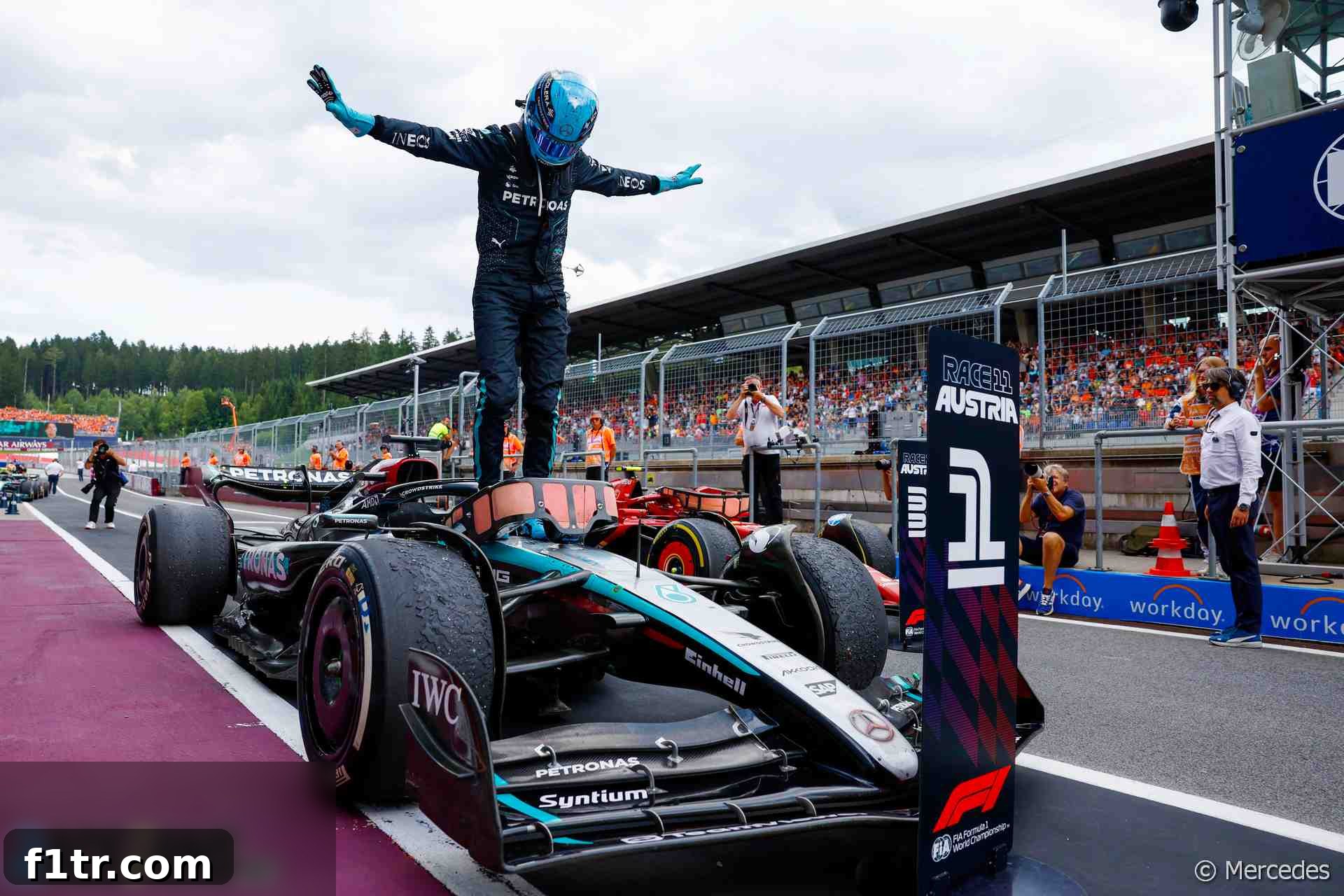
Both Mercedes and McLaren, understanding the critical nature of these final moments, wisely refrained from disturbing their drivers with unnecessary radio messages. With a previous race victory under his belt from the end of 2022, Russell could draw upon that confidence, holding his nerve remarkably well even as Piastri relentlessly closed in. Finally, at the end of the 71st lap, Russell rounded the notorious final pair of right-handers for the last time, crossing the chequered flag to become a two-time Grand Prix winner. This triumph broke Mercedes’ second-longest win drought in Formula 1 history, a monumental achievement for the team.
“It’s not over until it’s over! Great job,” Russell celebrated over the radio, his voice crackling with emotion, before receiving congratulations and a heartfelt apology from his team principal. “Yeah George, my bad – speaking in the braking. It just got me!” Wolff confessed, acknowledging his own excited outburst.
Post-Race Reflections and Championship Implications
Although his victory had been significantly aided by the dramatic self-elimination of Max Verstappen and Lando Norris from contention, George Russell was more than happy to accept the unexpected gift. “I feel that Montreal was probably a victory that we missed out on and we ended up finishing P3,” he reflected. “Today was a deserving P3 and we got the victory. So it’s funny how this sport turns around and just credit to all the team for all the hard work they’ve done. Such huge progress since the start of the year.” His comments underscored the fluctuating fortunes of Formula 1 and the immense effort Mercedes had put into improving their car.
Oscar Piastri, naturally, was somewhat disappointed not to convert his strong late-race pace into a victory. However, having started out of position in seventh and meticulously fought his way through the field to even be in contention for a podium, he could certainly be satisfied with his day’s work. “It just kind of felt like we needed some more laps towards the end, unfortunately,” Piastri lamented. “But no, after starting seventh, obviously a good turnaround. I’m pretty happy.” His performance reaffirmed his growing stature as a top-tier F1 driver.
The Ferrari, widely considered the fourth-fastest car in Austria, meant Carlos Sainz’s third place was an unexpected but incredibly welcome reward for his consistent efforts throughout the weekend. “I think there was not much more in it this weekend,” Sainz stated. “Today, we set our targets in trying to beat the Mercedes. We managed to beat one, even if one of them got ahead. We tried everything we could.”
Lewis Hamilton, following the late-race drama, was promoted to fourth place. It later transpired that he had also been carrying damage, making his finish even more commendable. Max Verstappen, despite his collision, was handed a ten-second penalty for drifting into Norris. However, this penalty made no difference to the championship leader’s finishing position of fifth, a testament to his earlier dominance. Lando Norris ultimately retired in the pits, later admitting he might have continued had he driven back to the pits more carefully, a bitter pill to swallow given his strong performance.
Nico Hulkenberg initially lost sixth place to Sergio Perez’s damaged Red Bull on the final lap but executed a brilliant re-pass to secure Haas’ best result of the season at what is habitually their strongest track. Kevin Magnussen joined him in eighth, capping off a stellar weekend for the American team.
Daniel Ricciardo claimed valuable points in his 250th Grand Prix start, finishing ninth, a significant milestone for the Australian veteran. Pierre Gasly, after another contentious interaction with his Alpine teammate (who forced him off track at turn three), kept his top-ten streak alive with a tenth-place finish.
Advert | Become a RaceFans supporter andgo ad-free
Mercedes’ Long-Awaited Comeback and Russell’s Future
While much of the post-race discussion understandably centered on the unraveling of the once-cordial relationship between Max Verstappen and Lando Norris, it was easy to overlook the profound significance of Mercedes’ triumph. The Silver Arrows had finally managed to break a frustrating losing streak of 34 rounds, securing only their second victory in the ground effect era. The team that had once been the dominant force in Formula 1 had endured a long and arduous struggle to find its way back to the front of the grid. Even if this victory had arrived more through fortunate circumstances than sheer outright pace, George Russell was determined to savor every moment.
“I want to celebrate it because you can’t take these moments for granted,” said the ecstatic winner. “I feel that I’ve got a lot left in me and a lot more victories to come in the future but in an era of total dominance by one team and driver, any victory by any other driver, you need to enjoy it.” Russell’s words resonated deeply, highlighting the immense challenge of breaking through Red Bull’s current stranglehold on the sport. This victory, regardless of its unique circumstances, served as a powerful morale booster for Mercedes and a clear demonstration of Russell’s talent and resilience, signaling a potential turning point in their quest for sustained competitiveness.
Become a RaceFans Supporter
RaceFans thrives thanks to the generous support of its dedicated readers. By contributing £1 per month or £12 per year (or the equivalent in your local currency), you can help fund the creation, hosting, and ongoing development of RaceFans, both now and in the future.
Join the RaceFans Supporter community today and enjoy an ad-free browsing experience. Find out more or sign up via the links below:
- Become a RaceFans Supporter
- RaceFans Supporter FAQ
2024 Austrian Grand Prix News & Analysis
- Austrian GP clash will have taught Norris how to race Verstappen – Ricciardo
- Verstappen was “lucky” tyre damage didn’t force him to retire like Norris
- Pirelli introducing new C6 tyre to improve racing on street tracks next year
- Norris admits ‘overreacting’ but queries why Verstappen avoided track limits penalty
- Norris and Verstappen’s Austrian GP collision “blown out of proportion” – rivals
Browse all 2024 Austrian Grand Prix articles
Latest F1 Race Reviews
- Antonelli lucks in for second win and becomes youngest F1 championship leader
- Emotional Antonelli grabs first Formula 1 victory in Chinese Grand Prix
- Russell sees off Ferrari threat to lead Mercedes one-two in Melbourne
- Norris clinches F1 title by two points as Verstappen wins finale at Yas Marina
- McLaren strategy blunder in Losail hands Verstappen crucial win and shot at title
Read all F1 race reviews