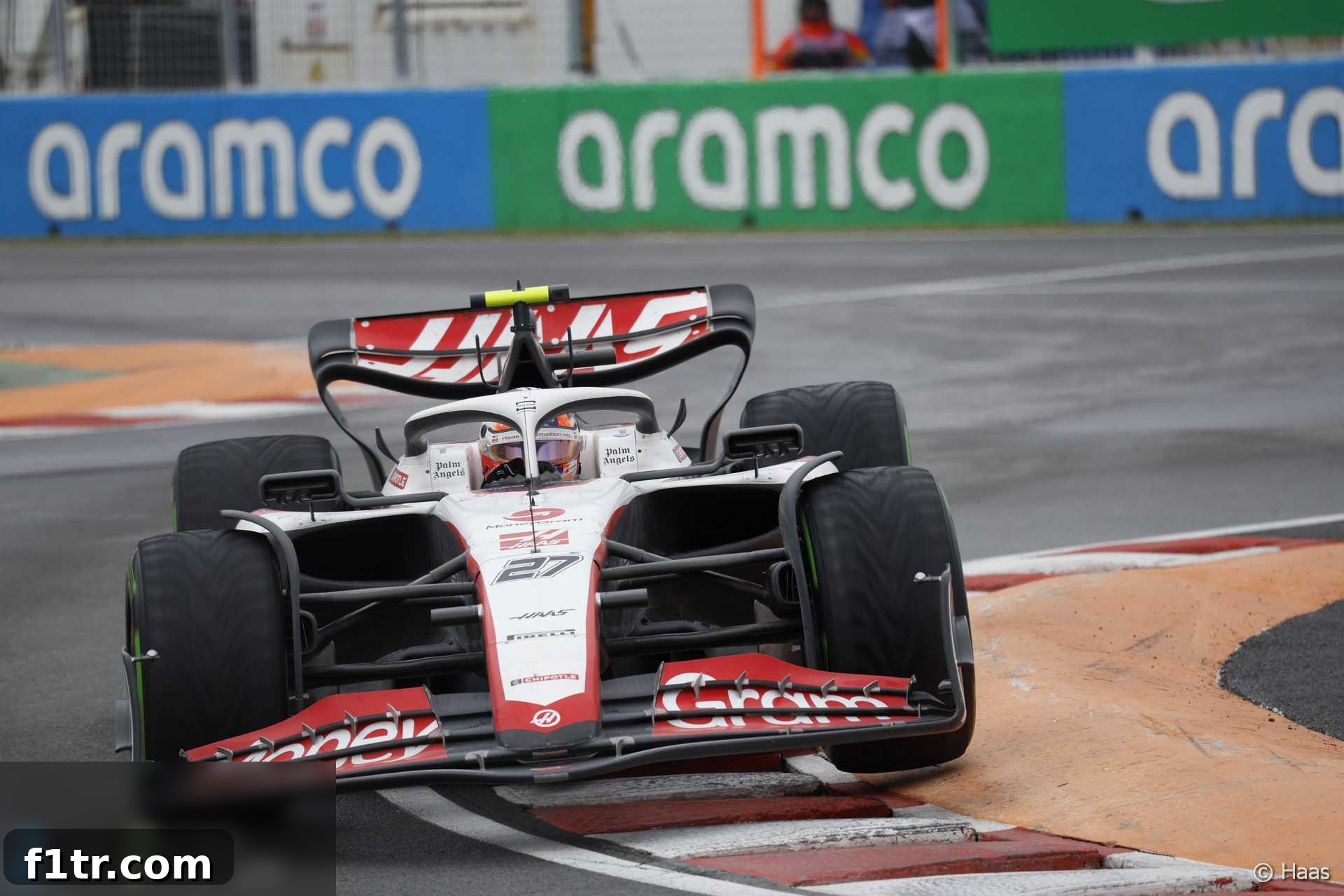
Nico Hulkenberg Penalised: Front Row Start Lost at Canadian Grand Prix
A thrilling qualifying session for the Canadian Grand Prix took an unfortunate turn for Nico Hulkenberg as he was stripped of his sensational front-row starting position. The Haas driver, who had put in a spectacular performance to qualify second, was handed a three-place grid penalty by the Formula 1 stewards. The infraction? Failing to slow down sufficiently under red flag conditions. This decision reshapes the top of the grid, pushing Hulkenberg back to fifth for Sunday’s race in Montréal.
Hulkenberg’s initial P2 qualification was a career-best and a significant achievement for the Haas F1 Team, placing him alongside championship leader Max Verstappen. The penalty, however, means he will now start from the third row, a setback that forces both driver and team to immediately recalibrate their strategic approach for the demanding Circuit Gilles Villeneuve. While the penalty is less severe than the standard ten-place drop typically applied for such breaches, it nonetheless highlights the critical importance of adhering to Formula 1’s stringent safety protocols, particularly during red flag periods.
The Red Flag Incident: Unpacking the Qualifying Breach
The incident that led to Hulkenberg’s penalty unfolded during the highly dramatic Q3 session of Canadian Grand Prix qualifying. Torrential rain had made track conditions treacherous, contributing to several dramatic moments and interruptions. The specific red flag in question was deployed after McLaren rookie Oscar Piastri crashed his car, making contact with the wall and bringing his session to an early end.
At the crucial moment the red flag was displayed, Nico Hulkenberg had just completed what would become his fastest lap, a stunning effort that initially put him second on the grid. He was already commencing another push lap when the red flag notification came through. Formula 1 regulations are unequivocal: drivers must immediately reduce their speed to a pre-defined “delta time” when red flags are shown. This regulation is paramount for ensuring the safety of marshals, medical teams, and other drivers navigating a potentially hazardous situation on track.
The stewards’ investigation meticulously reviewed telemetry data and Hulkenberg’s in-car communications. Their findings indicated that the Haas driver did not sufficiently comply with the mandated delta time reduction. Specifically, the stewards noted that Hulkenberg was at Turn One when the red flag was activated, and at that point, he was already 1.5 seconds over his delta time. This initial lapse set the stage for the subsequent breach, as he found it extremely difficult to bring his speed below the required delta in the subsequent sector. The delta time system is designed to enforce a consistent and safe deceleration across the entire circuit, preventing any driver from maintaining excessive speed during an emergency.
Hulkenberg’s Perspective: Confusion Amidst High Pressure
During his meeting with the stewards, Nico Hulkenberg provided his account of the incident, offering insight into the complexities faced by drivers in such high-pressure situations. He openly acknowledged the challenge of adhering to the delta time target, especially given that he had just concluded a flying lap and was immediately pushing for another when the red flag was called. However, his primary defense centered on a crucial aspect of in-car communication: confusion surrounding the audible “beep” signals in his headset.
Drivers rely on these beep signals to indicate whether they are running above or below the required delta time. Hulkenberg admitted to misinterpreting these vital audio cues at one point, leading him to mistakenly believe he was actually driving too slowly. The stewards’ report confirmed this, stating: “He also admitted to confusion about the beep signal in his headset, and therefore at one stage thought he was going too slow.” This revelation highlights the immense cognitive load and sensory input drivers manage during critical qualifying sessions, particularly when conditions are as unpredictable and rapidly changing as they were in Montréal.
While the stewards acknowledged Hulkenberg’s confusion as a contributing factor, they ultimately concluded that a breach of the regulations had occurred. The responsibility for understanding and reacting correctly to all in-car signals and safety procedures ultimately rests with the driver. This incident serves as a stark reminder of the unwavering focus and precision required at the pinnacle of motorsport, where even a momentary misjudgment or misinterpretation of a signal can have significant repercussions for a driver’s standing and their team’s prospects.
The Stewards’ Verdict: Mitigating Factors Lead to Lenient Penalty
After a thorough review of the incident, including Hulkenberg’s explanation and extensive telemetry data, the Formula 1 stewards reached a nuanced decision. While they unequivocally determined that a breach of the red flag regulations had taken place, they opted for a more lenient three-place grid penalty, rather than the standard ten-place drop typically applied for such infractions. This decision was heavily influenced by several mitigating circumstances.
A pivotal piece of evidence was the comparison of Hulkenberg’s telemetry data with that of Esteban Ocon (Car 31), another driver who successfully adhered to the delta times during the same red flag period. This comparison revealed that for the vast majority of the subsequent lap, Hulkenberg’s speed was broadly comparable to Ocon’s. This indicated that despite his initial failure to comply, his overall reduction in pace was, for the most part, in line with safe practice once he had processed the situation and began to slow down.
The stewards’ official statement clarified their reasoning: “We regard this as a mitigating circumstance. However, the regulation is very clear and whilst there is no question of the driver acting dangerously or driving unsafely, there was a breach and thus a penalty has to be imposed.” This statement is crucial, as it underscores that while Hulkenberg’s actions did not pose an overt safety risk, the strict letter of the law regarding delta time compliance during a red flag was not met. The core intent of the regulation is to ensure that cars are not traveling at excessive speeds when conditions are deemed unsafe, and in this specific instance, there was no concrete evidence that Hulkenberg’s speed was dangerously high, only that he failed to meet the *required* delta time target quickly enough.
In their final remarks, the stewards advised Hulkenberg to “make himself more familiar with the operational aspects of the delta signals” in the future. This implies that while his reported confusion was considered, it ultimately falls under a driver’s professional responsibility to fully comprehend and correctly respond to all in-car warnings and regulatory mandates. The stewards’ decision to impose a reduced penalty reflects a careful balance between strict adherence to rules and a pragmatic assessment of the circumstances, recognizing a technical infringement rather than a deliberate disregard for safety.
Impact on the Grid and Race Day Dynamics at Circuit Gilles Villeneuve
The three-place grid penalty for Nico Hulkenberg dramatically alters his starting position for the Canadian Grand Prix, moving him from a sensational second place to fifth. This shift is profoundly significant for both the driver and the Haas F1 Team. A front-row start offers unparalleled advantages, including clean air, a clear view into Turn 1, and the ability to dictate pace in the early stages of the race. At a circuit like Circuit Gilles Villeneuve, renowned for its challenging overtaking opportunities, starting from second would have positioned Hulkenberg perfectly for a podium challenge or even a surprise victory, especially given the unpredictable weather frequently associated with Montréal.
Dropping to fifth places him amidst a much more congested and competitive pack, surrounded by formidable rivals such as Fernando Alonso and Lewis Hamilton, who are known for their aggressive opening lap strategies. This altered starting position will necessitate a significant recalculation of Haas’s initial race strategy, potentially shifting focus from outright pace at the front to more conservative tire management and opportunistic overtakes. For a team consistently striving for valuable championship points, losing such a prime starting spot is undeniably a considerable setback, despite P5 still representing a very strong qualifying result.
The penalty also has a direct impact on other drivers higher up the grid. Fernando Alonso, who originally qualified third, will now move up to second, securing a coveted front-row start alongside Max Verstappen. Lewis Hamilton also benefits, gaining a position to start third, with George Russell moving up to fourth. This reshuffling at the sharp end of the grid adds another layer of intrigue and unpredictability to what was already set to be an exhilarating race, with several top contenders now packed even closer together. The incident serves as a powerful reminder of how critical every single millisecond and every aspect of rule compliance is in the intensely competitive and tightly regulated world of Formula 1.
Broader Implications: F1 Regulations, Safety, and Driver Responsibility
The incident involving Nico Hulkenberg, and the subsequent penalty, offers a stark illustration of the paramount importance of safety regulations within Formula 1. Red flag conditions are deployed solely when there is a significant hazard on the racetrack—be it a crashed car, dangerous debris, or weather conditions that render racing unsafe. The “delta time” rule is a fundamental component of these safety protocols, meticulously designed to ensure that all cars reduce their speed in a controlled, consistent, and predictable manner. This minimizes the risk to marshals, medical personnel, and other drivers who might be navigating a dangerous situation, potentially at high speed.
The F1 stewards bear the crucial responsibility of rigorously upholding these regulations. While their aim is to apply consistent penalties, they also possess the vital discretion to consider mitigating circumstances, as demonstrated in Hulkenberg’s case. This delicate balance between strict enforcement and contextual judgment is absolutely essential for maintaining fairness across the grid, while simultaneously ensuring that safety standards remain non-negotiable. Every driver on the grid is expected to be intimately familiar with every facet of these rules, as their strict adherence directly impacts the well-being of every individual involved in a Grand Prix weekend.
Such penalties, while occasionally frustrating for teams and drivers, reinforce the exceptionally high standards of professionalism and safety expected in motorsport’s premier category. Every competitor understands that even a minor lapse in concentration or an honest misunderstanding of a critical signal can lead to consequences that not only affect their championship aspirations but also their team’s overall performance. The Canadian Grand Prix grid penalty for Nico Hulkenberg stands as a testament to this unwavering commitment to safety, even when it means foregoing a dream start on the grid.
With the grid now officially set, the F1 paddock eagerly awaits the race itself. The altered starting positions promise an even more thrilling and strategic spectacle at Circuit Gilles Villeneuve, as Hulkenberg, despite the setback, will undoubtedly be determined to convert his P5 start into a strong points finish for Haas.
More from the 2023 Canadian Grand Prix
- Norris ‘even more’ sure Canada penalty was wrong after review request fails
- McLaren seeking more than just downforce gains from major upgrade
- Winning more races won’t necessarily lead to F1 seat – Palou
- Red Bull’s testing restriction will “massively affect” 2024 car development
- Schumacher’s set-up input gives Mercedes a “super advantage” – Wolff
Browse all 2023 Canadian Grand Prix articles