2021 IndyCar Season Kicks Off with Thrilling Pre-Season Testing at Sebring
The engines roared back to life yesterday at the historic Sebring International Raceway in Florida, marking the official start of pre-season testing for the much-anticipated 2021 IndyCar Series. This crucial initial phase saw three prominent teams hitting the track, meticulously fine-tuning their machines and allowing drivers to re-acclimatize, or in some cases, acclimate for the very first time, to the demanding world of open-wheel racing. Sebring, renowned for its challenging and unforgiving characteristics, provides an ideal proving ground for teams and drivers as they embark on their quest for championship glory.
Pre-season testing is more than just a formality; it’s a critical period for every team and driver aiming for a competitive edge. It allows engineers to validate off-season developments, test new components, and gather invaluable data under real-world conditions. For drivers, it’s an opportunity to shake off the rust, build rapport with their new cars and teams, and understand the nuanced behaviors of their vehicles before the pressure of race day sets in. The diverse nature of Sebring’s surface, a mix of concrete and asphalt, alongside its notoriously bumpy sections, makes it particularly beneficial for evaluating car setups and driver stamina, simulating the varied challenges encountered throughout an IndyCar season.
Chip Ganassi Racing Leads the Charge with a Star-Studded Lineup
Among the teams making their presence felt at Sebring was the formidable Chip Ganassi Racing, a powerhouse in American motorsport. Their lineup for the test day was nothing short of captivating, featuring a blend of seasoned champions, ambitious newcomers, and drivers looking to build on previous successes. This highly anticipated season sees Ganassi fielding a team brimming with potential, and their early performance at Sebring offers a glimpse into their aspirations.
Scott Dixon: The Reigning Champion’s Relentless Pursuit
Leading the charge for Ganassi was none other than the reigning IndyCar Series champion, Scott Dixon. The six-time champion, often dubbed “The Iceman” for his cool demeanor and clinical precision, began his pursuit of an unprecedented seventh championship. Dixon’s presence at testing underscores his dedication and relentless drive, even after achieving such immense success. His insights and feedback are invaluable to the team, guiding the development of the car and setting the benchmark for his teammates. With each lap, Dixon was not only preparing himself but also subtly influencing the direction of the team’s entire 2021 campaign, aiming to once again be the standard-bearer in the fiercely competitive series.
Jimmie Johnson’s Grand IndyCar Induction
Perhaps the most significant and widely discussed development at Sebring was the full-fledged debut of NASCAR legend Jimmie Johnson in an IndyCar. Johnson, a seven-time NASCAR Cup Series champion, has embarked on a bold new chapter in his illustrious career, joining Chip Ganassi Racing for selected road and street course events in 2021. His transition from the heavy, closed-wheel stock cars of NASCAR to the agile, high-downforce open-wheel machines of IndyCar is one of motorsport’s most intriguing storylines. The contrast between the two disciplines is stark, demanding entirely different driving techniques and mental approaches.
Johnson candidly shared his initial impressions from the cockpit: “I got a fair amount of laps,” he commented, highlighting his dedication to accumulating crucial mileage. “I’m really just trying to understand how to slow the car down so quickly and maximise the car in the braking zones.” This quote perfectly encapsulates the fundamental difference between NASCAR and IndyCar. IndyCars, with their significant downforce and carbon-ceramic brakes, offer prodigious stopping power, requiring drivers to recalibrate their braking points and modulate pressure with extreme precision. The sensation of negative G-forces under heavy braking in an IndyCar is far more intense than in a stock car, demanding physical and mental adaptation. Johnson’s willingness to learn and his humility in acknowledging the challenge have endeared him to the IndyCar paddock and its fans. He also praised his new colleagues, adding, “My team mates have been great, working really well with me to get up to speed, and just having a ton of fun.” This collaborative spirit within Ganassi will be vital for Johnson’s development.
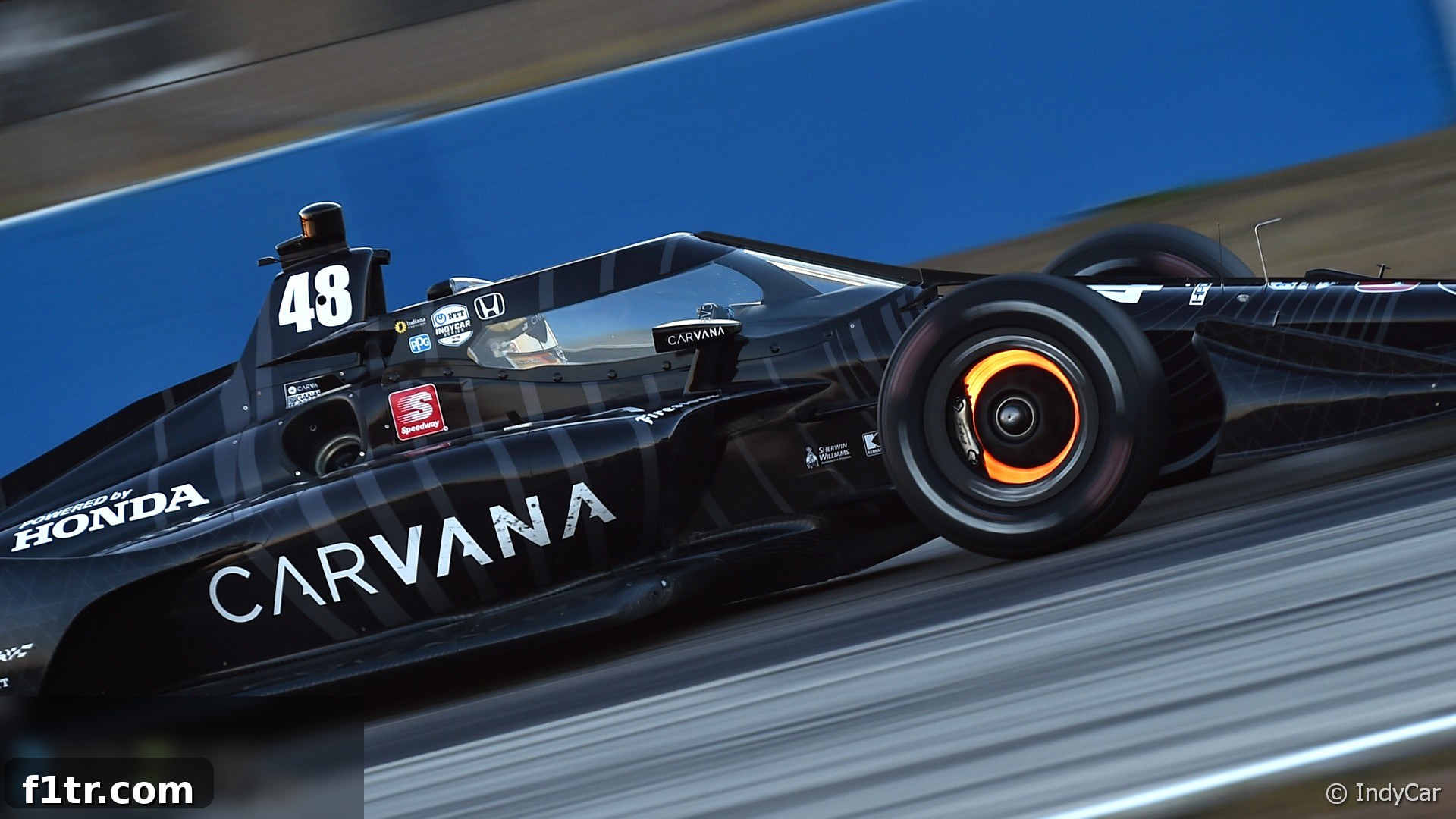
Visually, Johnson’s car at Sebring featured a sleek, plain black livery adorned with the prominent logos of Carvana, his primary sponsor for his IndyCar endeavor. The team’s pit equipment was painted in a matching dark blue, hinting at a sophisticated and unified brand image. The anticipation for the full reveal of his 2021 car design is palpable. “I’m very excited for the 2021 car unveil,” Johnson added, “it will come down the pipeline before long.” This partnership with Carvana is not just a sponsorship; it represents a significant investment in Johnson’s audacious career shift and the broader appeal of IndyCar racing.
Alex Palou and Marcus Ericsson Complete Ganassi’s Formidable Quartet
Chip Ganassi Racing’s strong showing at Sebring was further bolstered by the presence of another exciting newcomer, Alex Palou. The young Spaniard joins Ganassi after a remarkably promising debut season with Dale Coyne Racing, where he quickly demonstrated his speed and adaptability. Moving to a top-tier team like Ganassi signifies the high regard in which Palou is held, and his performance in testing will be crucial for integrating into his new environment and building upon his rookie successes. Fans are eager to see how he elevates his game with the resources of a championship-contending team.
Completing Ganassi’s testing lineup was Marcus Ericsson, now in his second year with the team. The Swedish driver, who showed flashes of brilliance in his debut season with Ganassi, is looking to translate that potential into consistent top results. A second year with the same team allows for greater familiarity with the car, the engineering staff, and the overall team philosophy, often leading to a significant step up in performance. Ericsson’s experience will be key in a team with a veteran champion and two drivers adapting to new roles.
Other Contenders On Track: Foyt and Carlin Prepare for the Season
Beyond the Ganassi stable, other teams were also hard at work at Sebring, signaling their intent for the upcoming season. The pre-season test saw valuable track time for AJ Foyt Racing and Carlin Motorsports, both aiming to make significant strides in 2021.
AJ Foyt Racing: Experience and Youth
The iconic AJ Foyt Racing team, steeped in IndyCar history, fielded its 2020 drivers, Sebastien Bourdais and Dalton Kellett. Bourdais, a veteran with extensive open-wheel experience, brings invaluable technical feedback and race craft to the team. His ability to dissect car performance and guide development is a tremendous asset for Foyt as they strive for improved competitiveness. Dalton Kellett, on the other hand, represents the team’s investment in burgeoning talent. His continued development within the team framework is essential, and Sebring provided an ideal opportunity for him to hone his skills and gain critical seat time.
Carlin and Max Chilton Look Ahead
Max Chilton was present for Carlin, the British-based team that has established a presence in IndyCar. Chilton, known for his diverse motorsport background including Formula 1, is a consistent and analytical driver. His feedback is crucial for Carlin as they work to optimize their package and aim for stronger performances throughout the year. Carlin’s participation in early testing highlights their commitment to arriving at the first race fully prepared and competitive.
The Unseen Work: What Pre-Season Testing Truly Reveals
While lap times are rarely the focus of early pre-season testing, the sheer amount of unseen work occurring behind the scenes is immense. Teams are meticulously checking systems, running through different aero configurations, evaluating tire degradation, and simulating race scenarios. Data engineers pour over telemetry, comparing driver feedback with digital readouts to find those elusive tenths of a second. This early testing phase is also vital for pit crew practice, ensuring that the critical ballet of a pit stop is executed flawlessly when the season begins. The rough surface of Sebring is particularly good at exposing mechanical weaknesses and chassis flex, allowing teams to address these issues long before they impact a race weekend. It’s a holistic approach to preparation, where every detail matters.
Anticipation Builds for a Thrilling 2021 IndyCar Season
The first day of IndyCar testing at Sebring has successfully ignited the excitement for the 2021 season. With established champions like Scott Dixon gearing up for another title fight, and motorsport legends like Jimmie Johnson embarking on audacious new challenges, the narrative for the year is already compelling. The blend of veteran prowess and emerging talent across the grid promises a season filled with unpredictable races, intense rivalries, and unforgettable moments. As teams pack up their equipment from Sebring, the focus will undoubtedly shift to analyzing the mountains of data collected and preparing for the next phase of development. Fans worldwide can now eagerly count down the days until the green flag drops for the first race, marking the official commencement of what is shaping up to be a truly spectacular IndyCar season.
For more insights and the latest updates on the IndyCar Series, explore our related articles:
IndyCar Insights
- IndyCar driver McLaughlin cleared of injury after crashing through barrier at Barber
- Schumacher says his IndyCar feels like ‘an F2 car, just with better tyres’
- IndyCar “way faster than Formula 1” in some corners, says Grosjean
- FIA to award more F1 superlicence points to IndyCar drivers from 2026
- Schumacher to race full-time in IndyCar with RLL in 2026
Browse all IndyCar articles