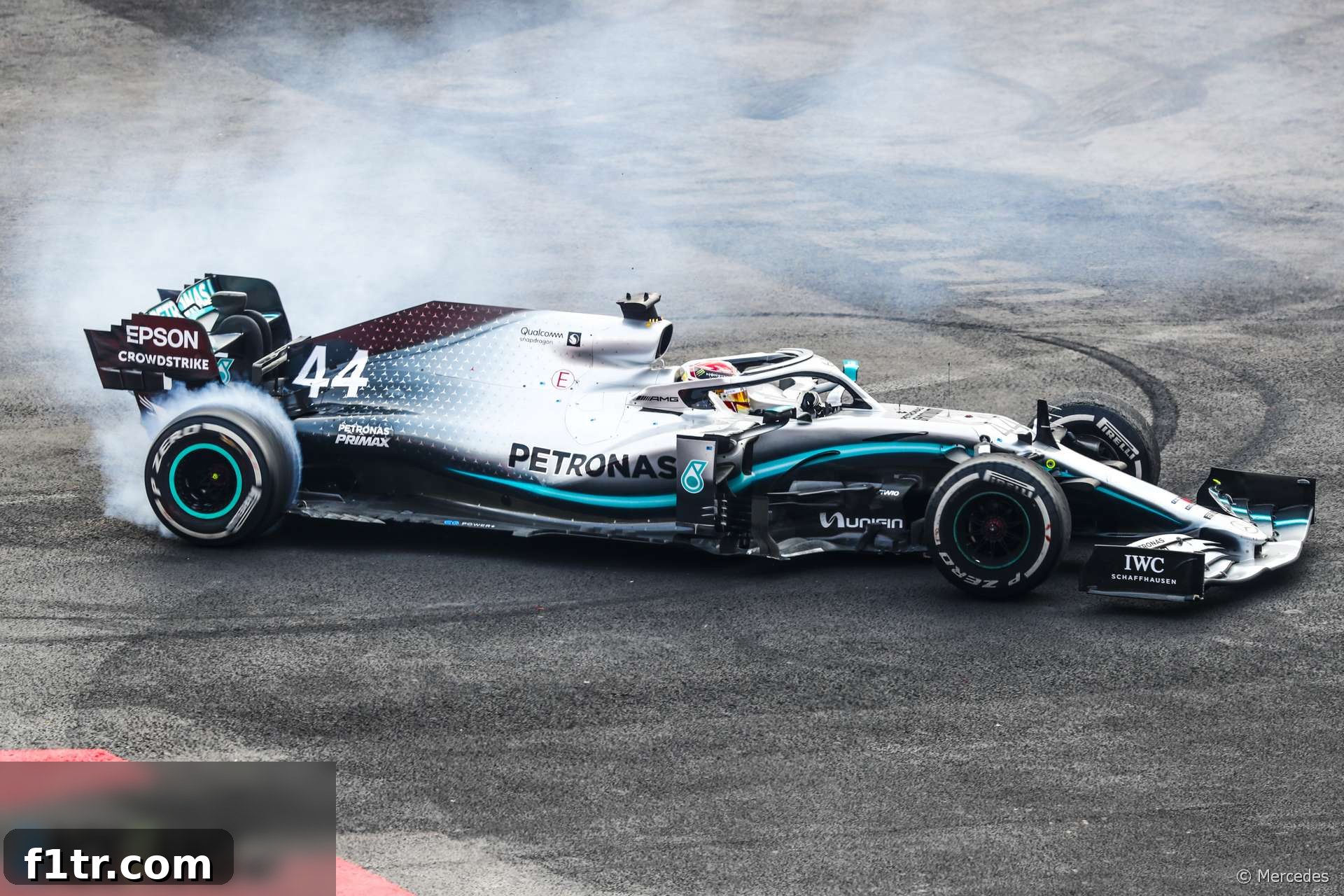
In the thrilling world of Formula 1, success often hinges on possessing the fastest car on the grid. For a substantial period over the past six seasons, Lewis Hamilton and Mercedes enjoyed this enviable advantage, dominating the sport with unparalleled consistency. However, a noticeable shift in momentum had begun to emerge, with Ferrari showcasing formidable pace and securing six consecutive pole positions leading up to the Mexican Grand Prix. This remarkable qualifying streak hinted at a potential power struggle at the forefront of the championship, raising anticipation for what promised to be a captivating race weekend.
The Autódromo Hermanos Rodríguez circuit in Mexico City presents a unique challenge for teams and drivers alike. Its punishing high altitude significantly impacts engine performance and aerodynamic efficiency, demanding bespoke setups and strategies. While Mercedes had historically found this venue a tough nut to crack, Red Bull, with their innovative chassis design and the exceptional talent of Max Verstappen, had consistently thrived here. Verstappen, the victor of the previous two Mexican Grands Prix, underscored his affinity for the track by setting the fastest time in qualifying, putting himself in prime position for a third consecutive win.
Thus, entering the race, Mercedes and Hamilton faced an unusual predicament: they knew their main rivals, Ferrari and Red Bull, possessed superior raw speed. Yet, in a testament to strategic brilliance, unwavering determination, and perhaps a touch of good fortune, Hamilton orchestrated a truly remarkable comeback. He emerged victorious, securing a critical win that brought his sixth world championship title to the brink of certainty, a feat achieved by overcoming formidable challenges and capitalizing on the misfortunes of his closest competitors. For Hamilton to conquer Mexico, three key rivals would, directly or indirectly, pave his path to glory.
Verstappen: A Series of Unfortunate Events
Max Verstappen’s Mexican Grand Prix weekend began with the elation of provisional pole position, only to swiftly descend into frustration. During the crucial second runs of Q3, Valtteri Bottas suffered a heavy crash, sending his Mercedes into the TecPro barriers at turn 17. The moment a marshal waved a yellow flag at the incident site, the regulations dictated that drivers approaching the section must lift off the throttle and be prepared to stop. Verstappen, having already set the fastest time during the first runs, seemed poised to clinch pole position, as any improvement under yellow flag conditions would be disallowed.
A critical data cable, vital for automatically relaying warning signals to the electronic timing system and driver cockpits, was severed in Bottas’s impact. However, F1 rules explicitly state that a physical waved yellow flag holds the same regulatory weight as an electronic light panel. While Hamilton passed the scene just before the flag was displayed and couldn’t improve enough for pole, the two remaining contenders, Sebastian Vettel and Verstappen, were both mandated to respect the yellow flag. This implied that both would have to slow down, effectively handing pole to Verstappen based on his earlier lap.
Yet, in a controversial turn of events, while Vettel appropriately lifted, Verstappen maintained his speed and improved his lap time. His subsequent, carefully chosen words in the official press conference – ambiguous and evasive – left a cloud of uncertainty regarding whether he had seen and deliberately ignored the yellow flag, or genuinely failed to notice it. Regardless of intent, the stewards’ verdict was clear: a three-place grid penalty for failing to slow down under yellow flags. This significant penalty stripped Verstappen of pole, elevating an all-Ferrari front row with Charles Leclerc ahead of Vettel, and crucially, moving Hamilton up the grid, directly ahead of his Red Bull rival. The stage was set for a fierce battle on lap one.
As the lights extinguished, Hamilton made a strong start, arguably better than Vettel’s, but the Ferrari driver aggressively squeezed him towards the grass on the run to Turn 1. While Vettel smoothly followed Leclerc into the first corner, a determined Verstappen, eager to recover from his grid penalty, made an audacious dive down the inside of Hamilton. The Red Bull driver was fully ahead in the braking zone and still held the advantage at the apex. Though he initially left Hamilton racing room on the exit, their rear wheels made contact, sending Hamilton sideways. Unable to correct his car for the rapid Turn 2, the pair tangled again, both forced onto the grass. This chaotic opening allowed Alexander Albon and Carlos Sainz Jnr to surge past, while Verstappen lost another position to Bottas, compounding his early race woes.
Despite the setbacks, Verstappen’s Red Bull was undeniably quick, and he was clearly fired up by the string of misfortunes. His attempt to snatch seventh place from Bottas was a masterclass in opportunistic driving, brilliantly judged and executed. However, fate once again dealt him a cruel hand. The move, while successful, resulted in a puncture for the Red Bull driver. To add insult to injury, the damage manifested just after he had passed the pit lane entrance, forcing him to complete an entire slow lap before he could get fresh tyres. This incident effectively eliminated one of Hamilton’s most potent rivals from contention for victory, a critical moment that would profoundly influence the race’s outcome.
Leclerc: The Pit Stop Gamble That Backfired
Just two weeks prior at Suzuka, Ferrari had squandered a commanding front-row lock-out, and it seemed they were destined to repeat their strategic missteps. In Mexico, however, they successfully held their positions at the start, granting them a strategic advantage and the ability to dictate the race tempo, aiming to fend off rivals’ gambits. However, the relentless pace of the remaining Red Bull of Alexander Albon kept the pressure on. While Vettel diligently kept within striking distance of Leclerc, carefully managing his tyres to avoid premature wear, Albon in third loomed ominously, often less than a second behind, signaling Red Bull’s clear intent.
On lap 14, Red Bull succumbed to the allure of an early pit stop, committing Albon to what they believed would be a two-stop strategy. Friday practice had indicated that tyre graining would be a persistent issue on the C3 medium compounds, reinforcing their belief that multiple stops would be necessary. Albon’s car was fitted with a fresh set of C3 medium tyres, and he rejoined the fray.
Albon emerged from the pits behind Carlos Sainz. This outcome seemingly aligned with Red Bull’s initial projections; Albon’s pit stop, executed with remarkable efficiency at only three-tenths slower than the race’s best, suggested they anticipated he would tuck in behind the McLaren. What they failed to foresee was Sainz’s tenacity and how challenging he would prove to be to overtake. “I was a bit confused because I didn’t think I was racing Carlos,” Albon admitted post-race. “And I don’t think we were.” Red Bull had presumably expected Albon to dispatch Sainz swiftly, allowing him to maintain his threat to Vettel’s position.
Ferrari, however, was visibly concerned by Albon’s potential to undercut them. With Vettel running so closely behind Leclerc, pitting Vettel first carried the significant risk of him emerging ahead of his teammate, thus reversing their meticulously established running order. Seemingly unwilling to gamble on this internal hierarchy, Ferrari made the fateful decision to call Leclerc in instead. This move proved to be a considerable misjudgment. Albon’s unexpected struggle behind Sainz meant Leclerc was actually under far less threat from the Red Bull than Ferrari had perceived; he rejoined the track a comfortable eight seconds ahead of Albon, rendering the early stop largely unnecessary.
Worse still for Leclerc, this early stop irrevocably locked him into a two-stop strategy, just as rival teams were beginning to understand that a single-stop approach might be viable. To compound his misery, Leclerc discovered his new set of medium tyres performed poorly compared to his first stint. He relayed his concerns over the radio, noting they felt “quite different than the previous ones.” From that point onwards, Leclerc consistently lacked the necessary pace to genuinely challenge for the lead, his podium hopes fading with each passing lap, a victim of his team’s strategic miscalculation.
Vettel: The Waiting Game That Proved Costly
Having both cars at the sharp end of the field is a luxurious position for any team, offering the strategic flexibility to cover multiple potential race outcomes. While Ferrari had been caught off guard by Albon’s early stop regarding Leclerc, they still held a strong hand with Sebastian Vettel out front. He extended his opening stint on soft tyres, aiming for a single-stop strategy – a viable option given the high altitude’s impact on tyre degradation, which can sometimes be lower than anticipated.
However, pinpointing the optimal moment for that sole pit stop proved unusually tricky, exacerbated by the inconsistent performance data on the hard compound tyres. Lewis Hamilton, meanwhile, was steadily closing the gap to Vettel. Ferrari harbored a genuine concern about pitting Vettel too early onto the hard tyres, fearing they might run out of tyre life and performance in the closing stages of the race. This conservative approach, born from caution, would ultimately backfire.
Worn hard tyres are particularly susceptible to losing temperature and grip, especially towards the end of a long stint. Mercedes, ever the strategists, had a cunning backup plan. Both Hamilton and Bottas had meticulously saved a fresh set of soft tyres. This tactical foresight meant that if they found themselves vulnerable on worn hard tyres late in the race, or if a Virtual Safety Car (VSC) or Safety Car period was deployed in the final laps, they could execute a swift pit stop for softs and unleash a potent attack in the final sprint. They also closely monitored Daniel Ricciardo, the sole driver who had boldly started the race on hard tyres. His lap times were holding up remarkably well, demonstrating the durability of the compound and allowing him to climb from 13th on the grid to a respectable sixth position, providing Mercedes with invaluable real-time data.
On lap 23, Mercedes made their decisive move, calling Hamilton into the pits. This was a calculated risk, committing him to a demanding 48-lap stint on the hard tyres. However, it placed Ferrari in an immediate bind. As soon as Hamilton rejoined the track, it became painfully clear that they could no longer pit Vettel and guarantee him rejoining ahead of the Mercedes. Initially, the team instructed Vettel to pit, but he countered with a suggestion to “let him go,” implying he believed he could extend his stint further. Before the lap concluded, Ferrari reluctantly agreed, acknowledging they had few viable alternatives. This moment proved to be the pivotal undercut, mirroring Ferrari’s own successful tactic against Mercedes in previous races.
Ferrari clung to the fading hope that Hamilton’s long stint on hard tyres would eventually force him into a second pit stop. But as the race wore on, this hope steadily evaporated. Vettel finally made his sole pit stop 14 laps after Hamilton, a significant delay. The theoretical benefit of fresher tyres failed to materialize into a sustained attack when he eventually closed in on the Mercedes. Even with the SF90’s inherent straight-line speed advantage, Vettel simply could not find a way past Hamilton, who masterfully managed his worn rubber. The final laps created what promised to be an enthralling spectacle: Hamilton carefully nursing his degraded tyres at the front, Vettel closing rapidly, followed by Bottas, and the two-stopping Leclerc on the freshest tyres of all. However, despite the tantalizing prospect, none of them could get close enough to launch a serious challenge for the lead, underscoring Hamilton’s defensive brilliance and Mercedes’ strategic prowess.
Perez Delights Home Crowd Amidst Midfield Battles
Max Verstappen’s blistering pace as he scythed through the field to claim a remarkable sixth place served as a stark reminder of his potential had it not been for the earlier puncture. His impressive recovery drive saw him finish ahead of the local hero, Sergio Perez, who delivered a sensational performance to thrill his adoring home crowd, securing what could be described as a ‘class win’ for his team. His seventh-place finish equalled his best result at his home Grand Prix.
Following the controversial events in Japan, where his team, Racing Point, played a role in both Renault cars being disqualified, Daniel Ricciardo was undoubtedly eager to get one over the Mexican driver. His attempt to dive down the inside of Perez at Turn 1, however, ultimately failed. Perez later playfully quipped to Ricciardo that the move might have worked if he were still driving a Red Bull, highlighting the difference in car performance.
Starting from seventh and eighth on the grid, neither McLaren driver managed to score points in what was a frustrating race for the Woking-based outfit. A catastrophic pit stop error severely hampered Lando Norris’s race, costing him valuable time and positions, while Carlos Sainz Jnr struggled terribly with the hard tyres after his switch, finding little grip or pace. This was a missed opportunity for McLaren to consolidate their position in the midfield battle.
Nico Hulkenberg held onto ninth place as he commenced his final lap, but his tyres were severely degraded, allowing Daniil Kvyat to close in rapidly. On their last tour, Kvyat attempted an aggressive overtake at Turn 16, unfortunately tagging the Renault and sending it spinning into the wall. The inevitable penalty, which a furious Kvyat vehemently protested, dropped the Toro Rosso driver out of the points. Pierre Gasly consequently inherited ninth place, finishing ahead of Hulkenberg, who heroically limped across the finishing line with a severely damaged rear wing after the collision.
Another driver who found the hard compound tyres particularly challenging was Lance Stroll. Despite a promising start, he steadily dropped out of the points-scoring positions in the latter half of the race, unable to extract sufficient performance from his Racing Point on the durable but less grippy compound. The Williams pair, meanwhile, endured their usual struggle at the back of the grid, though their race was momentarily enlivened by a bold move from Robert Kubica on his teammate George Russell at Turn 6, after Russell had run wide two corners prior. A startled Russell was forced to yield, though he eventually regained the position when a puncture forced Kubica into an unscheduled pit stop. Had it not been for that, both Williams cars might have finished ahead of Romain Grosjean, the Haas driver grappling with the challenges of a circuit that has historically proven to be the team’s weakest venue on the calendar.
Hamilton: A Sixth World Championship Almost Secured
Lewis Hamilton’s commanding tenth victory of the season in Mexico brought his sixth Formula 1 World Championship title tantalizingly close, virtually assuring him of the prestigious crown. Despite expressing doubts about his strategy on more than one occasion during the intense race, his stand-in race engineer, Marcus Dudley, and the entire Mercedes pit wall executed the day’s proceedings with near-perfect precision, demonstrating their deep understanding of the race dynamics and tyre management.
On a weekend where Mercedes openly admitted they did not possess the outright fastest car, their strategic acumen and ability to capitalize on rival misfortunes were simply unparalleled. They meticulously ensured they were in a prime position to exploit any opportunity that arose. Remarkably, the cards fell in their favor not just once, but repeatedly throughout the race. The grid penalty for Verstappen, his subsequent puncture, Ferrari’s misjudged pit stops for Leclerc and Vettel – each moment contributed to Hamilton’s improbable triumph.
Mercedes could easily have left Mexico City without either car on the podium, given the superior pace of their rivals at certain stages. Instead, they departed with a highly impressive one-three finish, a testament to their resilience and strategic brilliance. Both Red Bull and Ferrari, having shown flashes of exceptional speed and held commanding positions, would undoubtedly be left kicking themselves, reflecting on the critical errors that allowed their dominant rival to snatch victory from their grasp. This race was a defining moment, showcasing not just Hamilton’s driving prowess, but Mercedes’ unwavering strategic strength, even when under immense pressure and without the outright fastest machine.
2019 Mexican Grand Prix Related Articles
- Why Leclerc’s penalty decision took four hours longer than Kvyat’s
- Ferrari must start converting pole positions into wins – Binotto
- 2019 Mexican Grand Prix Star Performers
- Mercedes: Lost ‘wouvre panel’ cost Hamilton seven seconds
- Horner defends Verstappen’s driving after Hamilton’s “torpedo” criticism
Browse all 2019 Mexican Grand Prix articles
More F1 Race Reviews
- Antonelli lucks in for second win and becomes youngest F1 championship leader
- Emotional Antonelli grabs first Formula 1 victory in Chinese Grand Prix
- Russell sees off Ferrari threat to lead Mercedes one-two in Melbourne
- Norris clinches F1 title by two points as Verstappen wins finale at Yas Marina
- McLaren strategy blunder in Losail hands Verstappen crucial win and shot at title
Read all F1 race reviews