FIA Cracks Down on Flexi-Wings: F1 Teams Welcome New Technical Directive for Fair Competition
The highly competitive world of Formula 1 constantly pushes the boundaries of engineering and design, often leading to ingenious interpretations of technical regulations. In a significant move to ensure fair play and uphold the integrity of the sport, the Fédération Internationale de l’Automobile (FIA) has issued a new technical directive (TD) aimed at clamping down on so-called ‘flexi-wings’ and other excessively flexing aerodynamic components. This directive, set to come into effect at the upcoming Singapore Grand Prix, has been widely welcomed by team principals across the grid, who view it as a crucial step towards maintaining a level playing field.
Understanding Flexi-Wings and F1’s Strict Aerodynamic Rules
At the heart of modern Formula 1 lies aerodynamics, a complex science where every millimeter of a car’s surface is meticulously designed to generate downforce and minimize drag. ‘Flexi-wings’ refer to aerodynamic components, such as front wings, rear wings, or even sections of the car’s floor and nose, that are engineered to flex or deform at high speeds. While seemingly minor, such subtle deformation can yield significant aerodynamic advantages, allowing cars to run with lower drag on straights and increased downforce through corners, thereby improving lap times.
However, F1’s technical regulations are explicitly clear on the rigidity of aerodynamic parts. Article 3.2.2 of the sport’s technical regulations mandates that “all aerodynamic components or bodywork influencing the car’s aerodynamic performance must be rigidly secured and immobile” and that these parts “must produce a uniform, solid, hard, continuous, impervious surface under all circumstances.” This regulation is designed to prevent teams from gaining an unfair advantage through parts that change their aerodynamic characteristics depending on speed or load, thereby bypassing the spirit of the rules which dictate static aerodynamic surfaces. The inherent challenge for the FIA and teams alike has always been to define what constitutes “rigid” and “immobile” in an environment where even the stiffest materials will exhibit some degree of flex under extreme aerodynamic loads.
The FIA’s Proactive Stance: A Technical Directive Explained
The FIA’s latest technical directive serves as a formal notification and clarification to teams, signaling an increased scrutiny on specific areas of cars. While technical directives do not introduce new rules, they clarify the interpretation of existing ones and outline the methods by which compliance will be checked. In this instance, the governing body is informing teams that it will be employing more rigorous testing and observation methods to detect excessive flexing at high speeds, particularly focusing on critical areas such as the wings and the nosecone.
This proactive measure by the FIA stems from growing suspicions within the paddock that some teams might have been exploiting loopholes or pushing the limits of the existing regulations. The ability of the FIA to observe data and phenomena that are not immediately visible to rival teams gives them a unique vantage point to identify potential areas of non-compliance. By issuing this directive, the FIA aims to eliminate any ambiguity surrounding Article 3.2.2 and ensure that all teams operate under the same strict interpretation of aerodynamic rigidity. This commitment to consistent application of rules is vital for maintaining competitive balance and fostering trust among participants in a sport where innovation is constant but fair play is paramount.
Team Principals Weigh In: A Unified Welcome for Fair Play
McLaren’s Andrea Stella: Trusting the Governing Body
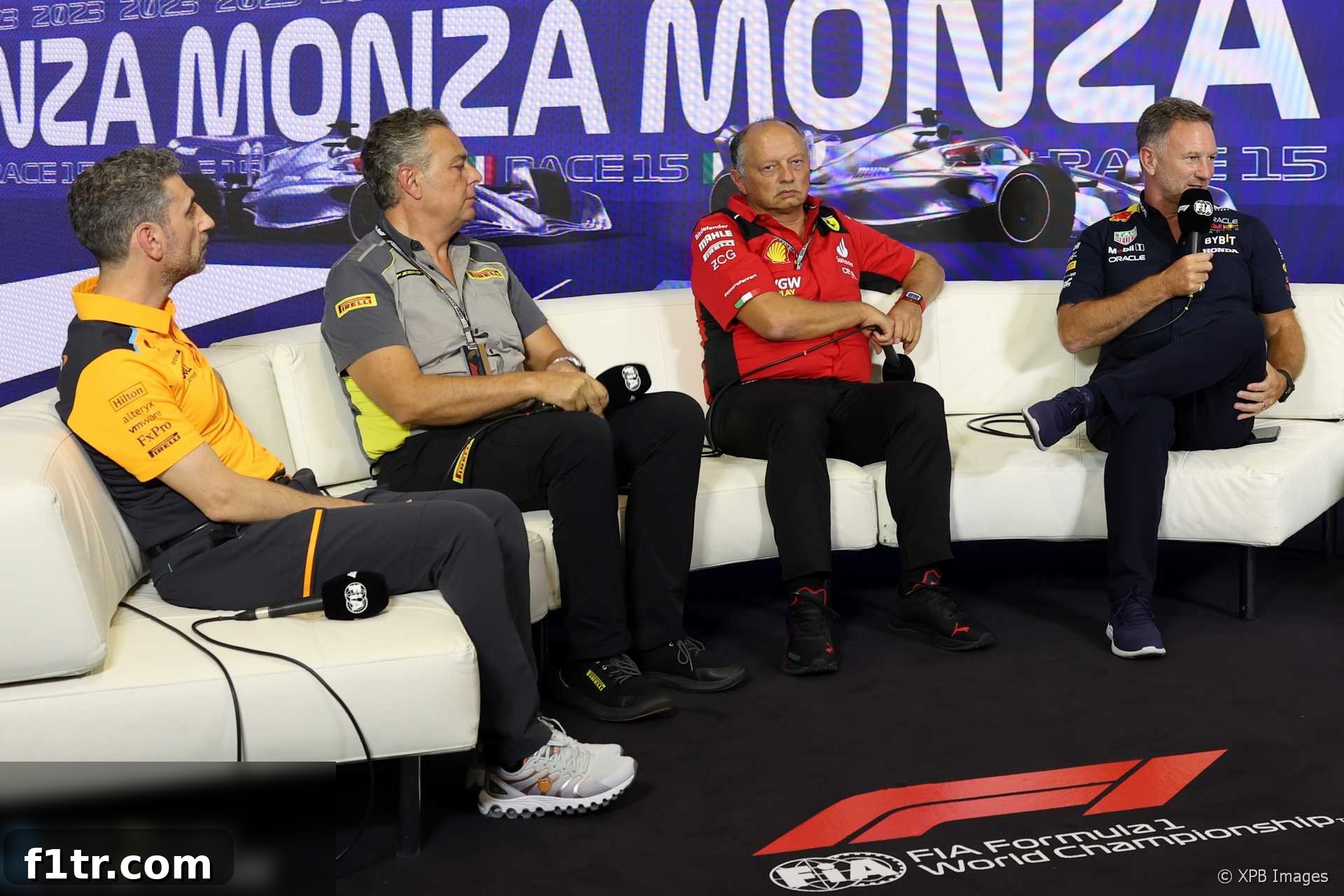
Among the first to voice support for the new technical directive was McLaren team principal Andrea Stella. Speaking at Friday’s team principals press conference, Stella articulated his team’s full confidence in the FIA’s judgment. “The FIA, they have a lot of information,” Stella remarked. “They can see things that other teams can’t see in terms of respecting cars. So they are very competent.” His statement highlights the unique position of the governing body, which possesses comprehensive data and analytical capabilities that allow it to identify subtle infractions or clever interpretations of the rules that might escape the notice of individual teams.
Stella further emphasized McLaren’s unwavering trust: “We 100% trust their judgement and their approach and if they thought that it was the time to release a technical directive, then it means that there is a reason for that.” For McLaren, the directive is not a cause for concern but rather a positive development. “We are not very concerned about that, to be honest, so we take the positive that if the FIA felt it was needed, it means that there is something to clamp down and for us I think is good news.” This perspective suggests that teams diligently adhering to the spirit of the regulations see such directives as beneficial, as they ensure that no competitor gains an unfair edge through dubious design practices, ultimately promoting fairer and more transparent racing.
Ferrari’s Frederic Vasseur: Seeking Clarity Amidst Ambiguity
Frederic Vasseur, the team principal of Ferrari, echoed Stella’s sentiments, emphasizing the role of a technical directive in clarifying ambiguous areas of the regulations. “By definition, a TD is a clarification of the regulation,” Vasseur explained. “It means that there was already a regulation in place.” His comment underscores the nature of TDs as interpretive documents rather than entirely new rules. In a sport where innovation often tests the limits of what is permissible, clear guidance on the interpretation of broad technical rules is essential for all teams.
Vasseur continued, reinforcing the necessity of trusting the FIA’s assessment: “As Andrea said, we have to trust the FIA that if they consider that they have to do the TD, it’s probably that the regulation was not clear enough and we trust the FIA in this direction to do that.” This acknowledgment highlights a critical aspect of F1 governance: the inherent tension between precise rules and creative engineering. When regulations can be interpreted in multiple ways, a TD provides definitive boundaries, ensuring that future designs align with the FIA’s intended purpose of the rules. For Ferrari, and likely many other teams, this clarification helps avoid costly redesigns or potential penalties down the line.
Red Bull and Aston Martin: Unfazed by the New Scrutiny
While some teams expressed clear welcome for the directive, others maintained that it would have no impact on their operations. Aston Martin team principal Mike Krack confidently stated on Thursday that “for us it will not be a headache.” Similarly, Christian Horner, team principal for Red Bull, who have dominated the 2023 season by winning all 13 races so far, assured that his team would be unaffected by the new scrutiny. “It’s not something that affects us,” Horner asserted, subtly alluding to perceived culprits elsewhere on the grid.
Horner’s further comment, “We’ve seen a few rubbery nose boxes, shall we say, so we’ll see those get addressed, I guess, in Singapore,” was particularly telling. This direct reference to “rubbery nose boxes” indicates that the issue of excessive flexing might extend beyond just wings and suggests that teams are keenly aware of where their rivals might be pushing the envelope. The confidence from teams like Red Bull and Aston Martin, coupled with the explicit nature of Horner’s remark, implies that the directive is targeted at specific practices that they believe they are not employing. Their statements, therefore, not only project compliance but also subtly shift attention towards other teams who might be forced to make adjustments before the Singapore Grand Prix, further intensifying the competitive dynamic within the paddock.
Impact on the Grid: The Singapore Grand Prix and Beyond
The introduction of this technical directive at the Singapore Grand Prix is particularly pertinent. The Marina Bay Street Circuit is a high-downforce track with numerous slow and medium-speed corners, where aerodynamic efficiency and stability are paramount. Any subtle advantage gained from flexing components could be amplified on such a circuit, making the FIA’s timing deliberate. Teams found to be in non-compliance will be required to modify their cars to meet the stricter interpretation of Article 3.2.2, which could potentially lead to a loss of performance if their existing designs relied on the now-prohibited flexibility. This might force some teams into rushed modifications, adding another layer of complexity to their preparations for one of the most physically demanding races on the calendar.
Beyond Singapore, this directive signifies the FIA’s ongoing commitment to ensuring the spirit of the regulations is maintained. The cat-and-mouse game between ingenious designers and vigilant regulators is a perennial feature of Formula 1. Each technical directive serves as a reminder that while innovation is celebrated, it must always remain within the established parameters of fair and equitable competition. This move by the FIA could therefore influence car development philosophies for the remainder of the season and even for 2024, as designers become even more cautious about how they interpret and apply the aerodynamic rigidity rules. The ultimate goal is to foster a competitive environment where success is determined by engineering prowess within the rules, rather than by exploiting regulatory grey areas.
2023 Italian Grand Prix
- Despite close battles at Monza, F1 drivers want more powerful DRS
- Monza “frustrating” for Alonso but Aston Martin expect better form in coming races
- F1 changed rules to stop Mercedes in 2021 but we won’t ‘cry foul’ now – Wolff
- McLaren will bring ‘follow-up to Austria upgrade’ before focusing on 2024 car
- Magnussen explains why his driving style rarely works with the Haas VF-23